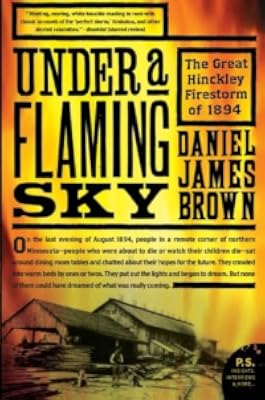
Under a Flaming Sky: The Great Hinckley Firestorm of 1894
by Daniel James Brown
On This Page
Description
On September 1, 1894 two forest fires converged on the town of Hinckley, Minnesota, trapping over 2,000 people. Daniel J. Brown recounts the events surrounding the fire in the first and only book on to chronicle the dramatic story that unfolded. Whereas Oregon's famous "Biscuit" fire in 2002 burned 350,000 acres in one week, the Hinckley fire did the same damage in five hours. The fire created its own weather, including hurricane-strength winds, bubbles of plasma-like glowing gas, and show more 200-foot-tall flames. In some instances, "fire whirls," or tornadoes of fire, danced out from the main body of the fire to knock down buildings and carry flaming debris into the sky. Temperatures reached 1,600 degrees Fahrenheit—the melting point of steel.As the fire surrounded the town, two railroads became the only means of escape. Two trains ran the gauntlet of fire. One train caught on fire from one end to the other. The heroic young African-American porter ran up and down the length of the train, reassuring the passengers even as the flames tore at their clothes. On the other train, the engineer refused to back his locomotive out of town until the last possible minute of escape. In all, more than 400 people died, leading to a revolution in forestry management practices and federal agencies that monitor and fight wildfires today.
Author Daniel Brown has woven together numerous survivors' stories, historical sources, and interviews with forest fire experts in a gripping narrative that tells the fascinating story of one of North America's most devastating fires and how it changed the nation.
. show less
Tags
Recommendations
Member Recommendations

alco261 Andersons's book is a collection of first person accounts and Brown's book is a history of the entire event (Anderson's book was also one of the books listed in Brown's bibliography).
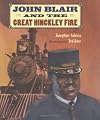
alco261 Under a Flaming Sky has first person account details of John Blair's efforts that day.
meggyweg The Great Fire of London.
Member Reviews
“On September 1, 1894, two forest fires converged on the town of Hinckley, MN, trapping more than 2000 people. The fire created its own weather, including hurricane-strength winds, bubbles of plasma-like glowing gas, and 200-foot tall flames. As temperatures reached 1,600 degrees F, the firestorm knocked down buildings and carried flaming debris high into the sky. Two trains—one with every single car on fire—became the only means of escape. In all, more than 400 people would die, leading to a revolution in forestry management and the birth of federal agencies that monitor and fight wildfires.”
This book tells the true story of the 1894 Great Hinckley Firestorm, which burned 350,000 acres in 5 hours and killed over 400 people. It show more is the story of a logging town in Minnesota. Many of those logs provided additional fuel to the fire. The narrative provides a vivid sense of this disaster. It also presents the context and aftermath.
It is well-structured. The author builds suspense as the fire approaches the town. He portrays the panic people feel when they find themselves trapped. Brown has woven these stories together through researching diaries, letters, and news articles. It is filled with individual stories and acts of heroism.
“As she stepped outside an enormous blast of hot air slammed into the house, bowling mother and child over, tumbling them 25 or 30 feet into a nearby cornfield. Anderson ran to them and knelt beside the dazed mother, imploring her to let him take the baby. He’d save its life if he could save his own…She resisted at first, but then looked where Anderson was pointing at the wall of flame advancing toward them and thrust the baby into Anderson’s arms.”
Brown’s grandfather was a child when this fire hit town, so he had a personal interest in documenting this disaster. His grandfather survived but lost family members. It is scary, heart-wrenching, and sad, but also an excellent example of bringing a lesser-known piece of history to light. show less
This book tells the true story of the 1894 Great Hinckley Firestorm, which burned 350,000 acres in 5 hours and killed over 400 people. It show more is the story of a logging town in Minnesota. Many of those logs provided additional fuel to the fire. The narrative provides a vivid sense of this disaster. It also presents the context and aftermath.
It is well-structured. The author builds suspense as the fire approaches the town. He portrays the panic people feel when they find themselves trapped. Brown has woven these stories together through researching diaries, letters, and news articles. It is filled with individual stories and acts of heroism.
“As she stepped outside an enormous blast of hot air slammed into the house, bowling mother and child over, tumbling them 25 or 30 feet into a nearby cornfield. Anderson ran to them and knelt beside the dazed mother, imploring her to let him take the baby. He’d save its life if he could save his own…She resisted at first, but then looked where Anderson was pointing at the wall of flame advancing toward them and thrust the baby into Anderson’s arms.”
Brown’s grandfather was a child when this fire hit town, so he had a personal interest in documenting this disaster. His grandfather survived but lost family members. It is scary, heart-wrenching, and sad, but also an excellent example of bringing a lesser-known piece of history to light. show less
So. It’s no secret I love disaster non-fiction and survival stories. An entire town fleeing a firestormnado apocalypse? Yes, please!
But this one felt curiously flat and I’m not sure why. A huge number of details were extrapolated (motivations, etc) from necessity, because the people died; usually that bothers me (I’m glaring at you, Children’s Blizzard) but here it seemed acceptable. Maybe because there were no “her final thoughts were of her beloved brown cow” or whatever (Children’s Blizzard, you are a right mess.)
This book seemed respectful, in a word, and the author wrote at some length of his reasons and research (thank you).
Well, anyway. It made me afraid of several horrible ways to die that I had never before show more considered, so there is that. I love to be afraid of horrible ways to die.
“Respectful” is the word that keeps coming to mind. There is no sense of gawking and rubbernecking at the tragedy, no shaming of the people who made all the wrong choices and died. Plenty of people made all the “right” choices and died, too. And we get a trace of that rare thing: closure. The author acknowledged, and dealt with, the aftermath of an enormous natural disaster in a time when phones were not yet invented. Survivors lurching around, shell-shocked and burned all over, hair and clothes gone. Their family, home, livelihood, health: gone.
Again without shaming, the author addresses the 19th c treatment of burns and the slow, gruesome death that waited for most of these people who had already suffered so much.
This is a personal topic for Mr Brown, which might influence the tone. His own grandfather had lived through the fires in Hinckley, as a child. Seventy years later he still woke up screaming. show less
But this one felt curiously flat and I’m not sure why. A huge number of details were extrapolated (motivations, etc) from necessity, because the people died; usually that bothers me (I’m glaring at you, Children’s Blizzard) but here it seemed acceptable. Maybe because there were no “her final thoughts were of her beloved brown cow” or whatever (Children’s Blizzard, you are a right mess.)
This book seemed respectful, in a word, and the author wrote at some length of his reasons and research (thank you).
Well, anyway. It made me afraid of several horrible ways to die that I had never before show more considered, so there is that. I love to be afraid of horrible ways to die.
“Respectful” is the word that keeps coming to mind. There is no sense of gawking and rubbernecking at the tragedy, no shaming of the people who made all the wrong choices and died. Plenty of people made all the “right” choices and died, too. And we get a trace of that rare thing: closure. The author acknowledged, and dealt with, the aftermath of an enormous natural disaster in a time when phones were not yet invented. Survivors lurching around, shell-shocked and burned all over, hair and clothes gone. Their family, home, livelihood, health: gone.
Again without shaming, the author addresses the 19th c treatment of burns and the slow, gruesome death that waited for most of these people who had already suffered so much.
This is a personal topic for Mr Brown, which might influence the tone. His own grandfather had lived through the fires in Hinckley, as a child. Seventy years later he still woke up screaming. show less
“On September 1, 1894, two forest fires converged on the town of Hinckley, MN, trapping more than 2000 people. The fire created its own weather, including hurricane-strength winds, bubbles of plasma-like glowing gas, and 200-foot tall flames. As temperatures reached 1,600 degrees F, the firestorm knocked down buildings and carried flaming debris high into the sky. Two trains—one with every single car on fire—became the only means of escape. In all, more than 400 people would die, leading to a revolution in forestry management and the birth of federal agencies that monitor and fight wildfires.”
This book tells the true story of the 1894 Great Hinckley Firestorm, which burned 350,000 acres in 5 hours and killed over 400 people. It show more is the story of a logging town in Minnesota. Many of those logs provided additional fuel to the fire. The narrative provides a vivid sense of this disaster. It also presents the context and aftermath.
It is well-structured. The author builds suspense as the fire approaches the town. He portrays the panic people feel when they find themselves trapped. Brown has woven these stories together through researching diaries, letters, and news articles. It is filled with individual stories and acts of heroism.
“As she stepped outside an enormous blast of hot air slammed into the house, bowling mother and child over, tumbling them 25 or 30 feet into a nearby cornfield. Anderson ran to them and knelt beside the dazed mother, imploring her to let him take the baby. He’d save its life if he could save his own…She resisted at first, but then looked where Anderson was pointing at the wall of flame advancing toward them and thrust the baby into Anderson’s arms.”
Brown’s grandfather was a child when this fire hit town, so he had a personal interest in documenting this disaster. His grandfather survived but lost family members. It is scary, heart-wrenching, and sad, but also an excellent example of bringing a lesser-known piece of history to light. show less
This book tells the true story of the 1894 Great Hinckley Firestorm, which burned 350,000 acres in 5 hours and killed over 400 people. It show more is the story of a logging town in Minnesota. Many of those logs provided additional fuel to the fire. The narrative provides a vivid sense of this disaster. It also presents the context and aftermath.
It is well-structured. The author builds suspense as the fire approaches the town. He portrays the panic people feel when they find themselves trapped. Brown has woven these stories together through researching diaries, letters, and news articles. It is filled with individual stories and acts of heroism.
“As she stepped outside an enormous blast of hot air slammed into the house, bowling mother and child over, tumbling them 25 or 30 feet into a nearby cornfield. Anderson ran to them and knelt beside the dazed mother, imploring her to let him take the baby. He’d save its life if he could save his own…She resisted at first, but then looked where Anderson was pointing at the wall of flame advancing toward them and thrust the baby into Anderson’s arms.”
Brown’s grandfather was a child when this fire hit town, so he had a personal interest in documenting this disaster. His grandfather survived but lost family members. It is scary, heart-wrenching, and sad, but also an excellent example of bringing a lesser-known piece of history to light. show less
As Robert Frost says, “Some say the world will end in fire; Some say in ice…”. Thus right after The Children’s Blizzard it was appropriate to read Under a Flaming Sky, about the Hinckley, Minnesota, firestorm of 1894. Same general pattern for a disaster story; it’s a little personal this time since the doomed include author Daniel James Brown’s grandfather.
Thus: the victims are mostly Scandinavian immigrants; the guilty parties are the timber companies that cut down the white pine forests and left highly flammable slash in their wake; the science involves a discussion of the mechanics of firestorms; the disaster is the convergence of two forest fires on the town of Hinckley in the abnormally hot summer of 1894; the heroes show more include railroad engineers who kept their train in the depot until it was actually on fire itself so the maximum number of residents could escape; the aftermath includes the author’s visit to the town to lay flowers on the mass grave that presumably includes his grandfather.
This is a somewhat more satisfying book than The Children’s Blizzard; the author includes more photographs and maps that make it easier to understand exactly what was going on. The big lesson for disaster response is to remember that your life is more important than your possessions. The smoke plumes from the converging forest fires to the south were visible for hours before they reached Hinckley and the other towns; since the wind was also from the south it didn’t take much to figure out that prospects were not good. In fact, a lot of Hinckley residents did decide to flee well in advance, but rather than go on foot or wagon they elected to wait for trains they knew would arrive in the afternoon, and packed belongings in anticipation of orderly loading on the cars. The author’s grandmother tried to drag her prized sewing machine to the depot (but fortunately gave up after only a few feet). The trains did show up; unfortunately at almost the same time as the fire. The Hinckley Fire Department did its best but its hoses burned through behind it and men abandoned their posts to save their families.
It would make a better disaster movie than The Children’s Blizzard, too – there’s more drama in burning alive than freezing to death. A southbound train found itself heading right into the fire; the engineer gambled, opened the throttle, and tried to make it through, figuring if he tried to reverse he might collide with another southbound train that wouldn’t see him in the smoke (as it happened, the other southbound train engineers decided they weren’t going any further and backed up). This “charge” worked, although there was a considerable amount of luck involved; the train eventually derailed as the ties burned beneath it and the rails spread, but it was out of the main fire core by then and the crew and passengers survived by drenching themselves with tender water.
Two more trains had pulled into Hinckley from the north; the engineers realized that things were bad but needed to water before they could leave. One of the two engines dropped its freight cars and coupled to the rear of the other train, and then both headed out of town after picking up as many fleeing citizens as they could. They almost waited too long – the train actually caught fire, and they just made it across a burning bridge before it collapsed. They stopped at two other small towns, but nobody took them seriously and no other passengers boarded. Eventually, surrounded by flames, they stopped next to Skunk Lake and the conductors and porters hurried passengers into the water, where they waited out the fire with no further ill effects.
People unable to make it to the train tried a variety of tactics, with varying success, mostly depending on the vagaries of the fire. A large plowed field saved a number, but another group that took refuge in a swamp found it had dried up and they burned alive from radiant heat. A few bodies of water – a flooded quarry, a pond – saved others, but the Grindstone River was reduced by drought to shallow pools and people trying to seek refuge there died. Some lived by jumping into their wells or their tornado shelters, but others died from oxygen deprivation in the same shelters (18 bodies were removed from one well). Another lucky group took refuge in the Eastern Minnesota RR roundhouse; the author speculates the roundhouse sheet-metal walls reflected enough heat to keep them alive, despite outside temperatures high enough to melt rails and boxcar frames into puddles (apparently Rosie O’Donnell thermal physics were not yet in force).
About 1200 people died altogether, with many bodies unidentifiable and little heaps of calcined bones still turning up in out-of-the-way corners years later. There are some blurry pictures of bodies being gathered on a wagon and interred in a mass grave; I’m glad they aren’t any sharper.
A item relevant to web discussions of colloidal silver as a cure-all comes from Brown’s discussion of burn treatment; methods in use at the time were mostly worse than useless (mud, cow dung, roasted mice, raw eggs, vinegar, pig fat, boiled beans, beeswax, linseed oil, carron oil, carbolic acid, petroleum jelly, honey, and oak leaves are all mentioned; Brown notes that honey and oak leaves might have had a small beneficial effect due to the antiseptic properties of honey and the tanning ability of oak leaves). A little late for Hinckley, Dr. William Halstead of Johns Hopkins introduced powdered silver for burn treatment in 1895 and it actually worked – at least as far as infections were concerned; there were still all the fluid loss and metabolic problems associated with burns but at least opportunistic microbials were reduced.
Hinckley is now a casino town; there’s apparently a pretty good Fire Museum; I’ll have to visit if I ever find myself in that neck of the former woods. show less
Thus: the victims are mostly Scandinavian immigrants; the guilty parties are the timber companies that cut down the white pine forests and left highly flammable slash in their wake; the science involves a discussion of the mechanics of firestorms; the disaster is the convergence of two forest fires on the town of Hinckley in the abnormally hot summer of 1894; the heroes show more include railroad engineers who kept their train in the depot until it was actually on fire itself so the maximum number of residents could escape; the aftermath includes the author’s visit to the town to lay flowers on the mass grave that presumably includes his grandfather.
This is a somewhat more satisfying book than The Children’s Blizzard; the author includes more photographs and maps that make it easier to understand exactly what was going on. The big lesson for disaster response is to remember that your life is more important than your possessions. The smoke plumes from the converging forest fires to the south were visible for hours before they reached Hinckley and the other towns; since the wind was also from the south it didn’t take much to figure out that prospects were not good. In fact, a lot of Hinckley residents did decide to flee well in advance, but rather than go on foot or wagon they elected to wait for trains they knew would arrive in the afternoon, and packed belongings in anticipation of orderly loading on the cars. The author’s grandmother tried to drag her prized sewing machine to the depot (but fortunately gave up after only a few feet). The trains did show up; unfortunately at almost the same time as the fire. The Hinckley Fire Department did its best but its hoses burned through behind it and men abandoned their posts to save their families.
It would make a better disaster movie than The Children’s Blizzard, too – there’s more drama in burning alive than freezing to death. A southbound train found itself heading right into the fire; the engineer gambled, opened the throttle, and tried to make it through, figuring if he tried to reverse he might collide with another southbound train that wouldn’t see him in the smoke (as it happened, the other southbound train engineers decided they weren’t going any further and backed up). This “charge” worked, although there was a considerable amount of luck involved; the train eventually derailed as the ties burned beneath it and the rails spread, but it was out of the main fire core by then and the crew and passengers survived by drenching themselves with tender water.
Two more trains had pulled into Hinckley from the north; the engineers realized that things were bad but needed to water before they could leave. One of the two engines dropped its freight cars and coupled to the rear of the other train, and then both headed out of town after picking up as many fleeing citizens as they could. They almost waited too long – the train actually caught fire, and they just made it across a burning bridge before it collapsed. They stopped at two other small towns, but nobody took them seriously and no other passengers boarded. Eventually, surrounded by flames, they stopped next to Skunk Lake and the conductors and porters hurried passengers into the water, where they waited out the fire with no further ill effects.
People unable to make it to the train tried a variety of tactics, with varying success, mostly depending on the vagaries of the fire. A large plowed field saved a number, but another group that took refuge in a swamp found it had dried up and they burned alive from radiant heat. A few bodies of water – a flooded quarry, a pond – saved others, but the Grindstone River was reduced by drought to shallow pools and people trying to seek refuge there died. Some lived by jumping into their wells or their tornado shelters, but others died from oxygen deprivation in the same shelters (18 bodies were removed from one well). Another lucky group took refuge in the Eastern Minnesota RR roundhouse; the author speculates the roundhouse sheet-metal walls reflected enough heat to keep them alive, despite outside temperatures high enough to melt rails and boxcar frames into puddles (apparently Rosie O’Donnell thermal physics were not yet in force).
About 1200 people died altogether, with many bodies unidentifiable and little heaps of calcined bones still turning up in out-of-the-way corners years later. There are some blurry pictures of bodies being gathered on a wagon and interred in a mass grave; I’m glad they aren’t any sharper.
A item relevant to web discussions of colloidal silver as a cure-all comes from Brown’s discussion of burn treatment; methods in use at the time were mostly worse than useless (mud, cow dung, roasted mice, raw eggs, vinegar, pig fat, boiled beans, beeswax, linseed oil, carron oil, carbolic acid, petroleum jelly, honey, and oak leaves are all mentioned; Brown notes that honey and oak leaves might have had a small beneficial effect due to the antiseptic properties of honey and the tanning ability of oak leaves). A little late for Hinckley, Dr. William Halstead of Johns Hopkins introduced powdered silver for burn treatment in 1895 and it actually worked – at least as far as infections were concerned; there were still all the fluid loss and metabolic problems associated with burns but at least opportunistic microbials were reduced.
Hinckley is now a casino town; there’s apparently a pretty good Fire Museum; I’ll have to visit if I ever find myself in that neck of the former woods. show less
Perhaps it was the subject matter, or maybe Brown has improved vastly. After reading (twice!) and loving The Boys in the Boat, I wanted all this author can write. This book was competent, but not nearly as skillful or engaging. I'm glad to have read it, mostly for the historical aspects. There is lots to contemplate in the story. Brown accomplishes a good balancing of on the spot re-creation and background information. But his characters in this book can't compare to Joe Rantz and George Pocock.
There are several accounts of this tragedy available but this is the most readable I've come across. The author's personal connection to the disaster (his grandfather survived it) allows him to bring the story home to the modern reader. I liked how he brought current-day Hinckley into the story. There is a good index. Don't miss the P. S. section at the end of the paperback version; it's easy to overlook.
The story of a tragedy is not necessarily entertaining; I wouldn't describe "Under a Flaming Sky" as such. However, it is inspiring to read of the courage and fortitude of those who fought the flames, rescued the citizens, protected their families, endured and survived the horrors, and even those who cleaned up the carnage and rebuilt their society.
This particular story is personal in that the author's grandfather lived through it.
This book will add to your understanding of human nature, both good and bad. It will remind you that humanity cannot control nature. It will cause you to appreciate the fragility of life.
This particular story is personal in that the author's grandfather lived through it.
This book will add to your understanding of human nature, both good and bad. It will remind you that humanity cannot control nature. It will cause you to appreciate the fragility of life.
Members
- Recently Added By
Lists

Disaster Books
74 works; 19 members

Best History Books about Disasters
33 works; 19 members

Accidents, Disasters, and Tragedies
175 works; 7 members

Non-Fiction Worth Reading
1,015 works; 254 members
Author Information

6 Works 9,628 Members
Daniel James Brown was born in Berkeley, California. He received a Bachelor of Arts degree in English at the University of California at Berkeley and a Master of Arts degree from the University of California at Los Angeles. He has taught writing at San Jose State University and Stanford University. He is the author of The Indifferent Stars Above: show more The Harrowing Saga of a Donner Party Bride, Under a Flaming Sky: The Great Hinckley Firestorm of 1894, and The Boys in the Boat. (Bowker Author Biography) show less
Awards and Honors
Awards
Distinctions
Common Knowledge
- Canonical title
- Under a Flaming Sky: The Great Hinckley Firestorm of 1894
- Original publication date
- 2006
- People/Characters
- Engineer Jim Root; Porter John Blair; Conductor Tom Sullivan; Engineer William Best; Engineer Edward Barry; Rev. Emil Anderson (show all 9); Marie Hansen; Edward Hansen; Doctor Stephan
- Important places
- Minnesota, USA; Hinckley, Minnesota, USA; Duluth, Minnesota, USA; Sandstone, Minnesota, USA
- Important events
- Hinckley Fire
- Epigraph
- A fact is not a truth until you love it.
-John Keats - Dedication
- FOR THOSE WHO WERE THERE
AND THOSE WHO LOVED THEM - First words
- [Preface] Forty years after the Hinckley firestorm, my grandfather still sometimes awoke in the night, screaming.
[Preface] The experience of one who has passed through the Hinckley fire . . .
the truth . . . would seem like the wildest fancies of crazy
imagination; no pen can portray its terrible reality;
notongue can ev... (show all)en tell the bare truth of the awful ordeal.
--Angus Hay
[Prologue] Something was afoot that summer--something concealed, not yet revealed.
Lying alone on his cot in the darkness, nine-year-old Bill Grissinger wondered what it was that woke him.
[Epilogue] Neon lights and the usual jumble of fast-food joints and gas stations greeted me when I pulled off of Interstate 35 at the Hinckley exit late in the afternoon. - Last words
- (Click to show. Warning: May contain spoilers.)[Preface] In this age of terror, it reminds us that we have it in us to endure calamity, to rise above even the most trying circumstances, to replace fear with hope, to throw love and light back in the face of violence and darkness.
(Click to show. Warning: May contain spoilers.)[Prologue] None of them could have imagined that within thirty-six hours, people in places as far away as New York, San Francisco, and even London would be reading about the cruel hand that fate was about to deal them.
(Click to show. Warning: May contain spoilers.)The organic material that had accumulated in the soil over eons--in some places, as much as twelve feet thick--had been incinerated, leaving behind millions of acres of gravelly soil, sand, and roc that would never again support a white pine forest, nor any forest worthy of the name.
(Click to show. Warning: May contain spoilers.)[Epilogue] I turned and walked back out through the gate, swung it closed behind me, climbed into the car, and pulled out onto the dark highway, following the cones of light from my headlights, letting them lead me back down the dark road to the casino, to take my chances. - Publisher's editor
- McCullough, Jay
- Canonical DDC/MDS
- 977.662
- Canonical LCC
- F614.H6
Classifications
Statistics
- Members
- 403
- Popularity
- 77,289
- Reviews
- 18
- Rating
- (4.28)
- Languages
- English
- Media
- Paper, Audiobook, Ebook
- ISBNs
- 6
- UPCs
- 1
- ASINs
- 5