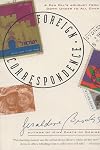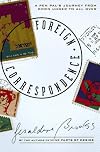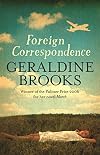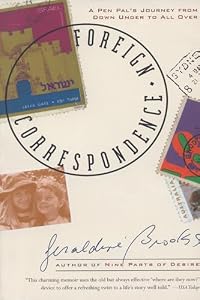
Foreign Correspondence: A Pen Pal's Journey from Down Under to All Over
by Geraldine Brooks
On This Page
Description
Biography & Autobiography. Travel. Nonfiction. HTML:As a young girl in a working-class neighborhood of Sydney, Australia, Geraldine Brooks longed to discover the places where history happens and culture comes from, so she enlisted pen pals who offered her a window on adolescence in the Middle East, Europe, and America. Twenty years later Brooks, an award-winning foreign correspondent, embarked on a human treasure hunt to find her pen friends. She found men and women whose lives had been show more shaped by war and hatred, by fame and notoriety, and by the ravages of mental illness. Intimate, moving, and often humorous, Foreign Correspondence speaks to the unquiet heart of every girl who has ever yearned to become a woman of the world. show lessTags
Recommendations













Member Reviews
Brooks started writing to pen pals when she was ten years old. Finding all of Brooks's pen pal letters prompted her to wonder if she could find their authors some thirty some odd years later. Where were these forty-something year olds? Who were they now as adults and what lives were they living? Before she launches on her journey to find lost relations, Brooks spends some time remembering her own childhood and how each pen pal played a part in it. As a kid she yearned to get away from boring Australia with its lack of culture and panache. As a good girl, she recalls her fear of her father's lack of participation in Catholic worship and how it might send him to hell and yet she herself wanted to be a rebel; "to kiss boys, take drugs, be show more hauled by the hair into a police van at an antiwar protest" (p 78). She remembers wanting to expand her religious horizons with the letters she would write and receive. Those pen pals would bring Brooks full circle by reminding her of her roots and just how far she has come as an adult. show less
The internet and e-mail have really taken a toll on letter writing. Now that we have instant gratification, we are losing out on the simple joy of opening the mailbox to find an unexpected or conversely eagerly awaited missive from a far away friend. Now we mostly find bills instead of handwritten personal thoughts. The closest we often get anymore is the fake "handwriting" font on some junk mail envelopes. This is such a shame. Letter writing is careful and slow and often brings great delight to the recipient. I know, because I still write letters (although not nearly as often as I used to) and I had many, many penpals from all over the world as I was growing up. I even still keep in touch with several of them, having been writing to show more them for almost 30 years now. Hearing from them way back when opened a new world to me, one that I didn't encounter in the many suburban neighborhoods we lived in throughout my childhood.
Australian Geraldine Brooks grew up in a Sydney that she feared was provincial. Her lower middle class neighborhood was mocked as a representation of all that was boring and backwards about Australia. In order to broaden her horizons, taking after the example of her father, she started to write letters. Her first penpal, Sonny, was only just across town but could have lived a world away. After Sonny, Brooks chose penpals in countries that interested her. She wrote Joannie in America, intrigued by the country of her father's birth. She wrote Mishal in Israel because she was fascinated by Judaism. When she found out that Mishal was an Israeli Arab, she found another Israeli, this time a Jewish Israeli, Cohen, to add to her collection of penpals. And finally, enamoured of the student upheavals in France, she also wrote to Janine. Through all of these penpals, she learned more of the world. Twenty years later, during her father's final illness, she discovers the letters of these penpals and wonders where life has taken them. Like the journalist she is, she determines to discover their stories.
Brooks has drawn the Australia of her childhood precisely and lovingly. She chronicles her own political awakening and leanings and their genesis very well. And she has created a full and extensive portrait of her correspondence with Joannie and with the social consciousness that both girls developed as they wrote back and forth. Her letters from the others are either less illuminating or she wasn't given permission to use as much from them since the sections about these penpals are not as full and lack the sprightly, in-depth personality that the portion about Joannie has. Once Brooks goes on her search for her lost penpals, she has an amazingly easy time of it finding them. The fact that all of them ultimately welcomed her in to see their lives now (well, ten years ago when the book was written anyway) is wonderful.
I thoroughly enjoyed this memoir both for its portrayal of the disappeared Australia of Brooks' childhood and adolescence and for the tale of tracking down her former penpals to see where their lives had taken them. I had an Australian penpal as a child and young adult, a couple of decades after Brooks, and I'd love the chance to do as Brooks did and find her. Michelle Ennor, are you out there somewhere? In any case, Brooks's memoir captures the innocence of a younger Australia, uncovers the seeds of her own life choices, and shows how our early life shapes us as well as the ways in which we find ourselves yearning for a different future than we had ever envisioned. show less
Australian Geraldine Brooks grew up in a Sydney that she feared was provincial. Her lower middle class neighborhood was mocked as a representation of all that was boring and backwards about Australia. In order to broaden her horizons, taking after the example of her father, she started to write letters. Her first penpal, Sonny, was only just across town but could have lived a world away. After Sonny, Brooks chose penpals in countries that interested her. She wrote Joannie in America, intrigued by the country of her father's birth. She wrote Mishal in Israel because she was fascinated by Judaism. When she found out that Mishal was an Israeli Arab, she found another Israeli, this time a Jewish Israeli, Cohen, to add to her collection of penpals. And finally, enamoured of the student upheavals in France, she also wrote to Janine. Through all of these penpals, she learned more of the world. Twenty years later, during her father's final illness, she discovers the letters of these penpals and wonders where life has taken them. Like the journalist she is, she determines to discover their stories.
Brooks has drawn the Australia of her childhood precisely and lovingly. She chronicles her own political awakening and leanings and their genesis very well. And she has created a full and extensive portrait of her correspondence with Joannie and with the social consciousness that both girls developed as they wrote back and forth. Her letters from the others are either less illuminating or she wasn't given permission to use as much from them since the sections about these penpals are not as full and lack the sprightly, in-depth personality that the portion about Joannie has. Once Brooks goes on her search for her lost penpals, she has an amazingly easy time of it finding them. The fact that all of them ultimately welcomed her in to see their lives now (well, ten years ago when the book was written anyway) is wonderful.
I thoroughly enjoyed this memoir both for its portrayal of the disappeared Australia of Brooks' childhood and adolescence and for the tale of tracking down her former penpals to see where their lives had taken them. I had an Australian penpal as a child and young adult, a couple of decades after Brooks, and I'd love the chance to do as Brooks did and find her. Michelle Ennor, are you out there somewhere? In any case, Brooks's memoir captures the innocence of a younger Australia, uncovers the seeds of her own life choices, and shows how our early life shapes us as well as the ways in which we find ourselves yearning for a different future than we had ever envisioned. show less
I really enjoyed this--reading the first part with Brooks growing up in Sydney, dreaming of an exciting bigger world, and then the second part in which she meets her pen pals about 25 years later, finds out who they really are (as opposed to who she made them out to be when she was young and corresponding with them). The chapter in Israel fascinated me--
This book describes Brooks' childhood in Sydney, and her attempts to reach outside of what she perceived as a provincial childhood through a series of pen-pals. In the later part of the book, she visits with the pen-pals as grown men and women.
An interesting premise, but I didn't feel that Brooks went deep enough to be truly insightful. A book with a smaller scope and greater depth (for example about her conversion to Judaism, and how that related to her childhood in Sydney) would have been more interesting.
However, it is interesting to see how, as a child, she viewed being Australian as second-rate and provinical and how that view kept her from seeing the richness of the country around her.
An interesting premise, but I didn't feel that Brooks went deep enough to be truly insightful. A book with a smaller scope and greater depth (for example about her conversion to Judaism, and how that related to her childhood in Sydney) would have been more interesting.
However, it is interesting to see how, as a child, she viewed being Australian as second-rate and provinical and how that view kept her from seeing the richness of the country around her.
This book is so much more than simply a story about penfriends - Brooks weaves her personal narrative and childhood obsessions in with her story, to show why she sought the particular penpals she wrote to. I enjoyed reading this a lot and it makes me want to pull out the stationery and write to my friends once again - a feeling I haven't had in a while.
I wish I could say I liked this more. You've doubtless seen the premise: she's pursuing the far-flung pen pals she wrote to while growing up in Australia in the 1960's and 1970's. Interspersing it with her growing-up years outside Sydney and her (US-born) father's colorful early life as a singer.
Problem is two-fold. First, most of the pals she finds--A French woman, now a contented housewife still living close to home, and two male Israelis--one Jewish, one Arab Christian--aren't very interesting or articulate. Oh, neither is the Aussie, barely a pen pal, who became a club owner in NYC. The interesting one is the US girl who died of anorexia; Brooks has remained close to her family despite the years.
Second problem, it takes so long to show more get here while you know the life Brooks was leading as a foreign correspondent in the Middle East had to be much more interesting! I have already read a couple of books by her husband, Tony Horwitz. He's great but he was the trailing spouse while she must have been a WSJ hotshot.
So she might be an even better writer, right? I'm joking, of course, but she had to have something special. I will give her another chance. I think she wrote a book about the Middle East as well as a novel. I'd try the nonfiction first. show less
Problem is two-fold. First, most of the pals she finds--A French woman, now a contented housewife still living close to home, and two male Israelis--one Jewish, one Arab Christian--aren't very interesting or articulate. Oh, neither is the Aussie, barely a pen pal, who became a club owner in NYC. The interesting one is the US girl who died of anorexia; Brooks has remained close to her family despite the years.
Second problem, it takes so long to show more get here while you know the life Brooks was leading as a foreign correspondent in the Middle East had to be much more interesting! I have already read a couple of books by her husband, Tony Horwitz. He's great but he was the trailing spouse while she must have been a WSJ hotshot.
So she might be an even better writer, right? I'm joking, of course, but she had to have something special. I will give her another chance. I think she wrote a book about the Middle East as well as a novel. I'd try the nonfiction first. show less
This is a memoir by the author of such wonderful books as People of the Book, Year of Wonders and March. This is the story of how Geraldine Brooks went from being a young girl with penpals (her early foreign correspondences) to a real-life career Foreign Correspondent. But it's much more than that. It is a story of growing up, a story of love and passion and yearning to see and to be more.
As an adult, going through her father's things after his death, she finds the packet of letters she kept from her penpals. As an adult now, she decides to try to find those long-lost and far-flung people. From the blurb on the back:
"She found men and women whose lives had been shaped by war and hatred, by fame and notoriety, and by the ravages of show more mental illness. Intimate, moving, and often humourous, Foreign Correspondence speaks to the unquiet heart of every girl who has ever yearned to become a woman of the world." show less
As an adult, going through her father's things after his death, she finds the packet of letters she kept from her penpals. As an adult now, she decides to try to find those long-lost and far-flung people. From the blurb on the back:
"She found men and women whose lives had been shaped by war and hatred, by fame and notoriety, and by the ravages of show more mental illness. Intimate, moving, and often humourous, Foreign Correspondence speaks to the unquiet heart of every girl who has ever yearned to become a woman of the world." show less
Members
- Recently Added By
Published Reviews
Foreign Correspondence by Geraldine Brooks who was born and raised in Australia. After moving to the U.S.A. she worked for eleven years on the Wall Street Journal, covering stories from some of the world’s most troubled areas, including Bosnia, Somalia and the Middle East.
“Foreign Correspondenece is not about her work but about her childhood and her teen age years in Australia and the way show more she enlisted pen pals who offered her a window on the world and on other cultures and different history. show less
“Foreign Correspondenece is not about her work but about her childhood and her teen age years in Australia and the way show more she enlisted pen pals who offered her a window on the world and on other cultures and different history. show less
added by grelobe
Lists

Books Read in 2025
4,090 works; 97 members
Author Information

15+ Works 39,625 Members
Geraldine Brooks is the author of two acclaimed works of nonfiction, "Nine Parts of Desire" and "Foreign Correspondence." A former war correspondent, her writing has appeared in The Wall Street Journal, The New York Times, and The Washington Post. (Publisher Provided) Geraldine Brooks was born in Sydney, Australia on September 14, 1955. She show more attended Bethlehem College Ashfield and the University of Sydney. She worked as a feature writer with a special interest in environmental issues for The Sydney Morning Herald for three years. In 1982, she won the Greg Shackleton Australian News Correspondents scholarship to the journalism master's program at Columbia University in New York City. She later worked for The Wall Street Journal, where she covered the Middle East, Africa, and the Balkans. She has written both fiction and non-fiction books including Year of Wonders, Nine Parts of Desire, and The Secret Chord. She has won several awards including the Nita Kibble Literary Award for Foreign Correspondence, the Pulitzer Prize in fiction in 2006 for March, the New England Book Award for Fiction and the Christianity Today Book Award for Caleb's Crossing, and the Australian Book of the Year Award and the Australian Literary Fiction Award in 2008 for People of the Book. (Bowker Author Biography) show less
Awards and Honors
Common Knowledge
- Original publication date
- 1999-01-19
- Important places
- Australia; Nazareth, Israel; New Jersey, USA; New South Wales, Australia; New York, USA; New York, New York, USA (show all 9); Saint-Martin-de-la-Brasque, Provence-Alpes-Côte d'Azur, France; Sydney, New South Wales, Australia; Tel Aviv, Israel
- Epigraph
- ... nothing is more sweet in the end than
country and parents ever,
even when far away one lives in a fertile place...
- The Odyssey - Dedication
- To the memory of Lawrie, and to Gloria
- First words
- It is a hot spring day and I am in the basement of my parents’ house in Sydney, sorting through tea chests.
- Last words
- (Click to show. Warning: May contain spoilers.)We poured the ashes down the golden sandstone, and the rest of the whiskey after them. The rain and the salt spray carried them far away.
Classifications
- Genres
- Nonfiction, Biography & Memoir, Travel, General Nonfiction
- DDC/MDS
- 070.4332092 — Computer science, information & general works News media, journalism & publishing Documentary media, educational media, news media; journalism; publishing Journalism Reporting Local interests Global
- LCC
- PN5516 .B76 .A3 — Language and Literature Literature (General) Literature (General) Journalism. The periodical press, etc. By region or country
- BISAC
Statistics
- Members
- 469
- Popularity
- 64,613
- Reviews
- 22
- Rating
- (3.80)
- Languages
- English
- Media
- Paper, Audiobook, Ebook
- ISBNs
- 19
- ASINs
- 3