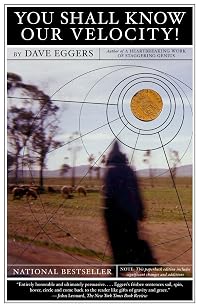
You Shall Know Our Velocity! {Vintage}
by Dave Eggers
On This Page
Description
After acquiring $32,000, Will and Hand, devastated over the death of their closest friend, travel around the world giving away the money, in a rowdy debut novel from the author of A Heartbreaking Work of Staggering Genius.Tags
Recommendations





Member Reviews
The story of two friends who travel to arbitrary places around the world at breakneck speed, in the attempt to give away $80,000 to random people they deem deserving. Eggers is both funny and profound; his style is uniquely his own but a mix of Twain and Joyce comes to mind as I try to put my finger on it.
Quotes:
On innocence:
"It had to be those kids. Only the most blessed of little people yells hello across an empty field to strangers with dirty clothes."
On perspective in traveling:
"I had been on a plane! A tiny percentage of all those who'd ever lived would ever be on an airplane..."
"To travel is selfish - that money could be used for hungry stomachs and you're using it for your hungry eyes..."
"We were done. No Cairo. No sunrise at show more Cheops. And from now on, there would never be options, never like this again. Lord this was obscene. We should have saved the money, most of it, invested it, so there would always be more. I could have done this every year if I had planned it better. I planned nothing well. I dreaded being back in Chicago, or Memphis, wherever - the stasis, the slow suffocation of accumulation."
On mad beauty:
"Oh to live among peacocks. I'd seen them once in person and they defied so many laws of color and gravity that they had to be mad geniuses waiting to take over everything."
On knowledge:
"That Hand didn't know more about Morocco - that it was green, for starters - demonstrated the great gaps in knowledge that occur when one gets most of one's information from the Internet."
"You know nothing until you're there. Nothing. Nothing nothing nothing. You know nothing of another person, nothing of another place. Nothing nothing nothing."
"We knew nothing; the gaps in our knowledge were random and annoying. They were potholes - they could be patched but they multiplied without pattern or remorse. And even if we knew something, had read something, were almost sure of something, we wouldn't ever know the truth, or come anywhere close to it. The truth had to be seen. Anything else was a story, entertaining but more embroidered fib than crude, shapeless fact."
"Anyway, I read news and look for and collect facts because so far they haven't added up anything. I had pictured, as a younger man, that the things I knew and woiuld know were bricks in something that woiuld, effortlessly, eventually, shape itself into something recognizable, meaningful. A massive and spiritual sort of geometry - a ziggurat, a pyramid. But here I am now, so many years on, and if there is a shape to all this, it hasn't revealed itself. But no, thus far the things I know grow out, not up, and what might connect all these things, connective tissues or synapses, or just some sense of order, doesn't exist, or isn't functioning, and what I knew at twenty-seven can't be found now."
On the human condition:
"The only infallible truth of our lives is that everything we love in life will be taken from us."
"We had beaten death yet again and we were now beating sleep and it would seem like we could do without either forever. And I then would have the idea, seeming gloriously true for a flickering moment, that we all should have a near-death experience weekly, twice weekly - how much we'd get done! The clarity we'd know!"
"When we pass by another person without telling them we love them it's cruel and wrong and we all know this. We live in a constant state of denial and imbalance."
"The water was not God. The water undulating slightly with the waves unformed was not spiritual. It was jagged cold water, and it felt perfect when we put our hand into it, and it kissed our palms again and again, would never stop kissing our palms - and why wasn't that enough?"
Just funny:
"I could smell me. Not a bad smell, not yet, but a distinct one, one with something to say."
"Hand burst from the bathroom like he'd been feeding bears and they'd turned on him. His own stink had overtaken him and now threw itself around the room."
"This was the day Hand announced, while eating fries and mayonnaise for lunch, that in his opinion, a great shit was better than bad sex, a view that was seconded by my mom, which just about killed Jack."
"Passing a middle-aged couple in matching jackets:
- You two need to change.
- What? Why? the middle-aged couple said, to my head, in my head.
- Because you are wearing the same jacket.
- We brought them while on vacation in Newport.
- You must be hidden from view.
- The jackets are nice.
- They are not nice. Think of the children."
"All of Senegal and beyond attainable, Senegal! - and with Huey Lewis on the local radio, coming through with stunning clarity: 'Do You Believe in Love?'
....
Janet Jackson was tinkling from the speakers, asking what we had done for her as of late."
"I could smell his breath, worlds contained within."
"In the center of the city center, in the dead-middle of all Dakar's traffic, the car died. Hand jumped into the driver's seat to start it. Nothing. The honking was first insane and soon symphonic." show less
Quotes:
On innocence:
"It had to be those kids. Only the most blessed of little people yells hello across an empty field to strangers with dirty clothes."
On perspective in traveling:
"I had been on a plane! A tiny percentage of all those who'd ever lived would ever be on an airplane..."
"To travel is selfish - that money could be used for hungry stomachs and you're using it for your hungry eyes..."
"We were done. No Cairo. No sunrise at show more Cheops. And from now on, there would never be options, never like this again. Lord this was obscene. We should have saved the money, most of it, invested it, so there would always be more. I could have done this every year if I had planned it better. I planned nothing well. I dreaded being back in Chicago, or Memphis, wherever - the stasis, the slow suffocation of accumulation."
On mad beauty:
"Oh to live among peacocks. I'd seen them once in person and they defied so many laws of color and gravity that they had to be mad geniuses waiting to take over everything."
On knowledge:
"That Hand didn't know more about Morocco - that it was green, for starters - demonstrated the great gaps in knowledge that occur when one gets most of one's information from the Internet."
"You know nothing until you're there. Nothing. Nothing nothing nothing. You know nothing of another person, nothing of another place. Nothing nothing nothing."
"We knew nothing; the gaps in our knowledge were random and annoying. They were potholes - they could be patched but they multiplied without pattern or remorse. And even if we knew something, had read something, were almost sure of something, we wouldn't ever know the truth, or come anywhere close to it. The truth had to be seen. Anything else was a story, entertaining but more embroidered fib than crude, shapeless fact."
"Anyway, I read news and look for and collect facts because so far they haven't added up anything. I had pictured, as a younger man, that the things I knew and woiuld know were bricks in something that woiuld, effortlessly, eventually, shape itself into something recognizable, meaningful. A massive and spiritual sort of geometry - a ziggurat, a pyramid. But here I am now, so many years on, and if there is a shape to all this, it hasn't revealed itself. But no, thus far the things I know grow out, not up, and what might connect all these things, connective tissues or synapses, or just some sense of order, doesn't exist, or isn't functioning, and what I knew at twenty-seven can't be found now."
On the human condition:
"The only infallible truth of our lives is that everything we love in life will be taken from us."
"We had beaten death yet again and we were now beating sleep and it would seem like we could do without either forever. And I then would have the idea, seeming gloriously true for a flickering moment, that we all should have a near-death experience weekly, twice weekly - how much we'd get done! The clarity we'd know!"
"When we pass by another person without telling them we love them it's cruel and wrong and we all know this. We live in a constant state of denial and imbalance."
"The water was not God. The water undulating slightly with the waves unformed was not spiritual. It was jagged cold water, and it felt perfect when we put our hand into it, and it kissed our palms again and again, would never stop kissing our palms - and why wasn't that enough?"
Just funny:
"I could smell me. Not a bad smell, not yet, but a distinct one, one with something to say."
"Hand burst from the bathroom like he'd been feeding bears and they'd turned on him. His own stink had overtaken him and now threw itself around the room."
"This was the day Hand announced, while eating fries and mayonnaise for lunch, that in his opinion, a great shit was better than bad sex, a view that was seconded by my mom, which just about killed Jack."
"Passing a middle-aged couple in matching jackets:
- You two need to change.
- What? Why? the middle-aged couple said, to my head, in my head.
- Because you are wearing the same jacket.
- We brought them while on vacation in Newport.
- You must be hidden from view.
- The jackets are nice.
- They are not nice. Think of the children."
"All of Senegal and beyond attainable, Senegal! - and with Huey Lewis on the local radio, coming through with stunning clarity: 'Do You Believe in Love?'
....
Janet Jackson was tinkling from the speakers, asking what we had done for her as of late."
"I could smell his breath, worlds contained within."
"In the center of the city center, in the dead-middle of all Dakar's traffic, the car died. Hand jumped into the driver's seat to start it. Nothing. The honking was first insane and soon symphonic." show less
This seems like a book I was supposed to like - the back-cover blurb is unrestrained: 'wildly talented writer', 'entertaining and profoundly original tale', 'pitch-perfect dialogue'. Sadly, as I struggled to get to the halfway point of pointlessness, I could no longer ignore the sense of my own life's timeline dwindling rapidly. I have only one life to live. Sharing any more of it with Mr Eggers just isn't possible. Forgive me.
There are two important twists to this story – twists I can tell you about that won’t be spoilers – and they are what makes this book so good. The first is in the book itself. The second is in the way the book has been published.
The book starts with an affectation that can easily set the reader off the rest of a book. “Everything within takes place after Jack died and before Mom and I drowned…” Shy of Sunset Boulevard, this is almost impossible to pull off. Don’t worry, Eggers has a plan (or eventually got a plan – remember those twists?). The narrator is Will who, with Hand, is traveling around the world in a few days trying to give away $32,000 and then get to Mexico in time for a friend’s wedding. They are trying to show more find just the right people, and they are struggling for the trip to go the way they want. At the most surface level, the story tells how their plans change, how they adapt, and how they continue. However, the trip itself is really an attempt by Will to address or forget things from the past. We learn that (as is indicated in the introduction) his friend Jack has died. He has also been the victim of a severe beating. His face still healing, he feels he is being stared at or avoided. The trip is (as would be expected) an internal and external exploration. And it is moving along nicely. Will and Hand have there problems, are only slightly likeable, but we have learned to care about them.
Then, about two-thirds of the way through the book, Hand takes over the narration. He is writing after the first publication of the book and is expressing his frustration because, apparently the book it isn’t one hundred per cent true. His revelations cast the entire story in a new framework, and what we thought we were beginning to understand about the people and the story has to be re-evaluated.
Which got me to wondering. There are references to other titles in Hand’s sidetrack. I had already noticed the cover of this paperback edition included a note that the edition included significant changes and additions. Further, the title page indicated the name of the book had been previously retitled as Sacrament. Interesting choice of words – “retitled”. Was this a case of the author building these clues in the actual book – building in the question of which was reality and which was the novel? So I explored more and found that the hard back was issued without the insert from Hand. What had this book been before? And what was it meant to be now?
So an interesting story gets turned on its ear in two different ways. Reading the insert from Hand with the knowledge that Eggers had actually changed the focus of what he had written (and was even confessing through Hand) kept me thinking at two and three different levels throughout the rest of the book.
In the end, the $32,000 is all given away and Will makes it to Mexico on time. But trying to determine which reality exists in this fiction, and re-exploring these characters through each revelation adds a texture and complexity to this book that, one, I do not think could have existed in the original and, two, raises this book to a level above most others. show less
The book starts with an affectation that can easily set the reader off the rest of a book. “Everything within takes place after Jack died and before Mom and I drowned…” Shy of Sunset Boulevard, this is almost impossible to pull off. Don’t worry, Eggers has a plan (or eventually got a plan – remember those twists?). The narrator is Will who, with Hand, is traveling around the world in a few days trying to give away $32,000 and then get to Mexico in time for a friend’s wedding. They are trying to show more find just the right people, and they are struggling for the trip to go the way they want. At the most surface level, the story tells how their plans change, how they adapt, and how they continue. However, the trip itself is really an attempt by Will to address or forget things from the past. We learn that (as is indicated in the introduction) his friend Jack has died. He has also been the victim of a severe beating. His face still healing, he feels he is being stared at or avoided. The trip is (as would be expected) an internal and external exploration. And it is moving along nicely. Will and Hand have there problems, are only slightly likeable, but we have learned to care about them.
Then, about two-thirds of the way through the book, Hand takes over the narration. He is writing after the first publication of the book and is expressing his frustration because, apparently the book it isn’t one hundred per cent true. His revelations cast the entire story in a new framework, and what we thought we were beginning to understand about the people and the story has to be re-evaluated.
Which got me to wondering. There are references to other titles in Hand’s sidetrack. I had already noticed the cover of this paperback edition included a note that the edition included significant changes and additions. Further, the title page indicated the name of the book had been previously retitled as Sacrament. Interesting choice of words – “retitled”. Was this a case of the author building these clues in the actual book – building in the question of which was reality and which was the novel? So I explored more and found that the hard back was issued without the insert from Hand. What had this book been before? And what was it meant to be now?
So an interesting story gets turned on its ear in two different ways. Reading the insert from Hand with the knowledge that Eggers had actually changed the focus of what he had written (and was even confessing through Hand) kept me thinking at two and three different levels throughout the rest of the book.
In the end, the $32,000 is all given away and Will makes it to Mexico on time. But trying to determine which reality exists in this fiction, and re-exploring these characters through each revelation adds a texture and complexity to this book that, one, I do not think could have existed in the original and, two, raises this book to a level above most others. show less
A book about friendship, grief, life, and imagination, this is a whirlwind journey across countries in the company of two unique (and yet believable) twenty-somethings who are just beginning to come to grips with the world around them. Eggers delivers on perfect dialogue, one moment humorous and one moment heartbreaking, with believable and realistic affections and emotions. Some may read this, and say that they're too off the wall to be real, but I'd vouch that no, these characters are right off the street of contemporary America, no more lost or centered than plenty of people I've known, with thoughts that are not more crazy, but are delivered here perfectly and realistically.
This isn't the traditional novel--it comes together like a show more slowly building mystery that you never realized was a mystery, and it drives at every motion you have along the way. This book may not be for everyone, but I can't recommend it highly enough (to anyone) if you want a solid fast-moving read that's worth your while, if you allow it to make you think about what you're reading and take it seriously (when it asks you to) for even a moment. show less
This isn't the traditional novel--it comes together like a show more slowly building mystery that you never realized was a mystery, and it drives at every motion you have along the way. This book may not be for everyone, but I can't recommend it highly enough (to anyone) if you want a solid fast-moving read that's worth your while, if you allow it to make you think about what you're reading and take it seriously (when it asks you to) for even a moment. show less
This is the second book I've read by Dave Eggers and, while they are vastly different books, I had the same reaction to both of them: awe, confusion, contemplation and annoyance.
You Shall Know Our Velocity! is a book with an authentic personality, and one in which I was engaged in an abusive love affair. I rolled my eyes at many parts, was angry at some and felt my mouth drop open in shock at others. I felt betrayed, I felt hopeful, I fell in love and when it was all over, I felt both bitter and wiser as a result of having read it.
You can read other reviews for details on the plot – but I wish you wouldn't. There were so many surprises in here, both in plot and in the development of characters. I went into this book with no idea what show more it was about and I believe my experience to be richer as a result.
This is not a book that everyone will enjoy. But if you are a person who lets literature touch your life and who looks to books as a way to journey through the life of another, then I believe you will cherish this book as much as I did. show less
You Shall Know Our Velocity! is a book with an authentic personality, and one in which I was engaged in an abusive love affair. I rolled my eyes at many parts, was angry at some and felt my mouth drop open in shock at others. I felt betrayed, I felt hopeful, I fell in love and when it was all over, I felt both bitter and wiser as a result of having read it.
You can read other reviews for details on the plot – but I wish you wouldn't. There were so many surprises in here, both in plot and in the development of characters. I went into this book with no idea what show more it was about and I believe my experience to be richer as a result.
This is not a book that everyone will enjoy. But if you are a person who lets literature touch your life and who looks to books as a way to journey through the life of another, then I believe you will cherish this book as much as I did. show less
Basically one of the most idealistic modern fairy tales I’ve read. Eggers is definitely a talented writer as I just could not stop reading. The book is not without it’s flaws, though. Eggers’ wide eyed naïve view of the world is seldom shaken, and save for Will’s self effacing monologues the story exists without any real conflict. Yeah, okay, Will is internally conflicted but it just wasn’t enough for me. And the main characters, though great to read about, are still the only real voices throughout the novel…and Hand gets really annoying after the first hundred pages or so. Still, this is a fantastic read and definitely worth your time.
This was certainly a very different literary experience. One I wanted to read quite slowly because I had the feeling I may never read anything quite like it again. The basis of the plot is original to say the least - two zany guys (who under happier circumstances would probably be halfway up a mountain extreme-ironing or something like that) decide to go round the world, but one of them can only get a week off work so it has to be done in double quick time. And the other has just earned a staggering amount of money for doing very little work, and wants to give it away to the needy. So off they go in search of poor people.
The book can be enjoyed on various different levels. It's very funny pretty much all the way through - and doesn't show more mind poking fun at the characters' limited world view (What? No direct flights from Greenland to Rwanda? What is the world coming to?). Lots of opportunities, too, for laughs on a worldwide scale. I liked the way Qatar's requirement for a visa that took a week to process was described as 'a ludicrous display of hubris for a country the shape and size of a thumb'.
I'm inclined not to mention where the characters do end up going, though, because another thing I enjoyed about the book is the 'mystery tour' element. Everyone knows it isn't possible to see the world in a week because....well, air travel just doesn't work like that. As is the case throughout the book, reality crowds in on the characters' wacky world, and what actually happens is a very believable and yet quite breathtaking dash through just a few of the countries that literature usually passes by.
The book has a serious side, of course, and aside from the recent death of their friend which has left them traumatised, the characters experience unexpected difficulties offloading their cash. Thought provoking issues are raised - like the difficulties of being rich when you didn't ask to be, and the way in which charity almost always comes across as condescending. Symbolic parallels with Western economies are easily drawn. This said, some of the scenes involving the giving of cash are comedy classics - the soda bottle incident was worth five stars on its own.
All in all, a great read. After all, how many people get the chance to go careering headlong around the world attempting to tape money to donkeys? Probably not many, and this book is the next best thing. show less
The book can be enjoyed on various different levels. It's very funny pretty much all the way through - and doesn't show more mind poking fun at the characters' limited world view (What? No direct flights from Greenland to Rwanda? What is the world coming to?). Lots of opportunities, too, for laughs on a worldwide scale. I liked the way Qatar's requirement for a visa that took a week to process was described as 'a ludicrous display of hubris for a country the shape and size of a thumb'.
I'm inclined not to mention where the characters do end up going, though, because another thing I enjoyed about the book is the 'mystery tour' element. Everyone knows it isn't possible to see the world in a week because....well, air travel just doesn't work like that. As is the case throughout the book, reality crowds in on the characters' wacky world, and what actually happens is a very believable and yet quite breathtaking dash through just a few of the countries that literature usually passes by.
The book has a serious side, of course, and aside from the recent death of their friend which has left them traumatised, the characters experience unexpected difficulties offloading their cash. Thought provoking issues are raised - like the difficulties of being rich when you didn't ask to be, and the way in which charity almost always comes across as condescending. Symbolic parallels with Western economies are easily drawn. This said, some of the scenes involving the giving of cash are comedy classics - the soda bottle incident was worth five stars on its own.
All in all, a great read. After all, how many people get the chance to go careering headlong around the world attempting to tape money to donkeys? Probably not many, and this book is the next best thing. show less
Members
- Recently Added By
Author Information

170+ Works 73,608 Members
Dave Eggers was born on March 12th, 1970, in Boston, Massachusetts. His family moved to Lake Forest, Illinois when he was a child. Eggers attended the University of Illinois at Urbana-Champaign, until his parents' deaths in 1991 and 1992. The loss left him responsible for his eight-year-old brother and later became the inspiration for his highly show more acclaimed memoir "A Heartbreaking Work of Staggering Genius". Published in 2000, the memoir was nominated for a nonfiction Pulitzer the following year. Eggers edits the popular "The Best American Nonrequired Reading" published annually. In 1998, he founded the independent publishing house, McSweeney's which publishes a variety of magazines and literary journals. Eggers has also opened several nonprofit writing centers for high school students across the United States. Eggers has written several novels and his title, A Hologram for the King, was a finalist for the 2012 National Book Award. His most recent work of fiction, entitled The Circle, was published in 2013. His recent nonfiction books are The Monk of Mokha (January 2018) and What Can a Citizen Do? (Illustrated by Shawn Harris)(September 2018). (Bowker Author Biography) show less
Some Editions
Series
Belongs to Publisher Series
Work Relationships
Is an expanded version of
Common Knowledge
- Canonical title
- You Shall Know Our Velocity! {Vintage}
- Original title
- Sacrament
- Alternate titles
- You Shall Know Our Velocity! {Vintage}
- Original publication date
- 2002 (1e édition originale américaine) (1e édition originale américaine); 2003-09-18 (1e traduction et édition française ∙ Du monde entier ∙ Gallimard) (1e traduction et édition française ∙ Du monde entier ∙ Gallimard)
- Epigraph*
- /
- Dedication*
- /
- First words*
- Tout ce qui suit se déroule après la mort de Jack et avant notre noyade, à maman et à moi, dans un fery en feu sur le fleuve Guaviare aux eaux froides et brunes, au centre-ouest de la Colombie, en compagnie de quarante-de... (show all)ux autochtones dont nous n'avions même pas fait la connaissance. [...]
- Last words*
- (Click to show. Warning: May contain spoilers.)[...]. Seigneur, je crois bien que c'est la fin, là. Il s'arrête une minuite au moins, je le jure, et puis les sons et les images reviennent et pendant deux mois encore, deux mois interminables et merveilleux je vais vivre ! Nous allons vivre !
- Original language*
- Anglais (Etats-Unis) (Etats-Unis)
- Disambiguation notice
- "Sacrament" is a revised and expanded version (i.e., a significantly different version) of "You Shall Know Our Velocity". The Vintage edition of this revision was given the title "You Shall Know Our Velocity!" - Note th... (show all)e added explanation point at the end.
*Some information comes from Common Knowledge in other languages. Click "Edit" for more information.
Classifications
Statistics
- Members
- 3,273
- Popularity
- 5,253
- Reviews
- 46
- Rating
- (3.59)
- Languages
- Dutch, English, French
- Media
- Paper, Audiobook, Ebook
- ISBNs
- 9
- ASINs
- 7