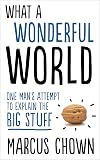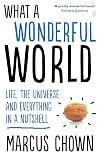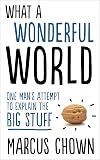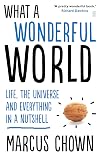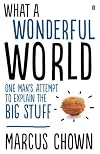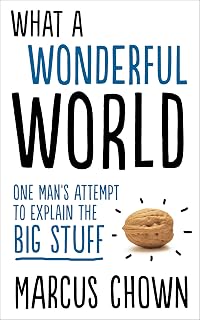
What a Wonderful World: One Man's Attempt to Explain the Big Stuff
by Marcus Chown
On This Page
Description
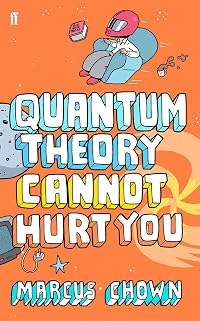
With wit, colour and clarity, What A Wonderful World quickly and painlessly brings us up to speed on how the world of the 21st century works. From economics to physics and biology to philosophy, Marcus Chown explains the complex forces that shape our universe. Why do we breathe? What is money? How does the brain work? Why did life invent sex? Does time really exist? How does capitalism work - or not, as the case may be? Where do mountains come from? How do computers work? How did humans get show more to dominate the Earth? Why is there something rather than nothing? In What a Wonderful World, Marcus Chown, bestselling author of Quantum Theory Cannot Hurt You and the Solar System app, uses his vast scientific knowledge and deep understanding of extremely complex processes to answer simple questions about the workings of our everyday lives. Lucid, witty and hugely entertaining, it explains the basics of our essential existence, stopping along the way to show us why the Atlantic is widening by a thumbs' length each year, how money permits trade to time travel why the crucial advantage humans had over Neanderthals was sewing and why we are all living in a giant hologram. show lessTags
Recommendations





Member Reviews
The thing about What a Wonderful World is that it is like a fruitcake – very rich, very dense, and full of tasty little nuggets. For instance, did you know that the invention of cookery was a milestone on a par with tool use? It allowed us to broaden our diets in prehistory, and any ecologist will tell you what access to good nutrition will do for any animal. Or that galaxies are organized, and indeed possibly even created, by the giant black holes at their centre?
What a Wonderful World is a digest, if you like, about the construction and function of practically everything – the cells in your body, the Earth itself, international banking, quantum theory, sex, Deep Time – the list goes on. It’s something that you dip into when show more you’re in the right mood, but when you are it’s consistently interesting and rewarding and represents a considerable body of scholarship and research which has been dissected to the point where you can be gently guided through its more fascinating corners. The image of a “plate graveyard” at the centre of the Earth where tectonic plates drift down to die still lingers in the imagination, and as I am not particularly driven to seek out books on plate tectonics, its something that I might, in the normal course of things, never have learned anything about.
It’s also deeply topical in places (see the section on international banking, for one). There’s a great discussion on the eminently newsworthy topic of inflation in relation to the Big Bang (I only received this book last year, and inflation is described within, quite carefully, as a theory). As a writer interested in the idea of multiverses, there is a fantastic wealth of imaginative detail. Did you know that scientists have worked out how far you need to walk in order to meet your doppelganger in another universe? (Clue, it’s a long, long way, but you will meet them if you keep going.)
Sometimes I was a little lost, but that’s okay, because you feel in safe hands just following on.
I really enjoyed it – in the madness of house, job, and life move and the insane rush of mandatory reading that took up the earlier part of my year, this was a guilty pleasure I could dip into as Fate allowed. Though challenging in places, there is nothing a reasonably literate person couldn’t follow. I’d recommend it to anyone interested in learning more about the universe than the usual surface tropes. show less
What a Wonderful World is a digest, if you like, about the construction and function of practically everything – the cells in your body, the Earth itself, international banking, quantum theory, sex, Deep Time – the list goes on. It’s something that you dip into when show more you’re in the right mood, but when you are it’s consistently interesting and rewarding and represents a considerable body of scholarship and research which has been dissected to the point where you can be gently guided through its more fascinating corners. The image of a “plate graveyard” at the centre of the Earth where tectonic plates drift down to die still lingers in the imagination, and as I am not particularly driven to seek out books on plate tectonics, its something that I might, in the normal course of things, never have learned anything about.
It’s also deeply topical in places (see the section on international banking, for one). There’s a great discussion on the eminently newsworthy topic of inflation in relation to the Big Bang (I only received this book last year, and inflation is described within, quite carefully, as a theory). As a writer interested in the idea of multiverses, there is a fantastic wealth of imaginative detail. Did you know that scientists have worked out how far you need to walk in order to meet your doppelganger in another universe? (Clue, it’s a long, long way, but you will meet them if you keep going.)
Sometimes I was a little lost, but that’s okay, because you feel in safe hands just following on.
I really enjoyed it – in the madness of house, job, and life move and the insane rush of mandatory reading that took up the earlier part of my year, this was a guilty pleasure I could dip into as Fate allowed. Though challenging in places, there is nothing a reasonably literate person couldn’t follow. I’d recommend it to anyone interested in learning more about the universe than the usual surface tropes. show less
Ratings
Members
- Recently Added By
Lists

Books Read in 2021
5,361 works; 114 members
Author Information

37+ Works 2,186 Members
Formerly a radio astronomer at the California Institute of Technology in Pasadena, Marcus Chown is cosmology consultant of New Scientist. His books include The Ascent of Gravity (named the Sunday Times 2017 Science Book of the Year), What A Wonderful World, Quantum Theory Cannot Hurt You, and We Need to Talk About Kelvin.
Awards and Honors
Awards
Classifications
Statistics
- Members
- 95
- Popularity
- 328,286
- Reviews
- 2
- Rating
- (3.82)
- Languages
- Czech, English, Spanish
- Media
- Paper, Audiobook, Ebook
- ISBNs
- 9
- UPCs
- 1
- ASINs
- 4