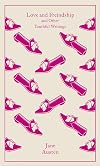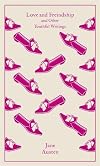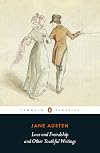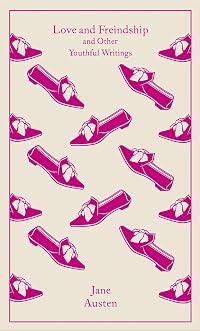
Love and Freindship: And Other Youthful Writings
by Jane Austen
On This Page
Description
"Jane Austen's brilliantly sophisticated teenage writings constitute her beginnings as a writer. We see in the works in this volume the sheer fun of her early sketches and their ridicule of human foibles, her parody of the absurdities of romance and sentimental fiction, her decision-making over choice of word and incident, her changing attitude towards character and style, and especially her early fascination with wordplay and hidden meanings that reveal her sprightly show more imagination."--Introduction. show lessTags
Recommendations




Member Reviews
At this point I’ve read and reread all of Austen’s novels. Each time I dive into her work I discover new things to reflect upon. This was my first foray into her juvenilia and I was surprised to find her sharp wit and sense of humor were already developed. She clearly improved her character and plot development with age, but these early works still have her tone.
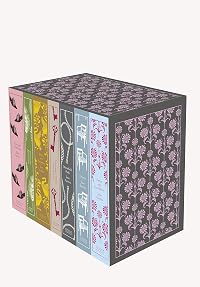
I’d already read Lady Susan, which is included her, but the rest was new to me. I have to say the Penguin Clothbound Classics edition was excellent. The introduction includes information about the pieces in the book and Austen’s life, which provides context and depth.
"A remarkable feature of the juvenilia is its ability to subvert limitations imposed on young women, show more especially in the field of education."
Each of the tales focuses more on a single plot point than on character development. There's the girl who accidentally gotten engaged to two different men, and then commits suicide because she felt so bad. Another flirts at a ball and is scandalized. There are also quite a few glimpses of her later novels. In "From a Young Lady crossed in Love to her freind" we meet a young woman who is overwhelmed with heartbreak when she is betrayed by a man named Willoughby, just like Sense and Sensibility.
Austen’s sense of humor is particularly obvious in “The History of England”. She declares it is written by "a partial, prejudiced, and ignorant Historian". It includes lines like…
"During his reign, Lord Cobham was burnt alive, but I forget what for."
Her dedications at the beginning of each story became one of my favorite parts of the book. They’re intentionally overly serious and very amusing.
BOTTOM LINE: Austen’s juvenilia is playful and fun, but it also shows the promise of the writer that she will become. I loved having the chance to learn more about one of my favorite authors through her early work. A must for any true Austen fan! show less
I’d already read Lady Susan, which is included her, but the rest was new to me. I have to say the Penguin Clothbound Classics edition was excellent. The introduction includes information about the pieces in the book and Austen’s life, which provides context and depth.
"A remarkable feature of the juvenilia is its ability to subvert limitations imposed on young women, show more especially in the field of education."
Each of the tales focuses more on a single plot point than on character development. There's the girl who accidentally gotten engaged to two different men, and then commits suicide because she felt so bad. Another flirts at a ball and is scandalized. There are also quite a few glimpses of her later novels. In "From a Young Lady crossed in Love to her freind" we meet a young woman who is overwhelmed with heartbreak when she is betrayed by a man named Willoughby, just like Sense and Sensibility.
Austen’s sense of humor is particularly obvious in “The History of England”. She declares it is written by "a partial, prejudiced, and ignorant Historian". It includes lines like…
"During his reign, Lord Cobham was burnt alive, but I forget what for."
Her dedications at the beginning of each story became one of my favorite parts of the book. They’re intentionally overly serious and very amusing.
BOTTOM LINE: Austen’s juvenilia is playful and fun, but it also shows the promise of the writer that she will become. I loved having the chance to learn more about one of my favorite authors through her early work. A must for any true Austen fan! show less
3.75⭐️ rounded up
What a delightful collection of Jane Austen’s juvenilia. Some of the writings were more entertaining than others. I especially enjoyed Jane’s farcical history of England, Lady Susan, and some of her novellas.
One of the most humorous quotes from this collection was this:
“Lovely and too charming Fair one, notwithstanding your forbidding squint, your greasy tresses and your swelling back, which are more frightful than imagination can paint or pen describe, I cannot refrain from expressing my raptures at the engaging Qualities of your Mind, which so amply atone for the Horror with which your first appearance must ever inspire the unwary visitor.”
I also liked the last letter in the book, which is attributed to show more her, and in which she humorously writes to a periodical author to tell him his stories need more women in them (that they haven’t got them is a ghastly oversight, of course, and the stories would be so much more interesting with ladies, as she illustrates). She concludes, “If you think fit to comply with this my injunction, you may expect to hear from me again, and perhaps I may even give you a little assistance; - but, if not - may your work be condemned to a pastry-cook’s shop, and may you always continue a bachelor, and be plagued with a maiden sister to keep house for you.”
I just find her utterly delightful and for the most part, I enjoyed the collection very much. show less
What a delightful collection of Jane Austen’s juvenilia. Some of the writings were more entertaining than others. I especially enjoyed Jane’s farcical history of England, Lady Susan, and some of her novellas.
One of the most humorous quotes from this collection was this:
“Lovely and too charming Fair one, notwithstanding your forbidding squint, your greasy tresses and your swelling back, which are more frightful than imagination can paint or pen describe, I cannot refrain from expressing my raptures at the engaging Qualities of your Mind, which so amply atone for the Horror with which your first appearance must ever inspire the unwary visitor.”
I also liked the last letter in the book, which is attributed to show more her, and in which she humorously writes to a periodical author to tell him his stories need more women in them (that they haven’t got them is a ghastly oversight, of course, and the stories would be so much more interesting with ladies, as she illustrates). She concludes, “If you think fit to comply with this my injunction, you may expect to hear from me again, and perhaps I may even give you a little assistance; - but, if not - may your work be condemned to a pastry-cook’s shop, and may you always continue a bachelor, and be plagued with a maiden sister to keep house for you.”
I just find her utterly delightful and for the most part, I enjoyed the collection very much. show less
An omnibus of all of Jane Austen's writing as a youth, including Lady Susan, this was in many ways an eye opener. Austen's sly wit is often mentioned when discussing her 6 major novels, but her early writing is something else altogether; nothing sly about her writing here: it's full of Monty Python-esque humour, snark, farce and, in the case of Lady Susan outright, premeditated malice to a degree I wouldn't have ever thought Jane Austen likely to have written. All in all, a delightful discovery.
The book is laid out in the exact order Jane Austen's three notebooks were, which, with few exceptions, were in roughly chronological order. The progression of her writing and the evolution of maturity are evident and scheming malice aside, Lady show more Susan reads like Austen's later works.
I experienced a combination of dread and curiosity about these works; reading the writings of a juvenile runs the risk of tediousness. Fortunately what tediousness existed was contained in blessedly short stories and none of them were without entertainment value. Foremost, it was a genuine pleasure to find that my favorite author was, behind it all, someone I'd have loved being friends with and whose snark I would have greatly enjoyed. show less
The book is laid out in the exact order Jane Austen's three notebooks were, which, with few exceptions, were in roughly chronological order. The progression of her writing and the evolution of maturity are evident and scheming malice aside, Lady show more Susan reads like Austen's later works.
I experienced a combination of dread and curiosity about these works; reading the writings of a juvenile runs the risk of tediousness. Fortunately what tediousness existed was contained in blessedly short stories and none of them were without entertainment value. Foremost, it was a genuine pleasure to find that my favorite author was, behind it all, someone I'd have loved being friends with and whose snark I would have greatly enjoyed. show less
Jane's Juvenilia, so this is not as polished and well thought out as her novels.
Letters done to amuse her family. There are parts where the humor really shines through.
Letters done to amuse her family. There are parts where the humor really shines through.
Ratings
Members
- Recently Added By
Author Information

708+ Works 317,237 Members
Jane Austen's life is striking for the contrast between the great works she wrote in secret and the outward appearance of being quite dull and ordinary. Austen was born in the small English town of Steventon in Hampshire, and educated at home by her clergyman father. She was deeply devoted to her family. For a short time, the Austens lived in the show more resort city of Bath, but when her father died, they returned to Steventon, where Austen lived until her death at the age of 41. Austen was drawn to literature early, she began writing novels that satirized both the writers and the manners of the 1790's. Her sharp sense of humor and keen eye for the ridiculous in human behavior gave her works lasting appeal. She is at her best in such books as Pride and Prejudice (1813), Mansfield Park (1814), and Emma (1816), in which she examines and often ridicules the behavior of small groups of middle-class characters. Austen relies heavily on conversations among her characters to reveal their personalities, and at times her novels read almost like plays. Several of them have, in fact, been made into films. She is considered to be one of the most beloved British authors. (Bowker Author Biography) show less
Series
Belongs to Publisher Series
Penguin Clothbound Classics (2014)
Common Knowledge
- Canonical title
- Love and Freindship: And Other Youthful Writings
- Original language
- English
Classifications
Statistics
- Members
- 564
- Popularity
- 52,355
- Reviews
- 4
- Rating
- (3.98)
- Languages
- English, Italian
- Media
- Paper, Ebook
- ISBNs
- 15
- ASINs
- 6