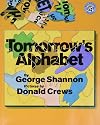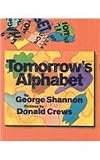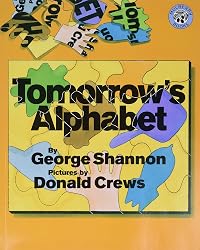
Tomorrow's Alphabet
by George Shannon, Donald Crews (Illustrator)
On This Page
Description
Introduces items that eventually become things that start with each letter of the alphabet, such as O is for acorn, which becomes tomorrow's oak tree.Tags
Recommendations



Member Recommendations
Member Reviews
A is for seed...tomorrow's apple.
Readers with a grasp of the alphabet and letter-sound correspondence will quickly catch on to the pattern here, and it's a very inventive concept for an alphabet book, and beautifully designed!
My one small quibble is that they used "cheese" for the letter C, and the "ch" digraph isn't one of the usual sounds for C; they could have used a hard C, like in cat, or a soft C, like in Celia.
Readers with a grasp of the alphabet and letter-sound correspondence will quickly catch on to the pattern here, and it's a very inventive concept for an alphabet book, and beautifully designed!
My one small quibble is that they used "cheese" for the letter C, and the "ch" digraph isn't one of the usual sounds for C; they could have used a hard C, like in cat, or a soft C, like in Celia.
This book is probably a little advanced for kids who are still trying to figure out A = apple, b = ball, c = cat. (Or maybe not. Sometimes children surprise you!) Instead of a being for apple, it's for seed - TOMORROW'S apple. H is for yarn - TOMORROW'S hat. So kids have to think a little bit about each example.
Still, even with the slightly novel approach, the book is pretty straightforward. Example and tomorrow example are given on opposite pages of the same spread (so you can see the answer before you guess it, if you like), and the language follows a careful pattern: $LETTER is for $NOUN, tomorrow's $OTHER NOUN.
The artwork is well-done and - in a little touch I'm *very happy with* - it's inclusive. There are six people shown in this show more book (well, two people, one person on a raisin box, two sets of hands, and a foot) and these people (and hands and foot) come in a variety of skin tones. Just like the children reading this book do. If you don't spend your time trying to find books with people that look like your own loved ones, or like your own students, you probably don't know what a big deal this is. But it IS. Children deserve to see themselves reflected in their books. Not all the time, but at least SOMEtimes. show less
Still, even with the slightly novel approach, the book is pretty straightforward. Example and tomorrow example are given on opposite pages of the same spread (so you can see the answer before you guess it, if you like), and the language follows a careful pattern: $LETTER is for $NOUN, tomorrow's $OTHER NOUN.
The artwork is well-done and - in a little touch I'm *very happy with* - it's inclusive. There are six people shown in this show more book (well, two people, one person on a raisin box, two sets of hands, and a foot) and these people (and hands and foot) come in a variety of skin tones. Just like the children reading this book do. If you don't spend your time trying to find books with people that look like your own loved ones, or like your own students, you probably don't know what a big deal this is. But it IS. Children deserve to see themselves reflected in their books. Not all the time, but at least SOMEtimes. show less
Oh! I'm tempted to give this a five star rating, because so many books of the last 10 years or so are much like this earlier one. But objectively I have to admit that this is not quite as amazing as the very best of those.... Still, it's timeless and I hope your library still has a copy.
Definitely use a sheet of paper or another book so you and your children can try to make the predictions!! Why is R for grapes??
I will continue to look for more by George Shannon.
Definitely use a sheet of paper or another book so you and your children can try to make the predictions!! Why is R for grapes??
I will continue to look for more by George Shannon.
A clever idea, but harder than I realized for young children: E is for embers, J is jack-o'-lantern. Each two-page spread has today on the left and tomorrow on the right; I covered the right side and had kindergartners guess what the word would be. For example, A is for seed---tomorrow's apple.
Retelling: This is not your typical alphabet book with a letter and a word that begins with that letter on each page. The reader is baffled by the first page that reads "A is for seed" because "seed" does not begin with 'a'. Then you read, "tomorrow's apple" and "apple" does start with 'A'! Shannon explores transformations, with each letter pointing to what the object once was.
Thoughts and Feelings: I had a lot of fun guessing what the words might be and I imagine you will too! As alphabet books go, this is a good one.
Thoughts and Feelings: I had a lot of fun guessing what the words might be and I imagine you will too! As alphabet books go, this is a good one.
Anno’s Alphabet: An Adventure in Imagination and George Shannon’s Tomorrow’s Alphabet are two distinct types of alphabet books. Anno’s book, at first glance, is a beautifully illustrated simple word-picture alphabet book, whereas Shannon’s book includes a riddle component. Anno depicts each letter as if fashioned out of wood, with images of woodworking tools appearing in the opening pages preceding the title page. In each image that represents a letter (i.e., a kangaroo for the letter “K”), there is at least a wooden detail within the object pictured. But if one looks closely at the intricate monochromatic borders that decorate each page, one can find at least one object that also begins with that letter, and sometimes show more more (on the “K” page there is a king, key, knife and knot “hidden” inside the border). The fine, detailed handling of letters, borders and representational images are quite appealing. A key at the end notes all the objects hidden in the borders. A Boston Globe-Horn Book Award (Picture Book) 1975. Preschool-7 (for the hidden imagery).
In comparison, Tomorrow’s Alphabet requires the reader to predict what each letter stands for, based on a given clue. For example, “A is for seed” is followed by “tomorrow’s apple.” The letter is always the same color the alphabetically matched word (“A” and the word “apple,” etc.), to further clarify the connection. It’s an engaging concept, and I have successfully used this book for kindergartners and first graders. First graders are a perfect target grade. However, some pairs are too obscure (“F is for wheat—tomorrow’s flour”) and the book’s layout is problematic. Both set-up (“D is for puppy” and answer (“tomorrow’s dog”) are on the same 2-page spread, so I have had to bend back half the book to not display the answer when posing the challenge. Donald Crews’ illustrations are mostly clear and adequate. No awards could be found.
Anno, M. (1975). Anno's alphabet: An adventure in imagination. New York: Crowell.
Shannon, G., & Crews, D. (1995). Tomorrow's alphabet. New York: Greenwillow Books. show less
In comparison, Tomorrow’s Alphabet requires the reader to predict what each letter stands for, based on a given clue. For example, “A is for seed” is followed by “tomorrow’s apple.” The letter is always the same color the alphabetically matched word (“A” and the word “apple,” etc.), to further clarify the connection. It’s an engaging concept, and I have successfully used this book for kindergartners and first graders. First graders are a perfect target grade. However, some pairs are too obscure (“F is for wheat—tomorrow’s flour”) and the book’s layout is problematic. Both set-up (“D is for puppy” and answer (“tomorrow’s dog”) are on the same 2-page spread, so I have had to bend back half the book to not display the answer when posing the challenge. Donald Crews’ illustrations are mostly clear and adequate. No awards could be found.
Anno, M. (1975). Anno's alphabet: An adventure in imagination. New York: Crowell.
Shannon, G., & Crews, D. (1995). Tomorrow's alphabet. New York: Greenwillow Books. show less
This is an alphabet book, that encourages students to predict what item will come from the original. For example the book states, "E is for fire, tomorrow's ember" or "N is for twigs, tomorrow's nest."
This book should only be used with students who have a clear understanding of graphemes, otherwise they may become confused. This is a great way to introduce the concept of predictions to young readers, and it also displays the idea of cause and effect. This book could be used with older readers, and they can then create their own "tomorrow's alphabet" book. Overall, this book is fun and can educate readers about what different items originate as.
This book should only be used with students who have a clear understanding of graphemes, otherwise they may become confused. This is a great way to introduce the concept of predictions to young readers, and it also displays the idea of cause and effect. This book could be used with older readers, and they can then create their own "tomorrow's alphabet" book. Overall, this book is fun and can educate readers about what different items originate as.
Members
- Recently Added By
Author Information

55+ Works 4,559 Members
George Shannon is an American author. He was born on February 14, 1952 in Caldwell, Kansas. A former children's librarian and professional storyteller, he has worked as a freelance writer and lecturer for over 25 years. Though primarily a children's author, his YA title Unlived Affections was nominated for a Lambda Literary award in 1990. Lizard's show more Song was his first children's book to be accepted. His other titles include: Who Put the Cookies in the Cookie Jar, A Very Witchy Spelling Bee, Turkey Tot, Rabbit's Gift and Chicken Scratches. (Bowker Author Biography) show less

Awards and Honors
Awards
Series
Belongs to Publisher Series
Common Knowledge
- Canonical title
- Tomorrow's Alphabet
- Dedication
- For Brian, Andrew, and Kaitlyn Shannon ---G.S.
For Ann, Nina, and Amy and the Gang at Greenwillow and Susan and Ava (who put her foot in it) ---D.C. - First words
- A is for seed ---
- Last words
- (Click to show. Warning: May contain spoilers.)tomorrow's ZERO
Classifications
Statistics
- Members
- 591
- Popularity
- 49,875
- Reviews
- 20
- Rating
- (4.17)
- Languages
- English
- Media
- Paper
- ISBNs
- 10
- ASINs
- 2