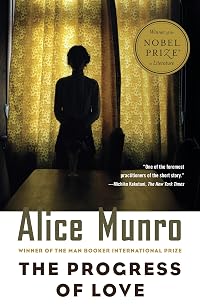
The Progress of Love
by Alice Munro
On This Page
Description
WINNER OF THE NOBEL PRIZE(R) IN LITERATURE 2013 Alice Munro, who received the National Book Critics Circle Award for her latest collection of stories, The Love of a Good Woman, is widely acknowledged as a modern master of the short story. In this earlier collection, she demonstrates all of those strengths that have won her so many literary accolades. A divorced woman returns to her childhood home where she confronts the memory of her parents' confounding yet deep bond. The accidental show more near-drowning of a child exposes the fragility of the trust between children and parents. A young man, remembering a terrifying childhood incident, wrestles with the responsibility he has always felt for his younger brother. In these and other stories Alice Munro proves once again a sensitive and compassionate chronicler of our times. Drawing us into the most intimate corners of ordinary lives, she reveals much about ourselves, our choices, and our experiences of love. show lessTags
Recommendations












Member Reviews
The cover of my eighties-paperback edition of "The Progress of Love" is awful: the title done in off-shades of almost-aquamarine and mustard yellow. The stories in it are, of course, excellent, but I already knew that before picking it up. Reading Alice Munro is sometimes delightfully and sometimes frustratingly like reading a Vladimir Nabokov paragraph, or watching an NBA player hit an endless succession of free-throws. It's an awesome performance, but, at the same time, almost boring in its excellence. It's not a question -- as Woody Allen might have it -- of standing too close to the target. Most of the time, Alice is just that good.
It's hard not to read a certain kind of passivity into Munro's female characters after the unpleasant show more revelations about her family life came to light, but women trapped in domestic situations that lacked satisfying solutions were always something of a specialty of hers. In most of these stories, really leaving -- be it physically, emotionally, or simply in memory -- seems beyond most characters' abilities, and, in others, like "Eskimo," the prospect of decisive action seems fraught. This would seem, in many ways, like a recipe for frustration, were the author not able to express it so well. Munro's prose is gentle and flowing, but at the same time economical: she seems to be able to offer a complete description of a character in two sentences, or a that of the first year of a marriage in a paragraph. It takes her longer to suss out the complete picture of her characters' lives, but her stories never seem incomplete, and her readers' understanding of her characters often seems to extend exactly as far as she wishes it to. This isn't to say that she knows the full story, either, but only that, like the best modernists who preceded her, she knows where to draw the line between the knowable and the unknowable. I could go on, but in the spirit of the topic at hand, I'll stop. Four well-earned stars, despite the awful cover. We're talking about Alice Munro here. What else was it going to be? show less
It's hard not to read a certain kind of passivity into Munro's female characters after the unpleasant show more revelations about her family life came to light, but women trapped in domestic situations that lacked satisfying solutions were always something of a specialty of hers. In most of these stories, really leaving -- be it physically, emotionally, or simply in memory -- seems beyond most characters' abilities, and, in others, like "Eskimo," the prospect of decisive action seems fraught. This would seem, in many ways, like a recipe for frustration, were the author not able to express it so well. Munro's prose is gentle and flowing, but at the same time economical: she seems to be able to offer a complete description of a character in two sentences, or a that of the first year of a marriage in a paragraph. It takes her longer to suss out the complete picture of her characters' lives, but her stories never seem incomplete, and her readers' understanding of her characters often seems to extend exactly as far as she wishes it to. This isn't to say that she knows the full story, either, but only that, like the best modernists who preceded her, she knows where to draw the line between the knowable and the unknowable. I could go on, but in the spirit of the topic at hand, I'll stop. Four well-earned stars, despite the awful cover. We're talking about Alice Munro here. What else was it going to be? show less
Genius: Alice Munro is, by my reckoning, the greatest short story writer of our time. Her collection, The Progress of Love, is ample proof. I recommend her work with trepidation to aspiring short story writers because her writing is intimidatingly exquisite. Charles Baxter or Lorrie Moore could profit from a session in the batting cage with Munro, but for most everybody else, it would be like taking your Tee-Ball Leaguer for a hitting tutorial with Ted Williams. What's so good about Munro's writing? Foremost is her precision. The center of the short story writer's craft is economy. It's very difficult to find a word that doesn't advance both story and theme in Munro's work. The reader finds himself stopping to ponder passages not show more because they're opaque but because they are so powerfully rendered and so intricately woven. I've taught "Monsieur Les Deux Chapeaux" for seven years, and Ross's moment on the bridge never fails to transport me and my students. I don't expect to find an end to my thought about this moment or the story itself. It will unquestionably remain a short story by which I measure all others. show less
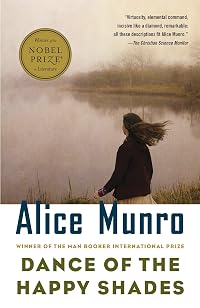
I tried earlier to read this author's first short story collection, Dance of the Happy Shades, and could find neither content nor style to keep me engaged. This collection was published about 18 years later and shows remarkable leaps to the skills I would hope all Nobel Prize winners in Literature would have. The author constantly shows remarkable insight into her characters and nuances in their situations that most other writers never approach. Have you ever had a situation where a parent or teacher or other key person made remarks to you and others in a group, seemingly not talking to you anymore directly than to the others, but in which you knew unquestionably that the person was relating a message intended specifically for your show more edification? They knew something you had done or were contemplating doing or had experienced, and they were masking their lecture to you in the form of a general group message. They knew. And they wanted you to know that they knew. But without ever letting anybody else know. The first story in this collection hit me hard in just that way. The author said she knew something significant about me -- in detail -- without ever using my name or town or anything connected to me in that way. Unfortunately, about half-way through the collection, it seemed she was talking intimately to other readers and my level of interest dissipated somewhat. That's okay. I suspect she'll have another message just for me in another collection and I'll be ready to absorb every word. show less
An upscale steakhouse chain, like Morton's or Capital Grille, will consistently serve you a perfectly cooked steak. That's why you shell out the money to go to a place like that, after all. And consistently cooking a steak perfectly is no mean feat- there are many places, even more expensive and ostensibly better restaurants, that fail to do that. At the end of the day, though, even when it's perfectly cooked, what you're getting is a by-the-numbers steak dinner, that doesn't take any risks or try to innovate. Alice Munro is the upscale chain steakhouse of literature: she writes stories that always have the same feel and often have the same subject matter, and she writes all of them exceedingly well. At the end of the day, though, she's show more serving you the same fare again and again, and no individual story is likely to stand out. If small town personal drama is something that appeals to you, Munro has enough of that to keep you satiated for months, if not years, but never expect her to surprise you.
The first half of this collection made me think that Munro wrote the same story over and over. All the stories featured a small-town Canadian, usually a slightly-past-middle-aged woman, experiences something that sparks a memory of personal hardships in her past. That memory becomes the conduit for the actual content of the story, the narrative only returning to the present (where nothing happens) at the end of the short tale. The second half featured stories that broke this formula, but that still always centered on small-town Canada dealing with low-key personal drama. Elements like a white haired woman and a man working as a mechanic recur, the same tone is present in every story, and the narrative voice is exactly the same despite the narrators ostensibly having different lives. Thus the second half of this collection revealed that while Munro's stories aren't always formulaic in terms of content, they still always (at least in this collection) feel the same. Writing this review only a week or so after finishing the collection, the individual stories have already begun to blend together in my mind.
I get why people like Munro, she writes well (although I didn't find many passages particularly striking) and she writes with consistency. If you like her shtick then I can see her being an author you revisit on a regular basis, because you know what you're going to get and you know you're going to like it. At the end of the day, though, I can't help but find her boring. No matter what hardship her characters are dealing with- slow brother, cheating spouse, disliked father, otherwise unideal childhood- the stories all read the same, and none of the narrative voices are distinguishable. I can't imagine reading through fifteen collections worth of this same basic story being rehashed, I don't think my brain could handle that much sameness. I don't love Flannery O'Connor, but her stories have variety, and they aren't all passive. I found myself hungering for a Flannery O'Connor story in the midst of reading Munro. If you like Alice Munro that's perfectly fine, I can understand that, I just don't happen to find the particular subject matter Munro always focuses on to be particularly compelling. If Alice Munro is your absolute favorite author, though, then I'd really encourage you to take more risks when you select what books you read going forward- there's more to eat out there than steak. show less
The first half of this collection made me think that Munro wrote the same story over and over. All the stories featured a small-town Canadian, usually a slightly-past-middle-aged woman, experiences something that sparks a memory of personal hardships in her past. That memory becomes the conduit for the actual content of the story, the narrative only returning to the present (where nothing happens) at the end of the short tale. The second half featured stories that broke this formula, but that still always centered on small-town Canada dealing with low-key personal drama. Elements like a white haired woman and a man working as a mechanic recur, the same tone is present in every story, and the narrative voice is exactly the same despite the narrators ostensibly having different lives. Thus the second half of this collection revealed that while Munro's stories aren't always formulaic in terms of content, they still always (at least in this collection) feel the same. Writing this review only a week or so after finishing the collection, the individual stories have already begun to blend together in my mind.
I get why people like Munro, she writes well (although I didn't find many passages particularly striking) and she writes with consistency. If you like her shtick then I can see her being an author you revisit on a regular basis, because you know what you're going to get and you know you're going to like it. At the end of the day, though, I can't help but find her boring. No matter what hardship her characters are dealing with- slow brother, cheating spouse, disliked father, otherwise unideal childhood- the stories all read the same, and none of the narrative voices are distinguishable. I can't imagine reading through fifteen collections worth of this same basic story being rehashed, I don't think my brain could handle that much sameness. I don't love Flannery O'Connor, but her stories have variety, and they aren't all passive. I found myself hungering for a Flannery O'Connor story in the midst of reading Munro. If you like Alice Munro that's perfectly fine, I can understand that, I just don't happen to find the particular subject matter Munro always focuses on to be particularly compelling. If Alice Munro is your absolute favorite author, though, then I'd really encourage you to take more risks when you select what books you read going forward- there's more to eat out there than steak. show less
A masterly collection of enjoyable short stories, which read as pared down novels and compress an enormous amount of life and feeling into a few pages.
Although they read as naturalistic tales that might almost be anecdotes, they are beautifully crafted stories. My favourite is "The Moon in the Orange Street Skating Rink", which tells a life story, or two, and creates a whole other world. Excellent.
Although they read as naturalistic tales that might almost be anecdotes, they are beautifully crafted stories. My favourite is "The Moon in the Orange Street Skating Rink", which tells a life story, or two, and creates a whole other world. Excellent.
Alice Munro won the Nobel Prize for Literature in 2013. I've read quite a few of her short stories but thought that this occasion was a good excuse to read some more. However, this book was the only one I had on my shelves and, as it happened, it was also available as a Book Club Kit from the Winnipeg Public Library. So I talked my work book club into reading it for January 2014.
This book won the GG for English fiction in 1986 but, to be honest, there are other books of her short stories that I have enjoyed more. The other finalists for the GG were Lois Braun for A Stone Watermelon, John Metcalf for Adult Entertainment and Aritha van Herk for No Fixed Address. I haven't read any of those books so I can't really compare them but I show more suspect The Progress of Love was the best of a weak bunch. After all, even a sub-par Munro is still a work of literature.
The title story is probably the best in the book. It is told from the point of view of a young girl about her parents, especially her mother. It's been my observation before that Munro really knows how to depict a child's mind. She must have an incredible memory because I think she uses a lot of her own childhood in those types of stories.
I was most disappointed in Eskimo which is about a woman on a plane trip to Tahiti who is sitting close to a couple. The female is much younger than the male but since she tells him at one point that he is not her father it is obvious that theirs is a sexual relationship. And although the narrator has her doubts about the relationship in the end she does nothing. I felt like there was no point in telling this story if there wasn't going to be some outcome.
We'll be meeting to discuss this soon. I predict most people won't have liked the book and I'm disappointed that the Munro we picked to read wasn't a better one. show less
This book won the GG for English fiction in 1986 but, to be honest, there are other books of her short stories that I have enjoyed more. The other finalists for the GG were Lois Braun for A Stone Watermelon, John Metcalf for Adult Entertainment and Aritha van Herk for No Fixed Address. I haven't read any of those books so I can't really compare them but I show more suspect The Progress of Love was the best of a weak bunch. After all, even a sub-par Munro is still a work of literature.
The title story is probably the best in the book. It is told from the point of view of a young girl about her parents, especially her mother. It's been my observation before that Munro really knows how to depict a child's mind. She must have an incredible memory because I think she uses a lot of her own childhood in those types of stories.
I was most disappointed in Eskimo which is about a woman on a plane trip to Tahiti who is sitting close to a couple. The female is much younger than the male but since she tells him at one point that he is not her father it is obvious that theirs is a sexual relationship. And although the narrator has her doubts about the relationship in the end she does nothing. I felt like there was no point in telling this story if there wasn't going to be some outcome.
We'll be meeting to discuss this soon. I predict most people won't have liked the book and I'm disappointed that the Munro we picked to read wasn't a better one. show less
The characters in these 11 short stories have hearts that are startled or weighed down by the responsibilities of love, or which are gnawed by hidden hate and cruelty. PW wrote that Munro offers "a freshness of vision, a breadth of sympathy and a wide-ranging imagination."
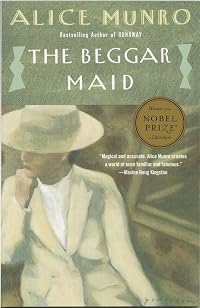
A prize-winning Canadian author, Munro has been praised for such works as The Moons of Jupiter and The Beggar Maid. This collection of 11 stories thoughtfully explores the themes of self-knowledge and love. Families, friends, eccentrics, lovers, the characters all bear the marks and burdens of unpredictable individualism and humanity. Girlish friendship and imaginings end in betrayal, estrangement, and self-revelation over the years in "Jesse and Meribeth." A show more small-town nurse in "Eskimo" unveils layers of female obligation and the complexities of love when trying to befriend a young girl on a plane to Tahiti. "A Queer Streak" has about it the satisfying subtlety, wholeness, and horror of legend. show less
A prize-winning Canadian author, Munro has been praised for such works as The Moons of Jupiter and The Beggar Maid. This collection of 11 stories thoughtfully explores the themes of self-knowledge and love. Families, friends, eccentrics, lovers, the characters all bear the marks and burdens of unpredictable individualism and humanity. Girlish friendship and imaginings end in betrayal, estrangement, and self-revelation over the years in "Jesse and Meribeth." A show more small-town nurse in "Eskimo" unveils layers of female obligation and the complexities of love when trying to befriend a young girl on a plane to Tahiti. "A Queer Streak" has about it the satisfying subtlety, wholeness, and horror of legend. show less
Members
- Recently Added By
Lists

501 Must-Read Books
529 works; 72 members

One Book, Many Authors
441 works; 40 members

Governor General of Canada's English Fiction Awards
89 works; 3 members
Author Information

129+ Works 30,460 Members
Alice Munro was born Alice Laidlaw in Wingham, Ontario on July 10, 1931. She published her first story, The Dimensions of a Shadow, while a student at the University of Western Ontario in 1950. She left the university in 1951 to get married and start a family. In 1972 she became Writer in Residence at the University of Western Ontario. Her first show more collection, Dance of the Happy Shades, was published in 1968 and won the Governor General's Award, Canada's highest literary prize. Her other works include Lives of Girls and Women, The View from Castle Rock, Something I've Been Meaning to Tell You, Too Much Happiness, and Dear Life. She has received several awards including the Governor General's Award for fiction for Who Do You Think You Are? and The Progress of Love, the Giller Prize for Runaway in 2004, the Man Booker International Prize in 2009 for her lifetime body of work, and the 2013 Nobel Prize in Literature. Her stories have appeared in numerous publications including The New Yorker, The Paris Review, and The Atlantic Monthly. Also, in 2013, her title Dear Life: Stories made The New York Times Best Seller List. (Bowker Author Biography) show less
Some Editions
Awards and Honors
Awards
Distinctions
Notable Lists
Series
Belongs to Publisher Series
Keltainen kirjasto (212)
Work Relationships
Is contained in
Common Knowledge
- Canonical title*
- Liefdesvorderingen
- Original title
- The Progress of Love
- Alternate titles*
- Liefdes vorderingen
- Original publication date
- 1986 (Engels) (Engels); 1990 (Nederlands) (Nederlands)
- Dedication
- For my sister Sheila
- First words
- I got a call at work, and it was my father.
- Last words
- (Click to show. Warning: May contain spoilers.)(It is too late to talk of this now: it has been decided.)
- Blurbers
- Tyler, Anne
- Original language*
- Engels
*Some information comes from Common Knowledge in other languages. Click "Edit" for more information.
Classifications
Statistics
- Members
- 1,012
- Popularity
- 25,797
- Reviews
- 17
- Rating
- (3.98)
- Languages
- 10 — Chinese, Danish, Dutch, English, Finnish, German, Italian, Portuguese, Spanish, Swedish
- Media
- Paper, Audiobook, Ebook
- ISBNs
- 43
- ASINs
- 10