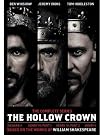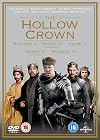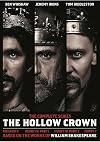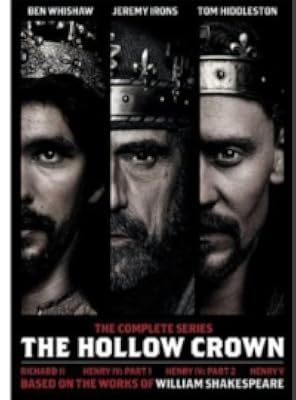
The Hollow Crown : Complete series {2012 + 2016 television series}
by BBC (Company), Dominic Cooke (Adapter; Director), Richard Eyre (Adapter; Director), Rupert Goold (Adapter; Director), Rory Kinnear (Actor [Bolingbroke/Henry IV]), Sam Mendes (Executive producer), Ben Power (Adapter), William Shakespeare (Original text), Ben Whishaw (Actor [Richard II])
The Hollow Crown {BBC television series} (Collections and Selections — )
On This Page
Description
The Hollow crown: New adaptations of Shakespeare's tetralogy of history plays comprising the 'Henriad' for the BBC's 2012 Cultural Olympiad: King Richard; II King Henry IV, Part 1; King Henry IV, Part 2 and King Henry V. The plays chronicle a continuous period in British history from the end of the 14th century to the aftermath of the Battle of Agincourt in 1415. Together, the plays comprise a story with recurring themes of power struggles, redemption, family conflict and betrayal.Pt 1. show more Prince Hal (Tom Hiddleston) defies his father, King Henry IV (Jeremy Irons) by spending his time at Mistress Quickly's (Julie Walters) tavern in the company of the dissolute Falstaff (Simon Russell Beale) and his companions. The King is threatened by a rebellion led by Hal's rival, Hotspur (Joe Armstrong), his father Northumberland (Alun Armstrong), and his uncle Worcester (David Hayman). During the Battle of Shrewsbury, Hal faces Hotspur in mortal combat.Pt 2. Northumberland (Alun Armstrong) is told of the death of his son Hotspur in service of the King (Jeremy Irons). The Lord Chief Justice (Geoffrey Palmer) attempts to separate Falstaff (Simon Russell Beale) from the Prince Hal (Tom Hoddleston). The rebels continue to plot against the crown but their forces are outwitted. This brings comfort to the dying King, who is finally reconciled with his son. Falstaff rushes to Hal's coronation with the expectation of high office."The newly crowned King of England, Henry V, (Tom Hiddleston) is persuaded by his courtiers including Exeter (Anton Lesser) and York (Paterson Joseph), that he also has a rightful claim to lands in France. The chorus (John Hurt) tells of England's preparations for war and Henry's army sails for France. After Exeter's diplomacy is rebuffed by the French King (Lambert Wilson) Henry lays siege to and captures the town of Harfleur. The French now take Henry's claims seriously and challenge the English army to battle at Agincourt"--Container.After halting a duel between warring nobles Bolingbroke and Mowbray, Richard II banishes both men from his kingdom. Following the death of Bolingbroke's father, John of Gaunt, Richard seizes his money and land to pay for wars against rebels in Ireland. Bolingbroke returns to claim his birthright and more. show lessTags
Recommendations















Member Reviews
Includes the making of Richard II, Henry IV, and Henry V
Ratings
Members
- Recently Added By
Author Information


Richard Eyre, for 10 years artistic director of the Royal National Theatre, won the Laurence Olivier Award for Outstanding Achievement in 1997. He lives in London. (Bowker Author Biography)


William Shakespeare, 1564 - 1616 Although there are many myths and mysteries surrounding William Shakespeare, a great deal is actually known about his life. He was born in Stratford-Upon-Avon, son of John Shakespeare, a prosperous merchant and local politician and Mary Arden, who had the wealth to send their oldest son to Stratford Grammar School. show more At 18, Shakespeare married Anne Hathaway, the 27-year-old daughter of a local farmer, and they had their first daughter six months later. He probably developed an interest in theatre by watching plays performed by traveling players in Stratford while still in his youth. Some time before 1592, he left his family to take up residence in London, where he began acting and writing plays and poetry. By 1594 Shakespeare had become a member and part owner of an acting company called The Lord Chamberlain's Men, where he soon became the company's principal playwright. His plays enjoyed great popularity and high critical acclaim in the newly built Globe Theatre. It was through his popularity that the troupe gained the attention of the new king, James I, who appointed them the King's Players in 1603. Before retiring to Stratford in 1613, after the Globe burned down, he wrote more than three dozen plays (that we are sure of) and more than 150 sonnets. He was celebrated by Ben Jonson, one of the leading playwrights of the day, as a writer who would be "not for an age, but for all time," a prediction that has proved to be true. Today, Shakespeare towers over all other English writers and has few rivals in any language. His genius and creativity continue to astound scholars, and his plays continue to delight audiences. Many have served as the basis for operas, ballets, musical compositions, and films. While Jonson and other writers labored over their plays, Shakespeare seems to have had the ability to turn out work of exceptionally high caliber at an amazing speed. At the height of his career, he wrote an average of two plays a year as well as dozens of poems, songs, and possibly even verses for tombstones and heraldic shields, all while he continued to act in the plays performed by the Lord Chamberlain's Men. This staggering output is even more impressive when one considers its variety. Except for the English history plays, he never wrote the same kind of play twice. He seems to have had a good deal of fun in trying his hand at every kind of play. Shakespeare wrote 154 sonnets, all published on 1609, most of which were dedicated to his patron Henry Wriothsley, The Earl of Southhampton. He also wrote 13 comedies, 13 histories, 6 tragedies, and 4 tragecomedies. He died at Stratford-upon-Avon April 23, 1616, and was buried two days later on the grounds of Holy Trinity Church in Stratford. His cause of death was unknown, but it is surmised that he knew he was dying. (Bowker Author Biography) show less

All Editions
Series

Work Relationships
Contains
Common Knowledge
- Canonical title
- The Hollow Crown : Complete series {2012 + 2016 television series}
- Original publication date
- 2012-06-30
- People/Characters
- Richard II, King of England; Henry IV, King of England; Henry V, King of England; Henry VI, King of England; Richard III, King of England
- Important places
- England
- Related movies
- The Hollow Crown (2012 | IMDb)
- Original language
- English
- Canonical DDC/MDS
- 791.45750941
Classifications
- DDC/MDS
- 791.45750941 — Arts & recreation Recreation, sports, and performing arts Movies, TV, Video Motion pictures, radio, television, podcasting Television Programs; television plays Two or More Programs
- LCC
- PN1992.77 .H65 — Language and Literature Literature (General) Literature (General) Drama Broadcasting Television broadcasts
Statistics
- Members
- 88
- Popularity
- 362,911
- Reviews
- 1
- Rating
- (4.42)
- Languages
- English
- ISBNs
- 1
- UPCs
- 2
- ASINs
- 6