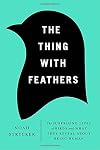
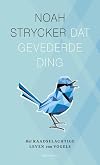
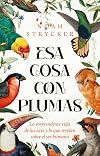
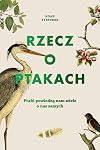
The Thing with Feathers: The Surprising Lives of Birds and What They Reveal About Being Human
by Noah Strycker
On This Page
Description
Birds are highly intelligent animals, yet their intelligence is dramatically different from our own and has been little understood. As we learn more about the secrets of bird life, we are unlocking fascinating insights into memory, relationships, game theory, and the nature of intelligence itself. The Thing with Feathers explores the astonishing homing abilities of pigeons, the good deeds of fairy-wrens, the influential flocking abilities of starlings, the deft artistry of bowerbirds, the show more extraordinary memories of nutcrackers, the lifelong loves of albatrosses, and other mysteries-revealing why birds do what they do, and offering a glimpse into our own nature. Drawing deep from personal experience, cutting-edge science, and colorful history, Noah Strycker spins captivating stories about the birds in our midst and shares the startlingly intimate coexistence of birds and humans. With humor, style, and grace, he shows how our view of the world is often, and remarkably, through the experience of birds. show lessTags
Recommendations

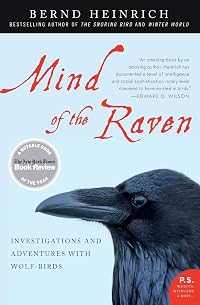
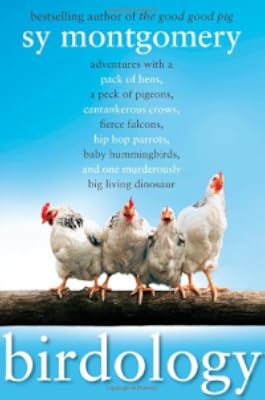
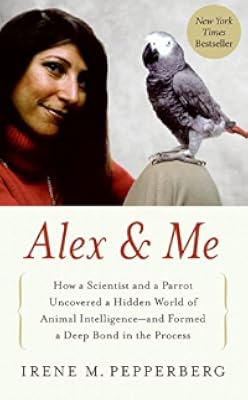
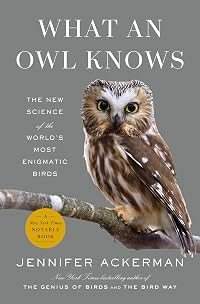
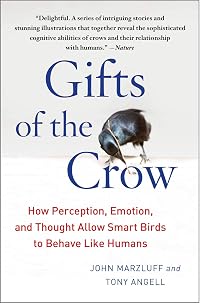
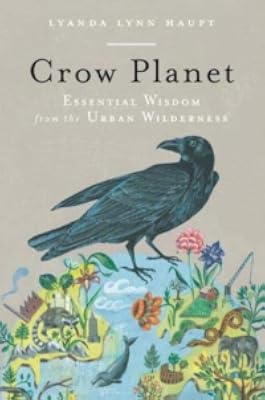
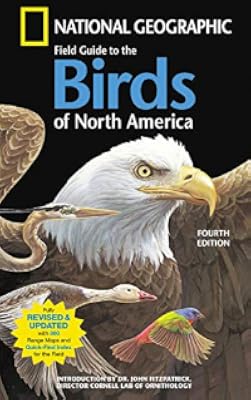

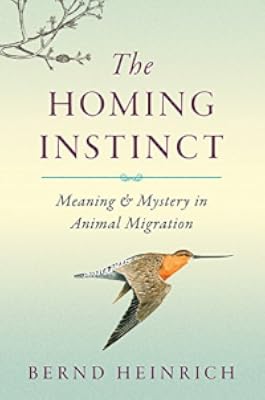


Member Recommendations
Member Reviews
I thoroughly enjoyed "The Thing with Feathers." This well-written book discusses specialized traits and behaviours of various bird species with both humor and charm. The assertiveness of the smallest hummingbirds, the amazing migratory journeys, the sensitivity of the vultures' nose, the fascinating and distracting irruptions of the magnificant snowy owl; all are described with sufficient detail and scope to both inform and fascinate. My only quibble, and it is minor, is that some of the observations regarding parallels with human traits seemed unecessary and distracting. Rather, I wanted more of the elegant portraits of bird species and their interesting peculiarities of behaviour. The author's expertise on birds is apparent but he is show more neither patronizing or pedantic in tone; both the experienced biologist or birder and the curious amateur should enjoy this work and find new perspectives and information. My thanks to LibraryThing Early Reviewers for this very enjoyable book. show less
 This review was written for LibraryThing Early Reviewers.
You might not think you could learn anything about humans by studying birds, but Noah Strycker, who calls himself "a full-time bird man," thinks you can. What's more, he has written a terrific new book, "The Thing with Feathers" (Riverhead Books), in which he discusses 13 bird species whose behavior may shed light on human behavior.
Do bowerbirds display an artistic sense when males build elaborate bowers to attract mates? Is their behavior all that different from human males who sometimes use art, whether it is rock music or a sporty car, to attract women?
Are fairy-wrens being altruistic when they help feed the young of unrelated fairy-wrens? Does their behavior teach us anything about human acts of generosity?
Can the lifetime mating of show more albatrosses really be called love? Why do they seem to do it better than most human couples?
Whether he's writing about the militant ways of hummingbirds or the pecking order of chickens, Strycker always returns to the human species and draws some surprising conclusions.
I wonder how others in the scientific community feel about Strycker's research. Do they find him guilty of recklessly extending human qualities to animals? But never mind. He writes more for general readers than for scientists, and this general reader, at least, is impressed. Here is one of my favorite of Strycker's conclusions: "Sure, we can never know whether or not real altruism exists in this universe, but wouldn't it be wise for us -- considering the bleak alternative -- to take a cue from fairy-wrens, and act as if it did? show less
Do bowerbirds display an artistic sense when males build elaborate bowers to attract mates? Is their behavior all that different from human males who sometimes use art, whether it is rock music or a sporty car, to attract women?
Are fairy-wrens being altruistic when they help feed the young of unrelated fairy-wrens? Does their behavior teach us anything about human acts of generosity?
Can the lifetime mating of show more albatrosses really be called love? Why do they seem to do it better than most human couples?
Whether he's writing about the militant ways of hummingbirds or the pecking order of chickens, Strycker always returns to the human species and draws some surprising conclusions.
I wonder how others in the scientific community feel about Strycker's research. Do they find him guilty of recklessly extending human qualities to animals? But never mind. He writes more for general readers than for scientists, and this general reader, at least, is impressed. Here is one of my favorite of Strycker's conclusions: "Sure, we can never know whether or not real altruism exists in this universe, but wouldn't it be wise for us -- considering the bleak alternative -- to take a cue from fairy-wrens, and act as if it did? show less
This review was written for LibraryThing Early Reviewers.What a special treat this book is! It's delightful whether or not you're into birds, but it is especially terrific for those interested in birds and nature.
This book is written as a series of essays, each of which highlights one particular species of bird, but not only that. The essay points out a particular feature of each noted species and uses research to compare bird behavior with human behavior. If this sounds boring, it's absolutely not. It's fascinating! The author writes clearly and with humor. He discusses such subjects as the homing ability of pigeons, the aggressiveness of hummingbirds, the pecking order of chickens, and the love (really?!) of albatrosses. I believe that most readers would find this book tremendously show more entertaining and informative. show less
This book is written as a series of essays, each of which highlights one particular species of bird, but not only that. The essay points out a particular feature of each noted species and uses research to compare bird behavior with human behavior. If this sounds boring, it's absolutely not. It's fascinating! The author writes clearly and with humor. He discusses such subjects as the homing ability of pigeons, the aggressiveness of hummingbirds, the pecking order of chickens, and the love (really?!) of albatrosses. I believe that most readers would find this book tremendously show more entertaining and informative. show less
This review was written for LibraryThing Early Reviewers.First of all, thank you Karen for giving me this book – I loved it. The Wall Street Journal describes Strycker as someone who “thinks like a biologist but writes like a poet”, a description I cannot improve on. The fact that he’s also only 26-yrs old make me almost hate him.
The contents are divided into 3 parts, Body, Mind and Spirit, and each part features 4 to 5 essays on different birds, some notable quality of theirs and how it compares to the same quality in humans. It’s fascinating stuff and the writing is both elegant and humorous.
The contents are divided into 3 parts, Body, Mind and Spirit, and each part features 4 to 5 essays on different birds, some notable quality of theirs and how it compares to the same quality in humans. It’s fascinating stuff and the writing is both elegant and humorous.
I loved this book. I have been casual birdwatcher most of my life but usually find any book other than a field guide on the dry side. Not necessarily boring but they often just don't hold my attention. "The Thing With Feathers" is anything but boring. When I received my copy in the mail I sat right down and read half of it without stopping. It is fascinating and humorous and crams a lot of interesting info into just under 300 pages. Having had several discussions recently with other birders about birds and their sense of smell, or lack thereof, the chapter on Turkey Vultures and birds sense of smell was so educational and not only helped dispel the myths we were all operating under, but gave so much more insight into that one small part show more of what makes a bird a bird. I also learned about "tend and befriend" in addition to what I already knew of "fight or flight", and a bird's ability to dance. This is a fun book that explains a lot about bird behavior and their operating systems and does so on an easy to understand level for the new and seasoned birder alike. The humor is just an added bonus. If you have a birder on your gift list, buy them this book! I am also really glad I have a tolerant spouse because at several points in the book I stopped and read him some of the statistics and even he was fascinated! (Edited to add that the section on the Snowy Owl irruption is very timely since it is big news again this year!) show less
This review was written for LibraryThing Early Reviewers.Noah Strycker spends a good part of each year in the field (such as at a research station in Antarctica, or as staff ornithologist on a cruise ship), using this experience to focus on one interesting characteristic of a given species, and reflecting on what it can tell us of the bird's personality, its adaptive role in its environment, and how it may relate it to the human condition. The linkage is not solely behavioural, which is to say rooted in evolutionary biology, though Part 1 is devoted to the Body, and Part 2 to the Mind, and in these sections of his book much is made of adaptive behaviour and what it reveals about our own activities. But Strycker is reflective enough and affectionate enough of birds, to find in them a show more reflection of human Spirit, to which he devotes his Part 3.
The book offers a nice structure for highlighting some trait or ability of some 13 different birds, and interesting tidbits on evolutionary context. Strycker's enthusiasm is evident, as well as his curiosity in linking what he sees in a bird, to literature generally. For birders, I anticipate this is more diversion than a contribution to ornithology; but it may excite a motivation to learn more about specific birds, and a talent for observing what is interesting in those birds one happens across.
So, the nutcracker's singular memory for finding thousands of seed caches vital to surviving winter, literally thousands in a season containing 4-5 seeds each and buried as long as 9 months previously, in locations which change year to year. Turns out, despite the lack of a hippocampus, birds share a spatial memory sense with humans, and like the Memory Palace mnemonic it requires practice and regular use to maintain this level of recall. Or, seeming wanderlust in owls or aggression in hummingbirds (!) serve to focus attention on human wandering and innate aggression. The linkage to Spirit is necessarily further removed: more a prompt for considerations on what it is to be self-aware, than to argue the magpie shares the self-awareness of people. So Strycker launches from a discussion of fairy wren cooperation upon an exceedingly interesting review of Game Theory, and how forgiveness and betrayal fit into tit-for-tat strategies as explored in David Axelrod's political science conferences, especially in the hypotheses of Martin Nowak.
Strycker contributes an ink-and-paper sketch of each bird in the section page, nicely done.
//
Some favourite bits:
● Buzzard excrement is itself sterile, a result of the necessary stomach of iron when feeding on bacteria- / -spore laden meat [58];
● Possible connection between 7R allele (risk gene) and nomadism, a la Chatwin hypothesis; owl irruptions into lower continent from tundra not linked to lemming population shifts, and do not result in the majority starving or never returning to Arctic [72, 79-80, 88]
● Power law of a species' metabolism rate x life expectancy (a constant of 1 bn heartbeats), which we humans have stretched to 2-3 bn via medicine;
● Hummingbirds are capable of flying backward [94], go into a torpor each night in order to maintain metabolism during the day, and as they have no natural predators (too swift and small) nor need for joint hatching / feeding, do not flock but are solitary birds [98-99];
● Tend-and-befriend as corollary to fight-or-flight instinct, illustrated by penguins [118];
● 2 basic outlooks on origin of music: that it has no survival benefit but "a byproduct of our large, complex brains", pleasant like unnecessary fats & oils and sugars [140]; and that there must be an adaptive benefit, for example the musilanguage approach that music predates and stimulates language development in the species (Steve Brown, "motherese");
● Thorleif Schjelderup-Ebbe's research into pecking order = eating order = aggression in chickens [147-48]; incidentally, that chickens first were bred for cockfighting, and domestic chickens descended from these breeding lines [159]
● The generally high intelligence of corvids (magpies, ravens, nutcrackers); magpies have funerals for their own [194], and will taunt dogs / cats;
● Use of forced perspective by bowerbirds to appeal to prospective mates.
● Martin Novak postulating that cooperation is on par with mutation and natural selection in its central role in evolution. The tit-for-tat strategy enhanced with a "forgiveness" element, such that betrayal was neutralized so long as two or more players established a sound basis for cooperation among themselves. (Implication: betrayal from within the alliance could once again reset cycle of cooperation / selfishness a la Prisoner's Dilemma.)
//
"If an observed behavior does not exist in the natural behavioral repertoire, it has no potential to increase or decrease fitness and thus cannot be directly selected for or against." [143] show less
The book offers a nice structure for highlighting some trait or ability of some 13 different birds, and interesting tidbits on evolutionary context. Strycker's enthusiasm is evident, as well as his curiosity in linking what he sees in a bird, to literature generally. For birders, I anticipate this is more diversion than a contribution to ornithology; but it may excite a motivation to learn more about specific birds, and a talent for observing what is interesting in those birds one happens across.
So, the nutcracker's singular memory for finding thousands of seed caches vital to surviving winter, literally thousands in a season containing 4-5 seeds each and buried as long as 9 months previously, in locations which change year to year. Turns out, despite the lack of a hippocampus, birds share a spatial memory sense with humans, and like the Memory Palace mnemonic it requires practice and regular use to maintain this level of recall. Or, seeming wanderlust in owls or aggression in hummingbirds (!) serve to focus attention on human wandering and innate aggression. The linkage to Spirit is necessarily further removed: more a prompt for considerations on what it is to be self-aware, than to argue the magpie shares the self-awareness of people. So Strycker launches from a discussion of fairy wren cooperation upon an exceedingly interesting review of Game Theory, and how forgiveness and betrayal fit into tit-for-tat strategies as explored in David Axelrod's political science conferences, especially in the hypotheses of Martin Nowak.
Strycker contributes an ink-and-paper sketch of each bird in the section page, nicely done.
//
Some favourite bits:
● Buzzard excrement is itself sterile, a result of the necessary stomach of iron when feeding on bacteria- / -spore laden meat [58];
● Possible connection between 7R allele (risk gene) and nomadism, a la Chatwin hypothesis; owl irruptions into lower continent from tundra not linked to lemming population shifts, and do not result in the majority starving or never returning to Arctic [72, 79-80, 88]
● Power law of a species' metabolism rate x life expectancy (a constant of 1 bn heartbeats), which we humans have stretched to 2-3 bn via medicine;
● Hummingbirds are capable of flying backward [94], go into a torpor each night in order to maintain metabolism during the day, and as they have no natural predators (too swift and small) nor need for joint hatching / feeding, do not flock but are solitary birds [98-99];
● Tend-and-befriend as corollary to fight-or-flight instinct, illustrated by penguins [118];
● 2 basic outlooks on origin of music: that it has no survival benefit but "a byproduct of our large, complex brains", pleasant like unnecessary fats & oils and sugars [140]; and that there must be an adaptive benefit, for example the musilanguage approach that music predates and stimulates language development in the species (Steve Brown, "motherese");
● Thorleif Schjelderup-Ebbe's research into pecking order = eating order = aggression in chickens [147-48]; incidentally, that chickens first were bred for cockfighting, and domestic chickens descended from these breeding lines [159]
● The generally high intelligence of corvids (magpies, ravens, nutcrackers); magpies have funerals for their own [194], and will taunt dogs / cats;
● Use of forced perspective by bowerbirds to appeal to prospective mates.
● Martin Novak postulating that cooperation is on par with mutation and natural selection in its central role in evolution. The tit-for-tat strategy enhanced with a "forgiveness" element, such that betrayal was neutralized so long as two or more players established a sound basis for cooperation among themselves. (Implication: betrayal from within the alliance could once again reset cycle of cooperation / selfishness a la Prisoner's Dilemma.)
//
"If an observed behavior does not exist in the natural behavioral repertoire, it has no potential to increase or decrease fitness and thus cannot be directly selected for or against." [143] show less
I am a birder by default. When I was a child, I used to sit on the couch in our living room and watch the birds in my mother's birdfeeder, rooting for the Juncos to beat out the Blue Jay bullies. My brothers were both birders, so I learned early the different sparrows and finches that came to feed.
The Thing With Feathers by Noah Strycker is a perfect read for anyone interested in what we have in common with our feathered friends. Every chapter is devoted to a specific bird and its similarities to humans. For example, in one chapter, we learn the fears of penguins while in another chapter we learn the reverence of magpies (it is believed that magpies actually hold "funerals" for their deceased peers). Chapters really act as individual show more essays and don't have to be read in order, so I went right to the section that discussed the Snowy Owl, where I learned about our new white feathered friends.
Still, I found other chapters just as intriguing. My favorite chapter turned out to be about Strycker's exploration of albatross love. Of course, as an English professor, the albatross will always be first and foremost, a literary allusion, but Strycker's references to the albatross's life (which is spent mostly in the air) were fascinating.
The Thing With Feathers is Strycker's second book, and even if you don't consider yourself a birder, you will enjoy this collection. Afterall, who hasn't wondered about the fast pace of the hummingbird or how turkey buzzards can stomach the carcass of roadkill? show less
The Thing With Feathers by Noah Strycker is a perfect read for anyone interested in what we have in common with our feathered friends. Every chapter is devoted to a specific bird and its similarities to humans. For example, in one chapter, we learn the fears of penguins while in another chapter we learn the reverence of magpies (it is believed that magpies actually hold "funerals" for their deceased peers). Chapters really act as individual show more essays and don't have to be read in order, so I went right to the section that discussed the Snowy Owl, where I learned about our new white feathered friends.
Still, I found other chapters just as intriguing. My favorite chapter turned out to be about Strycker's exploration of albatross love. Of course, as an English professor, the albatross will always be first and foremost, a literary allusion, but Strycker's references to the albatross's life (which is spent mostly in the air) were fascinating.
The Thing With Feathers is Strycker's second book, and even if you don't consider yourself a birder, you will enjoy this collection. Afterall, who hasn't wondered about the fast pace of the hummingbird or how turkey buzzards can stomach the carcass of roadkill? show less
This review was written for LibraryThing Early Reviewers.Members
- Recently Added By
Lists

Recommended Nature Writing
346 works; 180 members

Books Read in 2016
4,666 works; 199 members

Favorite Animal Non-Fiction
293 works; 144 members

To Read
140 works; 1 member
Author Information

8 Works 877 Members
Noah Strycker has studied birds in some of the world's most extreme environments and is associate editor of the American Birding Association's flagship magazine, Birding. He writes, lectures, and lives near Eugene, Oregon, between field seasons.
Some Editions
Awards and Honors
Common Knowledge
- Canonical title
- The Thing with Feathers: The Surprising Lives of Birds and What They Reveal About Being Human
- Original title
- The Thing with Feathers: The Surprising Lives of Birds and What They Reveal About Being Human; The Thing with Feathers : The Surprising Lives of Birds and What They Reveal About Being Human
- Original publication date
- 2014-03-20; 2014
- Original language
- English
Classifications
Statistics
- Members
- 473
- Popularity
- 64,468
- Reviews
- 35
- Rating
- (4.23)
- Languages
- 6 — Dutch, English, French, Italian, Polish, Spanish
- Media
- Paper, Audiobook, Ebook
- ISBNs
- 16
- ASINs
- 6