Sinful Folk: A Novel of the Middle Ages
by Ned Hayes 
Sinful Folk (Collections and Selections — Complete)
On This Page
Description
A tragic loss. A desperate journey. A mother seeks the truth. In December of 1377, four children were burned to death in a suspicious house fire. Villagers traveled hundreds of miles across England to demand justice. Sinful Folk is the story of this terrible mid-winter journey as seen by Mear, a former nun who has lived for a decade disguised as a mute man, raising her son quietly in this isolated village. For years, she has concealed herself and all her history. But on this journey, she show more will find the strength to claim the promise of her past and create a new legacy. Mear begins her journey in terror and heartache, and ends in triumph and redemption. The remarkable new novel by Ned Hayes, illustrated by New York Times bestselling author/illustrator Nikki McClure, Sinful Folk illuminates the medieval era with profound insight and compassion. show lessTags
Recommendations









Member Reviews
Set in medieval England, Sinful Folk follows Mear, a nun named Miriam disguised as a mute, old man. In Mear’s small village, five boys burned to death in a house fire, including Mear’s son, Christian. The fire was not an accident. The door was roped shut and the murderer has not been discovered. Mear and some village men decide to make the long trek to London to demand justice for their deaths, hauling the boys’ dead bodies in a cart behind them. Mear is going on the journey to discover her son’s killer, whom she believes may be one of her companions.
The historical detail and quality story-telling in this book was a surprise. I would categorize it as a historical thriller, though it’s not a swashbuckling, sword-fighting type show more of story. Sinful Folk is agonizingly suspenseful. It’s a slow burn, full of unreliable stories and questionable characters. It never lagged, never meandered, and I was riveted.
Along this journey we learn Mear’s backstory, why she is disguised, how she came to have a son, and why she can’t reveal her identity to any of her companions, even though she trusts many them with her life. The lives of these men are harsh. The winter is brutal and meat is scarce. It’s painfully cold and the men are filthy and tortured with agonizing hunger. Every character is selfish, starving, and angry in their grief. The writing was above par, and the pacing was intense. I looked forward to reading this story every time I cracked the spine, and towards the end I eschewed chores, phones, and schedules to get to the end.
I gave it 5 stars on Goodreads because I enjoyed the entire book, not just the ending, or the middle, as is so often the case. I was full of anticipation to read it as it reached its close. The author’s attention to detail only enhanced the mystery of Mear’s story.
Sinful Folk is a hidden gem. I don’t give out 5 stars on Goodreads readily, and this book deserves the praise. show less
The historical detail and quality story-telling in this book was a surprise. I would categorize it as a historical thriller, though it’s not a swashbuckling, sword-fighting type show more of story. Sinful Folk is agonizingly suspenseful. It’s a slow burn, full of unreliable stories and questionable characters. It never lagged, never meandered, and I was riveted.
Along this journey we learn Mear’s backstory, why she is disguised, how she came to have a son, and why she can’t reveal her identity to any of her companions, even though she trusts many them with her life. The lives of these men are harsh. The winter is brutal and meat is scarce. It’s painfully cold and the men are filthy and tortured with agonizing hunger. Every character is selfish, starving, and angry in their grief. The writing was above par, and the pacing was intense. I looked forward to reading this story every time I cracked the spine, and towards the end I eschewed chores, phones, and schedules to get to the end.
I gave it 5 stars on Goodreads because I enjoyed the entire book, not just the ending, or the middle, as is so often the case. I was full of anticipation to read it as it reached its close. The author’s attention to detail only enhanced the mystery of Mear’s story.
Sinful Folk is a hidden gem. I don’t give out 5 stars on Goodreads readily, and this book deserves the praise. show less
On the road to find out
Sinful Folk: A Novel of the Middle Ages by Ned Hayes (Campanile Books, $12.95), with illustrations by Nikki McClure.
On a cold winter night in 1377, several boys are burned to death in a house fire. One of them is the son of Mears, a deaf-mute man.
Except Mears is actually the disguise of a former nun, who has hidden away in this village to raise her son in peace.
The fire was not an accident, and the fathers of the dead boys—and other villagers—undertake a pilgrimage in winter and without their Lord’s permission to seek justice from the king. Not only is the mystery of how the boys died—and of why Miriam, a nun, would have a son, let alone be pretending to be a deaf-mute man in order to raise him—a show more compelling one, based on an historical incident, but the outrageousness of peasants taking it upon themselves to seek justice is a bit of a mystery as well.
Like all good pilgrimage stories—and yes, there are echoes of “The Canterbury Tales” in this, but not overly so—this one unfolds as they move through the cold and brutal rural landscape of medieval England.
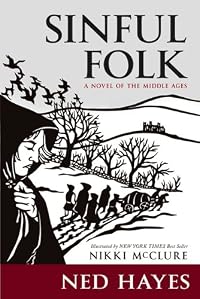
By focusing on the underclass, Hayes has given us a view of the period that doesn’t often show up in historical fiction. Nikki McClure’s contrasting paper illustrations add to the sense that we’re looking directly into the past, in a dark and foreboding version of an illuminated manuscript.
A very good mystery, Sinful Folk is also a very good historical novel. show less
Sinful Folk: A Novel of the Middle Ages by Ned Hayes (Campanile Books, $12.95), with illustrations by Nikki McClure.
On a cold winter night in 1377, several boys are burned to death in a house fire. One of them is the son of Mears, a deaf-mute man.
Except Mears is actually the disguise of a former nun, who has hidden away in this village to raise her son in peace.
The fire was not an accident, and the fathers of the dead boys—and other villagers—undertake a pilgrimage in winter and without their Lord’s permission to seek justice from the king. Not only is the mystery of how the boys died—and of why Miriam, a nun, would have a son, let alone be pretending to be a deaf-mute man in order to raise him—a show more compelling one, based on an historical incident, but the outrageousness of peasants taking it upon themselves to seek justice is a bit of a mystery as well.
Like all good pilgrimage stories—and yes, there are echoes of “The Canterbury Tales” in this, but not overly so—this one unfolds as they move through the cold and brutal rural landscape of medieval England.
By focusing on the underclass, Hayes has given us a view of the period that doesn’t often show up in historical fiction. Nikki McClure’s contrasting paper illustrations add to the sense that we’re looking directly into the past, in a dark and foreboding version of an illuminated manuscript.
A very good mystery, Sinful Folk is also a very good historical novel. show less
Ned Hayes’s Sinful Folk is based upon one of those small historical events—a tantalizing mention that goes unexplained, so the lack of a full record makes it the territory of the novelist, rather than the historian.
In this case, the mention was of a suspicious fire that killed five young men in 1377 and the decision by a group of folk from their village to travel over 200 miles in mid-winter to present the young men’s bodies to the King and demand justice.
For us, a journey of 200 miles may seem negligible: three or four hours in a car and there you are. In the 14th Century such a journey was a truly heroic undertaking for several reasons. First, those making the journey were peasants. Not the happy, well-fed, well-clothed, show more folk-dancing peasants one encounters at a present-day “medieval” fair. Real, 14th Century peasants: hungry by mid-winter, unsure whether the food they’ve stored will see them through the remaining months of cold, dressed in rags, their feet wrapped in strips of cloth with a bit of leather tied to their soles for a little more protection, illiterate all of them—except the central character, Mear—blaming witches and Jews for the misfortunes that befall them, quick to fight, accustomed to sudden injury and death. These are the people traveling 200 miles, on foot, in the snow.
In addition, at that time peasants needed sanction from their Lord or local Abbott if they wanted to undertake any sort of a journey. The villagers, as Mear reminds us partway through the narrative, “have no blessing or sanction from our Lord, Sir Peter, to be abroad upon the open road. This makes us vagabonds; any man may kill or injure us without consequence.” The territory they pass through is populated by people as poor, as hungry, and as desperate as they are. They can hope for no assistance and must constantly fear attack, theft, and murder.
The story is told in Mear’s voice, and reading it, listening to it is a genuine pleasure. Mear isn’t the 21st Century ethos in a 14th Century body that populates too much of the fiction set in this period. Mear is a man—actually woman—of the time: educated and intelligent, but with a sense of what is possible and what is right that is shaped by his—her—era and social class.
Mear, Miriam, posses as a mute man and has done so for ten years, since first arriving in the village. Over the course of the novel, we learn her life story in bits and pieces and come to understand why she’s made this choice. Mear’s story provides the primary narrative thread holding the novel together, but this novel has other narrative threads as well, including the slow process of discovering how and why the five young men died. These threads weave over and under the story of Mear’s past, creating a whole that offers both complexity and integrity.
It may sound clichéd, but I truly didn’t want this novel to end. Over and over again it provokes real thought about the characters, about human values, about the limited vision of Mear’s time and of our own. It offers immediate entertainment, but is also the sort of work that will hold up to repeated readings. I would happily spend many more hours, and many more pages, in Mear’s company.
*****
Ned Hayes’s Sinful Folk is currently available as a Kindle download via Amazon and will be released as a paperback by Campanile Press on January 22. This is an absolutely wonderful read, so let me just note that I don’t know which is the better choice: to buy the electronic copy so you can begin it now or to wait for the print edition for the pleasure of holding a physical copy of this excellent read. I read this book as an electronic ARC, but I’m planning to pre-order it in print, so I’ll have both. And I expect I’ll be making my way through the print version more than once over the next few years. show less
In this case, the mention was of a suspicious fire that killed five young men in 1377 and the decision by a group of folk from their village to travel over 200 miles in mid-winter to present the young men’s bodies to the King and demand justice.
For us, a journey of 200 miles may seem negligible: three or four hours in a car and there you are. In the 14th Century such a journey was a truly heroic undertaking for several reasons. First, those making the journey were peasants. Not the happy, well-fed, well-clothed, show more folk-dancing peasants one encounters at a present-day “medieval” fair. Real, 14th Century peasants: hungry by mid-winter, unsure whether the food they’ve stored will see them through the remaining months of cold, dressed in rags, their feet wrapped in strips of cloth with a bit of leather tied to their soles for a little more protection, illiterate all of them—except the central character, Mear—blaming witches and Jews for the misfortunes that befall them, quick to fight, accustomed to sudden injury and death. These are the people traveling 200 miles, on foot, in the snow.
In addition, at that time peasants needed sanction from their Lord or local Abbott if they wanted to undertake any sort of a journey. The villagers, as Mear reminds us partway through the narrative, “have no blessing or sanction from our Lord, Sir Peter, to be abroad upon the open road. This makes us vagabonds; any man may kill or injure us without consequence.” The territory they pass through is populated by people as poor, as hungry, and as desperate as they are. They can hope for no assistance and must constantly fear attack, theft, and murder.
The story is told in Mear’s voice, and reading it, listening to it is a genuine pleasure. Mear isn’t the 21st Century ethos in a 14th Century body that populates too much of the fiction set in this period. Mear is a man—actually woman—of the time: educated and intelligent, but with a sense of what is possible and what is right that is shaped by his—her—era and social class.
Mear, Miriam, posses as a mute man and has done so for ten years, since first arriving in the village. Over the course of the novel, we learn her life story in bits and pieces and come to understand why she’s made this choice. Mear’s story provides the primary narrative thread holding the novel together, but this novel has other narrative threads as well, including the slow process of discovering how and why the five young men died. These threads weave over and under the story of Mear’s past, creating a whole that offers both complexity and integrity.
It may sound clichéd, but I truly didn’t want this novel to end. Over and over again it provokes real thought about the characters, about human values, about the limited vision of Mear’s time and of our own. It offers immediate entertainment, but is also the sort of work that will hold up to repeated readings. I would happily spend many more hours, and many more pages, in Mear’s company.
*****
Ned Hayes’s Sinful Folk is currently available as a Kindle download via Amazon and will be released as a paperback by Campanile Press on January 22. This is an absolutely wonderful read, so let me just note that I don’t know which is the better choice: to buy the electronic copy so you can begin it now or to wait for the print edition for the pleasure of holding a physical copy of this excellent read. I read this book as an electronic ARC, but I’m planning to pre-order it in print, so I’ll have both. And I expect I’ll be making my way through the print version more than once over the next few years. show less
“I must learn to be as the bear in a cage with the stick that pokes it always, through the bars. The bear acts as if the stick is made of air, and takes no notice of it, even when it is sharpened and draws blood. I must do the same.”
This historical mystery grabbed me from the brief historical note at the beginning. Set during the reign of Richard II in 1377, the small village of Duns, England. A tragic house fire takes the lives of five young boys; but the fire is very suspicious. Why were all of the boys at the weaver's house in the night? Why were they locked in? Why did they all have precious possessions with them? Some townsfolk think that this is the work of the Jews. Seeking justice the father's of the boys decide to bring the show more bodies of their boys to the King to pass judgement. We see the treacherous 200 mile long journey on the dangerous roads through the cold winter through the eyes of Maer.
Maer is one of the best historical fiction characters I have come across. Disguised as a man and a mute since she reached the town 10 years prior with her infant son, Maer has many secrets that she must protect. I felt an instant bond to Maer's character and protective instinct. Since Maer does not speak through most of the story, the writing is mostly through Maer's inner-dialogue and conversations that she hears. This is done in a wonderful and lyrical way. The mystery unfolds slowly and we unravel stories little-by-little. Ned Hayes has definitely woven a gripping tale that will keep you intrigued the whole way through.
This book was received for free in return for an honest review. show less
This historical mystery grabbed me from the brief historical note at the beginning. Set during the reign of Richard II in 1377, the small village of Duns, England. A tragic house fire takes the lives of five young boys; but the fire is very suspicious. Why were all of the boys at the weaver's house in the night? Why were they locked in? Why did they all have precious possessions with them? Some townsfolk think that this is the work of the Jews. Seeking justice the father's of the boys decide to bring the show more bodies of their boys to the King to pass judgement. We see the treacherous 200 mile long journey on the dangerous roads through the cold winter through the eyes of Maer.
Maer is one of the best historical fiction characters I have come across. Disguised as a man and a mute since she reached the town 10 years prior with her infant son, Maer has many secrets that she must protect. I felt an instant bond to Maer's character and protective instinct. Since Maer does not speak through most of the story, the writing is mostly through Maer's inner-dialogue and conversations that she hears. This is done in a wonderful and lyrical way. The mystery unfolds slowly and we unravel stories little-by-little. Ned Hayes has definitely woven a gripping tale that will keep you intrigued the whole way through.
This book was received for free in return for an honest review. show less
Sinful Folk is one of those novels that you are not too sure of at the beginning but once you hit that 100 page mark, you are hooked. This story takes place in the 14th century and is about a woman, Mear ( Miriam Houmont) who lives as a man for over 10 years in a small village in England, raising her illegitimate son Christian. There is a fire where five boys are trapped in and die and Mear fears for her son. The door to the house is tied with rope to prevent the boys from being able to escape. What Mear fears the most has happened, her son is one of the dead boys. The father's of the boys are beside themselves and are determined to find out who the killer is, so they decide to take a journey to England and take their boys to the King show more to get justice.
The trip to London is fraught with danger from outside elements and also from the small group, because someone in the group is the murderer. The story that is told as the group does not know a killer is in their midst, is that the Jews did it even though at this time all the Jews were killed, forced to convert or driven out of England by the Crown's orders. Mear is able to keep her true identity a secret until to she needs to tell her story to save her life and those of the group as she is arrested for the murders. She is forced to 'come out' if you will, to tell her tale of the love that she had for Edward the Black Prince, brother to Richard II and tell the birthright of her son.
This story is a suspenseful medieval tale of a mother's love and her quest to find the truth not only in her personal life but the reason why the boys, including her son, were murdered in such a cruel manner. Superstitions abound as they tended to do in these early times, of witches and spells and anything the low born peasants are wont to believe. The reader who loves historical fiction will find this passionate novel, based on a true story, definitely worth a read. I highly recommend it. show less
The trip to London is fraught with danger from outside elements and also from the small group, because someone in the group is the murderer. The story that is told as the group does not know a killer is in their midst, is that the Jews did it even though at this time all the Jews were killed, forced to convert or driven out of England by the Crown's orders. Mear is able to keep her true identity a secret until to she needs to tell her story to save her life and those of the group as she is arrested for the murders. She is forced to 'come out' if you will, to tell her tale of the love that she had for Edward the Black Prince, brother to Richard II and tell the birthright of her son.
This story is a suspenseful medieval tale of a mother's love and her quest to find the truth not only in her personal life but the reason why the boys, including her son, were murdered in such a cruel manner. Superstitions abound as they tended to do in these early times, of witches and spells and anything the low born peasants are wont to believe. The reader who loves historical fiction will find this passionate novel, based on a true story, definitely worth a read. I highly recommend it. show less
In a small village during the Middle Ages, a fire has killed five boys: Breton, Stephen, Matthew, Jonathon and Christian. Christian's mother Mear has been living as a mute man for the past decade, and the village has no idea all of the secrets she hides. The only proof she has of her past is a ring she finds her son was wearing around his neck when he died-- the ring of his father.
Mear has been working for the blacksmith Salvius, who has been her friend since she and her son were found injured and desperate when Christian was but a baby. Salvius is blond, tall and handsome, and he has always taken on the role of a leader. He has also been the caretaker of the orphan boy Cole, who is known for his habits of thieving and lying.
The fire show more occurred in the home of Benedict the weaver, whose son Stephen was also killed. Some, like Breton's father Tom, wish to point to Benedict and his Jewish wife Sophia as the ones who set the fire.
Mear's good friend Liam bravely attempted to save their boys, including his own son Jonathon. Liam is a large, red-headed "layabout" woodsman, and he is the one person who can always make Mear laugh.
Counter to that is the carpenter Geoff-- the dark, brooding father of Matthew. Mear has always found Geoff somewhat distasteful. There are rumors that Geoff was molested by his father when he was a boy, and that maybe he has his father's predilections.
After the fire, these despondent parents embark on a journey to the king, along with Hob the alderman, seeking justice for their children.
During the trip, dangers abound and secrets are uncovered. We learn that Mear used to have another friend, a woman by the name of Nell. Nell took Mear in after she was brought to the village, and offered her sanctuary. But it seems some in the village may have viewed Nell as something of a witch, and she was killed some years before (and mystery surrounds her death). After all, in villages where everyone knows everyone's business, and speculates on what they don't know, people can be bitter and backbiting.
I loved this story. The characters drew me in, and the author has such a talent for putting emotion into visual pictures, to give them real substance.
The author pulled me into a tragic and engaging story, with all the sights, smells and emotions of the characters' world. It had a Gothic feel to it, and in my mind as I saw them on their journey, I envisioned a dark and desolate snow-covered woods, like something out of the north of Game of Thrones. I heard the creak of the wagon wheels and felt the cold. I heard the silence of no birds or insects making themselves known.
The characters bicker and argue on their dangerous trek, but they also fight for and care for one another.
My final word: This was my kind of book. It is a clever, interesting and touching story inspired by history, and the paranoia and persecution that surrounded those of the Jewish faith (stories were rampant that the Jewish would drink the blood of Christian children, and there are accounts of local Jews being blamed for things like fires). This story is all about facing your past. Restrained and yet absorbing, this story may be dark and barren, but it isn't bereft of hope. Don't fear. Take Mear's hand, and she'll lead you down the path of your past, through the flames, and will bring you safely to the other side-- from the darkness of your past and into the brilliance of your future. show less
Mear has been working for the blacksmith Salvius, who has been her friend since she and her son were found injured and desperate when Christian was but a baby. Salvius is blond, tall and handsome, and he has always taken on the role of a leader. He has also been the caretaker of the orphan boy Cole, who is known for his habits of thieving and lying.
The fire show more occurred in the home of Benedict the weaver, whose son Stephen was also killed. Some, like Breton's father Tom, wish to point to Benedict and his Jewish wife Sophia as the ones who set the fire.
Mear's good friend Liam bravely attempted to save their boys, including his own son Jonathon. Liam is a large, red-headed "layabout" woodsman, and he is the one person who can always make Mear laugh.
Counter to that is the carpenter Geoff-- the dark, brooding father of Matthew. Mear has always found Geoff somewhat distasteful. There are rumors that Geoff was molested by his father when he was a boy, and that maybe he has his father's predilections.
After the fire, these despondent parents embark on a journey to the king, along with Hob the alderman, seeking justice for their children.
During the trip, dangers abound and secrets are uncovered. We learn that Mear used to have another friend, a woman by the name of Nell. Nell took Mear in after she was brought to the village, and offered her sanctuary. But it seems some in the village may have viewed Nell as something of a witch, and she was killed some years before (and mystery surrounds her death). After all, in villages where everyone knows everyone's business, and speculates on what they don't know, people can be bitter and backbiting.
I loved this story. The characters drew me in, and the author has such a talent for putting emotion into visual pictures, to give them real substance.
The author pulled me into a tragic and engaging story, with all the sights, smells and emotions of the characters' world. It had a Gothic feel to it, and in my mind as I saw them on their journey, I envisioned a dark and desolate snow-covered woods, like something out of the north of Game of Thrones. I heard the creak of the wagon wheels and felt the cold. I heard the silence of no birds or insects making themselves known.
The characters bicker and argue on their dangerous trek, but they also fight for and care for one another.
My final word: This was my kind of book. It is a clever, interesting and touching story inspired by history, and the paranoia and persecution that surrounded those of the Jewish faith (stories were rampant that the Jewish would drink the blood of Christian children, and there are accounts of local Jews being blamed for things like fires). This story is all about facing your past. Restrained and yet absorbing, this story may be dark and barren, but it isn't bereft of hope. Don't fear. Take Mear's hand, and she'll lead you down the path of your past, through the flames, and will bring you safely to the other side-- from the darkness of your past and into the brilliance of your future. show less
Set in 1377, Sinful Folk follows a band of starving villagers who are pilgrimaging to court to plead for justice following the suspicious deaths of their sons. Five boys burned to death in a house, intentionally locked in by an unusual knot. The village, already facing a hard winter and impending famine, immediately suspects Jews as the culprits. The boys' bereaved fathers gather the bodies of their sons and decide to keep them unburied to let the King witness their cruel deaths.
Each villager, however, carries a dark secret with them, and on the road, beset by bloodthirsty knights and bands of murderous rogues, one twisted truth after another emerges.
The deceptively simple premise belies a more complicated novel that hit every note show more right for me: wonderful evocation of setting & era, fascinating characters, dramatic plot, and surprising historic details. The grimy, wintry feel of the landscape is a character, too: with just a hint of air conditioning, I was shivering along with our travelers, my skin crawling at the everyday reality of life for a medieval peasant.
The story is carried by Mear, mute parent to a murdered son, who has lived nearly two decades as a man in this small village after fleeing the convent where she thought her lover -- her son's father -- would come for them. As our narrator, Mear is curious, clever, and observant, her voice inviting us to experience the sadness and horror she does. (I suspect this would make a smashing audiobook for that reason!)
Despite the dark premise, the novel reads quickly, with many exciting interludes, and I found myself racing through the story. Nikki McClure, the illustrator who did the cover design, provides small illustrated elements that open every few chapters, and they're striking and interesting.
My only complaint is that the historical note was really a brief piece about Edward the Black Prince rather than a larger essay touching on the other events that occurred in the novel. While the details about Edward were interesting, I am intensely curious to learn if some of the things that befell our travelers were historically true or wholly fictional.
Recommended for fans of medieval fic as well as those who like stories of commoners (seriously, between the cold and the grime, I was esp grateful for my shower!). A great end-of-summer read, or one to save when facing a snowy weekend! show less
Each villager, however, carries a dark secret with them, and on the road, beset by bloodthirsty knights and bands of murderous rogues, one twisted truth after another emerges.
The deceptively simple premise belies a more complicated novel that hit every note show more right for me: wonderful evocation of setting & era, fascinating characters, dramatic plot, and surprising historic details. The grimy, wintry feel of the landscape is a character, too: with just a hint of air conditioning, I was shivering along with our travelers, my skin crawling at the everyday reality of life for a medieval peasant.
The story is carried by Mear, mute parent to a murdered son, who has lived nearly two decades as a man in this small village after fleeing the convent where she thought her lover -- her son's father -- would come for them. As our narrator, Mear is curious, clever, and observant, her voice inviting us to experience the sadness and horror she does. (I suspect this would make a smashing audiobook for that reason!)
Despite the dark premise, the novel reads quickly, with many exciting interludes, and I found myself racing through the story. Nikki McClure, the illustrator who did the cover design, provides small illustrated elements that open every few chapters, and they're striking and interesting.
My only complaint is that the historical note was really a brief piece about Edward the Black Prince rather than a larger essay touching on the other events that occurred in the novel. While the details about Edward were interesting, I am intensely curious to learn if some of the things that befell our travelers were historically true or wholly fictional.
Recommended for fans of medieval fic as well as those who like stories of commoners (seriously, between the cold and the grime, I was esp grateful for my shower!). A great end-of-summer read, or one to save when facing a snowy weekend! show less
Members
- Recently Added By
Author Information

6 Works 258 Members
Ned Hayes is a LibraryThing Author, an author who lists their personal library on LibraryThing.
All Editions
Some Editions
Series

Work Relationships
Contains
Common Knowledge
- Original publication date
- 2014-01-19
- Epigraph
- Pray for us, we sinful folk unstable
….
My child is dead within these two weeks
Soon after that, he went out of this town…
With many a tear trickling on our cheeks
– Geoffrey Chaucer,
T... (show all)he Canterbury Tales - Quotations
- “April comes to us, with her showers sweet. I wake to the cries of little birds before the light comes across the heath. They wait all night with open eyes. Now, with the rain at dawn, their voices make melody.
I t... (show all)urn back the reveled cloth of gold on my bed and walk to gaze beyond my glazed casement window. In the plaintive voices of the wood fowl, I imagine my mother calling to me, her words echoing across the years.”
“I remember the fire, it burns bright, always around me. I close my eyes, and tears stream out. The tides of the past seize me, bear me out to sea.”
"Every night, I slip into the empty winter land of memory."
Classifications
Statistics
- Members
- 102
- Popularity
- 315,819
- Reviews
- 21
- Rating
- (4.28)
- Languages
- English
- Media
- Paper, Ebook
- ISBNs
- 2
- ASINs
- 1