On This Page
Description
"An epic novel that spans thirty years in the lives of a farm family in Iowa, telling a parallel story of the changes taking place in America from 1920 through the early 1950s"--Provided by publisher.Tags
Recommendations

Member Reviews
"Walter Langdon hadn't walked out to check the fence along the creek for a couple of months - now that the cows were up by the barn for easier milking in the winter, he'd been putting off fence-mending - so he hadn't seen the pair of owls nesting in the big elm."
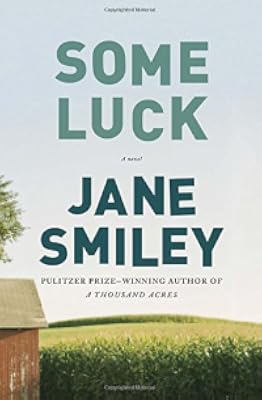
So begins [Some Luck], the first book in a trilogy about the Langdon family spanning 100 years (1920-2019). The book begins as Walter and Rosanna Langdon welcome their first child, Frankie. The Langdons are an Iowa farm family, not an easy life. As their family grows, their struggles are those of the broader world - the Great Depression, World War II, the beginning of the Cold War. With only one chapter representing each year, we drop into and out of the Langdon family's lives, show more but as with a treasured family album, the snapshots blur together to create a rich picture of this family. Each person is distinct, approaching trials and joys in unique ways. Even when they are babies, Smiley does an excellent job of helping us see the world through each of the children's eyes.
I was lucky enough to hear Jane Smiley read from this book at the Iowa City Book Festival. As she described the trilogy (which is completed - I believe the other two books will come out within the next year or so), I was struck by how ambitious this project is. This is not just an epic, capturing a century of one family's life. Instead, it is a lens, capturing a century through one family's eyes. I was sad to see this book end. I'm pretty sure that the Langdons will stay in my head until I get the chance to pick up their story in 1954. show less
So begins [Some Luck], the first book in a trilogy about the Langdon family spanning 100 years (1920-2019). The book begins as Walter and Rosanna Langdon welcome their first child, Frankie. The Langdons are an Iowa farm family, not an easy life. As their family grows, their struggles are those of the broader world - the Great Depression, World War II, the beginning of the Cold War. With only one chapter representing each year, we drop into and out of the Langdon family's lives, show more but as with a treasured family album, the snapshots blur together to create a rich picture of this family. Each person is distinct, approaching trials and joys in unique ways. Even when they are babies, Smiley does an excellent job of helping us see the world through each of the children's eyes.
I was lucky enough to hear Jane Smiley read from this book at the Iowa City Book Festival. As she described the trilogy (which is completed - I believe the other two books will come out within the next year or so), I was struck by how ambitious this project is. This is not just an epic, capturing a century of one family's life. Instead, it is a lens, capturing a century through one family's eyes. I was sad to see this book end. I'm pretty sure that the Langdons will stay in my head until I get the chance to pick up their story in 1954. show less
Some Luck tells the story of a Midwestern farming family, the Langdons, from 1920 when the first child is born, to 1953 and the death of the patriarch. It does this with one chapter a year - and I don't mean a voluminous chapter that goes through the whole year, but a snapshot from each year, in different seasons. (As the family grows and spreads out over space, the chapters get more diffuse, but the structure stays the same). So you might end a chapter with a woman meeting a man, and in the following chapter you see their married life. In this way, all the big events of the century, like the Great Depression, WWII, McCarthyism, pass by through the lens of their impact on the Langdons and their surroundings.
When I started this book, I show more didn't think the format would work, but it won me over - I felt that I had come to know them all, gently and over time, the way you might get to know a new neighbour or in-law. This is the first in a trilogy, which takes the family all the way to the present day (and in fact four years into the future, as Smiley published the last one in 2016). Although I enjoyed reading this, I don't feel a strong pull to see what the Langdons do next. That said, I do like Jane Smiley's writing so I may well find myself getting to it at some point.
Walter looked around. His work crew was revived now, and making jokes – did you hear about the farmer who won the lottery? As if there were lotteries anymore. When they asked him what he was going to do with his million dollars, reported Theo Whitehead, he said, ‘Well, I guess I’ll just farm till it’s gone.’ show less
When I started this book, I show more didn't think the format would work, but it won me over - I felt that I had come to know them all, gently and over time, the way you might get to know a new neighbour or in-law. This is the first in a trilogy, which takes the family all the way to the present day (and in fact four years into the future, as Smiley published the last one in 2016). Although I enjoyed reading this, I don't feel a strong pull to see what the Langdons do next. That said, I do like Jane Smiley's writing so I may well find myself getting to it at some point.
Walter looked around. His work crew was revived now, and making jokes – did you hear about the farmer who won the lottery? As if there were lotteries anymore. When they asked him what he was going to do with his million dollars, reported Theo Whitehead, he said, ‘Well, I guess I’ll just farm till it’s gone.’ show less
Jane Smiley's return to rural life is a steady, knowledgeable novel whose overriding sentiment is "anything can happen on a farm". In this book, it does. The central character is Frank, son of Rosanna and Walter, themselves farm children of German heritage. Frank is so intelligent and defiant that his parents and siblings are intimidated by him, especially younger brother Joe, whom Frank torments.
Running chronologically from 1920, when Rosanna and Walter marry, until the end of their union in 1953, the saga encompasses drought, wars, death, socialism, literature, horses, and, most strongly, deep family devotion.
Some Luck (what a title!) contains no blinding revelations: just this haunting quote, summing up this all-encompassing tale show more -"Corporal, here's what I learned in the war. There's nothing more haunted than a house. Beings gather there. Every house is a planet, exerting gravitational pull. Every house is in a dark wood, every house has a wicked witch in it." show less
Running chronologically from 1920, when Rosanna and Walter marry, until the end of their union in 1953, the saga encompasses drought, wars, death, socialism, literature, horses, and, most strongly, deep family devotion.
Some Luck (what a title!) contains no blinding revelations: just this haunting quote, summing up this all-encompassing tale show more -"Corporal, here's what I learned in the war. There's nothing more haunted than a house. Beings gather there. Every house is a planet, exerting gravitational pull. Every house is in a dark wood, every house has a wicked witch in it." show less
I liked this a lot—more than I thought I would when I first started it. It's very, very Midwestern, and I'm not saying that with any kind of coastal condescension. The characters, the action, the pace, all are very even and agreeable, but she somehow manages to avoid this being in any way boring. You keep waiting for some kind of flashy disaster to come, and it never does in the way you think it will. It's all matter-of-fact, but—when you pull back and look at the whole thing—quite well plotted. Even though there are a bunch of characters whose voices aren't super differentiated, I still had no trouble keeping track of them or telling who was who.
She did a neat job of it, painting a picture of a family in the first half of the show more 20th century and making it both interesting on the personal level and having it also be an un-showy American history lesson. Synecdoche, I guess. Anyway, quite enjoyable and now I'm bummed that Random House didn't send me the galley of the sequel because I want to know how everyone's doing. show less
She did a neat job of it, painting a picture of a family in the first half of the show more 20th century and making it both interesting on the personal level and having it also be an un-showy American history lesson. Synecdoche, I guess. Anyway, quite enjoyable and now I'm bummed that Random House didn't send me the galley of the sequel because I want to know how everyone's doing. show less
I'm a total sucker for this kind of daily-life anthropological fiction, with rich understanding and respect for the characters and the connections between grand social and technological changes and the way people live.
Plus, as a child of Iowa and Kansas with big opinions about how the agricultural communities were screwed and screwed themselves, it was compelling to see if play out in this story. It made me feel more connected to my ancestors, and more melancholy for the life they knew and lost.
Trilogy completion check-in: it's good. Read on.
Plus, as a child of Iowa and Kansas with big opinions about how the agricultural communities were screwed and screwed themselves, it was compelling to see if play out in this story. It made me feel more connected to my ancestors, and more melancholy for the life they knew and lost.
Trilogy completion check-in: it's good. Read on.
A compelling family saga that tiptoed into my consciousness. Jane Smiley tells the Langdon's story through the ordinary details of simple lives. The power of this novel lies in Smiley's strong characterizations. Farm life, embracing it, escaping it, surviving it, each character is fully developed. I won't soon forget this family and will look for second book in this trilogy.
For the first third of this book, it was absolutely five stars. Smiley handles the shifting point of view with expert hands, and I completely enjoyed seeing the world through the lens of each distinct personality. I especially loved reading from the perspectives of the Langdon children.
As the children got older, though, probably starting around Pearl Harbor, I found myself reading less deeply. There's a way that I read when I want to luxuriate in the world of the book and another way that just gets me through the words, and I found myself doing more of the latter in the second half of the book. I didn't follow the parts about war and politics and real estate investment and Cold War intrigue very well. I couldn't really get into that show more chunk of the book---the more modern, less farm-oriented parts---but then it got more interesting to me again, and I was just feeling like I was getting back into the five-star reading from the beginning when the book ended.
I enjoyed reading about what life might have been like for my grandparents and their parents (and for my own parents as little ones), but the thing I like best about this book is the way that, when they're young adults, the characters feel on top of things, either in control or destined to be in control of their lives, and then after a decade (or a few decades) they look around and realize that life just happened to them despite the illusion that they'd been in the driver's seat.
I find that feeling of being mere flotsam in the flow of time both comforting and terrifying. show less
As the children got older, though, probably starting around Pearl Harbor, I found myself reading less deeply. There's a way that I read when I want to luxuriate in the world of the book and another way that just gets me through the words, and I found myself doing more of the latter in the second half of the book. I didn't follow the parts about war and politics and real estate investment and Cold War intrigue very well. I couldn't really get into that show more chunk of the book---the more modern, less farm-oriented parts---but then it got more interesting to me again, and I was just feeling like I was getting back into the five-star reading from the beginning when the book ended.
I enjoyed reading about what life might have been like for my grandparents and their parents (and for my own parents as little ones), but the thing I like best about this book is the way that, when they're young adults, the characters feel on top of things, either in control or destined to be in control of their lives, and then after a decade (or a few decades) they look around and realize that life just happened to them despite the illusion that they'd been in the driver's seat.
"Normally, Rosanna took credit for everything, good and bad..., but now she thought, this was too much. She could not have created this moment, these lovely faces, these candles flickering, the flash of the silverware, the fragrances of the food hanging over the table, the heads turning this way and that, the voices murmuring and laughing...as if on cue, Walter...looked at Rosanna, and they agreed in that instant: something had created itself from nothing." (332)
I find that feeling of being mere flotsam in the flow of time both comforting and terrifying. show less
Members
- Recently Added By
Lists

Folio Prize 2015 Longlist
79 works; 2 members

Dublin Literary Award Longlist 2016
148 works; 4 members

Library List - Pulitzer Adjacent
40 works; 1 member
Author Information

50+ Works 25,571 Members
Jane Smiley was born in Los Angeles, California on September 26, 1949. She received a B. A. from Vassar College in 1971 and an M.F.A. and a Ph.D from the University of Iowa. From 1981 to 1996, she taught undergraduate and graduate creative writing workshops at Iowa State University. Her books include The Age of Grief, The Greenlanders, Moo, Horse show more Heaven, Ordinary Love and Good Will, Some Luck, and Early Warning. In 1985, she won an O. Henry Award for her short story Lily, which was published in The Atlantic Monthly. A Thousand Acres received both the National Book Critics Circle Award and the Pulitzer Prize. (Bowker Author Biography) show less
Awards and Honors
Series

Work Relationships
Common Knowledge
- Canonical title
- Some Luck
- Original publication date
- 2014
- People/Characters
- Walter Langdon; Rosanna Vogel Langdon; Rosanna Langdon; Frank Langdon; Eloise Vogel
- Important places
- Denby, Iowa
- Dedication
- This trilogy is dedicated to John Whiston, Bill Silag, Steve Mortensen, and Jack Canning, with many thanks for decades of patience, laughter, insight, information, and assistance.
- First words
- Walter Langdon hadn't walked out to check the fence along the creek for a couple of months--now that the cows were up by the barn for easier milking in the winter, he'd been putting off fence-mending--so he hadn't seen the pa... (show all)ir of owls nesting in the big elm.
Walter Langdon hadn't walked out to check the fence along the creek for a couple of months-now that the cows were up in the barn for easier milking in the winter, he'd been putting off the fence mending-so he hadn't seen the ... (show all)pair of owls nesting in the big elm. - Last words
- (Click to show. Warning: May contain spoilers.)Mama started crying and coughing, then sniffling and blowing her nose, and as long as the words were not said, Claire didn't have to react, didn't have to feel that thing that she was going to feel, that thing that was like an empty house with the windows smashed and the paint peeling and the pillars of the porch broken and the porch roof itself collapsing, which was something she had never seen, but became something she would never forget.
- Original language
- English US
Classifications
Statistics
- Members
- 1,393
- Popularity
- 17,037
- Reviews
- 83
- Rating
- (3.72)
- Languages
- English, French, Spanish
- Media
- Paper, Audiobook, Ebook
- ISBNs
- 21
- ASINs
- 6