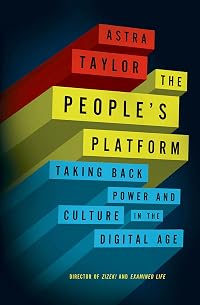
The People's Platform: Taking Back Power and Culture in the Digital Age
by Astra Taylor
On This Page
Description
From a cutting-edge cultural commentator and documentary filmmaker, this work is a bold and brilliant challenge to cherished notions of the Internet as the great democratizing force of our age. The Internet has been hailed as a place where all can be heard and everyone can participate equally. But how true is this claim? In this seminal dismantling of techno-utopian visions, the author argues that for all that we "tweet" and "like" and "share," the Internet in fact reflects and amplifies show more real-world inequities at least as much as it ameliorates them. Online, just as off-line, attention and influence largely accrue to those who already have plenty of both. What we have seen so far, she says, has been not a revolution but a rearrangement. Silicon Valley tycoons now coexist with Hollywood moguls; a handful of giants like Amazon, Apple, Google, and Facebook remain the gatekeepers. And the worst habits of the old media model, the pressure to seek easy celebrity, to be quick and sensational above all, have proliferated online, where "aggregating" the work of others is the surest way to attract eyeballs and ad revenue. When culture is "free," creative work has diminishing value and advertising fuels the system. The new order looks suspiciously like the old one. We can do better, the author insists. The online world does offer an unprecedented opportunity, but a democratic culture that supports diverse voices, work of lasting value, and equitable business practices will not appear as a consequence of technology alone. If we want the Internet to truly be a people's platform, we will have to make it so. -- From publisher's website. show lessTags
Recommendations






Member Recommendations
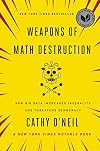
Weapons of Math Destruction: How Big Data Increases Inequality and Threatens Democracy by Cathy O'Neil
pbirch01 A similar argument but much more focused with better supporting examples.
Member Reviews
Every major advance in 20th century communications technology brought a promise of mass education, and popular control. Radio was to bring a School of the Air; trade unions owned radio stations to organize and educate on the public airwaves. It wound up being a terrific way to sell soap. Television brought Broadway to the masses, and ended up a vast wasteland. Cable was to bring public access and a low barrier to entry to create new networks dedicated to the public good. We know how that turned out. And now, the Internet.
Astra Taylor does a good job of explaining how the Internet has so much promise to democratize media and give artists, musicians and writers new ways of reaching the public, but wonders what the price of that access show more will be. When filmmakers like herself are encouraged to distribute their work for free ('it's good exposure," is the cry), you wonder whether we're creating more starving artists in the new century.
Taylor is solid in describing how the big corporations (old and new media) have again gained the upper hand in the battle for control of the Internet. Where she fails is in her offer as a solution. Her Manifesto for Sustainable Culture is more about allowing creatives the right to make a living (nothing wrong with that, BTW), less about "taking back power." That was disappointing to me. show less
Astra Taylor does a good job of explaining how the Internet has so much promise to democratize media and give artists, musicians and writers new ways of reaching the public, but wonders what the price of that access show more will be. When filmmakers like herself are encouraged to distribute their work for free ('it's good exposure," is the cry), you wonder whether we're creating more starving artists in the new century.
Taylor is solid in describing how the big corporations (old and new media) have again gained the upper hand in the battle for control of the Internet. Where she fails is in her offer as a solution. Her Manifesto for Sustainable Culture is more about allowing creatives the right to make a living (nothing wrong with that, BTW), less about "taking back power." That was disappointing to me. show less
 This review was written for LibraryThing Early Reviewers.
There's a lot to like about Astra Taylor's The People's Platorm. It's impassioned, vigorously argued, and buttressed with enough examples to satisfy even the most skeptical reader. Its central themes are articulately presented, and crucially important: We ignore them, as a society, at our peril. The new cultural economy created by the digitization of art, music, film, and text has – despite its exuberant rhetoric of democratization, transformation, and individual empowerment – replicated many of the worst inequalities of the older cultural economy it replaced, and created new ones. Artists are still exploited, voices from the margins are still silenced, and giant corporations still reap breathtaking profits (though the corporations show more are now likely to be the born-digital likes of Amazon, rather than old-media giants like NBC or Disney). Taylor documents this unhappy state of affairs, in lucid detail, over six chapters and 200 pages. As a primer on the worst features of the digital economy, it works brilliantly: an internet-age take on Engels' On the Condition of the Working Classes in England.
Interest in (and tolerance for) Taylor's approach is likely to be inversely proportional to a reader's level of immersion in what's already been written about digital culture. Genuine newcomers to these topics couldn't ask for a better book to bring them up to speed. Readers not genuinely new to the ongoing debates – for whom names like Clay Shirky, Jaron Lanier, Cory Doctorow, and Sherry Turkle ring even vague bells – will find less that is truly shocking or genuinely new to them in The People's Platform, and may be disconcerted at Taylor's conviction that wide-eyed utopian thinking about the internet is still commonplace and that she is being fresh and innovative by challenging it. People with a shelf of such books and a deep interest in the debates carried on in and around them may well be tempted, from time to time, to throw it violently across the room – frustrated with Taylor's preference for "it's awful" over "it's complicated." show less
Interest in (and tolerance for) Taylor's approach is likely to be inversely proportional to a reader's level of immersion in what's already been written about digital culture. Genuine newcomers to these topics couldn't ask for a better book to bring them up to speed. Readers not genuinely new to the ongoing debates – for whom names like Clay Shirky, Jaron Lanier, Cory Doctorow, and Sherry Turkle ring even vague bells – will find less that is truly shocking or genuinely new to them in The People's Platform, and may be disconcerted at Taylor's conviction that wide-eyed utopian thinking about the internet is still commonplace and that she is being fresh and innovative by challenging it. People with a shelf of such books and a deep interest in the debates carried on in and around them may well be tempted, from time to time, to throw it violently across the room – frustrated with Taylor's preference for "it's awful" over "it's complicated." show less
This review was written for LibraryThing Early Reviewers.The author was very involved with Occupy Wall Street and comes off as your typical angry, left-wing reactionary. But underneath that, she has some really good points about control and how free the internet really is. The book is divided into six chapters with each chapter focusing on a particular aspect of the internet. One of the chapters I really appreciated was her views on creating new culture. I really appreciated her contributions as a documentary maker because it allowed one to view both the creator and the consumer point of view. She focuses on the Matthew effect - basically the rich getting richer and she presents many solid arguments for why this is often happening online without people realizing. Ultimately, the Matthew show more effect is real and even more present in the online world as in the offline world. show less
“Free” isn’t free; professional artists need money to live; surviving on advertising hurts creative content and leads to deceptive practices; private internet companies want too much of your data and pay too little in taxes. “[T]he psychology of creativity has become increasingly useful to the economy…. The ethos of the autonomous creator has been repurposed to serve as a seductive façade for a capricious system ….” Despite the promises of democratization that wouldn’t require organization (either within or without governments), this is still and increasingly a winner-take-all system: “The term ‘platform,’ which implies a smooth surface, misleads us, obscuring the ways technology companies shape our online lives, show more prioritizing and upraising certain purposes over others.” She also argues that “free” distribution doesn’t escape commodification, especially if you’re consuming cammed copies of a blockbuster—maybe abstaining from old media’s offerings entirely would be a better way of resisting The Man. The book’s arguments are largely bettered by Evgeny Morozov, though this is an accessible argument from the left. She is sympathetic to criticisms of copyright expansionism, but she argues that open access isn’t enough without a professional class of artists. Perhaps unsurprisingly, Taylor doesn’t say much about “piracy” or about how the professional class should be supported, though at the end she suggests substantially increased state support for the arts, as they do in other countries. I couldn’t help thinking that most of the problems she discussed were really problems of inequality. Why should you have to write (even marginally successful) poetry to be entitled to a baseline income? show less
Like Lambs to the Slaughter
There is no such thing as the public internet. Everything flows through private pipes. This statement appears in the conclusion of The People’s Platform, but frames Astra Taylor’s entire book. Her chapters descend a steep curve of hucksterism that has us all in its thrall.
It is rare that I get book this clear, this well thought out and this well organized. The People’s Platform condemns Web 2.0 for making everyone a serf in the billionaires’ playground. We create content, we upload everything in our lives, we list our friends and contacts for the social media sites to exploit, and we get nothing for it, at all. We do it for the “freedom” it gives us, for the creative license it gives us, for the show more feeling of community it gives us. The massive profits from it go entirely elsewhere. And those same corporations now dispense with our services for the freebies we give them.
The Internet is a funnel. We follow our friends, their comments and their likes and end up buying what they buy or recommend. Facebook even adds our photos to our likes, so friends will know immediately it’s us and it’s true. We populate whole websites with uploaded content for free, so that giant corporations can reap the benefits of either the content or the data about us and all the people we name. A prime example is book reviews, which have certain among us slavishly reading books and analyzing them for the benefit of the site’s sales. Writing critical reviews results in negative votes, which lower the reviewer’s rank, so the successful reviews tend be rather cheery. Taylor calls it digital feudalism, where users work the digital farm and owners reap the very real profits. “Online, originality doesn’t pay; aggregation does.”
That’s just the first chapter. From there, Taylor examines the new way of life, without job security, benefits, decent pay or hope of advancement. Where contract workers are fired rather than being taken on staff. Where endebted graduates have to take unpaid internships. Where Apple employees can’t get a working wage, but Apple has $140 billion it doesn’t know what to do with. Instead, it tells employees to be grateful for living the Apple Experience.
For years, we have criticized the French for (among other things) the majority of their university graduates having the goal of working in the civil service instead of entrepreneurship. But when we look at the new way of life in the USA, that’s a pretty understandable dream.
-The long tail of the internet is a joke. The 80/20 rule is dead; even 99/1 doesn’t do justice to how much the top sites take in, both views and dollars. Efforts outside those sites are pretty much wasted. By 2008, six artists were responsible for almost half of the sixty songs that had risen to number one.
-Journalism is pretty much dead, as sites like Yahoo refuse to consider the whole, and insist that individual articles stand on their own (ie. be profitable). One department can no longer subsidize another, so overseas journalism, for example, vaporizes. The result is four times as many people working in PR as in journalism, because that’s how to get coverage on the internet. Bloggers don’t count because almost none of them do any original research. Bloggers don’t hang out at city hall.
-Advertising makes everything more expensive, produces nothing of value to society, and distorts our civilization by collecting all the money among corporations to dole out if they can see further profit in it. Things of real value get less and less funding. Job security, above minimum wages and benefits are all going away. This is particularly an American disease, as many European countries actively invest to make their cultures sustainable. In the USA, culture is disposable, surviving at the whim of the for profit sector.
-The whole concept of friend means something very different than it used to. Friends are now people you keep up with by reading, not by engaging. Actual personal relationships have given way to the necessity of building networks and personal brands and sacrificing all else for the larger numbers.
-The whole notion of the internet ushering in a new era of openness and transparency has failed. The internet is controlled by gigantic corporations pushing their brands. They own the culture through copyright laws they have purchased in Washington. They can even prevent artists from using their own works.
There are moments where Taylor lowers her standards. In the advertising chapter she asks if we could imagine Silent Spring being sponsored by Autozone. Too silly. Autozone would never sponsor Silent Spring. (Maybe the Sierra Club would.) Autozone would sponsor Cars XVI. She degrades the main point, that journalism, authorship and creativity are all caving to advertising and its restrictive covenants. Overall, The People’s Platform is a challenging condemnation of what was to be our salvation. Instead, it’s not just more of the same, it’s worse.
David Wineberg show less
There is no such thing as the public internet. Everything flows through private pipes. This statement appears in the conclusion of The People’s Platform, but frames Astra Taylor’s entire book. Her chapters descend a steep curve of hucksterism that has us all in its thrall.
It is rare that I get book this clear, this well thought out and this well organized. The People’s Platform condemns Web 2.0 for making everyone a serf in the billionaires’ playground. We create content, we upload everything in our lives, we list our friends and contacts for the social media sites to exploit, and we get nothing for it, at all. We do it for the “freedom” it gives us, for the creative license it gives us, for the show more feeling of community it gives us. The massive profits from it go entirely elsewhere. And those same corporations now dispense with our services for the freebies we give them.
The Internet is a funnel. We follow our friends, their comments and their likes and end up buying what they buy or recommend. Facebook even adds our photos to our likes, so friends will know immediately it’s us and it’s true. We populate whole websites with uploaded content for free, so that giant corporations can reap the benefits of either the content or the data about us and all the people we name. A prime example is book reviews, which have certain among us slavishly reading books and analyzing them for the benefit of the site’s sales. Writing critical reviews results in negative votes, which lower the reviewer’s rank, so the successful reviews tend be rather cheery. Taylor calls it digital feudalism, where users work the digital farm and owners reap the very real profits. “Online, originality doesn’t pay; aggregation does.”
That’s just the first chapter. From there, Taylor examines the new way of life, without job security, benefits, decent pay or hope of advancement. Where contract workers are fired rather than being taken on staff. Where endebted graduates have to take unpaid internships. Where Apple employees can’t get a working wage, but Apple has $140 billion it doesn’t know what to do with. Instead, it tells employees to be grateful for living the Apple Experience.
For years, we have criticized the French for (among other things) the majority of their university graduates having the goal of working in the civil service instead of entrepreneurship. But when we look at the new way of life in the USA, that’s a pretty understandable dream.
-The long tail of the internet is a joke. The 80/20 rule is dead; even 99/1 doesn’t do justice to how much the top sites take in, both views and dollars. Efforts outside those sites are pretty much wasted. By 2008, six artists were responsible for almost half of the sixty songs that had risen to number one.
-Journalism is pretty much dead, as sites like Yahoo refuse to consider the whole, and insist that individual articles stand on their own (ie. be profitable). One department can no longer subsidize another, so overseas journalism, for example, vaporizes. The result is four times as many people working in PR as in journalism, because that’s how to get coverage on the internet. Bloggers don’t count because almost none of them do any original research. Bloggers don’t hang out at city hall.
-Advertising makes everything more expensive, produces nothing of value to society, and distorts our civilization by collecting all the money among corporations to dole out if they can see further profit in it. Things of real value get less and less funding. Job security, above minimum wages and benefits are all going away. This is particularly an American disease, as many European countries actively invest to make their cultures sustainable. In the USA, culture is disposable, surviving at the whim of the for profit sector.
-The whole concept of friend means something very different than it used to. Friends are now people you keep up with by reading, not by engaging. Actual personal relationships have given way to the necessity of building networks and personal brands and sacrificing all else for the larger numbers.
-The whole notion of the internet ushering in a new era of openness and transparency has failed. The internet is controlled by gigantic corporations pushing their brands. They own the culture through copyright laws they have purchased in Washington. They can even prevent artists from using their own works.
There are moments where Taylor lowers her standards. In the advertising chapter she asks if we could imagine Silent Spring being sponsored by Autozone. Too silly. Autozone would never sponsor Silent Spring. (Maybe the Sierra Club would.) Autozone would sponsor Cars XVI. She degrades the main point, that journalism, authorship and creativity are all caving to advertising and its restrictive covenants. Overall, The People’s Platform is a challenging condemnation of what was to be our salvation. Instead, it’s not just more of the same, it’s worse.
David Wineberg show less
I left Facebook this February. So I've been thinking a lot about the challenges the internet introduces lately. This book is a perfect backdrop for these musings. I guess the fact that I'm even writing a review for this book on a for-profit platform is a little bit depraved or at least hypocritical.
It's a close call, but this is my favorite book that I've read this year.
Do you think the internet has changed much about the world? Astra Taylor will have you reconsider. Sure, how we do things might be changing, power and money still fall in similar distribution. If anything, the spread of the internet and digital technologies has accelerated the rise of inequality.
Has the internet broadened people's perspective? I see it as two show more populations, overlapping but diverging. On the one hand, there are people of relative privileged that can get the most out of the internet, and do. Wikipedia contributors. Americans that find white papers of the land use history of China by Chinese scholars. Commoners that get connected up with the Zapatistas. And then there's the majority of people, whose perspectives have actually narrow. They go to Fox or CNN. They scroll through their homogeneous Facebook feed. They watch a few music videos on YouTube produced by massive studios.
In a way the books a bit sneaky, because it introduces "radical" subjects like conversation on privilege though the lens of a world that everybody loves talking about: the internet!
It's phenomenally well-researched and quite well-written. I think why I like it so much is that the internet is a subject that inspires such massive amounts of enthusiasm for the future, and this book debunks the fallacy that the internet changes everything. Our conversations about what the internet is changing distract us from the more important conversations about what the internet isn't changing that really needs changing!
A few small critiques:
In section five, "The Double Anchor," Astra paints the picture that "open" is more aligned with corporate interests than that of the citizenry. She drives home the perspective that "free" actually just means that artists and creators end of making even less and that platforms instead rake in all the money. At least with the old media people had an expectation that creators be paid; with the internet we've lost that.
She starts discussing our culture around money and value. I think she begins to tread a dangerous line though. Although she mentions Unconditional Basic Income, her logic could be interpreted to prop up the perspective that people should be compensated for their skills, their attention, and their ideas. And this starts sounding awfully close to capitalism. She touches on gift culture, but doesn't get into it's potential. A large part of her critique is the fact that large corporations use the work of creatives for profit without passing along royalties or credit.
Luckily, Creative Commons has come up with a very comprehensive addition to copyright law to solve this problem! Don't want people to use your work for financial gain? Great! Put it under "NC," or noncommercial. Want attribution? Great! That's built into all CC licenses, it's called "BY." Obviously, these licenses aren't used as broadly as they're applicable. But it's not as though there aren't frameworks for intersecting with the issues Astra's highlighted.
Also, when discussing gift culture, Astra claims that most gifts focus on products, rather than production. I've been focused on the production side of gift culture for years now through models like the gift license and fellowing. Yes, these models aren't yet broadly known, but they're out there and growing. Also, scholars like David Bollier have written extensively on how commons [which focus on production], are a great alternative to the property and ownership paradigm we've been working under.
Then in the conclusion, Astra makes the call for "Sustainable Culture." Words like "regenerative" or "slow" likely much better sum up what she's trying to say. Sustainability fell out of favor in the mid-2000s for it's emphasis on stasis rather than dynamism. There's a lot to learn from movements like Transition Towns, Slow Food, Slow Money, and Regenerative Capitalism. Again, I think Astra's done a great job in summing up the dominant trends, but hasn't adequately surveyed [or reported upon] promising alternative motion.
Oh, and I love how she mentions the massive economic inefficiencies of advertising. But she doesn't drive home this fact any close to enough. She could have put an entire section into this. We'd be much better off burning the $700 billion annually that goes into advertising; it would revalue the dollar and wouldn't cause negative cultural externalities. I wrote something about this back in 2012.
I guess what I'm say is that, although Astra has comprehensively researched the "problem," her explorations into solutions is relatively limited and might make readers feel unnecessarily discouraged, at a loss for "solutions."
If you're reading this Astra, don't take my critiques personally. Think of them more as an inspiration for the sequel. And you've done a beautiful job. Getting into all the solutions probably would have made the book less of a page-turner.
In conclusion, if you use the internet, read this book. show less
It's a close call, but this is my favorite book that I've read this year.
Do you think the internet has changed much about the world? Astra Taylor will have you reconsider. Sure, how we do things might be changing, power and money still fall in similar distribution. If anything, the spread of the internet and digital technologies has accelerated the rise of inequality.
Has the internet broadened people's perspective? I see it as two show more populations, overlapping but diverging. On the one hand, there are people of relative privileged that can get the most out of the internet, and do. Wikipedia contributors. Americans that find white papers of the land use history of China by Chinese scholars. Commoners that get connected up with the Zapatistas. And then there's the majority of people, whose perspectives have actually narrow. They go to Fox or CNN. They scroll through their homogeneous Facebook feed. They watch a few music videos on YouTube produced by massive studios.
In a way the books a bit sneaky, because it introduces "radical" subjects like conversation on privilege though the lens of a world that everybody loves talking about: the internet!
It's phenomenally well-researched and quite well-written. I think why I like it so much is that the internet is a subject that inspires such massive amounts of enthusiasm for the future, and this book debunks the fallacy that the internet changes everything. Our conversations about what the internet is changing distract us from the more important conversations about what the internet isn't changing that really needs changing!
A few small critiques:
In section five, "The Double Anchor," Astra paints the picture that "open" is more aligned with corporate interests than that of the citizenry. She drives home the perspective that "free" actually just means that artists and creators end of making even less and that platforms instead rake in all the money. At least with the old media people had an expectation that creators be paid; with the internet we've lost that.
She starts discussing our culture around money and value. I think she begins to tread a dangerous line though. Although she mentions Unconditional Basic Income, her logic could be interpreted to prop up the perspective that people should be compensated for their skills, their attention, and their ideas. And this starts sounding awfully close to capitalism. She touches on gift culture, but doesn't get into it's potential. A large part of her critique is the fact that large corporations use the work of creatives for profit without passing along royalties or credit.
Luckily, Creative Commons has come up with a very comprehensive addition to copyright law to solve this problem! Don't want people to use your work for financial gain? Great! Put it under "NC," or noncommercial. Want attribution? Great! That's built into all CC licenses, it's called "BY." Obviously, these licenses aren't used as broadly as they're applicable. But it's not as though there aren't frameworks for intersecting with the issues Astra's highlighted.
Also, when discussing gift culture, Astra claims that most gifts focus on products, rather than production. I've been focused on the production side of gift culture for years now through models like the gift license and fellowing. Yes, these models aren't yet broadly known, but they're out there and growing. Also, scholars like David Bollier have written extensively on how commons [which focus on production], are a great alternative to the property and ownership paradigm we've been working under.
Then in the conclusion, Astra makes the call for "Sustainable Culture." Words like "regenerative" or "slow" likely much better sum up what she's trying to say. Sustainability fell out of favor in the mid-2000s for it's emphasis on stasis rather than dynamism. There's a lot to learn from movements like Transition Towns, Slow Food, Slow Money, and Regenerative Capitalism. Again, I think Astra's done a great job in summing up the dominant trends, but hasn't adequately surveyed [or reported upon] promising alternative motion.
Oh, and I love how she mentions the massive economic inefficiencies of advertising. But she doesn't drive home this fact any close to enough. She could have put an entire section into this. We'd be much better off burning the $700 billion annually that goes into advertising; it would revalue the dollar and wouldn't cause negative cultural externalities. I wrote something about this back in 2012.
I guess what I'm say is that, although Astra has comprehensively researched the "problem," her explorations into solutions is relatively limited and might make readers feel unnecessarily discouraged, at a loss for "solutions."
If you're reading this Astra, don't take my critiques personally. Think of them more as an inspiration for the sequel. And you've done a beautiful job. Getting into all the solutions probably would have made the book less of a page-turner.
In conclusion, if you use the internet, read this book. show less
When it comes to the production, distribution, and consumption of information, is the Internet a good thing, a bad thing, or just a different thing? In some ways, the Internet allows small producers to make a living while allowing for greater consumer choice; in other ways, it allows big producers to become ever more dominant, while quietly reducing the number of options consumers have. Everyone agrees that the Internet has dramatically changed the ways that businesses operate and content is created, yet the forces of centralization and monopolization continue to exert themselves in very familiar ways. The impact of the Internet on professions such as journalist, filmmaker, or author is extremely visible, yet it's surprisingly difficult show more to quantify exactly what happens to workers in those fields, much less find well-reasoned analyses of how to mitigate or ameliorate these tectonic shifts.
This is one of those works that's primarily negative, in that its critiques of existing attitudes towards its subject are much clearer than its "solutions". In this case, the effects that digital sharing technologies have had on existing high-tech industries have been subject to a lot of discussion but no clear proscriptions have emerged. Commentators like Clay Shirky have made lucrative careers for themselves as cheerleaders for the forces of "disruption", that ubiquitous buzzword that's usually wielded by people who aren't being disrupted - Taylor wants the reader to step back and consider the distributional impact of sharing technologies. A recurring theme is the ability of disruptive technologies to topple one existing power structure, at the (usually hidden) cost of entrenching a new one. An example is a company like Amazon and its battles with book publishers over royalties and pricing structures; who wins here - Amazon, publishers, authors, or readers? What about taxi companies vs Uber? Taylor Swift vs her record label vs Spotify? Everyone cheers when an old monopoly is toppled, but often a new monopoly is constructed, just one level off in the food chain.
The Taylor Swift analogy is probably the most relevant, since Taylor is most concerned with the economics of production. Does the existence of Spotify help or hurt Taylor Swift? Should audiences be on the side of the new distribution channels (whatever that means), the record companies, or simply the artists? Are artists like Taylor Swift better off with Spotify, traditional record labels, or some combination of the two? How about the next Taylor Swift, who is living in her shade, so to speak? The Internet famously facilitates "long tails", which allows for otherwise niche or marginal producers to find a voice and an audience. However, it also allows for network effects to exert their power as well, reinforcing the momentary ubiquity of Taylor Swift. Another famous example is the "Charlie bit my finger" video, which racked up huge numbers of hits on its way to becoming the most-viewed video of all time. This could be considered a triumph of the democratizing power of the Internet; unfortunately, for every truly viral video such as that one there are legions of more traditional corporate products, and today the list is thoroughly dominated by music videos, though "Charlie bit my finger" is still a top contender.
All of this is noteworthy. However, one prominent weakness of the book, aside from its paucity of solutions other than the expected vague outlines of motions towards copyright reform or general calls for more regulation, is that at times it feels like Taylor is just asking too much out of the Internet (a similar problem affected Tim Wu's otherwise thoughtful The Master Switch). If the Internet is just a platform, then blaming it for monopolies that use it is like blaming the ocean for the dominance of the Greek shipping industry, or blaming the electromagnetic spectrum for the Big Three TV studios in the pre-cable era. Additionally, in many ways it's hard to see how regulation, no matter how well-designed, would necessarily ameliorate the downsides of disruption - net neutrality might help companies like Netflix fight Comcast's attempts to charge it more for using so much bandwidth (and whether Netflix is actually in the right to demand that it be treated the same as anyone is of course an open question), but it doesn't help Hulu or Amazon Prime fight Netflix. Regulation is complicated, and in the case of media companies, which can simultaneously occupy several places in the chain of production and distribution, great care should be taken to avoid inadvertently stifling competition under the guise of assisting it.
Though Jean Tirole's reception of the 2014 Economics Nobel occurred after this book was published, his work on two-sided markets, particularly in the telecom field, would have given this book some more rigor. Her criticisms of claims that the Internet is inherently democratizing are on point, even if it's hard to tell from this book what the best way to resolve that issue might be. It seems like Taylor's heart is in the right place in terms of hoping for a more equitable distribution of power in these newly networked fields, but her work, though thoughtful, doesn't do much to get us there. show less
This is one of those works that's primarily negative, in that its critiques of existing attitudes towards its subject are much clearer than its "solutions". In this case, the effects that digital sharing technologies have had on existing high-tech industries have been subject to a lot of discussion but no clear proscriptions have emerged. Commentators like Clay Shirky have made lucrative careers for themselves as cheerleaders for the forces of "disruption", that ubiquitous buzzword that's usually wielded by people who aren't being disrupted - Taylor wants the reader to step back and consider the distributional impact of sharing technologies. A recurring theme is the ability of disruptive technologies to topple one existing power structure, at the (usually hidden) cost of entrenching a new one. An example is a company like Amazon and its battles with book publishers over royalties and pricing structures; who wins here - Amazon, publishers, authors, or readers? What about taxi companies vs Uber? Taylor Swift vs her record label vs Spotify? Everyone cheers when an old monopoly is toppled, but often a new monopoly is constructed, just one level off in the food chain.
The Taylor Swift analogy is probably the most relevant, since Taylor is most concerned with the economics of production. Does the existence of Spotify help or hurt Taylor Swift? Should audiences be on the side of the new distribution channels (whatever that means), the record companies, or simply the artists? Are artists like Taylor Swift better off with Spotify, traditional record labels, or some combination of the two? How about the next Taylor Swift, who is living in her shade, so to speak? The Internet famously facilitates "long tails", which allows for otherwise niche or marginal producers to find a voice and an audience. However, it also allows for network effects to exert their power as well, reinforcing the momentary ubiquity of Taylor Swift. Another famous example is the "Charlie bit my finger" video, which racked up huge numbers of hits on its way to becoming the most-viewed video of all time. This could be considered a triumph of the democratizing power of the Internet; unfortunately, for every truly viral video such as that one there are legions of more traditional corporate products, and today the list is thoroughly dominated by music videos, though "Charlie bit my finger" is still a top contender.
All of this is noteworthy. However, one prominent weakness of the book, aside from its paucity of solutions other than the expected vague outlines of motions towards copyright reform or general calls for more regulation, is that at times it feels like Taylor is just asking too much out of the Internet (a similar problem affected Tim Wu's otherwise thoughtful The Master Switch). If the Internet is just a platform, then blaming it for monopolies that use it is like blaming the ocean for the dominance of the Greek shipping industry, or blaming the electromagnetic spectrum for the Big Three TV studios in the pre-cable era. Additionally, in many ways it's hard to see how regulation, no matter how well-designed, would necessarily ameliorate the downsides of disruption - net neutrality might help companies like Netflix fight Comcast's attempts to charge it more for using so much bandwidth (and whether Netflix is actually in the right to demand that it be treated the same as anyone is of course an open question), but it doesn't help Hulu or Amazon Prime fight Netflix. Regulation is complicated, and in the case of media companies, which can simultaneously occupy several places in the chain of production and distribution, great care should be taken to avoid inadvertently stifling competition under the guise of assisting it.
Though Jean Tirole's reception of the 2014 Economics Nobel occurred after this book was published, his work on two-sided markets, particularly in the telecom field, would have given this book some more rigor. Her criticisms of claims that the Internet is inherently democratizing are on point, even if it's hard to tell from this book what the best way to resolve that issue might be. It seems like Taylor's heart is in the right place in terms of hoping for a more equitable distribution of power in these newly networked fields, but her work, though thoughtful, doesn't do much to get us there. show less
Members
- Recently Added By
Lists

The Hermenautic Bookshelf
111 works; 7 members
Author Information

10+ Works 820 Members
Astra Taylor is the author of The People's Platform (winner of the American Book Award) and made three documentary films, What Is Democracy? Zizek! and Examined Life. Taylor's writing has appeared in the New York Times, the Washington Post, n+1, and The Baffler, where she is a contributing editor. She lives in New York City.
Awards and Honors
Awards
Distinctions
Common Knowledge
- Original title
- The People's Platform : Taking Back Power and Culture in the Digital Age
Classifications
Statistics
- Members
- 218
- Popularity
- 149,790
- Reviews
- 16
- Rating
- (3.85)
- Languages
- English, French
- Media
- Paper, Ebook
- ISBNs
- 9
- ASINs
- 2