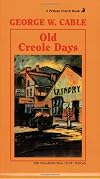
Old Creole Days
by George Washington Cable
On This Page
Description
Stories reflect Creole way of life during the transitory post-Civil War period.Tags
Recommendations
































Member Reviews
Fly in amber of a place and time. A bit hard to follow because some dialogue written in dialect. When the Creoles are speaking French to each other, it's in standard English. If they're speaking English it's written in dialect. It took me a while to be able to hear them. There is a lot here about the careful measurements of racial composition. Many plots turn on the possibility of 'mixing' occurring or having occurred. Though some witness or document usually shows up to prove it wasn't really so. Cable has been called a precursor to Faulkner. I was questioning this a minute ago, but now that I have written this...
Loving descriptions of the city. An evocative curio that's maybe not for everyone.
Loving descriptions of the city. An evocative curio that's maybe not for everyone.
$20-$100 .This is 1898 edition (1st is 1890).
En el escenario extravagante de la vieja Nueva Orleans, a fines del siglo XVIII, George Washington Cable nos cautiva con esta novela de contornos románticos y a la vez realistas. Desfilan por las páginas de este clásico de la literatura norteamericana, seres de ficción que pudieron ser reales or su convincente y auténtico color, de matices profundamente humanos: navegantes del Mississippi, tahures, caballeros y terratenientes sureños, hermosas mujeres con sangre negra, yankees desvaídos. Con el antecedente de haber sido el primer autor que se atrevió a escribir sobre la mezcla de razas, Cable, sureño él mismo, hace de este libro un documento tanto literario como histórico.
Sep 1, 2021Spanish
Ratings
Members
- Recently Added By
Lists

CCE 1000 Good Books List
1,033 works; 12 members

Trinity College Booklist (1951): Class Ten, English Literature
358 works; 5 members

Fiction (Mostly) in Selective Bibliography of American Literature 1775-1900
431 works; 3 members

Imani Perry: Eight Books That Explain the South
8 works; 1 member
Author Information

37+ Works 851 Members
Born and raised in New Orleans, in 1844, George Cable left school at age 14 and went to work to support his mother and sisters after his father's death. After serving in the Confederate Army during the Civil War, Cable worked at a variety of jobs before beginning to write. Attracted to certain aspects of Creole life, he was anxious to record this show more life before it entirely disappeared. His sympathies, however, did not extend to what he considered certain moral weaknesses in Creole civilization, particularly in its treatment of African Americans. As time went on, Cable began to speak out ever more openly on racial injustices in Louisiana and in the South generally. This brought a great deal of bitter criticism from fellow southerners and ultimately resulted in his moving to Massachusetts. His most explicit fictional treatment of racial injustice is probably John March: Southerner (1894), which he set in northern Alabama rather than Louisiana to emphasize the regional aspect of the racial problem. He also gave speeches, wrote letters to editors, and published articles on the problems of African-Americans in the South. Cable is especially well known for his stories about Creole life. His most successful literary work is The Grandissimes (1880), which has been compared in power and scope to the fiction of William Faulkner. The novel is somewhat marred by obvious editorializing and some wooden characterization, but it contains powerful scenes and deals with racial injustice, a subject all but taboo in the fiction of the time. Guy A. Cardwell has argued convincingly that Cable significantly altered Mark Twain's racial views when the two men were on a lecture tour together. Cable's treatment of race foreshadowed the work of such later Southern writers as Faulkner and Robert Penn Warren. Cable died in 1925. (Bowker Author Biography) show less
All Editions
Some Editions
Awards and Honors
Series
Belongs to Publisher Series
Work Relationships
Is contained in
Common Knowledge
- Canonical title
- Old Creole Days
- Original publication date
- 1879
- Important places
- New Orleans, Louisiana, USA
- First words
- A few steps from the St. Charles Hotel, in New Orleans, brings you to and across Canal Street, the central avenue of the city, and to that corner where the flower-women sit at the inner and outer edges of the arcaded sidewalk... (show all), and make the air sweet with their fragrant merchandise.
- Last words
- (Click to show. Warning: May contain spoilers.)Madame Delicieuse, for almost the first time in her life, and Dr. Mossy for the thousandth--blushed.
It was the odor of orange-blossoms.
Classifications
Statistics
- Members
- 190
- Popularity
- 171,935
- Reviews
- 3
- Rating
- (4.00)
- Languages
- English
- Media
- Paper, Ebook
- ISBNs
- 33
- ASINs
- 21