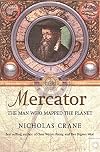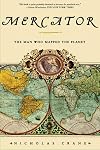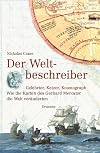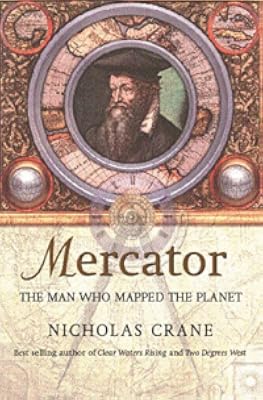
Mercator: The Man Who Mapped the Planet
by Nicholas Crane
On This Page
Description
An enthralling biography of the man who created the first real map of the world and changed civilization Born at the dawn of the age of discovery, Gerhard Mercator lived in an era of formidable intellectual and scientific advances. At the center of these developments were the cartographers who painstakingly pieced together the evidence to create ever more accurate pictures of the planet. Mercator was the greatest of all of them-a poor farm boy who attended one of Europe's top universities, show more was persecuted and imprisoned by the Inquisition, but survived to coin the term "atlas" and to produce the so-called projection for which he is known. Devoutly religious, yet gripped by Aristotelian science, Mercator struggled to reconcile the two, a conflict mirrored by the growing clash in Europe between humanism and the Church. Mercator solved the dimensional riddle that had vexed cosmographers for so long: How could the three-dimensional globe be converted into a two-dimensional map while retaining true compass bearings' The projection revolutionized navigation and has become the most common worldview. Nicholas Crane-a fellow geographer-has combined a keen eye for historical detail with a gift for vivid storytelling to produce a masterful biography of the man who mapped the planet. show lessTags
Recommendations









Member Recommendations
Member Reviews
I really enjoyed this book. The author presented a solid overview of Mercator's life. Additionally, the influences that were involved in Mercator's work (religious, political, etc.) were well examined, as well as the advances in technology and difficulties encountered in cartography and mapmaking. Additionally, the writing style was very engaging. Definitely worth reading.
What a good book. More than simply a biography of Mercator, but also a history of the Low Countries, its Renaissance and cartography. In a way it has to be, as Mercator was rather a passive figure and a quiet family man; and his letters from the first half of his life appear to have been destroyed to protect the innocent when he was imprisoned. A very useful approach for someone like me though, who really knows nothing about the Low Countries or their history. This book is very much in the style of popular non-fiction, but is the product of real scholarship. The breadth of Crane’s references are really quite amazing. In places the information comes so thick and fast you’ll have to wait until after breakfast. I learnt loads. I’ve show more read a few popular-style books on mapping over the years but stopped as they all seem to regurgitate the same information. This book does not and really stands apart. show less
An excellent book about Gerard Mercator, the father of modern map making. Or, how do you make a three dimensional globe fit on a two dimensional map. Without his grid system, GIS specialists would have a much harder time on the job....
The book is well researched, very interesting, and discusses the extreme changes of religion, personal freedom, and the role of kingdoms that is the background of Mercator's Life.
Mercator is an interesting person - born to a peasant family with the patriarch working as a shoe maker, Mercator manages to eke out an education when his uncle the priest sponsors him to the local college. After graduating, Mercator starts on the path that sets him up as a famous geographer - learning surveying, map making, and show more consolidating sources to create the most accurate maps of the time.
Overall, this dense book portrayed a man who lived an amazing life. Fully researched, with a strong background in the politics of this world. Not only do I know more about Mercator's life, but just want it meant to be living in world where Protestantism (and free thinking) was just starting.
One thing I would change is to place the different illustrations and figures in context with the narrative. It's hard to understand the maps and reasoning when the examples are all clumped together. show less
The book is well researched, very interesting, and discusses the extreme changes of religion, personal freedom, and the role of kingdoms that is the background of Mercator's Life.
Mercator is an interesting person - born to a peasant family with the patriarch working as a shoe maker, Mercator manages to eke out an education when his uncle the priest sponsors him to the local college. After graduating, Mercator starts on the path that sets him up as a famous geographer - learning surveying, map making, and show more consolidating sources to create the most accurate maps of the time.
Overall, this dense book portrayed a man who lived an amazing life. Fully researched, with a strong background in the politics of this world. Not only do I know more about Mercator's life, but just want it meant to be living in world where Protestantism (and free thinking) was just starting.
One thing I would change is to place the different illustrations and figures in context with the narrative. It's hard to understand the maps and reasoning when the examples are all clumped together. show less
I don't think it's maybe the best written book, but some of that is obviously down to the paucity of material about the man himself and to an extent the period. I'd have preferred a bit more detail on the maps (and globes) themselves and why they were so revolutionary rather than lists of people who were present at some event, but none-the-less it was worth the read to get a better feeling for the revolutionary times Mercator was living in and the impact he and his fellows had.
Crane's definitive biography of Gerard Kremer -- the man who would later become Gerard Mercator -- is breathtaking in its scholarship. While the early years are filled with "may haves" and "could have beens," once he becomes a scholar, his history lights up with excitement. Even though Mercator never left Northern Europe, he invented italic script, met the great humanists of the day, and mapped the world twice over. He collated and synthesized every ancient text and every map as well as created a now-universal projection system for cartography. This biography is a must-read.
A good book that places the cartographer in relation to some of the religious and political questions of his time. The reader also gets some insights on Exploration and the book trade of the sixteenth century. Sadly there is not a colour reproduction of Mercator's final world map...but I guess that's hard to come by. But I wish you all would read this book, for it is a considerable achievement.
A biography of the man who gave to the world of cartography the Atlas and the Mercator Projection. Crane sets the story amid the chaos of reformation Europe and the news from explorers of a growing world. Despite all that, the book is rather dry and Crane seems to stretch to make Mercator a heroic man of his era. I really had to struggle to complete it, but I suppose I’m a better man for it.
Members
- Recently Added By
Published Reviews
The great sixteenth-century cartographers, of whom Mercator would become the greatest, required two very different skills. They had to be able to garner, assimilate, adjudge and co-ordinate the geographical information provided by explorers and sailors who frequented the margins of the known. They also had to be able to imagine themselves suspended in the air, to achieve the visionary show more perspective of gods, gazing down on to the world from the amplitudes of heaven.
Mercator's name is most familiar to us because of the Mercator Projection: the solution he devised to represent the spheroidal surface of the globe on a two-dimensional plane. It is less well known that Mercator was the first man to conceive of mapping the entire surface of the planet or that he pioneered the idea of presenting multiple maps in bound books, to which he gave the name 'Atlas'. show less
Mercator's name is most familiar to us because of the Mercator Projection: the solution he devised to represent the spheroidal surface of the globe on a two-dimensional plane. It is less well known that Mercator was the first man to conceive of mapping the entire surface of the planet or that he pioneered the idea of presenting multiple maps in bound books, to which he gave the name 'Atlas'. show less
added by John_Vaughan
Author Information

45+ Works 1,537 Members
Nicholas Crane is a geographer and adventurer. He lives in London.
Some Editions
Common Knowledge
- Canonical title
- Mercator: The Man Who Mapped the Planet
- Original title
- Mercator: The Man Who Mapped the Planet
- Alternate titles*
- Mercator : de man die de aarde in kaart bracht
- Original publication date
- 2002 (Engels) (Engels); 2003 (Nederlands) (Nederlands)
- People/Characters
- Gerardus Mercator
- Important places*
- Rupelmonde
- Important events
- Development of the Mercator projection
- Dedication
- To Annabel, and to Imogen, Kit and Connie, with love.
- First words
- In the summer of 1511, Emerentia Kremer fell pregnant and the harvest failed.
- Last words
- (Click to show. Warning: May contain spoilers.)May the Lord', concluded Mercator's friend and future biographer, ' grant him a joyful resurrection on the Day of Judgement.'"
- Original language*
- Engels
*Some information comes from Common Knowledge in other languages. Click "Edit" for more information.
Classifications
- Genres
- Nonfiction, History, Biography & Memoir, General Nonfiction
- DDC/MDS
- 526.092 — Natural sciences & mathematics Astronomy Mathematical geography History, geographic treatment, biography Biography
- LCC
- GA923.5 .M5 .C73 — Geography, Anthropology and Recreation Mathematical geography. Cartography Mathematical geography. Cartography Cartography Maps. By region or country
- BISAC
Statistics
- Members
- 510
- Popularity
- 58,717
- Reviews
- 14
- Rating
- (3.38)
- Languages
- Dutch, English, German
- Media
- Paper, Ebook
- ISBNs
- 7
- ASINs
- 9