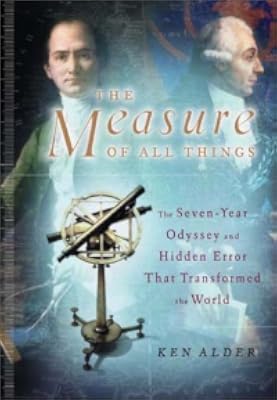
The Measure of All Things: The Seven-Year Odyssey and Hidden Error That Transformed the World
by Ken Alder
On This Page
Description
In June 1792, the erudite and cosmopolitan Jean-Baptiste-Joseph Delambre and the cautious and scrupulous Pierre-Francois-Andre Mechain set out from Paris -- one north to Dunkirk, the other south to Barcelona to calculate the length of the meter. In the face of death threats from village revolutionary councils, superstitious peasants, and civil war, they had only their wits and their letters to each other for support. Their findings would be used to create what we now know as the metric show more system. Despite their painstaking and Herculean efforts, Mechain made a mistake in his calculations that he covered up. The guilty knowledge of his error drove him to the brink of madness, and in the end, he died in an attempt to correct himself. Only then was his mistake discovered. Delambre decided to seal all evidence of the error in a vault at the Paris Observatory. Two hundred year later, historian Ken Alder discovered the truth. With scintillating prose and wry wit, Alder uses these previously overlooked letters, diaries, and journals to bring to life a remarkable time when everything was open to question and the light of reason made every dream seem possible. show lessTags
Recommendations






































Member Recommendations


John_Vaughan The French attempt at defining meridian and metric measurement.
Member Reviews
I asked for this book because I wanted to learn more about the development of the metric system and found so much more in it.
Other than the herculean effort it took to try and "measure" a portion of a meridian, it was the story of Méchain's struggles that helped me get a better understanding of the origin of the scientific concept of "precision". He couldn't understand why repeat measurements would yield different results and died thinking he had committed a serious scientific error that he was ashamed to reveal.
Other than the herculean effort it took to try and "measure" a portion of a meridian, it was the story of Méchain's struggles that helped me get a better understanding of the origin of the scientific concept of "precision". He couldn't understand why repeat measurements would yield different results and died thinking he had committed a serious scientific error that he was ashamed to reveal.
I have always believed in the paradox of formal systems. The accuracy of any measurement can only go so far no matter how perfect we think the system is. With the latest news of the deteriorating condition of the "official' kilogram which rots away in some shed in France, this book seems all the more timely. The metric system is flawed, but not by paradox; it is due to human error. Alder writes an excellent account of how this mistake happened and what its ramifications were and are.
Alder, an associate professor of history, has written a very interesting book about the establishment of the the metric system. It did, however, take me a while to get into the book because I began it in a very start and stop manner and because I knew very little about the early days of the French Revolution. This made following events as Alder told them a little confusing and I had to backtrack a bit each time I picked up the book. About a third of the way through the book caught me and the rest went relatively rapidly.
Being familiar with the metric system (I'm American and still deal in feet, pounds, and gallons in everyday life but had to become fluent in metric when studying math, physics, etc.) was helpful but Alder raised a lot of show more issues surrounding people's resistance to adopting new standards that I had not thought about previously.
A great deal of the book concerns the political reasons behind establishing a new system of measurement in France and the political reasons that made it extraordinarily difficult. Every new group that came into power in Paris threatened the completion of the project. Just trying to travel in the early days of the Revolution was fraught with peril with both Delambre and Mechain being detained at various times. They both found themselves in warzones, suspected of being spies, sorcerers, and enemies of whichever locals they had to deal with. The weather was often uncooperative, France underwent a period of hyperinflation which played havoc with their funding, and the Academy was abolished so that their mission was in danger of being cancelled altogether.
Then there was Mechain's tendency to melancholia, the accident which undermined his physical health, and the 'error' whose contemplation caused him extreme mental agony and led to his fudging the data he eventually reported to his colleagues in Paris. The geodesic data collected by the two teams did in time lead to a better understanding of the difference between accuracy and precision and just what constitutes error. Indeed, the analysis of this data years later by Legendre and Gauss led to the development of modern statistics.
All in all, I was pleased with Alder's book on a fascinating piece of scientific history. show less
Being familiar with the metric system (I'm American and still deal in feet, pounds, and gallons in everyday life but had to become fluent in metric when studying math, physics, etc.) was helpful but Alder raised a lot of show more issues surrounding people's resistance to adopting new standards that I had not thought about previously.
A great deal of the book concerns the political reasons behind establishing a new system of measurement in France and the political reasons that made it extraordinarily difficult. Every new group that came into power in Paris threatened the completion of the project. Just trying to travel in the early days of the Revolution was fraught with peril with both Delambre and Mechain being detained at various times. They both found themselves in warzones, suspected of being spies, sorcerers, and enemies of whichever locals they had to deal with. The weather was often uncooperative, France underwent a period of hyperinflation which played havoc with their funding, and the Academy was abolished so that their mission was in danger of being cancelled altogether.
Then there was Mechain's tendency to melancholia, the accident which undermined his physical health, and the 'error' whose contemplation caused him extreme mental agony and led to his fudging the data he eventually reported to his colleagues in Paris. The geodesic data collected by the two teams did in time lead to a better understanding of the difference between accuracy and precision and just what constitutes error. Indeed, the analysis of this data years later by Legendre and Gauss led to the development of modern statistics.
All in all, I was pleased with Alder's book on a fascinating piece of scientific history. show less
4967. The Measure of All Things The Seven-Year Odyssey and Hidden Error That Transformed the World, by Ken Alder (read 14 Oct 2012) This book examines in great detail the genesis of the metric system in France in the 1790's. I thought the explanation of the tools and methods used by the French savants who generated the data used to create the meter could have been explained better, and also thought the importance ot the error could have been better explained. But I presume a scientist would find the account fully adequate. I did not find the book of great interest till it reached the history of the metric system and its adoption--eventually by all the countries of the world except Yemen, Liberia, and the United States. Maybe the Tea show more Party will lead this country to get in sync with the rest of the world? show less
A friend recommended this book and so I had high hopes for it, but this book started out with a bang and ended with a whimper. There is lots of history here but somehow it got more boring towards the end. Perhaps it should have been shorter. I would have liked to have more information on how Delambre covered up the errors and how he managed to keep others from discovering the error. I was also left with the question that if it was such a grave error why didn't it cause major problems? If the error was so huge why didn't it result in the junking of the metric system?
This is the true story of two French scientists who triangulated their way up and down the meridian crossing France - during the French Revolution, no less - in order to determine a precise length for the meter. The author, in researching all of this, discovered that not only was there an error in their measurements - rather than being a set one ten-millionth of the distance from the equator to the North Pole, the first meter was about 200 micrometers too short to meet that definition - but that they had known about it and covered it up. This should be a fascinating book, but to be honest, it was dry almost to the point of being unreadable. I kept having to go back and reread paragraphs over and over again. Finally, a few chapters in, I show more gave up. show less
As the Revolution raged, two astronomers were sent to determine the length of the meridian passing through Paris, from Dunkerque in the north to Barcelona, Spain, in the south. That figure, in turn, would be used to determine the length of the meter, a new measure of length that would, in turn, be used to establish an entire system of weights and measures—the metric system.
Both expeditions ran into problems from their onset—the weather, ignorant peasants, angry revolutionaries, approaching armies, disease, and the land itself. But Mechain’s measurements were undermined further by his own personality, his insistence on precision leading him into a significant error and an attempt to cover up that error.
Alder not only covers the show more details of expeditions, but also the politics surrounding the quest to establish a new measurement standard and the efforts required to get them adopted by France and other nations. The book is well written and a great read. If you ever wondered about the origins of the metric system, Alder’s book is a great place to start. show less
Both expeditions ran into problems from their onset—the weather, ignorant peasants, angry revolutionaries, approaching armies, disease, and the land itself. But Mechain’s measurements were undermined further by his own personality, his insistence on precision leading him into a significant error and an attempt to cover up that error.
Alder not only covers the show more details of expeditions, but also the politics surrounding the quest to establish a new measurement standard and the efforts required to get them adopted by France and other nations. The book is well written and a great read. If you ever wondered about the origins of the metric system, Alder’s book is a great place to start. show less
Members
- Recently Added By
Published Reviews
The Measure of All Things is one of the finest narrative histories I have ever read. It is beautifully written throughout, endlessly informative and meticulously documented. . . The result of this diligence, and Alder's brilliance as a writer, is a book which thrills at every level. It is at once a historical detective story, a marvellous demonstration of how science and its social context show more animate one another, a human drama of the highest order and a parable which proves that - as Protagoras put it 25 centuries ago - 'man is the measure of all things'. show less
added by mysterymax
Author Information

4 Works 1,185 Members
Ken Alder is an associate professor of history at Northwestern University and holds a Ph.D. from Harvard. A novelist and an avid bicyclist, he has biked Delambre and Mechain's entire route. His first book, Engineering the Revolution, won the 1998 Dexter Prize for the best book on the history of technology. He lives in Evanston, Illinois
Some Editions
Awards and Honors
Common Knowledge
- Original title
- The Measure of All Things
- Original publication date
- 2002
- People/Characters
- Jean Baptiste Joseph Delambre (1749-1822); Pierre Méchain (1744-1804)
- Epigraph
- Fabrice showed them his passport indicating he was a barometer salesman travelling with his wares. "This goes too far!" - Stendhal, The Charterhouse of Parma
- Dedication
- For Bronwyn and Madeline
It is the star to every wandering bark,
Whose worth's unknown, although his height be taken. - First words*
- En juin 1792, alors que la monarchie française vivait ses derniers jours et que la Terre commençait à tourner autour du nouvel axe de l'égalité révolutionnaire, deux astronomes partaient dans des directions opposées, d... (show all)ans une quête extraordinaire.
- Blurbers
- Brands, H. W.; Cantor, Norman; Tenner, Edward; Kruzweil, Allen; Lightman, Alan
*Some information comes from Common Knowledge in other languages. Click "Edit" for more information.
Classifications
Statistics
- Members
- 1,083
- Popularity
- 23,737
- Reviews
- 19
- Rating
- (3.77)
- Languages
- 10 — Dutch, English, French, German, Hebrew, Italian, Norwegian (Bokmål), Spanish, Swedish, Portuguese (Portugal)
- Media
- Paper, Audiobook, Ebook
- ISBNs
- 24
- ASINs
- 5