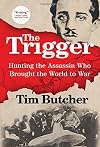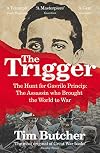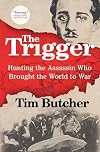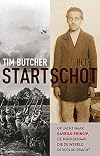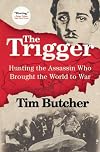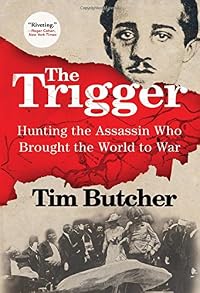
The Trigger: Hunting the Assassin Who Brought the World to War
by Tim Butcher
On This Page
Description
"On a summer morning in Sarajevo almost a hundred years ago, a teenager took a pistol out of his pocket and fired not just the opening rounds of the First World War but the starting gun for modern history. By killing Archduke Franz Ferdinand, the heir of the Austro-Hungarian Empire, Gavrilo Princip started a cycle of events that would leave 15 million dead from fighting between 1914 and 1918 and proved fatal for empires and a way of ruling that had held for centuries."--Publisher's description.Tags
Recommendations



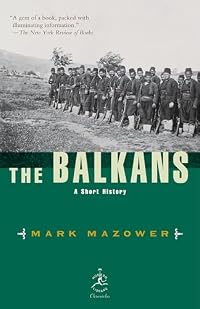
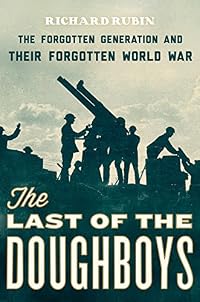
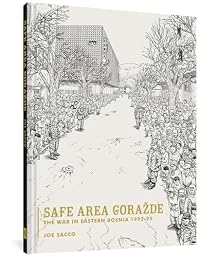
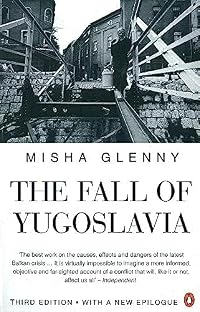


Member Recommendations
Member Reviews
I read this after returning from a trip to the Balkans. It certainly helps to make sense of a very complicated part of the world. Not only does Tim Butcher tread in the footsteps of the man who 'started' WW1 when he assassinated Archduke Franz Ferdinand in Sarajevo in June 1914, but he looks back into his own past as a fledgling reporter during the Balkan War of the 1990s. He expertly weaves together these two events with great insight and like every good historian goes back to the original sources where he finds them. His humanity leaps off the page and to cap it all, he has a wonderful writing style.
This book is equal parts biography, memoir, history, and travelogue. Tim Butcher travels Gavrilo Princip’s path from a small village in Herzegovina to Sarajevo to Belgrade and back to Sarajevo, where Princip fired the shots that took the life of Archduke Franz Ferdinand and his wife in 1914. This act is often cited as the spark than launched the Great War. During Butcher’s trek, he recalls his time as a journalist reporting on the Bosnian War in the 1990s. Covering Bosnian history from three timelines, 1910s, 1990s, and present day, and filling in the historical context, is an effective way to provide the big picture.
Butcher tracks the development of Princip from childhood to gifted student to assassin. He discovers a stone slab on show more which Princip had carved his initials, his school records, and evidence of his increasing involvement in political causes. Butch portrays Princip’s motivation to free the South-Slavs from rule by Austria-Hungary. Since Princip lived only 23 years, over a hundred years ago, the primary source material is limited, but Butcher has managed to craft these nuggets into a storyline that is easy to follow and provides a wealth of information. If you are interested in the history of Bosnia/Herzegovina or WWI, this is a great one to pick up. show less
Butcher tracks the development of Princip from childhood to gifted student to assassin. He discovers a stone slab on show more which Princip had carved his initials, his school records, and evidence of his increasing involvement in political causes. Butch portrays Princip’s motivation to free the South-Slavs from rule by Austria-Hungary. Since Princip lived only 23 years, over a hundred years ago, the primary source material is limited, but Butcher has managed to craft these nuggets into a storyline that is easy to follow and provides a wealth of information. If you are interested in the history of Bosnia/Herzegovina or WWI, this is a great one to pick up. show less
This book really affected me. It's written by a British journalist who decides to follow the footsteps--literally--of Gavrilo Princip from his boyhood home to his assassination of Archduke Ferdinand. He hikes across the country writing part travelogue, part history book. To add another layer, he had been in Bosnia during the Bosnian War in the 1990s, so he's also telling the story of his time there--and there are a few stories of WWII thrown in for good measure. Really fascinating.
It's a scary book, too, though because you see how little it takes before next door neighbors are sending bullets through each others' doors. People don't realize how easy it is to blow everything up.
It's a scary book, too, though because you see how little it takes before next door neighbors are sending bullets through each others' doors. People don't realize how easy it is to blow everything up.
This book is equal parts biography, memoir, history, and travelogue. Tim Butcher travels Gavrilo Princip’s path from a small village in Herzegovina to Sarajevo to Belgrade and back to Sarajevo, where Princip fired the shots that took the life of Archduke Franz Ferdinand and his wife in 1914. This act is often cited as the spark than launched the Great War. During Butcher’s trek, he recalls his time as a journalist reporting on the Bosnian War in the 1990s. Covering Bosnian history from three timelines, 1910s, 1990s, and present day, and filling in the historical context, is an effective way to provide the big picture.
Butcher tracks the development of Princip from childhood to gifted student to assassin. He discovers a stone slab on show more which Princip had carved his initials, his school records, and evidence of his increasing involvement in political causes. Butch portrays Princip’s motivation to free the South-Slavs from rule by Austria-Hungary. Since Princip lived only 23 years, over a hundred years ago, the primary source material is limited, but Butcher has managed to craft these nuggets into a storyline that is easy to follow and provides a wealth of information. If you are interested in the history of Bosnia/Herzegovina or WWI, this is a great one to pick up. show less
Butcher tracks the development of Princip from childhood to gifted student to assassin. He discovers a stone slab on show more which Princip had carved his initials, his school records, and evidence of his increasing involvement in political causes. Butch portrays Princip’s motivation to free the South-Slavs from rule by Austria-Hungary. Since Princip lived only 23 years, over a hundred years ago, the primary source material is limited, but Butcher has managed to craft these nuggets into a storyline that is easy to follow and provides a wealth of information. If you are interested in the history of Bosnia/Herzegovina or WWI, this is a great one to pick up. show less
I really liked this book! It developed into a saga I had not expected. Not only does the author cover the life and times of Gavrilo Princip, he also deals with the geography of the Balkans, some of its politics, its history. In a relatively short book the author adequately covers a great deal of ground. Of particular interest to me is the evolution of Princip's political views and philosophy. I will not spoil the book, but suffice to say Princip's ultimate goals were shown not to what I had believed after reading many books on the origins of WWI.
Tim Butcher does an outstanding of job of walking us through the growth and motivation for Princip in the assassination in June, 1914. Very much worth the read.
Tim Butcher does an outstanding of job of walking us through the growth and motivation for Princip in the assassination in June, 1914. Very much worth the read.
“The Trigger: Hunting the Assassin Who Brought the World to War”
by Tim Butcher
BIBLIOGRAPHIC DETAILS:
-Print: COPYRIGHT ©: 3 Jun 2014; ISBN: 978-0-8021-2325-1; PUBLISHER: Grove Press; PAGES: 352 pages; UNABRIDGED (Hardcover Info from Grove Atlantic https://groveatlantic.com/book/the-trigger/ ) [I didn’t see inside the printed version, so can only assume that it, like the digital version, has photographs, notes, bibliography, links, and index.]
-Digital: COPYRIGHT ©: 2 Jun 2014; eISBN 9780802191885; PUBLISHER: Grove Press; PAGES: 327 pages; ILLUSTRATED: Photographs; INCLUDES: Notes, Bibliography, Links, Index; UNABRIDGED (Digital Info from Libby app and downloaded eBoook)
-*Audio: COPYRIGHT ©: 12 Jun 2014; ISBN: Not found; show more PUBLISHER: Tantor Media, Inc.; DURATION: 10 hours; Unabridged; (Audiobook Info from Tantor.com https://tantor.com/the-trigger-tim-butcher.html )
-Feature Film or tv: No.
SERIES: No
SUMMARY/ EVALUATION:
-SELECTED: I can’t recall how I ran into this one, but the cover told me it would be about the assassin of Franz Ferdinand, and I did want to know more about the incident and it’s consequences.
-ABOUT: “The Trigger tells the story of a young man who changed the world forever. It focuses on the drama of the incident itself by following Prin[c]ip’s journey. By retracing his steps from the feudal frontier village of his birth, through the mountains of the northern Balkans to the great plain city of Belgrade and ultimately Sarajevo, Tim Butcher illuminates our understanding of Princip—the person and the place that shaped him—and makes discoveries about him that have eluded historians for a hundred years. Traveling through the Balkans on Princip’s trail, and drawing on his own experiences there as a war reporter during the 1990s, Butcher unravels this complex part of the world and its conflicts, and shows.” –From Grove Atlantic Publishers.
-OVERALL OPINION: This author was a journalist, covering the Balkans for the "Daily Telegraph" in the 1990’s. I always trust journalists from prominent publications to write something interesting and write it well. I was not disappointed.
I loved the first-person memoir approach of Tim’s journey, first with a talented translator (Arnie Hecimovic, whom Tim knew and trusted from his Bosnian war years of the '90’s, who’d learned English through the lyrics of such bands as The Clash) and then, hiking on his own. He traces the route (always dangerous with its share of wild animals such as bears and multiple clashing ethnicities and religious groups, and then made more so since the 90’s by the planting of numerous landmines) that the Bosnian Serb, Gavrilo Princip, made from his homeland of Obljaj to Sarajevo, where he planned to free Bosnia from foreign rule by shooting Archduke Franz Ferdinand, the heir to the Habsburg Empire, during Franz’s announced visit to Sarajevo.
Tim also visited Balkan towns and cities where Gavrilo worked and studied.
The book was quite informative and fascinating, and left me all the more curious as to everything involved in the domino effect of the consequences.
AUTHOR:
Tim Butcher:
“Tim Butcher worked for the Daily Telegraph from 1990 to 2009 as chief war correspondent, Africa bureau chief, and Middle East correspondent. His first book, Blood River, was a number-one bestseller in the UK and was shortlisted for the Samuel Johnson Prize. He lives in Cape Town. “ __From Grove Atlantic.
“Tim Butcher (born 15 November 1967) is an English author, broadcaster and journalist. He is the author of Blood River (2007), Chasing the Devil (2010) and The Trigger (2014), travel books blending contemporary adventure with history.” __Excerpt from Wikipedia
NARRATOR:
Gerard Doyle
“"Narrator Gerard Doyle performs this work as if he has an intimate knowledge of its content, leaving little doubt that he and the author are of like mind." ---AudioFile
“Gerard Doyle is an English actor and audiobook narrator. He has won 1 Audie Award and 35 Earphone Awards. AudioFile named him a Golden Voice Narrator.[1]
Doyle was born to Irish parents and was born and raised in England.[2]
He presently lives with his wife and two children in Sag Harbor, New York.[2]
Aside from narrating audiobooks, Doyle teaches theatre at a private school.[3] “ __From Wikipedia
**ME: I found Gerard to be an excellent narrator.
GENRE:
Nonfiction; Biography; Autobiography; History
TIME FRAME:
20th Century
SUBJECTS: (not comprehensive)
Austria; Hungary; Military; 20th Century U.S. History; World War I; German History; Eastern Europe; General Europe; Austria & Hungary; Travel; Contemporary; Wars and Conflicts; Balkan States – History; Politics; Gavrilo Princip
DEDICATION:
"For my greatest shapers Stanley and Lisette"
SAMPLE QUOTATION:
Excerpt from Chapter 1: “Fresh Flotsam”
“In other wars more people have died, more nations been involved and the world brought closer to annihilation, but somehow the First World War retains a dread aura all of its own. The guns fell silent all those years ago, but like a refrain that stays with the audience long after the music stops, the First World War has a returning power. So monumental was the suffering, so far-reaching the influence on history that the war still generates reward not just for writers, academics and artists, but for people simply learning about themselves, their bloodlines, their place. The Great War’s power lies with the suspicion that its impact has yet to be fully understood.
I was born in Britain half a century after the fighting ended, yet the First World War has always been thereabouts, a background presence shaping me and my setting, a founding sequence in my make-up. Often it was so faint it was difficult to discern: the whittling of one’s own self through the loss of a distant ancestor. Occasionally it spiked: in my teens sitting with my mother as she wept through the Festival of Remembrance televised each year from the Royal Albert Hall in London. But a war from a hundred years ago remains relevant enough to intrude on our todays through a sense that closure has perhaps yet to be reached. The moral clarity that framed the Second World War’s struggle against Nazi totalitarianism, or the Cold War’s friction between right and left, seems to evade the earlier conflict. The question, ‘Was it right to go to war in 1914?’ can be answered in many ways, through bullet points or lengthy treatises, but I wonder if any answer is totally convincing. This is what keeps the First World War so charged – the unease born of doubt as to whether the sacrifice was worthwhile. For me, this is what transforms so powerfully the words of Laurence Binyon, plain enough by themselves, but, when delivered on a raw November morning to a gathering of people wearing red paper poppies, they ache from what might have been: *We Will Remember Them*.
In the small Northamptonshire village where I grew up, the First World War was remembered in glass. Hellidon was too small to have shops, so the community revolved, as it had for centuries, around the church of St John the Baptist, a modest but stolid place of worship in keeping with the village’s position at the middle of Middle England. Built of locally quarried ironstone, St John’s was chilly-damp in winter, yet on summer nights the butterscotch masonry bled warmth from the day’s baking in the sun. It was old enough to have known fighting; indeed, my childish imagination was fired by stories about the runnels that flute the stone arch in the portico. I was told they had been left by seventeenth-century noblemen sharpening their swords before battle in the Civil War.
As children, my friends and I would dare each other to climb the bell-tower, and for years I earned pocket money mowing the grass in the graveyard. At the village carol service one year I fought my first trembling battle with stage fright when I was called on to read the Advent message from the Archangel Gabriel. A box had to be placed in the pulpit so that I could see out as I wrestled with nerves and difficult words. The next generation of Butchers would themselves pass through St John’s, with my firstborn niece being baptised there, while my own son would take snot-nosed delight in toddling up the lane to watch the bell-ringers at practice.
And each of these modest moments of a family’s making were watched over by four figures immortalised in a stained-glass window that was set to catch the southern sun Such windows are where biblical characters tend to be represented, but in the Hellidon village church a group of decidedly unbiblical-looking male faces have stared out since their unveiling in 1920. Against a setting of rich green foliage and red petals, daylight can give the figures an authentically holy glow. They wear the pure-silver armour of chivalrous medieval knights; indeed, one is helmeted, but the other three have the pasted-down, centre-parted hairstyles of early twentieth-century England. They are portraits of the menfolk of the village who gave their lives in the First World War: two brothers, William and James Hedges, Fred Wells and John Buchanan.
It was this window that first brought me to think about the war, although my early grasp was childlike. Mostly I was interested in the sword that the helmeted figure leans on and in the stirringly heroic words of the memorial’s swirling epitaph: ‘The Noble Army of Martyrs Praise Thee.’ These were men from my village, from my side. They died for us in a foreign place, in a cause that simply must have been noble. Now, back to the sword.”
RATING:.
4
STARTED READING – FINISHED READING
5/4/24 to 5/21/24 show less
by Tim Butcher
BIBLIOGRAPHIC DETAILS:
-Print: COPYRIGHT ©: 3 Jun 2014; ISBN: 978-0-8021-2325-1; PUBLISHER: Grove Press; PAGES: 352 pages; UNABRIDGED (Hardcover Info from Grove Atlantic https://groveatlantic.com/book/the-trigger/ ) [I didn’t see inside the printed version, so can only assume that it, like the digital version, has photographs, notes, bibliography, links, and index.]
-Digital: COPYRIGHT ©: 2 Jun 2014; eISBN 9780802191885; PUBLISHER: Grove Press; PAGES: 327 pages; ILLUSTRATED: Photographs; INCLUDES: Notes, Bibliography, Links, Index; UNABRIDGED (Digital Info from Libby app and downloaded eBoook)
-*Audio: COPYRIGHT ©: 12 Jun 2014; ISBN: Not found; show more PUBLISHER: Tantor Media, Inc.; DURATION: 10 hours; Unabridged; (Audiobook Info from Tantor.com https://tantor.com/the-trigger-tim-butcher.html )
-Feature Film or tv: No.
SERIES: No
SUMMARY/ EVALUATION:
-SELECTED: I can’t recall how I ran into this one, but the cover told me it would be about the assassin of Franz Ferdinand, and I did want to know more about the incident and it’s consequences.
-ABOUT: “The Trigger tells the story of a young man who changed the world forever. It focuses on the drama of the incident itself by following Prin[c]ip’s journey. By retracing his steps from the feudal frontier village of his birth, through the mountains of the northern Balkans to the great plain city of Belgrade and ultimately Sarajevo, Tim Butcher illuminates our understanding of Princip—the person and the place that shaped him—and makes discoveries about him that have eluded historians for a hundred years. Traveling through the Balkans on Princip’s trail, and drawing on his own experiences there as a war reporter during the 1990s, Butcher unravels this complex part of the world and its conflicts, and shows.” –From Grove Atlantic Publishers.
-OVERALL OPINION: This author was a journalist, covering the Balkans for the "Daily Telegraph" in the 1990’s. I always trust journalists from prominent publications to write something interesting and write it well. I was not disappointed.
I loved the first-person memoir approach of Tim’s journey, first with a talented translator (Arnie Hecimovic, whom Tim knew and trusted from his Bosnian war years of the '90’s, who’d learned English through the lyrics of such bands as The Clash) and then, hiking on his own. He traces the route (always dangerous with its share of wild animals such as bears and multiple clashing ethnicities and religious groups, and then made more so since the 90’s by the planting of numerous landmines) that the Bosnian Serb, Gavrilo Princip, made from his homeland of Obljaj to Sarajevo, where he planned to free Bosnia from foreign rule by shooting Archduke Franz Ferdinand, the heir to the Habsburg Empire, during Franz’s announced visit to Sarajevo.
Tim also visited Balkan towns and cities where Gavrilo worked and studied.
The book was quite informative and fascinating, and left me all the more curious as to everything involved in the domino effect of the consequences.
AUTHOR:
Tim Butcher:
“Tim Butcher worked for the Daily Telegraph from 1990 to 2009 as chief war correspondent, Africa bureau chief, and Middle East correspondent. His first book, Blood River, was a number-one bestseller in the UK and was shortlisted for the Samuel Johnson Prize. He lives in Cape Town. “ __From Grove Atlantic.
“Tim Butcher (born 15 November 1967) is an English author, broadcaster and journalist. He is the author of Blood River (2007), Chasing the Devil (2010) and The Trigger (2014), travel books blending contemporary adventure with history.” __Excerpt from Wikipedia
NARRATOR:
Gerard Doyle
“"Narrator Gerard Doyle performs this work as if he has an intimate knowledge of its content, leaving little doubt that he and the author are of like mind." ---AudioFile
“Gerard Doyle is an English actor and audiobook narrator. He has won 1 Audie Award and 35 Earphone Awards. AudioFile named him a Golden Voice Narrator.[1]
Doyle was born to Irish parents and was born and raised in England.[2]
He presently lives with his wife and two children in Sag Harbor, New York.[2]
Aside from narrating audiobooks, Doyle teaches theatre at a private school.[3] “ __From Wikipedia
**ME: I found Gerard to be an excellent narrator.
GENRE:
Nonfiction; Biography; Autobiography; History
TIME FRAME:
20th Century
SUBJECTS: (not comprehensive)
Austria; Hungary; Military; 20th Century U.S. History; World War I; German History; Eastern Europe; General Europe; Austria & Hungary; Travel; Contemporary; Wars and Conflicts; Balkan States – History; Politics; Gavrilo Princip
DEDICATION:
"For my greatest shapers Stanley and Lisette"
SAMPLE QUOTATION:
Excerpt from Chapter 1: “Fresh Flotsam”
“In other wars more people have died, more nations been involved and the world brought closer to annihilation, but somehow the First World War retains a dread aura all of its own. The guns fell silent all those years ago, but like a refrain that stays with the audience long after the music stops, the First World War has a returning power. So monumental was the suffering, so far-reaching the influence on history that the war still generates reward not just for writers, academics and artists, but for people simply learning about themselves, their bloodlines, their place. The Great War’s power lies with the suspicion that its impact has yet to be fully understood.
I was born in Britain half a century after the fighting ended, yet the First World War has always been thereabouts, a background presence shaping me and my setting, a founding sequence in my make-up. Often it was so faint it was difficult to discern: the whittling of one’s own self through the loss of a distant ancestor. Occasionally it spiked: in my teens sitting with my mother as she wept through the Festival of Remembrance televised each year from the Royal Albert Hall in London. But a war from a hundred years ago remains relevant enough to intrude on our todays through a sense that closure has perhaps yet to be reached. The moral clarity that framed the Second World War’s struggle against Nazi totalitarianism, or the Cold War’s friction between right and left, seems to evade the earlier conflict. The question, ‘Was it right to go to war in 1914?’ can be answered in many ways, through bullet points or lengthy treatises, but I wonder if any answer is totally convincing. This is what keeps the First World War so charged – the unease born of doubt as to whether the sacrifice was worthwhile. For me, this is what transforms so powerfully the words of Laurence Binyon, plain enough by themselves, but, when delivered on a raw November morning to a gathering of people wearing red paper poppies, they ache from what might have been: *We Will Remember Them*.
In the small Northamptonshire village where I grew up, the First World War was remembered in glass. Hellidon was too small to have shops, so the community revolved, as it had for centuries, around the church of St John the Baptist, a modest but stolid place of worship in keeping with the village’s position at the middle of Middle England. Built of locally quarried ironstone, St John’s was chilly-damp in winter, yet on summer nights the butterscotch masonry bled warmth from the day’s baking in the sun. It was old enough to have known fighting; indeed, my childish imagination was fired by stories about the runnels that flute the stone arch in the portico. I was told they had been left by seventeenth-century noblemen sharpening their swords before battle in the Civil War.
As children, my friends and I would dare each other to climb the bell-tower, and for years I earned pocket money mowing the grass in the graveyard. At the village carol service one year I fought my first trembling battle with stage fright when I was called on to read the Advent message from the Archangel Gabriel. A box had to be placed in the pulpit so that I could see out as I wrestled with nerves and difficult words. The next generation of Butchers would themselves pass through St John’s, with my firstborn niece being baptised there, while my own son would take snot-nosed delight in toddling up the lane to watch the bell-ringers at practice.
And each of these modest moments of a family’s making were watched over by four figures immortalised in a stained-glass window that was set to catch the southern sun Such windows are where biblical characters tend to be represented, but in the Hellidon village church a group of decidedly unbiblical-looking male faces have stared out since their unveiling in 1920. Against a setting of rich green foliage and red petals, daylight can give the figures an authentically holy glow. They wear the pure-silver armour of chivalrous medieval knights; indeed, one is helmeted, but the other three have the pasted-down, centre-parted hairstyles of early twentieth-century England. They are portraits of the menfolk of the village who gave their lives in the First World War: two brothers, William and James Hedges, Fred Wells and John Buchanan.
It was this window that first brought me to think about the war, although my early grasp was childlike. Mostly I was interested in the sword that the helmeted figure leans on and in the stirringly heroic words of the memorial’s swirling epitaph: ‘The Noble Army of Martyrs Praise Thee.’ These were men from my village, from my side. They died for us in a foreign place, in a cause that simply must have been noble. Now, back to the sword.”
RATING:.
4
STARTED READING – FINISHED READING
5/4/24 to 5/21/24 show less
Ratings
Members
- Recently Added By
Lists

Top Five Books of 2020
982 works; 348 members

Best Travel Writing - Non-Fiction
110 works; 6 members
Author Information

6+ Works 1,544 Members
Tim Butcher worked for the Daily Telegraph from 1990 to 2009 as chief war correspondent, Africa bureau chief, and Middle East correspondent. His first book, Blood River, was a number-one bestseller in the UK and was shortlisted for the Samuel Johnson Prize. He lives in Cape Town.
Some Editions
Awards and Honors
Common Knowledge
- Canonical title
- The Trigger: Hunting the Assassin Who Brought the World to War
- Alternate titles
- The Trigger: A Journey Through the Land and Legend of the Teenager Who Led the World to War; The Trigger: Taking the Journey that Led the World to War
- Original publication date
- 2014
- People/Characters
- Gavrilo Princip; Franz Ferdinand, Archduke of Austria
- Important places
- Sarajevo; Austro-Hungarian Empire; Balkans; Bosnia and Herzegovina
- Important events
- Assassination of Archduke Franz Ferdinand; World War I; Bosnian War
- First words
- This story springs from many sources, but the most powerful one for me was a discovery I made at a street market in Sarajevo, back when the city was under siege in 1994.
- Blurbers
- Boyd, William; David, Saul; Stone, Norman; Murphy, Dervla; Richards, Sir David; MacLean, Rory (show all 7); Roberts, Andrew
Classifications
Statistics
- Members
- 267
- Popularity
- 120,993
- Reviews
- 6
- Rating
- (4.16)
- Languages
- Dutch, English, Portuguese
- Media
- Paper, Audiobook, Ebook
- ISBNs
- 19
- ASINs
- 3