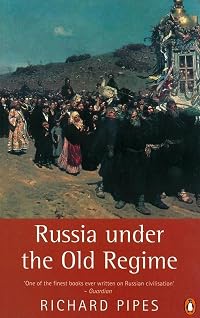
Russia under the Old Regime
by Richard Pipes
On This Page
Description
The theme of this book is the poliltical system of Russia. It traces the growth of the Russian state from its beginnings in the ninth century to the end of the nineteenth, and the parallel development of the principal social orders: peasantry, nobility, middle class and clergy. The question which it poses is why in Russia -- unlike the rest of Europe to which Russia belongs by virtue of her location, race and religion -- society has proven unable to impose on political authority any kind of show more effective restraints. After suggesting some answers to this problem, I go on to show how in Russia the opposition to absolutism tended to assume the form of a struggle for ideals rather than for class interests, and how the imperial government, challenged in this manner, responded by devising administrative practices that clearly anticipate those of the modern police state. - Foreword. show lessTags
Recommendations


















Member Reviews
A highly detailed account of the social development and legal-political environment of pre-revolutionary Russia, right from the early days of Kiev and Muscovy, down to the Romanovs and the ultimate collapse in 1917 and the Communist takeover. The analysis deals in great depth with the relations between the ruling dynasty, the court officials and intimates, the class of 'nobles', the peasants, the serfs, and the non-Russian minorities in the outlying regions. The ruler were convinced that their hold on the country required complete control, and when they started loosening their iron grip and allowing some minimum human rights to the individuals (such as the abolition of serfdom in 1861), imbalances in the power relationships inexorably show more led to confrontation. With the spread of education and awareness of the Enlightenment values that were energizing the Western world in the 18th and 19th centuries, inevitably the people of Russia also started demanding a modern polity. Here again there were tensions between the mass of rurl people, who may have preferred a regime grounded in the Orthodox religion and the tradition of loyalty to the Tsar as the representative of God on earth, whereas the progressive elements in the upper classes yearned for a free and democratic, constitutional government.
I felt the initial chapters a little heavy and obscure, especially the strange terms used for different economic and administrative relations, but as the account progressed to more modern times, it became easier to follow, and really caught my interest and curiosity. I will probably need a couple more readings to internalize the timelines and personalities, but on the whole I would think this an essential book to achieve a good understanding of the country and even the sources of its present predicament, in between the medieval and the modern, in between the West and the East. show less
I felt the initial chapters a little heavy and obscure, especially the strange terms used for different economic and administrative relations, but as the account progressed to more modern times, it became easier to follow, and really caught my interest and curiosity. I will probably need a couple more readings to internalize the timelines and personalities, but on the whole I would think this an essential book to achieve a good understanding of the country and even the sources of its present predicament, in between the medieval and the modern, in between the West and the East. show less
Generally, the book is written in a more academic and somewhat dry tone; however, it's still readable enough. The author does reasonably well with discussing and highlighting the different influences on Russian government and culture, starting in the Medieval period and working through to the decades preceding the Russian Revolution. If you're interested in Russian history, this might be worth checking out.
This book is a good example of scientific historical analysis. Pipes starts with a debatable proposition and proceeds to identify and examine all the facts and relationships to support his proposition and produces a must read book on Russian history.
Pipes argues that the basis of the Russian state is a patrimonial state; that is, a state based on the ruler treating the country as a personal possession. Key relationships within the patrimonial state were developed to support the ruler in his ownership and that the personal will of the ruler would be carried out.
There are 3 key factors that lead to this development. Firstly, the climate and quality of the soil limited the types of social and political organization that could develop. show more
Secondly, the domination of the Dnieper basin by the Vikings in the 9th century introduced the centrality of the economic motive in the purpose of the state to the still lowly developed Russian tribes.
Finally, the Monguls/Tartars in the 13th and 14th centuries, whose “absentee” control provided the annual tribute was paid and the leading Prince paying homage to the Khan, reinforced the concept of the paramount authority of the Grand Prince and the principality as his personal possession.
The result was a country where the objective of the state was the material enrichment of the ruler and the blocking of the development of alternative sources of power that could challenge the ruler. The national psyche too developed with the ruler as the provider of all benefits in society at its core.
Pipes goes on to argue that all of Russia’s history down to his day’s Communist Party was merely a development of this patrimonial state. The attempts by Peter I and Catherine II to Europeanize Russia all resulted in being subsumed within the patrimonial concept, continuing to enhance the authority of the Tsar. The late 19th century attempts by the boyars to develop along the lines of western Europe were a failure and only gave rise to a new centralized ruler in the Communist Party that would refashion existing institutions and psyches to perpetuate the patrimonial state.
Easy to ready, lively arguments and plenty of descriptions of key events makes this an excellent contribution to the understanding of Russian history. show less
Pipes argues that the basis of the Russian state is a patrimonial state; that is, a state based on the ruler treating the country as a personal possession. Key relationships within the patrimonial state were developed to support the ruler in his ownership and that the personal will of the ruler would be carried out.
There are 3 key factors that lead to this development. Firstly, the climate and quality of the soil limited the types of social and political organization that could develop. show more
Secondly, the domination of the Dnieper basin by the Vikings in the 9th century introduced the centrality of the economic motive in the purpose of the state to the still lowly developed Russian tribes.
Finally, the Monguls/Tartars in the 13th and 14th centuries, whose “absentee” control provided the annual tribute was paid and the leading Prince paying homage to the Khan, reinforced the concept of the paramount authority of the Grand Prince and the principality as his personal possession.
The result was a country where the objective of the state was the material enrichment of the ruler and the blocking of the development of alternative sources of power that could challenge the ruler. The national psyche too developed with the ruler as the provider of all benefits in society at its core.
Pipes goes on to argue that all of Russia’s history down to his day’s Communist Party was merely a development of this patrimonial state. The attempts by Peter I and Catherine II to Europeanize Russia all resulted in being subsumed within the patrimonial concept, continuing to enhance the authority of the Tsar. The late 19th century attempts by the boyars to develop along the lines of western Europe were a failure and only gave rise to a new centralized ruler in the Communist Party that would refashion existing institutions and psyches to perpetuate the patrimonial state.
Easy to ready, lively arguments and plenty of descriptions of key events makes this an excellent contribution to the understanding of Russian history. show less
Une étude passionnante, globale et thématique.
Mar 2, 2021French
Ratings
Members
- Recently Added By
Lists

r/AskHistorians' Recommended Books
1,068 works; 19 members
Author Information

47+ Works 2,782 Members
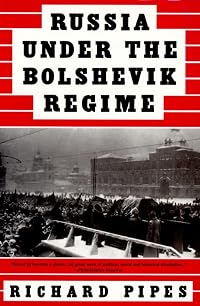
Richard Pipes was born Ryszard Edgar Pipes in Cieszyn, Poland on July 11, 1923. Soon after German troops entered Warsaw, he and his family fled to Italy on forged passports in 1939. They reached the United States a year later. He was attending Muskingum College in Ohio when he was drafted into the Army Air Corps in 1942. He was sent to study show more Russian at Cornell University. He received a bachelor's degree from Cornell in 1946 and a doctorate in history from Harvard University in 1950. His dissertation became the basis of his first book The Formation of the Soviet Union: Communism and Nationalism, 1917-1923. His other books included Struve: Liberal on the Left, 1870-1905; Struve: Liberal on the Right, 1905-1944; U.S.-Soviet Relations in the Era of Détente; Survival Is Not Enough: Soviet Realities and America's Future; Russia Under the Old Regime; The Russian Revolution; Russia Under the Bolshevik Regime; and Vixi: Memoirs of a Non-Belonger. He served for two years as the director of Eastern European and Soviet affairs for President Ronald Reagan's National Security Council. He spent his entire academic career at Harvard University. He died on May 17, 2018 at the age of 94. (Bowker Author Biography) show less
Some Editions
Awards and Honors
Notable Lists
Series
Belongs to Publisher Series
Common Knowledge
- Canonical title
- Russia under the Old Regime
- Original title
- Russia under the old regime
- Original publication date
- 1974; 1974 (1e édition originale américaine) (1e édition originale américaine); 20013-03-28 (1e traduction et édition française, Pour l'histoire, Perrin) (1e traduction et édition française, Pour l'histoire, Perrin); 2017-03-02 (Réédition française, Tempus, Perrin) (Réédition française, Tempus, Perrin)
- Important places
- Russian Empire
- Epigraph*
- /
- Dedication
- To Daniel and Steven
- First words*
- Préface de l’auteur à l’édition française
[Richard Pipes, Septembre 2011, Chesham et Cambridge (États-Unis)]
La Russie sous l’Ancien Régime a pour origine une lettre que je reçus de George Wei... (show all)denfeld, directeur de la maison d’édition Weidenfeld and Nicolson, au début de l’année 1959. [...]
Préface du traducteur
[Andreï Kozovoï, Février 2012]
Avant de devenir à mes yeux un ouvrage classique de l’historiographie, La Russie sous l’Ancien Régime fut d’abord un livre parmi d’autres de ... (show all)la riche bibliothèque de mon père, Vadim Kozovoï (1937-1999). [...]
1
L’environnement et son impact
Le cadre géographique : végétation, sol, climat, précipitations et cours d’eau
N’en déplaise aux historiens nationalistes russes, en créant ... (show all)l’espèce humaine Dieu n’a pas placé les Russes à l’endroit où ils se trouvent aujourd’hui. [...] - Original language*
- Anglais (Etats-Unis) (Etats-Unis)
*Some information comes from Common Knowledge in other languages. Click "Edit" for more information.
Classifications
- Genres
- History, Nonfiction, General Nonfiction
- DDC/MDS
- 947 — History & geography History of Europe Eastern European Counties and Russia
- LCC
- DK40 .P47 — History of Europe, Asia, Africa and Oceania Russia. Soviet Union. Former Soviet Republics – Poland History of Russia. Soviet Union. Former Soviet Republics History
- BISAC
Statistics
- Members
- 453
- Popularity
- 67,806
- Reviews
- 4
- Rating
- (3.98)
- Languages
- 5 — Chinese, English, French, German, Italian
- Media
- Paper
- ISBNs
- 17
- ASINs
- 7