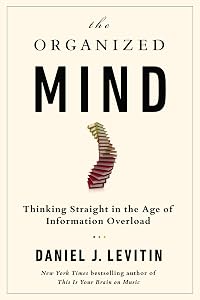
The Organized Mind: Thinking Straight in the Age of Information Overload
by Daniel J. Levitin
On This Page
Description
New York Times bestselling author and neuroscientist Daniel J. Levitin shifts his keen insights from your brain on music to your brain in a sea of details.The information age is drowning us with an unprecedented deluge of data. At the same time, we’re expected to make more—and faster—decisions about our lives than ever before. No wonder, then, that the average American reports frequently losing car keys or reading glasses, missing appointments, and feeling worn out by the effort show more required just to keep up.
But somehow some people become quite accomplished at managing information flow. In The Organized Mind, Daniel J. Levitin, PhD, uses the latest brain science to demonstrate how those people excel—and how readers can use their methods to regain a sense of mastery over the way they organize their homes, workplaces, and time.
With lively, entertaining chapters on everything from the kitchen junk drawer to health care to executive office workflow, Levitin reveals how new research into the cognitive neuroscience of attention and memory can be applied to the challenges of our daily lives. This Is Your Brain on Music showed how to better play and appreciate music through an understanding of how the brain works. The Organized Mind shows how to navigate the churning flood of information in the twenty-first century with the same neuroscientific perspective. show less
Tags
Recommendations






Member Recommendations
Member Reviews
I'm not giving a star rating to The Organized Mind since I gave up at the top of p. 81--that's the third page of a detailed inventory of retail stores' stock and organizational principles, if you're following along. Levitin bemoans information overload all the while overloading his poor readers with unnecessary information in the form of redundancy after redundancy after redundancy, and apparently doesn't see the irony. It's hard to believe that no editor said, "Hey, Dan, your readers are smart enough to understand what you're getting at, so maybe we want to cut this bit about Ace Hardware down to a paragraph or two." I simply couldn't bring myself to read another 300 pages of repetition looking for concrete advice that I suspect is show more going to boil down to putting a bowl for your keys by the door. I already have a bowl for my keys. Works great.
ETA: It occurs to me that he writes like he's lecturing to undergraduates, coming up with example after example to make a fairly basic point because he has to fill 50 minutes of class time. Also, I am super grouchy. show less
ETA: It occurs to me that he writes like he's lecturing to undergraduates, coming up with example after example to make a fairly basic point because he has to fill 50 minutes of class time. Also, I am super grouchy. show less
I started reading The Organized Mind and have abandoned it as life is too short to waste time on verbose trivia.
In abandoning this book I am applying the author's approach to dealing with information overload: filtering out trivia.
The Introduction takes up fourteen pages to say what could be said in one: Our minds are overloaded by the amount of information we receive and the number of decisions we have to make. Reduce the load on your mind by filtering out trivial information and not wasting time making decisions on trivial issued. Oh! I said it in two sentences.
The main text is no less verbose. It contains endless anecdotes of people being overloaded with information and exhausted from making decisions. On page 77 it starts to offer show more advice on how to declutter. This too is verbose and tiresome.
I quickly got to the point of skimming by reading the first sentences of paragraphs. That only led me to the conclusion that most of the paragraphs were unnecessary.
As Levitin advises, avoid wasting your time on unimportant things. He is right. Apply his approach and avoid this book. show less
In abandoning this book I am applying the author's approach to dealing with information overload: filtering out trivia.
The Introduction takes up fourteen pages to say what could be said in one: Our minds are overloaded by the amount of information we receive and the number of decisions we have to make. Reduce the load on your mind by filtering out trivial information and not wasting time making decisions on trivial issued. Oh! I said it in two sentences.
The main text is no less verbose. It contains endless anecdotes of people being overloaded with information and exhausted from making decisions. On page 77 it starts to offer show more advice on how to declutter. This too is verbose and tiresome.
I quickly got to the point of skimming by reading the first sentences of paragraphs. That only led me to the conclusion that most of the paragraphs were unnecessary.
As Levitin advises, avoid wasting your time on unimportant things. He is right. Apply his approach and avoid this book. show less
We are drowning in information. Levitin illustrates this with a biological example (15). Google Scholar reports 30,000 research articles on the nervous system of a squid. You can have a PhD in biology and never know all that’s been written on the topic!
This superabundance of accessible information has left us confused. We waste our time away making meaningless decisions that would not have been a matter of choice a few decades ago. This plethora of information can leave us overwhelmed. We have this vague sense that we can’t quite keep on top of everything we should know.
Daniel Levitin draws on scientific research studies as well as time management gurus to help us understand the problem. More than that, he offers practical ways for show more us to (as the subtitle says), think “straight in an age of information overload.”
One of the most interesting parts of Levitin’s book was his attack on the myth of multi-tasking. While we think we can do many things at once, “what we really do is shift our attention rapidly from task to task” (306). This leads to two problems:
1. We don’t devote enough attention to any one task.
2. We decrease the quality of our attention to a task.
Levitin is aware that self-professed multitaskers will disagree with this research. In one of the best scientific jargon-laden insults I’ve read, “a cognitive illusion sets in, fueled in part by a dopamine-adrenaline feedback loop, in which multitaskers think they are doing great” (306). Uni-taskers unite!
Multitasking is just a small part of this 500 page book (400+notes and index) in which every section had something interesting and enlightening to offer. If you want to understand more about how your mind works and how you can stay in control of the modern information torrent, Levitin is a great guide. show less
This superabundance of accessible information has left us confused. We waste our time away making meaningless decisions that would not have been a matter of choice a few decades ago. This plethora of information can leave us overwhelmed. We have this vague sense that we can’t quite keep on top of everything we should know.
Daniel Levitin draws on scientific research studies as well as time management gurus to help us understand the problem. More than that, he offers practical ways for show more us to (as the subtitle says), think “straight in an age of information overload.”
One of the most interesting parts of Levitin’s book was his attack on the myth of multi-tasking. While we think we can do many things at once, “what we really do is shift our attention rapidly from task to task” (306). This leads to two problems:
1. We don’t devote enough attention to any one task.
2. We decrease the quality of our attention to a task.
Levitin is aware that self-professed multitaskers will disagree with this research. In one of the best scientific jargon-laden insults I’ve read, “a cognitive illusion sets in, fueled in part by a dopamine-adrenaline feedback loop, in which multitaskers think they are doing great” (306). Uni-taskers unite!
Multitasking is just a small part of this 500 page book (400+notes and index) in which every section had something interesting and enlightening to offer. If you want to understand more about how your mind works and how you can stay in control of the modern information torrent, Levitin is a great guide. show less
The amount of retention that you gain through Levitin's careful prose is surprising. He elucidates concepts clearly and succinctly while providing relative background information to justify his points. There are also many real-world and abstract examples to support his findings, which helps with the overall flow and poise of the book. This is a mind-building exercise. Through what Levitin teaches, I feel like I have a better comprehension on how to separate important information from that which is not. A groundbreaking book in modern non-fiction, it deserves all the aplomb it gets.
4 stars.
4 stars.
When I last read Levitin, he was waxing scientific about our brains on music. That book was a little on the dense side but well done. This time he picks what seems like it would be a more challenging topic -- how we process information, and crafts a thoroughly readable, enjoyable treatment that could easily have been even denser.
Levitin tells us much about how memory works, what we are capable of achieving, and, just as importantly, what we cannot. He discusses at length the fallacy of multitasking: everyone thinks they do it, some even think they are good at it, but in reality, it is inefficient and wastes more time than it ever saves. In passing he also discusses a fundamental limitation of our attention span -- we can reasonably show more keep track of two, and not more than two, things at the same time. Two people talking at once we can manage, add a third, and it becomes jumbled noise.
Mental gymnastics are only part of what this book is about. Arranging information in conventional ways such as filing systems, both physical and digital. are covered. Techniques on remembering people and faces are covered. And probably my favorite part includes critical thinking: how to properly evaluate data and ask the right questions. One thing I found fascinating regarded treatment of prostate cancer. It is common among men, and often is aggressively treated by chemotherapy. Doctors point to a high rate of success, so they continue to prescribe this treatment to all who are afflicted. But after looking further into the numbers, Levitin discovered that only 5% of those treated have their life spans extended because of the treatment, while 25% experience negative effects from the treatment, including some (about 5%) who have their lives actually shortened by the treatment. When confronted with the data, oncologists appeared to be severely challenged by the simple math. That their patient is 95% more likely to be better off not getting the treatment is irrelevant to them. "But what if you are in the 5%?" they ask. Levitin contends that there is a lot of such deceptive practices, here and elsewhere. The media is a particularly egregious source. "Ebola cases in the US are up 300%", making it sound like an out of control epidemic rather than an increase from 1 patient to 3. Such percentages have their place among epidemiologists studying a disease, but alone they mean nothing but are often used to spread FUD.
The book wraps up with a critical slam against crowd-sourced information such as Wikipedia (he said the same thing I've been saying for years -- it's not a trustworthy source because anybody can edit and therefore the sources of the information cannot be trusted). Acceptable, peer-reviewed sources are available, he contends, if one takes the effort to find them. It's not just what you know, but having the confidence that what you know is true and correct. show less
Levitin tells us much about how memory works, what we are capable of achieving, and, just as importantly, what we cannot. He discusses at length the fallacy of multitasking: everyone thinks they do it, some even think they are good at it, but in reality, it is inefficient and wastes more time than it ever saves. In passing he also discusses a fundamental limitation of our attention span -- we can reasonably show more keep track of two, and not more than two, things at the same time. Two people talking at once we can manage, add a third, and it becomes jumbled noise.
Mental gymnastics are only part of what this book is about. Arranging information in conventional ways such as filing systems, both physical and digital. are covered. Techniques on remembering people and faces are covered. And probably my favorite part includes critical thinking: how to properly evaluate data and ask the right questions. One thing I found fascinating regarded treatment of prostate cancer. It is common among men, and often is aggressively treated by chemotherapy. Doctors point to a high rate of success, so they continue to prescribe this treatment to all who are afflicted. But after looking further into the numbers, Levitin discovered that only 5% of those treated have their life spans extended because of the treatment, while 25% experience negative effects from the treatment, including some (about 5%) who have their lives actually shortened by the treatment. When confronted with the data, oncologists appeared to be severely challenged by the simple math. That their patient is 95% more likely to be better off not getting the treatment is irrelevant to them. "But what if you are in the 5%?" they ask. Levitin contends that there is a lot of such deceptive practices, here and elsewhere. The media is a particularly egregious source. "Ebola cases in the US are up 300%", making it sound like an out of control epidemic rather than an increase from 1 patient to 3. Such percentages have their place among epidemiologists studying a disease, but alone they mean nothing but are often used to spread FUD.
The book wraps up with a critical slam against crowd-sourced information such as Wikipedia (he said the same thing I've been saying for years -- it's not a trustworthy source because anybody can edit and therefore the sources of the information cannot be trusted). Acceptable, peer-reviewed sources are available, he contends, if one takes the effort to find them. It's not just what you know, but having the confidence that what you know is true and correct. show less
Non più di tre stelle. Il libro non mi ha detto molto su come organizzare la mente per il semplice fatto che non ancora sappiamo come la mente funziona. Non sono uno scienziato, uno studioso della mente, sono soltanto uno che, come tutti, una mente ce l'ha e vorrebbe farla funzionare meglio. In questo caso si parla di organizzazione, qualcosa di più, ed è in questo che il libro difetta. Possiamo organizzare qualcosa soltanto se conosciamo con che cosa abbiamo a che fare. La mente umana non è un algoritmo, un programma, è certamente "qualcosa" di più. Presuntuoso parlare di organizzare ...
Much of the valuable productivity literature I've read has been written by professionals with experience in personal or business organizational systems who teach lessons learned from consulting and coaching over many years. The Internet is bloated with blog posts outlining individual productivity systems or productivity tips that may be transferable, in whole or part, to the situation of the reader. Dr. Levitin, by contrast, has expertise in the inner working of the mind and approaches productivity and organized thinking from the grey matter out.
According to Dr. Levitin's site, he "...earned his B.A. in Cognitive Psychology and Cognitive Science at Stanford University, and went on to earn his Ph.D. in Psychology from the University of show more Oregon, researching complex auditory patterns and pattern processing in expert and non-expert populations." Dr. Levitin has a gift for expressing complex scientific facts and theories in practical, but not simplistic, terms.
For productivity, Dr. Levitin blends neuroscience and the historical development of organizational systems to suggest ideas for improving data management, information filing and retrieval, and handling information. Like productivity expert David Allen, of the Getting Things Done (GTD) system, Dr. Levitin suggests developing external systems that efficiently handle information so we can use our minds for more productive work. Whereas Allen focuses on the "mind like water" result of efficient external systems, Dr. Levitin focuses on why the mind achieves this state from a medical perspective.
Dr. Levitin's section on the executive and daydream capacities of mental thought were extremely interesting and provide insight into some cognitive challenges we face because of the flow of information, technology, and the "multitasking" culture mentality. He also suggests ways to encourage either mode to engage for suitable tasks. His discussion of "flow state" and how to achieve it is very valuable.
Like "The Invisible Gorilla", the book also challenges what we think we know about how our mind and memory works and what science has revealed. He provides medical insight into the notion of multitasking and what really happens in our minds and the mental impact of task switching on our productivity and efficiency. He also gives us a mind tour of dreaming and learning that is both education and useful.
An important part of this work is the discussion of critical analysis skills and decision making structures to help when we are bombarded with information. It is important to analyze the information package (source, potential biases, authority, etc.) as well as the content of the information itself. His discussion of Wikipedia helps explain the challenge of handling data wisely. He also provides a framework for helping patients and caregivers use medical tests and information to make better healthcare decisions with the diagnoses and research available that speaks to their medical need.
The Organized Mind is a user guide for the mind. show less
According to Dr. Levitin's site, he "...earned his B.A. in Cognitive Psychology and Cognitive Science at Stanford University, and went on to earn his Ph.D. in Psychology from the University of show more Oregon, researching complex auditory patterns and pattern processing in expert and non-expert populations." Dr. Levitin has a gift for expressing complex scientific facts and theories in practical, but not simplistic, terms.
For productivity, Dr. Levitin blends neuroscience and the historical development of organizational systems to suggest ideas for improving data management, information filing and retrieval, and handling information. Like productivity expert David Allen, of the Getting Things Done (GTD) system, Dr. Levitin suggests developing external systems that efficiently handle information so we can use our minds for more productive work. Whereas Allen focuses on the "mind like water" result of efficient external systems, Dr. Levitin focuses on why the mind achieves this state from a medical perspective.
Dr. Levitin's section on the executive and daydream capacities of mental thought were extremely interesting and provide insight into some cognitive challenges we face because of the flow of information, technology, and the "multitasking" culture mentality. He also suggests ways to encourage either mode to engage for suitable tasks. His discussion of "flow state" and how to achieve it is very valuable.
Like "The Invisible Gorilla", the book also challenges what we think we know about how our mind and memory works and what science has revealed. He provides medical insight into the notion of multitasking and what really happens in our minds and the mental impact of task switching on our productivity and efficiency. He also gives us a mind tour of dreaming and learning that is both education and useful.
An important part of this work is the discussion of critical analysis skills and decision making structures to help when we are bombarded with information. It is important to analyze the information package (source, potential biases, authority, etc.) as well as the content of the information itself. His discussion of Wikipedia helps explain the challenge of handling data wisely. He also provides a framework for helping patients and caregivers use medical tests and information to make better healthcare decisions with the diagnoses and research available that speaks to their medical need.
The Organized Mind is a user guide for the mind. show less
Members
- Recently Added By
Author Information

15 Works 8,980 Members
Daniel J. Levitin was born on December 27, 1957 in San Francisco, California. He studied electrical engineering at the Massachusetts Institute of Technology and music at the Berkley College of Music before dropping out of college to become a record producer and professional musician. He returned to school in his thirties, where he studied show more cognitive psychology/cognitive science, receiving a B.A. from Stanford University in 1992 and a M.Sc. in 1993 and Ph.D. in 1996 from the University of Oregon. He is a cognitive psychologist, neuroscientist, and author. He runs the Levitin Laboratory for Musical Perception, Cognition, and Expertise at McGill University. He has published extensively in scientific journals and music trade magazines such as Grammy and Billboard. He is also the author of several books including This Is Your Brain on Music, The World in Six Songs, and The Organized Mind: Thinking Straight in the Age of Information Overload. (Bowker Author Biography) show less
Awards and Honors
Distinctions
Work Relationships
Common Knowledge
- Canonical title
- The Organized Mind: Thinking Straight in the Age of Information Overload
- Original publication date
- 2014
- Dedication
- To my mother and father for all they taught me
- First words
- Introduction
We humans have a long history of pursuing neural enhancement—ways to improve the brains that evolution gave us.
Chapter 1
One of the best students I ever had the privilege of meeting was born in communist Romania, under the repressive and brutal rule of Nicolae Ceaușescu. - Last words
- (Click to show. Warning: May contain spoilers.)The key to change is having faith that when we get rid of the old, something or someone even more magnificent will take its place.
- Blurbers
- Gilbert, Daniel; Shultz, George P.; Tetlock, Philip E.; Prusiner, Stanley B.; McChrystal, Stanley; Kaplan, Eric
Classifications
- Genres
- General Nonfiction, Nonfiction, Science & Nature
- DDC/MDS
- 153.4 — Philosophy & psychology Psychology Conscious mental processes and intelligence Thought, thinking, reasoning, intuition, value, judgment
- LCC
- BF323 .D5 .L49 — Philosophy, Psychology and Religion Psychology Psychology Consciousness. Cognition
- BISAC
Statistics
- Members
- 1,920
- Popularity
- 11,127
- Reviews
- 32
- Rating
- (3.52)
- Languages
- Dutch, English, French, Portuguese
- Media
- Paper, Audiobook, Ebook
- ISBNs
- 23
- ASINs
- 13