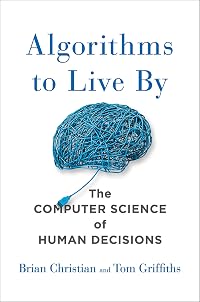
Algorithms to Live By: The Computer Science of Human Decisions
by Brian Christian, Tom Griffiths
On This Page
Description
A fascinating exploration of how insights from computer algorithms can be applied to our everyday lives, helping to solve common decision-making problems and illuminate the workings of the human mind. All our lives are constrained by limited space and time, limits that give rise to a particular set of problems. What should we do, or leave undone, in a day or a lifetime? How much messiness should we accept? What balance of new activities and familiar favorites is the most fulfilling? These show more may seem like uniquely human quandaries, but they are not: computers, too, face the same constraints, so computer scientists have been grappling with their version of such issues for decades. And the solutions they've found have much to teach us. In a dazzlingly interdisciplinary work, acclaimed author Brian Christian and cognitive scientist Tom Griffiths show how the algorithms used by computers can also untangle very human questions. They explain how to have better hunches and when to leave things to chance, how to deal with overwhelming choices and how best to connect with others. From finding a spouse to finding a parking spot, from organizing one's inbox to understanding the workings of memory, Algorithms to Live By transforms the wisdom of computer science into strategies for human living.--From dust jacket. show lessTags
Recommendations
Member Recommendations
Member Reviews
When a computer alphabetizes a list of words, or fits a curve to a series of data points, or decides what it should keep handy in parts of its memory it can access quickly, what exactly is it doing? Well, it's using an algorithm, some set of instructions that give it the rules for how it should proceed in tackling the problem before it. Of course, for any given problem some algorithms may be more efficient or give better results than others, and a lot of computer science and a fair amount of mathematics is dedicated to finding the best algorithms for the problems we want solved. And those rules are often ones we humans can use, too, whether we're deciding which tasks to tackle first in order to miss the fewest deadlines, or show more re-organizing our closets, or deciding when to stop driving around looking for a better parking space.
And that's what this book is about: algorithms of the kind computers use, and their applications in the real world. Which, I admit, sounds dull. I suppose to most people, it may be dull. But, giant nerd that I am, I found it fascinating. Intellectually exciting, even. How amazing is it that a very small change in the requirements of a problem can alter the task of finding the best solution from a simple to an impossible one... or that, by going back to the simpler version of the problem and working from there, you can often come very, very close to that best solution, anyway? This book is full of things like that that made me go wow, from the notion that introducing randomness into calculations about non-random things can actually give better results, to guidelines on how to make the best possible guesses based on completely insufficient data, to the welcome confirmation that I'm already intuitively using the optimal methods for alphabetizing my bookshelves.
It's all wonderfully well-written, too: beautifully comprehensible and full of excellent examples. There's also, for my mind, exactly the right amount of math, as the authors talk us through careful mathematical thinking without ever getting bogged down in equations. Or computer code, for that matter. It's all just nice, clear, readable English.
Am I going to go out now and apply the algorithms discussed here towards improving my own life? Well... maybe. Did I come away from it feeling like I understand the world better? I think so. Did I come away feeling I understand more about the tools we have for understanding the world? Absolutely. I also may have come away regretting more than ever that I didn't major in computer science, because it really did just light up all kinds of nerdy areas in my brain. show less
And that's what this book is about: algorithms of the kind computers use, and their applications in the real world. Which, I admit, sounds dull. I suppose to most people, it may be dull. But, giant nerd that I am, I found it fascinating. Intellectually exciting, even. How amazing is it that a very small change in the requirements of a problem can alter the task of finding the best solution from a simple to an impossible one... or that, by going back to the simpler version of the problem and working from there, you can often come very, very close to that best solution, anyway? This book is full of things like that that made me go wow, from the notion that introducing randomness into calculations about non-random things can actually give better results, to guidelines on how to make the best possible guesses based on completely insufficient data, to the welcome confirmation that I'm already intuitively using the optimal methods for alphabetizing my bookshelves.
It's all wonderfully well-written, too: beautifully comprehensible and full of excellent examples. There's also, for my mind, exactly the right amount of math, as the authors talk us through careful mathematical thinking without ever getting bogged down in equations. Or computer code, for that matter. It's all just nice, clear, readable English.
Am I going to go out now and apply the algorithms discussed here towards improving my own life? Well... maybe. Did I come away from it feeling like I understand the world better? I think so. Did I come away feeling I understand more about the tools we have for understanding the world? Absolutely. I also may have come away regretting more than ever that I didn't major in computer science, because it really did just light up all kinds of nerdy areas in my brain. show less
 This review was written for LibraryThing Early Reviewers.
The highest praise I can give a book is to say it changed my life. This book changed my life before I had even finished reading it.
At the same time, I hesitate to recommend the book broadly because it was such a perfect book for me that I have to assume it would be less perfect for almost anyone else.
Briefly, "Algorithms to Live By" presents a series of well-known computer algorithms and explains how they are used to solve common problems in computer science. Then it takes each algorithm and applies it to real-world problems, discussing whether or not we, as human beings, approximate the algorithm's behavior with our own actions.
This may make the book sound incredibly dry, like the authors are trying to turn people into computers and show more squelch out all humanity. Instead, the authors are taking an algorithmic look the human condition. (E.g., how does the explore/exploit trade-off explain why there are certain times in our lives when it's easier or harder for us to make new friends? Can the concept of intractability free us from worrying about making perfect choices?)
If you have a strong background in computer science, you probably won't learn anything new from the algorithms presented in this book, although you may still be interested in some of the real-world applications of those algorithms. However, if you have little background in computer science, but an interest in algorithms and a patience for technical prose—seriously, this is the kind of book where you have to stop and think for a minute between each paragraph—this is the book for you.
You may even find that this book significantly changes the way you approach some aspects of your life, or at least helps you better understand why you behave the way you do. show less
At the same time, I hesitate to recommend the book broadly because it was such a perfect book for me that I have to assume it would be less perfect for almost anyone else.
Briefly, "Algorithms to Live By" presents a series of well-known computer algorithms and explains how they are used to solve common problems in computer science. Then it takes each algorithm and applies it to real-world problems, discussing whether or not we, as human beings, approximate the algorithm's behavior with our own actions.
This may make the book sound incredibly dry, like the authors are trying to turn people into computers and show more squelch out all humanity. Instead, the authors are taking an algorithmic look the human condition. (E.g., how does the explore/exploit trade-off explain why there are certain times in our lives when it's easier or harder for us to make new friends? Can the concept of intractability free us from worrying about making perfect choices?)
If you have a strong background in computer science, you probably won't learn anything new from the algorithms presented in this book, although you may still be interested in some of the real-world applications of those algorithms. However, if you have little background in computer science, but an interest in algorithms and a patience for technical prose—seriously, this is the kind of book where you have to stop and think for a minute between each paragraph—this is the book for you.
You may even find that this book significantly changes the way you approach some aspects of your life, or at least helps you better understand why you behave the way you do. show less
This review was written for LibraryThing Early Reviewers.After a very long time I read a book that I could completely relate to. Having been a programmer decades ago, I loved reveling in the algorithms I had long stopped thinking about. But personal nostalgia aside, here's why I loved the book (to give it the rare 5 stars).
There are books on decision making, there are books on behavioral economics and then there are books on computer science. This book combines all three inside one cover to give a pretty comprehensive view of how people behave and decide things along with the underlying principles of how it's done in the computer sciences' world.
The book merely iterates or perhaps explains to us what we intrinsically know and do by citing how it's done in the computer world. That bridge show more between what seemed abstract and computational versus the invisible logic and processes in our own minds and lives is what sets this book apart.
It delves into some complex topics, but the authors manage to simplify it for the readers which is something very few authors can do. The duo have written a book that any student of psychology or computer science would love to read. show less
There are books on decision making, there are books on behavioral economics and then there are books on computer science. This book combines all three inside one cover to give a pretty comprehensive view of how people behave and decide things along with the underlying principles of how it's done in the computer sciences' world.
The book merely iterates or perhaps explains to us what we intrinsically know and do by citing how it's done in the computer world. That bridge show more between what seemed abstract and computational versus the invisible logic and processes in our own minds and lives is what sets this book apart.
It delves into some complex topics, but the authors manage to simplify it for the readers which is something very few authors can do. The duo have written a book that any student of psychology or computer science would love to read. show less
First off, I'm a computer scientist, so a lot of these principles were old hat. However, in many cases I hadn't made the connection to human behavior.
The book takes you through a variety of basic computer science theory, then explains how it relates to real life (your own decisions or tasks, sports, games, or life in general). I appreciated having these connections pointed out, but often the chapters got bogged down in example after example. After several pages covering one example, the last thing I needed was yet another example.
The book was not a light, enjoyable read. It required effort, concentration and a good deal of willpower to continue. I would have preferred a lighter handling of each section with more takeaways. If you're show more looking for an entertaining yet helpful trip through the overlap between computer science and your behavior, look elsewhere. show less
The book takes you through a variety of basic computer science theory, then explains how it relates to real life (your own decisions or tasks, sports, games, or life in general). I appreciated having these connections pointed out, but often the chapters got bogged down in example after example. After several pages covering one example, the last thing I needed was yet another example.
The book was not a light, enjoyable read. It required effort, concentration and a good deal of willpower to continue. I would have preferred a lighter handling of each section with more takeaways. If you're show more looking for an entertaining yet helpful trip through the overlap between computer science and your behavior, look elsewhere. show less
This review was written for LibraryThing Early Reviewers.A fun and insightful read. I was recommended it by a law school friend and also a work friend. My first whack at the book ended in skepticism, and the glowing review by the author of the Power of Habit worried me (I don't tend to like self-help books, but this book was thankfully more substantive than the average self-help book). The introduction started off interestingly enough, arguing that contrary to the stereotypes of a meticulous calculator that carries out each decimal calculation to perfect precision, computer science was often about uncertainties, guesses and tradeoffs between bad and worse results. However, the book then immediately undermines that argument by trying to impress the reader by introducing the answer of 37% to show more the secretary problem (how to find the best secretary when each interview is a one shot game, with a 100% acceptance to offer rate, and no cardinal but ordinal ranking discovered as one interviews). Worse still, the book is candid enough to admit that the solution changes with additional assumptions such as the ability to ask again, the chances the applicant will reject the offer, and full cardinal information, but not candid enough to reveal some of the basic assumptions of the basic model, that is a random distribution of applicants. However, I'm glad I read on, because the rest of the book was much better, introducing computer science concepts, variations on the basic model and applying the core concept to non-computer science domains such as aging, organizing and forgiveness.
The chapter on the secretary problem introduces and discusses optimal stopping problems, noting that despite the optimal strategy, results (measured as getting the absolute best) are often disappointing. The book also discusses the trade-off between exploring the new, and enjoying the old. The chapter had a few interesting insights on how near the end of an interval, it makes less sense to explore and more sense to exploit old favorites (or why it makes sense for the old to prefer classics over novelty). It also discusses interesting strategies like staying until losing, and the gittins index, a probabilistic trade-off that slightly rewards exploring over exploiting (under strong assumptions of course), and algorithms such as simply selecting the option with the highest upper confidence bound to minimize regret. The sorting chapter introduces the bubble sort, the insertion sort, and merge-sort as well as concepts of constant, liner, exponential and factorial time. The chapter's section on tournament structure bored me a bit, with the exception that its footnote, that the NCAA seed system has never allowed a 16 seed to beat a 1 seed, is incorrect as of 2018. It also discusses the trade-off between sorting and searching. The caching chapter discussed the use of caches to speed up processes, as well as algorithms for managing caches from random eviction, FIFO to least recently used (useful for organizing closets it turns out, and the hidden genius of heaps). The chapter ends with a reflection on the forgetting curve, a human response remarkably similar to cleaning a cache. I found the chapter on scheduling the most challenging, both in terms of my personal life as well as the material. Scheduling are the strategies to order and prioritize tasks, and include Moore's algorithm (ejecting the longest task if we miss a deadline, in order of upcoming deadlines), the rule of finishing the shortest tasks first (with appropriate weights for the importance of tasks), priority inversion (low priority tasks take take too long, blocking high priority tasks), precedence constraint (high priority tasks have a preconditions of lower priority tasks), how certain problems are simply intractable, context switch (switching costs), and thrashing (where metawork/scheduling overtakes the actual work) [the fix is to get either more memory or just work through the tasks]. The chapter on Bayesian reasoning was relatively standard, suggesting either just extrapolating the average (a normal prior) or just adding a constant (an Erlang prior). An interesting argument made was that with an uninformed prior, one should just double the time one has observed something or multiply observations by a constant if the prior is a power law. More interesting is the research that in many human domains where people are expected to have much experience, people actually implicitly apply Bayes's Rule, enough to the point that interesting priors can be reversed engineered (however, perhaps unsurprisingly, in domains where people typically do not have experience, they have terrible predictions, and news can counterproductively skew priors). The chapter even notes a variation of the marshmallow experiment that tries to show that the results may be from rational expectations of the trustworthiness of experimenters and not the use of willpower. The chapter on overfitting seems fairly obvious except for the interesting solutions to overfitting, including cross validation (with another data source), regularization (penalizing models for complexity) [for example the Lasso, the sum of the absolute values of coefficients], early stopping (just focusing on the most important factors). The relaxation chapter is essentially about relaxing the constraints of intractable or near intractable problems in order to solve and find a bound for seemingly impossible problems. The randomness chapter explained the monte carlo method which is essentially entering random inputs to see if the outputs stablize or become predictable. I found the concept of primality tests, that is, formulas that can confirm to a measurable probability that certain numbers are prime fascinating. Truly fascinating were the algorithms that introduced randomness into the problem solving method. The chapter explains strategies such as hill climbing, looking for the best local improvements, adding in some randomness to escape dead-ends, and the metropolis algorithm, randomly accepting bad tweaks as well as good ones. I was particularly moved by the metaphor of cooling metals that inspired simulated annealing, starting with high randomness but then reducing the random element as the solution becomes better and better. I found the chapter on networking to be a good review of packet (the internet) vs circuit (phones) switching, and TCP protocol. I also learned what exactly the byzantine general problem was (two generals can never be sure that the other side got the message), exponential backoff (doubling delay before retransmit attempts, with interesting applications to forgiveness, double the requirement each time someone disappoints you), AIMD (transmitted packets increase by 1, and dropped packets cut transmission rate in half)[though the book tragically confuses the Cravath system with a simple up & out], and the importance of backchannels (acknowledgements in grunts, uh huhs etc) in human communication. The chapter on game theory started relatively slow, with simple explanations of nash, prisoner's dilemma, recursion and dominant strategies. A few concepts I particularly liked was the price of anarchy (the efficiency difference between uncoordinated and coordinated games), and mechanism design, changing the payoffs of a game (by central authorities setting minimums for example, in a race to the bottom) to move to "good" equilibriums. The book made an interesting point about the evolutionary advantage of emotions in solving certain bad equilibriums, from the desire for revenge/justice in creating socially beneficial deterrence, to love as a involuntary commitment device. I even admired to a degree the section about auction design and information cascades (a random signal snowballs because everyone assumes someone else knows something). English and dutch auctions can suffer from information cascades as well as attempts to overshade/undershade competing bids recursively. The second price sealed auction however, creates the incentive for everyone to bid honestly, while all producing the same revenue for the auctioneer. The main part of the book ends hopefully with the revelation principle, that all games involving hiding the truth can be turned into games to incentivize honesty. In the epilogue the authors suggest computational kindness, the idea that sometimes not leaving the choice up to someone else (by for example suggesting some options) can be helpful by reducing the necessity of them figuring out the options.
Overall I highly recommend the book. For non-computer science students, a very diverse and well written introduction into what I assume are core principles. I found many of the suggestions of the book at the very least interesting if not enlightening. I would argue that many concepts actually belong to the domain of economics (such as the game theory, overfitting, bayes's rule and even the randomness chapter) which is one of the reasons I found the book so enjoyable. Sometimes the book oversimplifies with a naive and simplistic view of the world (for example suggesting that stores contract to not sell on certain days in order to avoid prisoner's dilemma ignoring the fact this probably violates anti-trust laws), but I assume that's for narrative convenience. The book doesn't attempt to solve all of your problems (nor can it), but it suggests new ways of looking at them that I would guess most people are not exposed to. At the core, the book is about decision making through the lens of computer science, a truly relatable and worthy endeavor. show less
The chapter on the secretary problem introduces and discusses optimal stopping problems, noting that despite the optimal strategy, results (measured as getting the absolute best) are often disappointing. The book also discusses the trade-off between exploring the new, and enjoying the old. The chapter had a few interesting insights on how near the end of an interval, it makes less sense to explore and more sense to exploit old favorites (or why it makes sense for the old to prefer classics over novelty). It also discusses interesting strategies like staying until losing, and the gittins index, a probabilistic trade-off that slightly rewards exploring over exploiting (under strong assumptions of course), and algorithms such as simply selecting the option with the highest upper confidence bound to minimize regret. The sorting chapter introduces the bubble sort, the insertion sort, and merge-sort as well as concepts of constant, liner, exponential and factorial time. The chapter's section on tournament structure bored me a bit, with the exception that its footnote, that the NCAA seed system has never allowed a 16 seed to beat a 1 seed, is incorrect as of 2018. It also discusses the trade-off between sorting and searching. The caching chapter discussed the use of caches to speed up processes, as well as algorithms for managing caches from random eviction, FIFO to least recently used (useful for organizing closets it turns out, and the hidden genius of heaps). The chapter ends with a reflection on the forgetting curve, a human response remarkably similar to cleaning a cache. I found the chapter on scheduling the most challenging, both in terms of my personal life as well as the material. Scheduling are the strategies to order and prioritize tasks, and include Moore's algorithm (ejecting the longest task if we miss a deadline, in order of upcoming deadlines), the rule of finishing the shortest tasks first (with appropriate weights for the importance of tasks), priority inversion (low priority tasks take take too long, blocking high priority tasks), precedence constraint (high priority tasks have a preconditions of lower priority tasks), how certain problems are simply intractable, context switch (switching costs), and thrashing (where metawork/scheduling overtakes the actual work) [the fix is to get either more memory or just work through the tasks]. The chapter on Bayesian reasoning was relatively standard, suggesting either just extrapolating the average (a normal prior) or just adding a constant (an Erlang prior). An interesting argument made was that with an uninformed prior, one should just double the time one has observed something or multiply observations by a constant if the prior is a power law. More interesting is the research that in many human domains where people are expected to have much experience, people actually implicitly apply Bayes's Rule, enough to the point that interesting priors can be reversed engineered (however, perhaps unsurprisingly, in domains where people typically do not have experience, they have terrible predictions, and news can counterproductively skew priors). The chapter even notes a variation of the marshmallow experiment that tries to show that the results may be from rational expectations of the trustworthiness of experimenters and not the use of willpower. The chapter on overfitting seems fairly obvious except for the interesting solutions to overfitting, including cross validation (with another data source), regularization (penalizing models for complexity) [for example the Lasso, the sum of the absolute values of coefficients], early stopping (just focusing on the most important factors). The relaxation chapter is essentially about relaxing the constraints of intractable or near intractable problems in order to solve and find a bound for seemingly impossible problems. The randomness chapter explained the monte carlo method which is essentially entering random inputs to see if the outputs stablize or become predictable. I found the concept of primality tests, that is, formulas that can confirm to a measurable probability that certain numbers are prime fascinating. Truly fascinating were the algorithms that introduced randomness into the problem solving method. The chapter explains strategies such as hill climbing, looking for the best local improvements, adding in some randomness to escape dead-ends, and the metropolis algorithm, randomly accepting bad tweaks as well as good ones. I was particularly moved by the metaphor of cooling metals that inspired simulated annealing, starting with high randomness but then reducing the random element as the solution becomes better and better. I found the chapter on networking to be a good review of packet (the internet) vs circuit (phones) switching, and TCP protocol. I also learned what exactly the byzantine general problem was (two generals can never be sure that the other side got the message), exponential backoff (doubling delay before retransmit attempts, with interesting applications to forgiveness, double the requirement each time someone disappoints you), AIMD (transmitted packets increase by 1, and dropped packets cut transmission rate in half)[though the book tragically confuses the Cravath system with a simple up & out], and the importance of backchannels (acknowledgements in grunts, uh huhs etc) in human communication. The chapter on game theory started relatively slow, with simple explanations of nash, prisoner's dilemma, recursion and dominant strategies. A few concepts I particularly liked was the price of anarchy (the efficiency difference between uncoordinated and coordinated games), and mechanism design, changing the payoffs of a game (by central authorities setting minimums for example, in a race to the bottom) to move to "good" equilibriums. The book made an interesting point about the evolutionary advantage of emotions in solving certain bad equilibriums, from the desire for revenge/justice in creating socially beneficial deterrence, to love as a involuntary commitment device. I even admired to a degree the section about auction design and information cascades (a random signal snowballs because everyone assumes someone else knows something). English and dutch auctions can suffer from information cascades as well as attempts to overshade/undershade competing bids recursively. The second price sealed auction however, creates the incentive for everyone to bid honestly, while all producing the same revenue for the auctioneer. The main part of the book ends hopefully with the revelation principle, that all games involving hiding the truth can be turned into games to incentivize honesty. In the epilogue the authors suggest computational kindness, the idea that sometimes not leaving the choice up to someone else (by for example suggesting some options) can be helpful by reducing the necessity of them figuring out the options.
Overall I highly recommend the book. For non-computer science students, a very diverse and well written introduction into what I assume are core principles. I found many of the suggestions of the book at the very least interesting if not enlightening. I would argue that many concepts actually belong to the domain of economics (such as the game theory, overfitting, bayes's rule and even the randomness chapter) which is one of the reasons I found the book so enjoyable. Sometimes the book oversimplifies with a naive and simplistic view of the world (for example suggesting that stores contract to not sell on certain days in order to avoid prisoner's dilemma ignoring the fact this probably violates anti-trust laws), but I assume that's for narrative convenience. The book doesn't attempt to solve all of your problems (nor can it), but it suggests new ways of looking at them that I would guess most people are not exposed to. At the core, the book is about decision making through the lens of computer science, a truly relatable and worthy endeavor. show less
This book is very much in my wheel house--computer science and interdisciplinary analysis, and I really enjoyed it. I think it makes for a lot of interesting conversation. This may become 5 stars if it sticks with me.
I really liked the ideas about how our seemingly irrational behaviors are often due the fact that the problems are intractable and thus are rational, how the fact that it takes longer to remember things might not be degeneration, but a natural consequence of searching massive amounts of data, that piles are not a disgraceful form of organization, overfitting (I am personally angered by how this happens in our education system), computational kindness, and how exponential backoff "offers a way to have finite patience and show more infinite mercy."
My one critique was the section about pecking orders and dominance hierarchies, while yes there are observations in the natural world, and that can be related to sorting, making arguments that hierarchies are "scientifically" better or more peaceful is strongly akin to past scientific rationalization that have been used for centuries to justify racism, sexism, etc. It is better to just not go down that road. show less
I really liked the ideas about how our seemingly irrational behaviors are often due the fact that the problems are intractable and thus are rational, how the fact that it takes longer to remember things might not be degeneration, but a natural consequence of searching massive amounts of data, that piles are not a disgraceful form of organization, overfitting (I am personally angered by how this happens in our education system), computational kindness, and how exponential backoff "offers a way to have finite patience and show more infinite mercy."
My one critique was the section about pecking orders and dominance hierarchies, while yes there are observations in the natural world, and that can be related to sorting, making arguments that hierarchies are "scientifically" better or more peaceful is strongly akin to past scientific rationalization that have been used for centuries to justify racism, sexism, etc. It is better to just not go down that road. show less
Lots of interesting stuff in this engaging look at how we might apply computer algorithms to daily life. Unfortunately, many of the algorithms are for solving problems that are much simplified compared to their human equivalents. And unsimplifying them sometimes leads to problems that are basically unsolvable. This is where some of the book's most interesting sections occur, however, such as the revelation that sometimes less data can produce a better forecast than more data, or that in some cases a high probability can substitute for mathematical certainty. Sometimes, the authors don't do justice to an algorithm, however. The Vickrey Auction (where the winning bidder pays the amount bid by the second highest bidder), for instance, is show more presented as being almost infallible, but a quick Google search seems to show that it results in overbidding. Whereas in most cases throughout the book, a reader will say, "Wait a minute, it doesn't work like that" and a few pages later the authors address that concern or a similar one, in this case it appears the authors were rushing through the last chapter on Game Theory and just wanted to be done with it. Nevertheless, I recommend this to anyone who has an interest in decision making, how humans think, and how computers think. It is an eye-opening and mind-opening read. show less
Members
- Recently Added By
Lists

For Science!
39 works; 5 members

KayStJ's to-read list
1,616 works; 11 members

Books Read in 2022
5,226 works; 112 members

My Favorite Books
26 works; 1 member
Author Information

7 Works 2,940 Members
Brian Christian is the author of the acclaimed bestsellers The Most Human Human and Algorithms to Live By (with Tom Griffiths), which have been translated into nineteen languages. A visiting scholar at the University of California, Berkeley, he lives in San Francisco.
1 Work 1,837 Members
Awards and Honors
Distinctions
Series
Belongs to Publisher Series
Sci-Clopedia (4)
Work Relationships
Is contained in
Common Knowledge
- Canonical title
- Algorithms to Live By: The Computer Science of Human Decisions
- Original title
- Algorithms to Live By: The Computer Science of Human Decisions
- Original publication date
- 2017
Classifications
- Genres
- Technology, General Nonfiction, Science & Nature, Nonfiction
- DDC/MDS
- 153.4 — Philosophy & psychology Psychology Conscious mental processes and intelligence Thought, thinking, reasoning, intuition, value, judgment
- LCC
- BF39 .C4885 — Philosophy, Psychology and Religion Psychology Psychology Philosophy. Relation to other topics
- BISAC
Statistics
- Members
- 1,899
- Popularity
- 11,296
- Reviews
- 51
- Rating
- (3.96)
- Languages
- 8 — Czech, English, French, German, Greek, Polish, Portuguese, Chinese, traditional
- Media
- Paper, Audiobook, Ebook
- ISBNs
- 26
- ASINs
- 10

