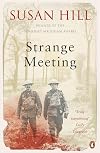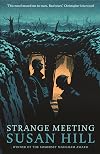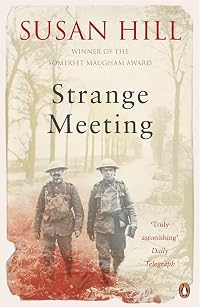
Strange Meeting
by Susan Hill
On This Page
Description
'He was afraid to go to sleep. For three weeks, he had been afraid of going to sleep...'Young officer John Hilliard returns to his battalion in France following a period of sick leave in England. Despite having trouble adjusting to all the new faces, the stiff and reserved Hilliard forms a friendship with David Barton, an open and cheerful new recruit who has still to be bloodied in battle. As the pair approach the front line, to the proximity of death and destruction, their strange show more friendship deepens. But each knows that soon they will be separated... show lessTags
Recommendations















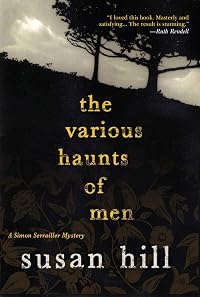
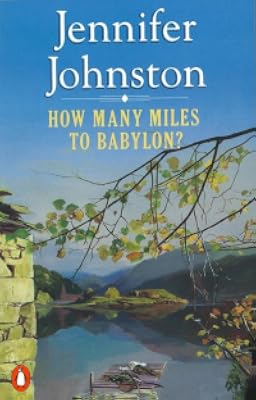
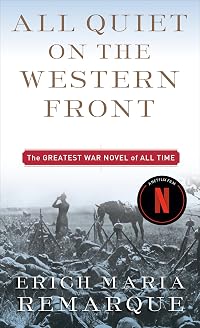
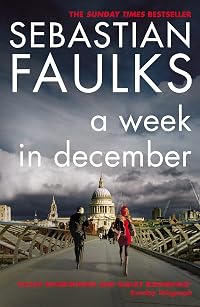

Member Recommendations

Member Reviews
Despite the inevitability of their being sad and depressing, I will persist in reading novels about the First World War. Maybe I’d stop if there wasn’t so much well-written fiction about the war, and indeed wars in general. In this case, 'Strange Meeting' is an account of the relationship between two officers over a relatively short period in training camps and trenches. Said relationship is ambiguously homoerotic, but I read it as an intense romantic friendship. It was very moving to see the two young men find comfort in each other’s company in appalling conditions. Their conversations about how to bear the pointless and cruel loss of life all around them were very powerful. Perhaps the most notable aspect of their relationship show more is that they are totally honest with each other - for Hillard, the older officer, this is something he has never experienced with another person. The two can admit to weakness in each other’s company in a way that they cannot to others. It is repeatedly noted in the text that there is particular pressure on officers, as they generally lack the supportive bonds of brotherhood that enlisted men have. Moreover, they have to enforce orders that they know are stupid, wrong, and will lead to more pointless deaths.
This monologue from Barton to Hilliard will stay with me:
Of course, the especial pain of reading WWI novels is that they never end happily and this one is no exception. It’s elegantly written and very moving, though. I also appreciated the author’s afterword. Hill comments very straightforwardly that the thing she is most often asked about it is whether the two main characters have a sexual relationship. She says she didn’t write them with that intention, but if they did it would not change anything about the narrative. Moreover, she doesn’t see either of them as entirely straight or gay. This refreshing response allows the reader to interpret as they prefer. As she says, though, it doesn’t really matter, as the point is that the two love each other and that helps them cope with the horrors of the trenches. Their sense of alienation from normal life clearly intensifies their relationship and it is this sense of estrangement from normality that is captured brilliantly by the narrative. 'Strange Meeting' is a miniature masterpiece. show less
This monologue from Barton to Hilliard will stay with me:
"That Private who was snipered - looking at him I could have wept and wept, he seemed to be all the men who had ever been killed, John. I remember everything about him, his face, his hair, his hands. I remember how pale his eyelashes were and I thought of how alive he’d been, how much there had been going on inside him - blood pumping round, muscles working, brain saying do this, do that, his eyes looking at me. I thought of it all, how he’d been born and had a family, I thought of everything that had gone into making him - and it wasn’t that I was afraid and putting myself in his place down there on the ground. I just wanted him alive again, it seemed the only important thing. I just wanted to stay there and look at him, I couldn’t take it in, that he’d been so alive, and then he just lay, spouting out blood and that was that, he was dead, nothing."
Of course, the especial pain of reading WWI novels is that they never end happily and this one is no exception. It’s elegantly written and very moving, though. I also appreciated the author’s afterword. Hill comments very straightforwardly that the thing she is most often asked about it is whether the two main characters have a sexual relationship. She says she didn’t write them with that intention, but if they did it would not change anything about the narrative. Moreover, she doesn’t see either of them as entirely straight or gay. This refreshing response allows the reader to interpret as they prefer. As she says, though, it doesn’t really matter, as the point is that the two love each other and that helps them cope with the horrors of the trenches. Their sense of alienation from normal life clearly intensifies their relationship and it is this sense of estrangement from normality that is captured brilliantly by the narrative. 'Strange Meeting' is a miniature masterpiece. show less
This was a hidden gem. So vibrantly written that it's impossible not to be moved by its pages.
I read the afterword by the author, who claims that completing the novel was a catharsis; an exorcism; a tribute they needed to write for every young man who suffered in WW1. It is not a panorama of the whole war, but a peek into a microcosm (which it performs very well). Clearly this was written with love and care. So many thoughtfully-placed moments and so much poignant dialogue.
I do feel that the writing overindulges in the horrors of the war, and although it's not without purpose, it is what generally puts me off of novels set in this era. The elaborate descriptions, in efforts to be evocative, sometimes throw the pacing off. The plot was show more quite predictable.
Still, 4 stars? The real merit comes from the relationship between the two main characters, and whether/how they are changed by their friendship. Side note: I thought this was an LGBT novel (which is what actually provoked me to read it) but it's quite discreet and could be read as entirely platonic. Nevertheless, I felt myself becoming invested, and turning the pages desperately for a hopeful ending.
Content warnings:war, death, blood, gore, sexism [period-accurate] show less
I read the afterword by the author, who claims that completing the novel was a catharsis; an exorcism; a tribute they needed to write for every young man who suffered in WW1. It is not a panorama of the whole war, but a peek into a microcosm (which it performs very well). Clearly this was written with love and care. So many thoughtfully-placed moments and so much poignant dialogue.
I do feel that the writing overindulges in the horrors of the war, and although it's not without purpose, it is what generally puts me off of novels set in this era. The elaborate descriptions, in efforts to be evocative, sometimes throw the pacing off. The plot was show more quite predictable.
Still, 4 stars? The real merit comes from the relationship between the two main characters, and whether/how they are changed by their friendship. Side note: I thought this was an LGBT novel (which is what actually provoked me to read it) but it's quite discreet and could be read as entirely platonic. Nevertheless, I felt myself becoming invested, and turning the pages desperately for a hopeful ending.
Content warnings:
Short, deeply felt, and infinitely sad. What struck me about "Strange Meeting" is that it seems like such a personal book it is, particularly when one considers that the conflict that it describes represented the industrialization of wartime casualties. Hill's characters seem to be defending the last vestiges of their individuality in the face of a horror to vast for them -- or anyone -- to grasp, and its just heartbreaking to watch. It ends badly, of course, as the particulars of men's lives and experiences are reduced to nothing again and again due to what seems like nothing more than random chance and incredibly bad odds. The author depicts the relationship at the book's center beautifully. It represents, as David Barton's character show more does during the book's first section, an oasis of human feeling, and even, perhaps, an opportunity for emotional growth, that somehow survives in the face of positively inhuman conditions. To her credit, Hill resists the urge to shock her reader with examples of the Great War's atrocities, though I imagine that her description of an unsuccessful attempt to take a German trench will probably stay with me for a while. Her writing, though never flowery, is lyrical and understated: the novel's focus remains on the things that get her characters through their ordeal. A fine addition the already extensive canon of literature about one of modernity's defining -- and most terrible -- events. Recommended. show less
Strange Meeting is a story of male friendship in the midst of war. John Hilliard is a young officer returning to France (WWI) after recuperating from a leg injury. If truth be told he is glad to be back, as the stay at home with his emotionally distant family has not been all that therapeutic. Losses were many in his absence and among the many new faces is David Barton, another young officer who he must share a room for a few weeks with. David is a much-liked, open, good-natured and congenial fellow—very different from John—but a friendship develops between the two. Soon, the unit which has been back away from the front lines on a kind of respite, is to be sent forward again and John is loathe to see David be changed by the real show more horrors of war as he has been.
In vividly descriptive prose, Hill brings alive through these two men a moment in history in all its inglorious and psychological detail. There's an appropriately subdued tone, perhaps a respectful mournfulness to the book which hangs heavy over the story and Hill does not gratuitously belabor any gore—she does not need to—a tribute to her skill as a writer. The end result of all of this is a riveting and subtly powerful book that transcends its 179 pages. show less
In vividly descriptive prose, Hill brings alive through these two men a moment in history in all its inglorious and psychological detail. There's an appropriately subdued tone, perhaps a respectful mournfulness to the book which hangs heavy over the story and Hill does not gratuitously belabor any gore—she does not need to—a tribute to her skill as a writer. The end result of all of this is a riveting and subtly powerful book that transcends its 179 pages. show less
I had never read a book by Susan Hill before and read this one only because of its subject matter. This is a beautifully composed and written book about the close friendship between two young men in the British Army in the earlier stages of World war I. Its structure is quite simple - one of them returns to the war after a minor injury, meets the other on the slow progress up the line towards the front and there they meet their (differing) fates. The prose is quite spare but beautifully descriptive, and athough almost totally about men (there are just a few tangential female characters) the female author has captured beautifully and realistically, it seems to me, the relationship which grows between a very reserved man and a very open show more one, at a time of great stress. The book is not very long; it is decidedly anti-war without being stridently so. show less
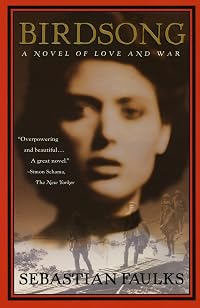
Beautifully written story of two men during World War I. Hill explores the sense of bewilderment, futility, despair and meaninglessness in a story that while firmly rooted in the conflict manages to be much more than just a war story. It's a fairly short novel, but somehow manages to say so much more than books that are eight times it's length (such as Birdsong). One of the most moving accounts of the war I have ever read, and I can honestly say that I experienced my own sense of loss once I came to the end.
Fabulous trip down memory lane regarding some iconic (as well as some less well known) children's television series. Packed full of interesting details for enthusiasts and casual readers alike, go back to the days when British show more television companies took children's drama seriously, spending time crafting a quality product.
I loved this book.
© Koplowitz 2009 show less
Fabulous trip down memory lane regarding some iconic (as well as some less well known) children's television series. Packed full of interesting details for enthusiasts and casual readers alike, go back to the days when British show more television companies took children's drama seriously, spending time crafting a quality product.
I loved this book.
© Koplowitz 2009 show less
Moving and heartbreaking, I thought it was brilliant how a woman writer takes on this intensely male and tough subject.
Members
- Recently Added By
Lists

World War I Fiction
94 works; 15 members
THE WAR ROOM
813 works; 24 members
Author Information

125+ Works 18,936 Members
Susan Hill was born in Scarborough, United Kingdom on February 5, 1942. She received a degree in English from King's College in London in 1963. Her first book, The Enclosure, was published during her first year at university. She worked as a freelance journalist between 1963 and 1968 and has been a monthly columnist for the Daily Telegraph since show more 1977. She founded her own publishing company, Long Barn Books, in 1996 and publishes a literary magazine called Books and Company. She has written works of fiction and non-fiction as well as children's books. She also edits short story compilations. Her works include Gentleman and Ladies, A Change for the Better, The Woman in Black, The Mist in the Mirror, and the Simon Serrailler Crime Novel series. She has won numerous awards including a Somerset Maugham Award for I'm the King of the Castle, the Whitbread Novel Award for The Bird of Night, the John Llewellyn Rhys Prize for The Albatross, and the Smarties Prize for Can It Be True? (Bowker Author Biography) show less
Series
Belongs to Publisher Series
Nonpareil Books (1992)
Common Knowledge
- Original publication date
- 1971
- People/Characters
- John Hilliard; David Barton
- Important places
- London, England, UK; Cherbourg, Manche, Normandy, France; Feuvry, Hauts-de-France, France (fictional)
Classifications
Statistics
- Members
- 397
- Popularity
- 78,846
- Reviews
- 14
- Rating
- (3.85)
- Languages
- English, German
- Media
- Paper, Audiobook, Ebook
- ISBNs
- 16
- ASINs
- 7