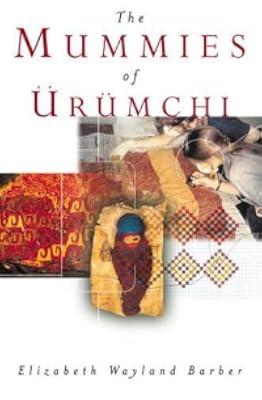
The Mummies of Ürümchi
by Elizabeth Wayland Barber
On This Page
Description
Examines the mummies located in the museums of Ürümchi, in Chinese Turkestan, which are from a blond Caucasian group of people dating as much as 4,000 years ago.Tags
Recommendations



















Member Recommendations

Member Reviews
Not really about the mummies of Ürümchi but interesting nevertheless. Ürümchi is where the museum displaying the mummies is, not where they were found; the museum is in the Xinjiang Uyghur Autonomous Region in northwest China, and things are kind of dicey there; the Uyghurs and the ethnic Chinese are not on the best of terms. The mummies are not artificially prepared bodies like Egyptian mummies but naturally preserved by cold, salty soil; author Elizabeth Wayland Barber doesn’t get to examine the mummies scientifically but just gets to see them in glass cases, just like any other museum visitor. She does get to examine textiles found with the mummies – she’s a textile specialist – and that’s pretty fascinating; the people show more of the time were excellent and artistic weavers. And they weren’t Chinese, but Caucasian -whatever that means – and they used an Indo-European language.
Barber spins this into a fascinating narrative, incorporating the history of weaving, the history of Indo-European language, and the history of the Western and Chinese exploration of the Tarim Basin. She tiptoes around the problems between Uyghurs and ethnic Chinese; I imagine she probably wants to continue to do research in the area and doesn’t want to get in trouble with the Chinese government.
Lots of illustrations- line drawings, historic photographs, and color plates. The illustrations do an excellent job of explaining the weaving techniques. And lots of good maps – almost every chapter leads off with a map that covers the subject under discussion. End notes and a thorough bibliography. Recommended. show less
Barber spins this into a fascinating narrative, incorporating the history of weaving, the history of Indo-European language, and the history of the Western and Chinese exploration of the Tarim Basin. She tiptoes around the problems between Uyghurs and ethnic Chinese; I imagine she probably wants to continue to do research in the area and doesn’t want to get in trouble with the Chinese government.
Lots of illustrations- line drawings, historic photographs, and color plates. The illustrations do an excellent job of explaining the weaving techniques. And lots of good maps – almost every chapter leads off with a map that covers the subject under discussion. End notes and a thorough bibliography. Recommended. show less
Ten years ago I spent a very cold snowy week in Urumchi waiting for my husband to pitch up from the Mongolian border. To while away the time, I went to the local museum which although technically open had all the lighting switched off. After some persuasion, which involved the greasing of palms, I persuaded one of the museum attendants to leave her cosy little room at the entrance and let me follow her through freezing, dark corridors to a gallery where she finally switched on a couple of lights and there, in dusty glass cases, I saw these amazing mummies. I had not known what I was going to see, and had no background information about them, but they were absolutely fascinating, and made me realise just how long the Silk Road had been show more in existance as one of mankind's great thoroughfares across our globe. A couple of years later this book was published and I fell on it with glee. It helped me understand what I had seen and put it in historical context. Barber is an expert in ancient textiles, so much of the book is devoted to the fabrics found wrapping and clothing the mummies however if anyone is paying a visit to this remote western part of China it is a book well worth reading in advance as it explains so much about the region and it's ancient history. show less
Barber describes the mummies found at Urumchi, Loulan and Cherche, located in the Tarim Basin, Central Asia. She focuses on the textiles found on these mummies and compares them with the tartan found on mummies found in ancient salt mines near Salzburg, Austria. The types of materials, weaves, types of looms, as well as the origin and spread of weaving technology is examined, and compared with neighbouring cultures. The world these ancient people inhabited is examined in an attempt to piece together their history and peculiar Western connections, both from what Barber personally observed and from the testimony of others who explored the Silk Road centuries earlier. Linguistic clues are also examined, as well as (then) newly discovered show more scripts and thus languages dubbed Tokharian. The historical movement of various groups of people are examined, taking into account the physical geography and changing climate of the area. Barber provides a riveting historical adventure during which an exotic and relatively unknown world is gradually revealed. The book contains numerous maps and many colour photographs.
This is an informative and interesting book that examines where various people making their home in the Tarim Basin came from, how they lived, their movements, their associations to the East (China) and West (Europe, Near East), and what eventually happened to them. Barber has an easy-going writing style that manages to remain professional but not dull or boring. show less
This is an informative and interesting book that examines where various people making their home in the Tarim Basin came from, how they lived, their movements, their associations to the East (China) and West (Europe, Near East), and what eventually happened to them. Barber has an easy-going writing style that manages to remain professional but not dull or boring. show less
I would recommend reading the hardback version rather than the paperback..the maps and photos are reduced to the point of uselessness. And some of the maps weren't that great to begin with.
That said, this is a highly readable account. The detailed analysis is a visual one - based on close observation of how textiles were made and fashioned into garments. It does not contain a forensic analysis of the bodies themselves.
It is a shame the book is being sold as a 'mystery' with the (possible) blue -eyed, tartan- weaving folk presented (by the publisher, not the author)as some kind of lost tribe of Celts. It is an interesting account in its own right and the preservation of the textiles and the features of the mummies is amazing enough show more without a need to sensationalise. show less
That said, this is a highly readable account. The detailed analysis is a visual one - based on close observation of how textiles were made and fashioned into garments. It does not contain a forensic analysis of the bodies themselves.
It is a shame the book is being sold as a 'mystery' with the (possible) blue -eyed, tartan- weaving folk presented (by the publisher, not the author)as some kind of lost tribe of Celts. It is an interesting account in its own right and the preservation of the textiles and the features of the mummies is amazing enough show more without a need to sensationalise. show less
Illuminating but esoteric history for Xinjiang buffs.
A Weaver looks at the mummies being found in Western China. A great book on the history of weaving, or rather, the evolution of weaving.
240 pages of information with extensive index & bibliography
Members
- Recently Added By
Lists

Handweavers Resources
30 works; 2 members

One Book, Many Authors
441 works; 40 members
Author Information

15+ Works 2,573 Members
Elizabeth Wayland Barber is the author of six books, including Women's Work The First 20,000 Years and The Mummies of rmchi. A professor emerita at Occidental College and a research associate at the Cotsen Institute of Archaeology, UCLA, she also teaches and choreographs for Occidental's Folk and Historical Dance Troupe, which she founded in 1971.
Some Editions
Awards and Honors
Awards
Common Knowledge
- Canonical title
- The Mummies of Ürümchi
- Alternate titles
- The Mummies of Ürümchi
- Original publication date
- 1999
- Important places
- Urumchi; Silk Road; Tarim Basin; China; Mongolia; Xinjiang, China
- Epigraph
- So, before the eyes of history has come a nation,
from whence is unknown;
Nor is it known how it scattered
and disappeared without a trace.
-- Nicholas Roerich
painter, philosopher,
traveler to Central ... (show all)Asia, 1926 - Dedication
- To Paul who supported me in a thousand ways AND to Irene and Victor who became valued friends during an unforgettable expedition
- First words
- So might the fashion page of the Tarim Times have read, around 1000 B.C., if anyone in the Tarim Basin of Central Asia had known how to read or write.
- Last words
- (Click to show. Warning: May contain spoilers.)And Dolkun, pointing to his own Caucasian face and pale brown hair, answers when his audience asks why all those early Caucasians disappeared: "We are not gone -- we are still here. . . .I am still here!"
Classifications
Statistics
- Members
- 543
- Popularity
- 54,636
- Reviews
- 9
- Rating
- (4.04)
- Languages
- English, Spanish
- Media
- Paper
- ISBNs
- 6
- ASINs
- 4