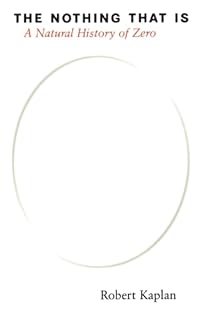
The Nothing that Is: A Natural History of Zero
by Robert Kaplan
On This Page
Description
Explores history to find evidence that humans have long struggled with the concept of zero, from the Greeks who may or may not have known of it, to the East where it was first used, to the modern-day desktop PC, which uses it as an essential letter in its computational alphabet.Tags
Recommendations






Member Reviews
This book has a ton of fake profundity, probably meant to be humourous and probably the most complete treatment of the Babylonian number system in a popular work. The first half of the book has a lot of fake profundity and very little mathematics, but the second part redresses the balance somewhat.
A brief discussion of individual chapters through chapter 10.
Chapter 1: Ancient number systems, including the Babylonian one. The Babylonian numbers in the book are aesthetically appealing.
Chapter 2 through 9: Fake profundity and a history of the concept and representation of zero.
Chapter 10: A bunch of abstract algebra presented lightly; deducing the necessary properties of 0 and confronting the predicament of 0^0 (which must be either 1 or 0 show more or possibly neither). Some simple group theory and the difference of squares technique for factoring polynomials. No general statements about when difference of squares is guaranteed to work, which disappoints me. show less
A brief discussion of individual chapters through chapter 10.
Chapter 1: Ancient number systems, including the Babylonian one. The Babylonian numbers in the book are aesthetically appealing.
Chapter 2 through 9: Fake profundity and a history of the concept and representation of zero.
Chapter 10: A bunch of abstract algebra presented lightly; deducing the necessary properties of 0 and confronting the predicament of 0^0 (which must be either 1 or 0 show more or possibly neither). Some simple group theory and the difference of squares technique for factoring polynomials. No general statements about when difference of squares is guaranteed to work, which disappoints me. show less
This is hard to review as it's on two opposite ends - fascinating subject satisfactorily explored and the purplest prose I've encountered. The history is dense, the math is surprisingly accessible, and the philosophy is heavily Christian.
Is it possible that Kaplan is a fan of Good Omens, or is it just coincidence that there are multiple references to things found in that book? Ussher's prediction of the exact hour when the world would end, "prestidigitation" in the same paragraph as angels dancing on the head of a pin, among others. Perhaps those were just common topics decades ago 😂.
Is it possible that Kaplan is a fan of Good Omens, or is it just coincidence that there are multiple references to things found in that book? Ussher's prediction of the exact hour when the world would end, "prestidigitation" in the same paragraph as angels dancing on the head of a pin, among others. Perhaps those were just common topics decades ago 😂.
This is a book that, a few years ago, made the perfect gift for my father, who has told me that he's read it several times. And so it's the perfect book to try and polish off while I'm visiting. (Because he'll miss it if I try to sneak off with it.) (My father does this too when visiting me. We both have more books than we can keep track of.)
However it was also a book which I didn't give myself enough time to read. While the book is not entirely made up of them, every now and then there would be - I have no better way to describe it - story problems. No no, don't run away in horror if you are somewhat math-phobic - you don't have to actually solve anything, and could actually just hop over those bits. But in and around those story show more problems were also ideas that really made me want to sit back, rethink the statements, and actually read parts over again. This is also the point at which I wanted footnotes - but I'll rant on that in a bit. But the main point here is that Kaplan is telling the history of something I'd never put much thought into, and made me rethink the way math was taught to me. Looking back I really with we'd had history of math along with math itself, but I can see why that rarely happens - there is only so much class time to get through everything.
One of the things that's still causing me amazement is the idea that when the Greeks memorized complicated mathematical computations they were doing them mentally with words - because there weren't numerals in the sense we knew them, numbers to them were represented by words. (Remember the old fashioned written checks? That line where you'd write the entire amount out in word form? Think of that. Now think of using that format with all forms of mathematics.) That's a vast amount to juggle in your memory, especially if you include the fact that they also didn't use zero as a placeholder for the larger numbers.
Also the book made me realize how many mathematicians from other cultures I never was introduced to, and curious to read more of their histories.
I should add here that this book would have easily rated four stars (Kaplan tells history in a delightful way) if not for the citation issue. It was also a problem in that I was reading the book in paper and stopping to go online to read cites every time I was interested in one wasn't easily done - if I'd read this in ebook form with cites it wouldn't have been an issue.
Citations and Sources
In a book like this citations are a big deal - well, for me-the-reader that is, and for anyone using this as part of a paper or secondary research material. The book gives you a url to check (and seems somewhat long in this day of "we can create shortened urls") which then refers you to this page: Oxford University Press, The Nothing That Is, which provides another link to the PDF of the citations (and a link to a quiz). Which makes me wonder - were the citations not ready at the time of publication? Did Kaplan just want them in a form he could easily update? Did the publisher quibble at the length of the citations? (The book is only 225 pages, so I doubt the later.) Is a PDF really the best format for this? (That PDF of footnotes is 170 pages long - and yes, I'll read them all. I'd rather have them with the rest of the text though.) It's kinda irritating to have to check this document just to see if there's a citation somewhere, because the book gives no indication whether or not there'll be a cite, footnote, or anything. (To be fair, it's not the first to use this style of endnotes. It's just divorcing them from the paper text that seems a bit odd to me.)
Easily accessible footnotes are a somewhat critical point when the author is citing multiple ancient sources in his text, and notes that there are multiple ancients who disagree on which culture came up with the concept of zero (apparently Greek, Hindu, Syrian, Chaldean - all were working on various aspects of sciences that were in the neighborhood of the idea of zero.) In this kind of situation it's helpful to know what translation an author used (whether the same translator was used for multiple sources, or whether the author translated texts himself, etc.), how easily the text is to refer to (ex, I can find it on Amazon vs. it's long out of print), etc. People who write about math are usually very adamant about exact citations - and that's not a gross generalization when these are the same folk that love their proofs.
Here's a specific example that happens multiple times in the book, p. 97:
Source info, SHORT version: Book has an index, but no bibliography. If you want to know the texts used you must cull through the online citations - there's no stand-alone bibliography, all information is within the notes. If you use this text as a reference do make note that the paper version has cites online (your professor will thank you). I'm assuming that the ebook version has them included, since that would be logical.
Mentioned in book, so interesting that it sent me googling (not in any order): Karl Lang-Kirnberg, Gerbert/Pope Sylvester II (Gerbert's aspices), Bhaskara, Diophantus, Heron, Pappus, Thymaridas, Plato's Timaeus, Petrus of Dacia, Adelard of Bath, psephos (counting stone), Al-Khowarizmi, Mahavira, Brahmagupta, James Ussher/Archibishop of Armagh, Ruth Benedict, Avicenna (autobiography of), Mancala or Kalaha (game), Manichaeism, Alexander de Villa Dei, John Sacrobosco, Filius Bonacci (Fibonacci), Nicolas Chuquet (Lyons 1484), Tally-stick, Counting board, Italy and double entry bookkeeping, Mattaus Schwartz and Jakob Fuller the Rich, Lucas Pacioli, Ulrich Wagner, Adam Riese, John Palegrave, Gregor Reisch, Nicole Oresme Bishop of Normandy, Michael Stifel, Pierre de Fermat, jeroboam, Kurt Godel, John Napier baron of Merchiston, Flann O'Brien and The Third Policeman, Gottfried Wilhelm Leibniz, Johann Bernoulli
Normally I'd link all of those to wikipedia - but you can see how many there are. That all of these made me want to read more history? A positive thing.
[An aside - I wasn't able to find anyone discussing these books of Kaplan in light of his other work. So I'm still unsure how I feel about this. Also assuming that Dr. Robert-Michael Kaplan is the same Kaplan who wrote the book I'm reviewing.]
I was at first somewhat concerned with buying this book for my father because I noticed that Kaplan has written books on eyesight like Seeing Without Glasses. This immediately worried me that it might be along the lines of the Bates System of Eye Exercises which came out in the 1940s, but which was still kicking about in the 1970s, and apparently still around today. I have vision such that I can't see much of anything without glasses, so this sort of thing annoys me in that there are a large amount of eye conditions where the vision can't be improved. (Personal bias here: I was placed in contacts at an early age to reduce the speed at which my vision was worsening. It's somewhat inconclusive as to how much this helped or whether the amount my vision was worsening naturally slowed down - but since I now have peripheral vision with contacts I'm not complaining!) Most of us wearing glasses aren't going to be able to cure the problem with exercise. Why would it matter what other books Kaplan wrote? Well, perhaps this is my bias, but if someone was promoting something that's not proven by science in another field, I'd worry about the rigor of their research and theory in other fields. Perhaps somewhat unfair on my part to judge other books by the subject of another, but I'm skeptical that way.
Quotes I enjoyed/pondered:
p 31:
p 37:
p 38, where I miss an easy to look up citation while reading, as the Marlow reference makes me curious:
p 39:
p. 45:
p 52:
p 66, about Adelard of Bath, returning from many travels:
Am I the only one who wonders if that recipe for toffee was any good, and who the researcher was that bumped into it years later?!!!
p 68:
p 70:
p 85, compulsive counting:
p 88, Mayans and zero:
However it was also a book which I didn't give myself enough time to read. While the book is not entirely made up of them, every now and then there would be - I have no better way to describe it - story problems. No no, don't run away in horror if you are somewhat math-phobic - you don't have to actually solve anything, and could actually just hop over those bits. But in and around those story show more problems were also ideas that really made me want to sit back, rethink the statements, and actually read parts over again. This is also the point at which I wanted footnotes - but I'll rant on that in a bit. But the main point here is that Kaplan is telling the history of something I'd never put much thought into, and made me rethink the way math was taught to me. Looking back I really with we'd had history of math along with math itself, but I can see why that rarely happens - there is only so much class time to get through everything.
One of the things that's still causing me amazement is the idea that when the Greeks memorized complicated mathematical computations they were doing them mentally with words - because there weren't numerals in the sense we knew them, numbers to them were represented by words. (Remember the old fashioned written checks? That line where you'd write the entire amount out in word form? Think of that. Now think of using that format with all forms of mathematics.) That's a vast amount to juggle in your memory, especially if you include the fact that they also didn't use zero as a placeholder for the larger numbers.
Also the book made me realize how many mathematicians from other cultures I never was introduced to, and curious to read more of their histories.
I should add here that this book would have easily rated four stars (Kaplan tells history in a delightful way) if not for the citation issue. It was also a problem in that I was reading the book in paper and stopping to go online to read cites every time I was interested in one wasn't easily done - if I'd read this in ebook form with cites it wouldn't have been an issue.
Citations and Sources
In a book like this citations are a big deal - well, for me-the-reader that is, and for anyone using this as part of a paper or secondary research material. The book gives you a url to check (and seems somewhat long in this day of "we can create shortened urls") which then refers you to this page: Oxford University Press, The Nothing That Is, which provides another link to the PDF of the citations (and a link to a quiz). Which makes me wonder - were the citations not ready at the time of publication? Did Kaplan just want them in a form he could easily update? Did the publisher quibble at the length of the citations? (The book is only 225 pages, so I doubt the later.) Is a PDF really the best format for this? (That PDF of footnotes is 170 pages long - and yes, I'll read them all. I'd rather have them with the rest of the text though.) It's kinda irritating to have to check this document just to see if there's a citation somewhere, because the book gives no indication whether or not there'll be a cite, footnote, or anything. (To be fair, it's not the first to use this style of endnotes. It's just divorcing them from the paper text that seems a bit odd to me.)
Easily accessible footnotes are a somewhat critical point when the author is citing multiple ancient sources in his text, and notes that there are multiple ancients who disagree on which culture came up with the concept of zero (apparently Greek, Hindu, Syrian, Chaldean - all were working on various aspects of sciences that were in the neighborhood of the idea of zero.) In this kind of situation it's helpful to know what translation an author used (whether the same translator was used for multiple sources, or whether the author translated texts himself, etc.), how easily the text is to refer to (ex, I can find it on Amazon vs. it's long out of print), etc. People who write about math are usually very adamant about exact citations - and that's not a gross generalization when these are the same folk that love their proofs.
Here's a specific example that happens multiple times in the book, p. 97:
"Even for those immune to superstition, zero as a number 'donnant ombre et encombre,' as a fifteenth-century French writer put it: a shadowy, obstructive number."Writers or scholars are vaguely referred to like this - if only once I'd think it might be someone nameless due to the age of the text. Without an immediate citation, I'm at sea. [If you look this up in the notes, this is referred to as "vdW 59; M 422." I'm still working out what vdW refers to - there's not a separate bibliography. The first reference to vdW in that PDF is from page 7 - but I don't see anything prior to that that could be a "acronymic reference" - feel free to help me out on this, anyone.]
Source info, SHORT version: Book has an index, but no bibliography. If you want to know the texts used you must cull through the online citations - there's no stand-alone bibliography, all information is within the notes. If you use this text as a reference do make note that the paper version has cites online (your professor will thank you). I'm assuming that the ebook version has them included, since that would be logical.
Mentioned in book, so interesting that it sent me googling (not in any order): Karl Lang-Kirnberg, Gerbert/Pope Sylvester II (Gerbert's aspices), Bhaskara, Diophantus, Heron, Pappus, Thymaridas, Plato's Timaeus, Petrus of Dacia, Adelard of Bath, psephos (counting stone), Al-Khowarizmi, Mahavira, Brahmagupta, James Ussher/Archibishop of Armagh, Ruth Benedict, Avicenna (autobiography of), Mancala or Kalaha (game), Manichaeism, Alexander de Villa Dei, John Sacrobosco, Filius Bonacci (Fibonacci), Nicolas Chuquet (Lyons 1484), Tally-stick, Counting board, Italy and double entry bookkeeping, Mattaus Schwartz and Jakob Fuller the Rich, Lucas Pacioli, Ulrich Wagner, Adam Riese, John Palegrave, Gregor Reisch, Nicole Oresme Bishop of Normandy, Michael Stifel, Pierre de Fermat, jeroboam, Kurt Godel, John Napier baron of Merchiston, Flann O'Brien and The Third Policeman, Gottfried Wilhelm Leibniz, Johann Bernoulli
Normally I'd link all of those to wikipedia - but you can see how many there are. That all of these made me want to read more history? A positive thing.
[An aside - I wasn't able to find anyone discussing these books of Kaplan in light of his other work. So I'm still unsure how I feel about this. Also assuming that Dr. Robert-Michael Kaplan is the same Kaplan who wrote the book I'm reviewing.]
I was at first somewhat concerned with buying this book for my father because I noticed that Kaplan has written books on eyesight like Seeing Without Glasses. This immediately worried me that it might be along the lines of the Bates System of Eye Exercises which came out in the 1940s, but which was still kicking about in the 1970s, and apparently still around today. I have vision such that I can't see much of anything without glasses, so this sort of thing annoys me in that there are a large amount of eye conditions where the vision can't be improved. (Personal bias here: I was placed in contacts at an early age to reduce the speed at which my vision was worsening. It's somewhat inconclusive as to how much this helped or whether the amount my vision was worsening naturally slowed down - but since I now have peripheral vision with contacts I'm not complaining!) Most of us wearing glasses aren't going to be able to cure the problem with exercise. Why would it matter what other books Kaplan wrote? Well, perhaps this is my bias, but if someone was promoting something that's not proven by science in another field, I'd worry about the rigor of their research and theory in other fields. Perhaps somewhat unfair on my part to judge other books by the subject of another, but I'm skeptical that way.
Quotes I enjoyed/pondered:
p 31:
"...The fact remains that Archimedes worked with number names rather than digits, and the largest of the Greek names was 'myriad,' for 10,000."
p 37:
"...Names belong to things, but zero belongs to nothing. It counts the totality of what isn't there. By this reasoning it must be everywhere with regard to this and that: with regard, for instance, to the number of humming-birds that that bowl with seven - or now six - apples. Then what does zero name? It looks like a smaller version of Gertrude Stein's Oakland, having no there there."
p 38, where I miss an easy to look up citation while reading, as the Marlow reference makes me curious:
"...Even an early edition of the Surya Siddhanta - the first important Indian book on astronomy - claimed the work to be some 2,163,500 years older than it has since been shown to be (though this revising wasn't made in time to excuse Christopher Marlowe, accused of atheism partly for pointing out that Indian texts predated Adam)."
p 39:
"...the fulfillment of every schoolboy's dream: the examiner prostrates himself before the youth and exclaims: 'You, not I, are the master mathematician!' "
p. 45:
"...Or was it that the Indians, like the Greeks, tended to equate wisdom, knowledge and memory, so that important matters such as mathematics were written in the memorable form of verse."
p 52:
"...The counting board sprinkled with green sand and blue sand that Remigius of Auxerre described in 900 AD sounds like something one would dearly love to own - but since he says that figures were drawn on it with a pointer (radius), it belongs to the same tradition, which also produced the wax tablets that Horace's schoolboy hung over his arm, and the slates that long after screeched in village schoolrooms."
p 66, about Adelard of Bath, returning from many travels:
"...And he brought back with him precious manuscripts, the real treasures of the East: a treatise on alchemy thinly disguised as a text on mixing pigments (though it also contained a recipe for making toffee), works on how to build foundations under water and how rightly to spring vaulted structures. He wrote a book of his own on falconry, in the form of a dialogue with his nephew."
Am I the only one who wonders if that recipe for toffee was any good, and who the researcher was that bumped into it years later?!!!
p 68:
"...One of our commonest words for zero, 'null,' comes from the medieval Latin nulla figura, 'no number,' and a Frenchman, writing in the fifteenth century, expressed the popular view well: 'Just as the rag doll wanted to be an eagle, the donkey a lion and the monkey a queen, the zero put on airs and pretended to be a digit.' "
p 70:
"...Think of the situation with words and with ideas. New words are always frisking about us like puppies - one month people go 'ballistic' and the next 'postal' - but few settle in companionably over the years and fewer still reach that venerable state where we can't imagine never having been able to whistle them up, there at our bidding. ...
...But the Republic of Numbers is vastly more conservative than those of language or ideas: Swiss in its reluctance to accept new members, Mafiesque in never letting them go, once sworn in. Think of irrational numbers, the guilty secret of the Pythagoreans, whose exposure shook Greek confidence to the core. Twenty-five hundred years later we can't do without them, though the sense in which they exist is debated still. And imaginaries? Mathematicians, who love high-wire acts, began thinking about the square roots of numbers as far back as Heron and Diophantus, but whenever these came up as solutions of equations they were called fictitious and the equations judged insoluble. Then in the Renaissance people began to calculate them, fictitious though they were."
p 85, compulsive counting:
"...Some have reached accommodation with their monster: Sir Francis Galton, cousin of Darwin and the father of Eugenics, counted everything in sight and even had gloves made up for him with pistons that drove ten separate counters, so that he could unobtrusively keep track of the percentage of beautiful women in Macedonian villages while tallying up the average price of goods in their shop windows. Others have just given themselves up, like the otherwise lumpish farm-hand Jedediah Buxton, who in the eighteenth century couldn't help calculating how many hair-breadths wide was every object in his path; and who, when taken to London as a treat to see the great Garrick in a play, announced at its end precisely how many words each actor had spoken, and how many steps they had taken in their dances."
p 88, Mayans and zero:
"...I mentioned that the gods of the underworld, the nine Lords of the Night, were ruled by the Death God - but I didn't tell you who this death-god was: he was Zero. His was the day of the Haab when time might stop. His was the end of each lesser and greater cycle, fearful pause. Now if a human were found who could take on Zero's personna - and if he could be put to a ritualistic death - then Death would die! And this, it seems, is just what the Maya did. They had a ritual ballgame between a player dressed as one of their hero twins, and one dressed as the God of Zero. The ball was an important hostage, such as a defeated king, who had been kept for many years and was now trussed up for the occasion. The two players skillfully passed and kicked and beat him to death, or killed him in the end by rolling him down a long flight of stairs; and it was the hero twin who always won by outwitting Zero. In other such games, the loser was sacrificed. But outwitting death wasn't enough. A human would be dressed in the regalia of the God of Zero, and then sacrificed by having his lower jaw torn off. As with most religions, the failure of ritual to achieve its aim didn't alter it, since even the barbarous live in hope."show less
This interesting little book caught my eye in the stacks of the local public library when I was searching for something else. It recounts the history of the concept of zero and the struggle over thousands of years to understand how to use it in calculations. The problem for the ancient Sumerians was this: zero is certainly nothing, yet is must also be something since it is a number or a symbol. This presents the perfect validation of the basic tenet of semantics "the word is not the thing that it stands for" as presented by Alfred Korzybski in his book on general semantics. Korzybski also discusses the tricky word 'is' which is also an important part of that seeming contradiction, as well as part of Bill Clinton's defense when he show more responded to an interrogation by asking what did the questioner mean by 'is'. The author continues to tell the story of how various cultures Hindu, Greek, etc. responded in the face of the paradox of being nothing and something at the same time.
In view of the current mania concerning Dec. 21, 2012, the most interesting part of this book for the typical reader will be the chapter on the Maya concept of zero and how they used it in their calendars. The Mayans were clever at math and used zero as a place holder in their computing before the Europeans. The author tells us that the Mayans had a superstition that the gods might chose to end the universe at the end of a calendar. To prevent this, the Mayans used six calendars with incommensurable periods so that they would never all end on the same day. The longest of these stretched over 68,000,000 years. They also started the first day of a new calendar unit with human sacrifice to appease the gods and they numbered this day with zero. The author states that they sometimes used the symbol of the god of death for zero although apparently a shell like symbol was more common. (In an example of Mayan denumeration shown in an article by E.E. Krupp in the November 2009 issue of "Sky and Telescope", there were several different symbols for zero, possibily indicative of what kind of thing there was none of. Thus they may not have had the abstract idea of the number zero, but they did have the idea of a place holder, or operator concept of zero. The zero day may have been merely an interlude between the old and new calendars in which the gods could be influenced to continue the universe.) It seems that the primitive Mayan superstition concerning the end of calendars has been transplanted into modern American culture; we hope without the human sacrifice part.
The story continues with the history of zero in the European area. There it was associated with evil or the devil, ideas about as crazy as the Mayans, but at least without the sacrificial aspects. It seems that it was the commercial value of using zero in bookeeping that finally turned the tide and zero was finally accepted as a number, but not untill the renaissance.
In the last half of the book the author discusses the role of zero in the present day. He gives a method of factorization using zero which generalizes completion of the square. A set of postulates for an integral domain are introduced to discuss the problem that zero is still a chimera for many people since it is the only number which cannot be a divisor. Von Neumann enters the picture to show how to identify zero with the empty set and thus create all numbers out of absolutely nothing (at least no material thing) in a completely logical way. In a sense, this resolves the conflict between zero as nothing and as a number. The basic rules of differential calculus are given to discuss the problem which some people still have with the limit dx -> 0 when it is necessary to keep dividing by dx all the way. Real variable theory now provides a logical resolution to this problem. With real numbers defined by Cauchy series and Dedekind cuts, taking limits appears completely natural and is completely logical.
However in spite of the valiant efforts of Von Neumann, Cauchy, and Dedekind the struggle continues to the present day, but now the arena is more in physics than mathematics. The author (a mathematcian) touches only briefly on this aspect. The present situation can be understood by reference toFrank Wilczek's book "The Lightness of Being", p. 84, where Wilczek tells us that in a private conversation, Richard Feynman admitted that in his youth, his view of empty space was "there's nothing there". Later in the conversation he says that he was deeply disappointed that quantum electrodynamics (QED) could not be developed without the concept of the field; but the mathematics needed fields. Indeed, in his book "QED, the Strange Theory of Light and Matter", he discribes the fundamental principles of that subject without using the word 'wave' or the word 'field'. Since it is now an accepted experimenatal fact the particles can appear out of 'empty' space, one may partly agree with Feynman that there was NO THING there, but one must think that there was something there (possibly intangible or immaterial but not nothing), or equate that creation of particles to shear magic. This would mean that our logic and our sciences were all really worthless. The scientific answer to what 'something' was there is 'non material fields' of various types. Of course there are many people besides Feynman that are emotionally disturbed by the suggestion that the intangible or immaterial could be real, maybe because the word 'spiritual' could be used to describe those conditions. Feynman's dilemma continues for many people up to the present. So this confronts most of the current world with the same semantic riddle which confronted the Sumerians 5000 years ago: 'nothing' which is also 'something'. The more things change the more they are the same.
For a number nut (like me) this book is marvelous recreational reading, but it could be educational reading for a person who did not understand or believe that mathematics can have an important impact on our culture and intellectual life. This book could also be an easy introduction to abstract mathematical thinking for a mature person. show less
In view of the current mania concerning Dec. 21, 2012, the most interesting part of this book for the typical reader will be the chapter on the Maya concept of zero and how they used it in their calendars. The Mayans were clever at math and used zero as a place holder in their computing before the Europeans. The author tells us that the Mayans had a superstition that the gods might chose to end the universe at the end of a calendar. To prevent this, the Mayans used six calendars with incommensurable periods so that they would never all end on the same day. The longest of these stretched over 68,000,000 years. They also started the first day of a new calendar unit with human sacrifice to appease the gods and they numbered this day with zero. The author states that they sometimes used the symbol of the god of death for zero although apparently a shell like symbol was more common. (In an example of Mayan denumeration shown in an article by E.E. Krupp in the November 2009 issue of "Sky and Telescope", there were several different symbols for zero, possibily indicative of what kind of thing there was none of. Thus they may not have had the abstract idea of the number zero, but they did have the idea of a place holder, or operator concept of zero. The zero day may have been merely an interlude between the old and new calendars in which the gods could be influenced to continue the universe.) It seems that the primitive Mayan superstition concerning the end of calendars has been transplanted into modern American culture; we hope without the human sacrifice part.
The story continues with the history of zero in the European area. There it was associated with evil or the devil, ideas about as crazy as the Mayans, but at least without the sacrificial aspects. It seems that it was the commercial value of using zero in bookeeping that finally turned the tide and zero was finally accepted as a number, but not untill the renaissance.
In the last half of the book the author discusses the role of zero in the present day. He gives a method of factorization using zero which generalizes completion of the square. A set of postulates for an integral domain are introduced to discuss the problem that zero is still a chimera for many people since it is the only number which cannot be a divisor. Von Neumann enters the picture to show how to identify zero with the empty set and thus create all numbers out of absolutely nothing (at least no material thing) in a completely logical way. In a sense, this resolves the conflict between zero as nothing and as a number. The basic rules of differential calculus are given to discuss the problem which some people still have with the limit dx -> 0 when it is necessary to keep dividing by dx all the way. Real variable theory now provides a logical resolution to this problem. With real numbers defined by Cauchy series and Dedekind cuts, taking limits appears completely natural and is completely logical.
However in spite of the valiant efforts of Von Neumann, Cauchy, and Dedekind the struggle continues to the present day, but now the arena is more in physics than mathematics. The author (a mathematcian) touches only briefly on this aspect. The present situation can be understood by reference toFrank Wilczek's book "The Lightness of Being", p. 84, where Wilczek tells us that in a private conversation, Richard Feynman admitted that in his youth, his view of empty space was "there's nothing there". Later in the conversation he says that he was deeply disappointed that quantum electrodynamics (QED) could not be developed without the concept of the field; but the mathematics needed fields. Indeed, in his book "QED, the Strange Theory of Light and Matter", he discribes the fundamental principles of that subject without using the word 'wave' or the word 'field'. Since it is now an accepted experimenatal fact the particles can appear out of 'empty' space, one may partly agree with Feynman that there was NO THING there, but one must think that there was something there (possibly intangible or immaterial but not nothing), or equate that creation of particles to shear magic. This would mean that our logic and our sciences were all really worthless. The scientific answer to what 'something' was there is 'non material fields' of various types. Of course there are many people besides Feynman that are emotionally disturbed by the suggestion that the intangible or immaterial could be real, maybe because the word 'spiritual' could be used to describe those conditions. Feynman's dilemma continues for many people up to the present. So this confronts most of the current world with the same semantic riddle which confronted the Sumerians 5000 years ago: 'nothing' which is also 'something'. The more things change the more they are the same.
For a number nut (like me) this book is marvelous recreational reading, but it could be educational reading for a person who did not understand or believe that mathematics can have an important impact on our culture and intellectual life. This book could also be an easy introduction to abstract mathematical thinking for a mature person. show less
Well-written, but prefer the Seife book on zero. This one is just a tiny bit ramblier, quick but not AS ingeniously phrased or structured.
As much interesting history as anything else.
Remove a star if you hate history.
Remove a star if you hate history.
Members
- Recently Added By
Lists

In Our Time books
4,934 works; 2 members
Author Information

5 Works 1,788 Members
Robert Kaplan has taught mathematics to people from six to sixty, most recently at Harvard University. In 1994, with his wife Ellen, he founded The Math Circle, a program, open to the public, for the enjoyment of pure mathematics. He has also taught Philosophy, Greek, German, Sanskrit, and Inspired Guessing. Robert Kaplan lives in Cambridge, MA.
All Editions
Common Knowledge
- Original publication date
- 1999
- People/Characters
- Archimedes of Syracuse
- Dedication
- To Frank Brimsek
3 hours 51 minutes 54 seconds - First words
- If you look at zero you see nothing; but look through it and you will see the world.
- Last words
- (Click to show. Warning: May contain spoilers.)Nothing that is there and the nothing that is.
Classifications
Statistics
- Members
- 1,071
- Popularity
- 23,800
- Reviews
- 9
- Rating
- (3.38)
- Languages
- 7 — Dutch, English, French, German, Italian, Portuguese, Spanish
- Media
- Paper, Ebook
- ISBNs
- 17
- ASINs
- 6