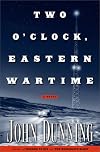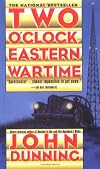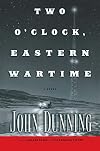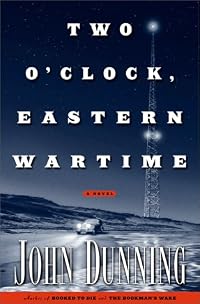
Two O'Clock, Eastern Wartime
by John Dunning
On This Page
Description
As bombs fall on England during the summer of 1942, a brave group of American actors entertains the nation via radio and scriptwriter Jack Dulaney investigates an unsolved murder and the disappearance of singer Holly Carnahan's father.Tags
Recommendations




Member Reviews
John Dunning was a jack-of-all-trades before he came to writing, but he caused a sensation in the mystery community with his novel, Booked to Die- featuring a former police officer turned book collector who solves crimes in the cut throat world of rare and first editions. It’s a subject he knows well, since he keeps some 8000 books, mostly mysteries, in a storage unit near his home in Denver. He has also written books about his other lifelong passion- old time radio, including an encyclopedia on the subject called “On the Air”.
Two O’clock Eastern Wartime combines the best of Dunning’s many talents into a historical novel that recreates the colorful era of wartime radio. Jack Dulaney is a down and out writer on the run from show more the law and his feelings for his best friend’s girl, Holly. But when his friend is killed at Pearl Harbor, and Holly suddenly disappears, Jack defies the hounds at his heels to search for her. He ends up in a coastal town in New Jersey, working as a writer for a radio station that even in this new era of radio had seen better days. He discovers that he has a talent for writing for radio, and soon his dramatic scripts are sizzling across the airwaves, bringing life and energy back into the station. He also discovers that this particular station has a dark past- radio actors have gone missing. Technicians have committed suicide for no reason. And there to his horror is Holly, living under an assumed name, in the center of the intrigue.
Two O’clock Eastern Wartime captures the high feeling of America as it came out of the Depression and entered into World War II. It also is alight with enthusiasm for the power of a new medium: “Radio” says one character, “is the greatest invention of the past four centuries. It ranks right up there with Gutenberg’s moveable type as an earthshaking force.” The author makes some interesting points about the differences involved in writing for radio- the necessity to write in clean, short sentences, with a maximum amount of impact in each word. How the writer must remember he has a listening audience, not a reading one. There can be no turning back the pages to re-read a favorite passage, or check on something that might have been missed earlier. Radio writers have once chance to capture their listener’s attention, and then their words are gone into space.
Dunning’s recreation of studio productions are fascinating - Jack’s radio stories have power and immediacy, perhaps because the cast has had only a day and a half to look at the script, and each production is done live. They reach into people’s living rooms to confront them with issues that had never yet seen print. Like every new art form, radio in this era was seized upon by visionaries- who saw in the medium a huge force for social change. The producers at WHAR, Jack’s fiery yet troubled station, became the first to put a black and white cast in the same studio together, the first to run shows for black audiences during radio’s “prime time”, and the first to run a series of dramas about prisoners of war- including America’s own.
It was, after all, wartime. The coastal town may have been a beach resort, but most of its visitors were soldiers on leave. And citizen patrols marched up and down the beaches at night, watching for enemy invasions or signs of German U-boats. Nationalism was high, and prejudice rampant- people with German ancestry changed their names. Nazi agents tried to recruit, or failing that, intimidate, Germans on American soil into being loyal to the fatherland. Radio writers tread a fine line, between the dogs of the newly created FCC (with its almost unlimited writ) and the US Bureau of Censorship (a wartime institution). It was a thrilling time- when limits were tested and boundaries were crossed. And the word “Art” took on a whole new meaning.
The drive and creativity behind WHAR is in peril, not just from the dark forces that brought Jack to town in the first place, looking for a girl. On the horizon is another new broadcast medium- television.
It is remarkable how quickly it all faded. In less than a decade television had made its debut, and American households traded the imaginative force of live drama for the carefully controlled and choreographed productions of a television studio. It is easy to see what the author thinks of that- we traded an art form for something vastly inferior. Scanning the cable television channels through a myriad of “reality” based shows, one can see his point. show less
Two O’clock Eastern Wartime combines the best of Dunning’s many talents into a historical novel that recreates the colorful era of wartime radio. Jack Dulaney is a down and out writer on the run from show more the law and his feelings for his best friend’s girl, Holly. But when his friend is killed at Pearl Harbor, and Holly suddenly disappears, Jack defies the hounds at his heels to search for her. He ends up in a coastal town in New Jersey, working as a writer for a radio station that even in this new era of radio had seen better days. He discovers that he has a talent for writing for radio, and soon his dramatic scripts are sizzling across the airwaves, bringing life and energy back into the station. He also discovers that this particular station has a dark past- radio actors have gone missing. Technicians have committed suicide for no reason. And there to his horror is Holly, living under an assumed name, in the center of the intrigue.
Two O’clock Eastern Wartime captures the high feeling of America as it came out of the Depression and entered into World War II. It also is alight with enthusiasm for the power of a new medium: “Radio” says one character, “is the greatest invention of the past four centuries. It ranks right up there with Gutenberg’s moveable type as an earthshaking force.” The author makes some interesting points about the differences involved in writing for radio- the necessity to write in clean, short sentences, with a maximum amount of impact in each word. How the writer must remember he has a listening audience, not a reading one. There can be no turning back the pages to re-read a favorite passage, or check on something that might have been missed earlier. Radio writers have once chance to capture their listener’s attention, and then their words are gone into space.
Dunning’s recreation of studio productions are fascinating - Jack’s radio stories have power and immediacy, perhaps because the cast has had only a day and a half to look at the script, and each production is done live. They reach into people’s living rooms to confront them with issues that had never yet seen print. Like every new art form, radio in this era was seized upon by visionaries- who saw in the medium a huge force for social change. The producers at WHAR, Jack’s fiery yet troubled station, became the first to put a black and white cast in the same studio together, the first to run shows for black audiences during radio’s “prime time”, and the first to run a series of dramas about prisoners of war- including America’s own.
It was, after all, wartime. The coastal town may have been a beach resort, but most of its visitors were soldiers on leave. And citizen patrols marched up and down the beaches at night, watching for enemy invasions or signs of German U-boats. Nationalism was high, and prejudice rampant- people with German ancestry changed their names. Nazi agents tried to recruit, or failing that, intimidate, Germans on American soil into being loyal to the fatherland. Radio writers tread a fine line, between the dogs of the newly created FCC (with its almost unlimited writ) and the US Bureau of Censorship (a wartime institution). It was a thrilling time- when limits were tested and boundaries were crossed. And the word “Art” took on a whole new meaning.
The drive and creativity behind WHAR is in peril, not just from the dark forces that brought Jack to town in the first place, looking for a girl. On the horizon is another new broadcast medium- television.
It is remarkable how quickly it all faded. In less than a decade television had made its debut, and American households traded the imaginative force of live drama for the carefully controlled and choreographed productions of a television studio. It is easy to see what the author thinks of that- we traded an art form for something vastly inferior. Scanning the cable television channels through a myriad of “reality” based shows, one can see his point. show less
The jacket blurbs gush about this novel (well, when don't they?), but can't say that I shared their enthusiasm. I found it, in a sense, overwritten. The plot is complicated, with various facets that unravel slowly and leave the reader wondering just how things are going to connect. That is not necessarily a bad thing in a mystery, but the mechanics were too evident for me: I had the feeling that I was watching an elaborate construct by the author unfold, rather than being swept up in the story itself.
(Sept/01)
(Sept/01)
BOTTOM-LINE:
Fantastic view of a wartime radio drama
.
PLOT OR PREMISE:
The year is 1942, and Jack Delaney is working as a writer for the local radio station where weird things happen, like actors going missing and potential German spies hiding in plain sight.
.
WHAT I LIKED:
The story starts off confused, and a hint of someone in trouble. Delaney has to escape a chain gang to help a woman he loves, even if she is already spoken for in his mind. And the trail leads to a radio station on a coastal town where he gets work. At that point, the story is three-fold -- a mystery involving German spies, a love story of sorts, and him learning about the radio busiiness as a writer. The radio business part is awesome.
.
WHAT I DIDN'T LIKE:
The German show more mystery is confused and the love story doubly so. Most of it makes very little sense and is more "hinted at" than "made real".
.
DISCLOSURE:
I received no compensation, not even a free copy, in exchange for this review. I am not personal friends with the author, nor do I follow him on social media. show less
Fantastic view of a wartime radio drama
.
PLOT OR PREMISE:
The year is 1942, and Jack Delaney is working as a writer for the local radio station where weird things happen, like actors going missing and potential German spies hiding in plain sight.
.
WHAT I LIKED:
The story starts off confused, and a hint of someone in trouble. Delaney has to escape a chain gang to help a woman he loves, even if she is already spoken for in his mind. And the trail leads to a radio station on a coastal town where he gets work. At that point, the story is three-fold -- a mystery involving German spies, a love story of sorts, and him learning about the radio busiiness as a writer. The radio business part is awesome.
.
WHAT I DIDN'T LIKE:
The German show more mystery is confused and the love story doubly so. Most of it makes very little sense and is more "hinted at" than "made real".
.
DISCLOSURE:
I received no compensation, not even a free copy, in exchange for this review. I am not personal friends with the author, nor do I follow him on social media. show less
The radio background and social history was dramatic and engaged my interest. Some of the radio stories created by the protagonist Jack (an alter ego of the author?) seemed worthy of full book-length treatment. The mystery, by contrast, was somewhat plodding (bloody, but plodding) until it wrapped up so suddenly at the end of the book that I was left wondering what happened and why. Fortunately the book is worth reading for the background alone -- however, I did not find it worth allotting the necessary 5% of my total baggage allowance in order to bring it back home on a flight from California.
Not what I was expecting. What I thought this would be, from the book description, and what I wanted was something along the lines of (though probably more serious than) … oh dear, this will take a little searching. AMC series, radio station – Ah: Remember WENN (1996 – 1998). I did, in the end, remember. "… Set at the fictional Pittsburgh radio station WENN in the early 1940s, it depicted events (both dramatic and comic) in the personal and professional lives of the station's staff in the era before and during World War II." Yes. I'd like some of that, please. (Seriously, I'd love another book set in a 40's radio station. I'll have to do some hunting.) The book description talks about "an English actor who walked out of the show more radio station six years ago and was never seen again" – I love those stories. There's something about a story about a man who enters a lane and never comes out the other end … it's as good as a locked room murder.
The story Two O'Clock, Eastern Wartime begins to tell is more of a conspiracy tale, involving men in dark glasses and clandestine surveillance and secret identities, none of which seems to have anything to do with the war going on. About a third of the way in it – and Jack Dulaney, the main character – finally settled into WHAR radio in New Jersey, and it started being part of what I wanted, in spades: behind the scenes in 40's radio. It was wonderful, and made me very glad I stuck it out.
Jack – or Jordan Ten Eyck, as he calls himself in this new life – is something of a wunderkind; he always wrote, and now adapts to radio drama like a pony to a field of clover, and he's amazing at it. A little too amazing, to tell the truth; the definitions of "Mary Sue" (in this case Gary Stu) kept going through my mind every time he knocked out another stunning script in an hour and a half, and every time he flouted the rules and was barely chastised when anyone else would have been fired and blackballed. He even marvels about how he's running the place in just a couple of months; it's a bit much. Particularly in conjunction with how his story ends …
For me it took a very long time to click into gear. There were a few storylines being juggled here, and I was somewhat disappointed that the one I was most interested in was given rather short shrift, and was, in fact, cut off. The ending wasn't what I would have wanted. I enjoyed the book – but I would have had a lot more fun with it if the radio setting had been the star. show less
The story Two O'Clock, Eastern Wartime begins to tell is more of a conspiracy tale, involving men in dark glasses and clandestine surveillance and secret identities, none of which seems to have anything to do with the war going on. About a third of the way in it – and Jack Dulaney, the main character – finally settled into WHAR radio in New Jersey, and it started being part of what I wanted, in spades: behind the scenes in 40's radio. It was wonderful, and made me very glad I stuck it out.
Jack – or Jordan Ten Eyck, as he calls himself in this new life – is something of a wunderkind; he always wrote, and now adapts to radio drama like a pony to a field of clover, and he's amazing at it. A little too amazing, to tell the truth; the definitions of "Mary Sue" (in this case Gary Stu) kept going through my mind every time he knocked out another stunning script in an hour and a half, and every time he flouted the rules and was barely chastised when anyone else would have been fired and blackballed. He even marvels about how he's running the place in just a couple of months; it's a bit much. Particularly in conjunction with how his story ends …
For me it took a very long time to click into gear. There were a few storylines being juggled here, and I was somewhat disappointed that the one I was most interested in was given rather short shrift, and was, in fact, cut off. The ending wasn't what I would have wanted. I enjoyed the book – but I would have had a lot more fun with it if the radio setting had been the star. show less
After reading about 200 pages I realized I had lost track of the characters, even though I cared about them and wanted to understand their story. I started over and wrote a few notes as I read the second time. I'm so glad I did. I was intrigued by Jack and Holly, Holly's father and grabbed by the frenetic activity of war time radio. Dunning's enthusiasm for and knowledge of radio shines through but does not detract from the characters. I know of no other book that captures the fear of the German attack along the eastern seaboard as well as this story does. Perhaps not Dunning's best but certainly worth reading.
I read about half. I felt that not enough was revealed at that point about whatever was going on. I liked the characters and the information about radio, but felt impatient with the plot.
Members
- Recently Added By
Author Information

23+ Works 9,682 Members
Awards and Honors
Awards
Common Knowledge
- Original title
- Two O'Clock Eastern Wartime
- Original publication date
- 2001
- People/Characters
- Jack Dulaney; Holly Carnahan; Loren Harford; Rue Nichols; Livia Teasdale; Pauline Flack (show all 8); Jethro Kidd; Gus Stoner
- Important places
- New Jersey, USA; Regina Beach, New Jersey, USA
- Important events
- Second Boer War (1899-10-11 | 1902-05-31); World War II (1939 | 1945)
- Dedication
- To Phyllis Westberg, and the spirit of Harold Ober
- First words
- Dulaney dreamed there was no war.
- Last words
- (Click to show. Warning: May contain spoilers.)Today is going to be long, long ago.
- Disambiguation notice
- John Dunning (1942- ), an American writer of detective fiction
Classifications
Statistics
- Members
- 592
- Popularity
- 49,033
- Reviews
- 13
- Rating
- (3.53)
- Languages
- English, German
- Media
- Paper, Audiobook, Ebook
- ISBNs
- 13
- ASINs
- 7