On This Page
Description
Jacob, who likes to wear dresses at home, convinces his parents to let him wear a dress to school, too.Tags
Recommendations


Member Reviews
In a warmly illustrated picture book meant to comfort both boys who are gender-nonconforming and their parents, young Jacob asks his mom for a dress to wear to school.
At first, Jacob’s interest in wearing dresses is limited to playing dress-up. When his classmate Christopher tells him he ought to wear boys’ clothes instead, Jacob’s friend Emily answers with age-appropriate defenses (“Christopher, stop telling us what to do”). Jacob’s mom hesitates when Jacob expresses interest in wearing a dress as school clothes, but eventually, both she and Jacob’s dad agree to it. The segments with Jacob’s mom and dad seem aimed at parents as much as at children. Jacob’s mom’s look of concern when he first asks about the dress is show more poignant, and his dad’s words of acceptance (“Well, it’s not what I would wear, but you look great”) could easily serve as a model for fathers in similar positions. What rings less true is the story’s rosy end. Faced with Christopher’s bullying comments and other kids’ laughter, Jacob is so buoyed by his new dress that he stands up to Christopher himself, then sprints triumphantly across the playground, “his dress spreading out like wings.”
Hopeful and affirming, but children familiar with bullying may find the conclusion too simple. (afterword, authors’ note) (Picture book. 4-8)
-Kirkus Review show less
At first, Jacob’s interest in wearing dresses is limited to playing dress-up. When his classmate Christopher tells him he ought to wear boys’ clothes instead, Jacob’s friend Emily answers with age-appropriate defenses (“Christopher, stop telling us what to do”). Jacob’s mom hesitates when Jacob expresses interest in wearing a dress as school clothes, but eventually, both she and Jacob’s dad agree to it. The segments with Jacob’s mom and dad seem aimed at parents as much as at children. Jacob’s mom’s look of concern when he first asks about the dress is show more poignant, and his dad’s words of acceptance (“Well, it’s not what I would wear, but you look great”) could easily serve as a model for fathers in similar positions. What rings less true is the story’s rosy end. Faced with Christopher’s bullying comments and other kids’ laughter, Jacob is so buoyed by his new dress that he stands up to Christopher himself, then sprints triumphantly across the playground, “his dress spreading out like wings.”
Hopeful and affirming, but children familiar with bullying may find the conclusion too simple. (afterword, authors’ note) (Picture book. 4-8)
-Kirkus Review show less
Jacob is a young boy with a variety of interests and tastes, amongst which is a fondness for dresses. Despite the teasing of his classmate Christopher, he persists in his desire to be the princess at dress-up time, and asks his mother if he can have a dress to wear to school. After her initial resistance, Jacob's mother helps him make the desired garment, and he proudly wears it to school. When Christopher once again makes himself obnoxious, starting a game of tag between the girls and boys, and telling Jacob he should be on the girls' team, Jacob feels the protective power of his dress, and doesn't let it get him down...
One of a number of recent picture-books meant to offer encouragement and affirmation to gender-fluid children - show more another recent one would be James Howe's Big Bob, Little Bob - Jacob's New Dress highlights the message that there are all kinds of boys, some of whom will be attracted to the dress and interests that have traditionally been defined by society as feminine, and that that's OK. Co-authors Sarah and Ian Hoffman are the parents of a gender-fluid son themselves, something mentioned in the dust-jacket blurb about them, so I appreciated the way that their own life experience has informed the story they have to tell. I also appreciated the fact that they mention, in their afterword, that gender-fluidity isn't a sure sign of such things as sexual orientation or even eventual gender identity, and that they think young childhood is too early a time to really know those things about any person. That dovetails with my own thinking on the matter, and leaves the issue open, something I think is so important when dealing with the young, who need the safety and space to experiment, without those experiments being read by the adults around them as one thing or another.
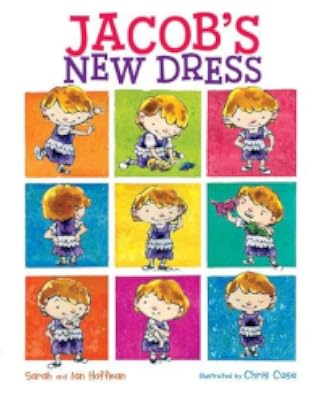
Leaving that aside, the story here is fairly engaging, despite the obvious didactic purpose of the authors, and the artwork is colorful and appealing, in a somewhat cartoon-like way. Recommended to anyone looking for stories about gender-fluid children specifically, or about issues of tolerance and bullying in general. show less
One of a number of recent picture-books meant to offer encouragement and affirmation to gender-fluid children - show more another recent one would be James Howe's Big Bob, Little Bob - Jacob's New Dress highlights the message that there are all kinds of boys, some of whom will be attracted to the dress and interests that have traditionally been defined by society as feminine, and that that's OK. Co-authors Sarah and Ian Hoffman are the parents of a gender-fluid son themselves, something mentioned in the dust-jacket blurb about them, so I appreciated the way that their own life experience has informed the story they have to tell. I also appreciated the fact that they mention, in their afterword, that gender-fluidity isn't a sure sign of such things as sexual orientation or even eventual gender identity, and that they think young childhood is too early a time to really know those things about any person. That dovetails with my own thinking on the matter, and leaves the issue open, something I think is so important when dealing with the young, who need the safety and space to experiment, without those experiments being read by the adults around them as one thing or another.
Leaving that aside, the story here is fairly engaging, despite the obvious didactic purpose of the authors, and the artwork is colorful and appealing, in a somewhat cartoon-like way. Recommended to anyone looking for stories about gender-fluid children specifically, or about issues of tolerance and bullying in general. show less
In a warmly illustrated picture book meant to comfort both boys who are gender-nonconforming and their parents, young Jacob asks his mom for a dress to wear to school.
At first, Jacob’s interest in wearing dresses is limited to playing dress-up. When his classmate Christopher tells him he ought to wear boys’ clothes instead, Jacob’s friend Emily answers with age-appropriate defenses (“Christopher, stop telling us what to do”). Jacob’s mom hesitates when Jacob expresses interest in wearing a dress as school clothes, but eventually, both she and Jacob’s dad agree to it. The segments with Jacob’s mom and dad seem aimed at parents as much as at children. Jacob’s mom’s look of concern when he first asks about the dress is show more poignant, and his dad’s words of acceptance (“Well, it’s not what I would wear, but you look great”) could easily serve as a model for fathers in similar positions. What rings less true is the story’s rosy end. Faced with Christopher’s bullying comments and other kids’ laughter, Jacob is so buoyed by his new dress that he stands up to Christopher himself, then sprints triumphantly across the playground, “his dress spreading out like wings.”
Hopeful and affirming, but children familiar with bullying may find the conclusion too simple. (afterword, authors’ note) (Picture book. 4-8)
-Kirkus Review show less
At first, Jacob’s interest in wearing dresses is limited to playing dress-up. When his classmate Christopher tells him he ought to wear boys’ clothes instead, Jacob’s friend Emily answers with age-appropriate defenses (“Christopher, stop telling us what to do”). Jacob’s mom hesitates when Jacob expresses interest in wearing a dress as school clothes, but eventually, both she and Jacob’s dad agree to it. The segments with Jacob’s mom and dad seem aimed at parents as much as at children. Jacob’s mom’s look of concern when he first asks about the dress is show more poignant, and his dad’s words of acceptance (“Well, it’s not what I would wear, but you look great”) could easily serve as a model for fathers in similar positions. What rings less true is the story’s rosy end. Faced with Christopher’s bullying comments and other kids’ laughter, Jacob is so buoyed by his new dress that he stands up to Christopher himself, then sprints triumphantly across the playground, “his dress spreading out like wings.”
Hopeful and affirming, but children familiar with bullying may find the conclusion too simple. (afterword, authors’ note) (Picture book. 4-8)
-Kirkus Review show less
Jacob likes to wear dresses sometimes. In the school (kindergarten?) dress-up corner, he imagines himself as the princess. Some other kids accept him just fine, while at least one other kid objects that Boys Can't Wear Dresses. When Jacob wants to wear a dress to school, his parents hesitate, though they accept him. He makes a dress-thing out of towel which he wears over his school clothes-- the other kid steals it. So he asks his mom to help him make a real dress-- and they sew one up together. His dad says "Well, it's not what I would wear, but you look great." Jacob wears his dress to school and stands up to the boy who insists he should be grouped with the girls. "I made this dress, I'm proud of it it, and I'm going to wear it!"
This show more is a great story about acceptance and support., especially as it models how adults can best react and supports kids who are different. Jacob's mom says "There are all sorts of ways to be a boy," which is perfect. Jacob's parents are shown struggling with the decision to let him wear the dress to school (pretty clearly because it is likely to stir things up) and we are told Jacob gets a "can't-breathe feeling" from that-- but they do support him. And Jacob experiences his dress as a kind of "soft, cottony, magic armor" when the other boy teases him. show less
This show more is a great story about acceptance and support., especially as it models how adults can best react and supports kids who are different. Jacob's mom says "There are all sorts of ways to be a boy," which is perfect. Jacob's parents are shown struggling with the decision to let him wear the dress to school (pretty clearly because it is likely to stir things up) and we are told Jacob gets a "can't-breathe feeling" from that-- but they do support him. And Jacob experiences his dress as a kind of "soft, cottony, magic armor" when the other boy teases him. show less
Nice "ok for boys to dress in dresses" book. The author does a terrific job introducing tension into the story as Jacob expresses his desire and challenges his parents to support him. It's hard to explain, but that moment (which repeats) in which he says something along the lines of -- you say it's ok to be me, this is me, and starts to get worried is a really effective way of introducing empathy.
Nicely and subtly addresses those moments of discomfort in the family about Jacob's choice to wear a dress, and also illustrates how family members and caregivers can be supportive of a gender-nonconforming child. Honest, child-friendly, and not at all pedantic. Well-done.
Like my recent review of the elephant and piggie book where elephant is worried that piggie will like her new friend more than him, and the message is that that's a silly thing to worry about but your kid is like "uh, yeah, why even tell us that in the first place" and then starts to wonder if his friends are also gonna like other kids more, this one seems too highly evolved for its own good: Jacob is wearing his dress and Emmett is maybe like "that kid has a nice dress" but more interested in what kinda trucks he's playing with, but then the other mean kid is like "boys can't wear dresses!" and the story is intended to be a heartwarming tale of triumphing over that kind of adversity and being true to yourself but maybe more just has show more the effect of planting in your two-year-old's mind a great perplexity and even a worm of doubt about whether, in fact, boys can wear dresses where there was no such doubt before. But maybe it's my fault for reading this book to a toddler when it's clearly more for six-year-olds. show less
Members
- Recently Added By
Lists

Youth: Sexuality & Gender
119 works; 1 member

School library books removed after TX state legislator inquiry
429 works; 6 members

Florida's Book Bans and Challenges
311 works; 4 members

B-B to Get
131 works; 1 member
Author Information

4 Works 510 Members
4 Works 456 Members
Ian Hoffman reports for the Albuquerque Journal where he covers nuclear weapons, science, and the environment, including the Los Alamos Natural Laboratory. He lives in Santa Fe, New Mexico. (Bowker Author Biography)
Some Editions
Awards and Honors
Awards
Notable Lists
Series

Common Knowledge
- Original publication date
- 2014
- People/Characters
- Jacob; Emily; Christopher
- Dedication
- For Sam Hoffman & Patrick Eleey:
our two generations of Jacob -- SH and IH
For Olivia, of course -- CC - First words
- Jacob ran to join Emily in the dress-up corner.
- Last words
- (Click to show. Warning: May contain spoilers.)Jacob sprinted across the playground, his dress spreading out like wings.
- Blurbers
- Tuerk, Catherine
Classifications
Statistics
- Members
- 393
- Popularity
- 79,560
- Reviews
- 29
- Rating
- (4.30)
- Languages
- English
- Media
- Paper, Ebook
- ISBNs
- 9
- ASINs
- 1