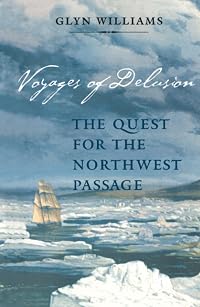
Voyages of Delusion: The Quest for the Northwest Passage
by Glyn Williams
On This Page
Description
The eighteenth century--the Age of Reason--was characterized by determined attempts by philosophers, scientists, and political theorists to dispel myth, superstition, and ignorance. But the Age of Reason also witnessed some of the most irrational and vainglorious attempts by sailors and speculators to find a navigable Northwest Passage that would lead through the icy seas of the Arctic from Hudson Bay to the wealth of the Pacific Ocean. Lured by the promise of fame and riches, men endured show more paralyzing cold, malnutrition, and terrifying storms. Many lives and fortunes were lost in the quest for the elusive "maritime philosopher's stone." Glyn Williams describes the adventures and mishaps of these misguided expeditions. show lessTags
Recommendations













Member Reviews
The fabled Northwest Passage that supposedly provided a sea route between the Atlantic and Pacific oceans around the top of North America intrigued Europeans for centuries. The search for a navigable route around North America was spurred by the dream of riches to be found in the unknown lands to the west and in the Orient as well as to avoid the tortuously long and hazardous route around Cape Horn at the bottom of South America or the even longer route via the Cape of Good Hope. The Spanish even had a name for it, Anian, but their repeated attempts to find it all failed. The French also had no success. This book provides an overview of the many failed attempts, mostly British, from James Knight of the Hudson Bay Company to Royal Navy show more Captains James Cook and George Vancouver, and their Spanish and French contemporaries.
The voyage of Christopher Middleton in 1741-2 demonstrated how harsh the conditions were in Hudson Bay during winter, especially as the men were ill-prepared, and the fresh food and clothing were insufficient. Many succumbed to frostbite or scurvy, for which there was no known cure at the time. When Middleton returned to England, he was accused of lying about his findings by his former sponsor, which made it difficult for him to gain further positions. But his findings were partly vindicated in a further voyage by William Moor and Francis Smith in 1746-7, which descended into enmity. And Middleton's discoveries were further verified 80 years later.
Before the 18th century, three Spanish captains claimed to have found the Strait of Anian or the Rio Los Reyes, and one of them claimed to have sailed through it to Hudson Bay. These accounts coloured the thinking and cartography throughout the 18th century. The French produced fantastic maps with a supposed sea within the western half of North America and the navigable channel suggested by the Spanish accounts. These drove the thinking of some of the English champions of the Northwest Passage. The Spanish accounts eventually proved to be false.
Cook's third voyage of discovery was brought about through a renewed interest in Britain to find the Northwest Passage from the Pacific as supposedly the Spanish had done. It appears that a large reward was put up to persuade Cook to take up this mission. Cook and his crew used Russian maps to guide them, but these proved to be utterly worthless to the exasperated master navigator. He was also led to believe that the polar sea would largely be ice free so that the crew was hugely disappointed to be confronted by an impenetrable ice barrier north of Bering Strait. Despite the disappointment and setbacks, Cook determined the shape of the Northwest coast of America that had eluded all previous attempts.
La Perouse followed Cook and attempted to find a way through, but the weather and time defeated him. This and other voyages to the Northwest coast helped to fill in some of the gaps that Cook had missed because he had assumed that some of the strings of coastal islands were the mainland. The tremendous number of islands along this coast provided a veritable maze that, combined with wishful thinking, led many people to believe that the fabled Spanish passage to Hudson Bay existed.
George Vancouver, who had twice sailed with Cook, finally put all the mythical passages beyond doubt by meticulously surveying the North West coast from the Strait of Juan de Fuca to the north of Kodiak Island, Alaska.
The illusory stories of the voyages of Juan de Fuca, Bartholomew de Fonte, and Lorenzo Ferrer Maldonado spurred European geographers and explorers into the search for a navigable passage through North America. It took more than a hundred years to show that no such passage existed despite the encouragement from land-based sponsors. This account of the exploration during the 18th century shows that the promise of riches, no matter how illusory, will drive men to follow mere suggestions. It took great navigators to finally dash those dreams but at the same time, they filled in the blanks of the North West coast of North America. Their achievements have to be admired and celebrated, not for their failure to find the impossible, but for their determination to disprove fantastic theories.
In my opinion, this is a well-researched book that demonstrates the fallibility of human nature when faced with the immense opportunities suggested by others. It took the dedicated labours of meticulous men, such as Cook, Vancouver, La Perouse, and Malaspina, to reveal the truth. I give this book 4 stars out of 5. show less
The voyage of Christopher Middleton in 1741-2 demonstrated how harsh the conditions were in Hudson Bay during winter, especially as the men were ill-prepared, and the fresh food and clothing were insufficient. Many succumbed to frostbite or scurvy, for which there was no known cure at the time. When Middleton returned to England, he was accused of lying about his findings by his former sponsor, which made it difficult for him to gain further positions. But his findings were partly vindicated in a further voyage by William Moor and Francis Smith in 1746-7, which descended into enmity. And Middleton's discoveries were further verified 80 years later.
Before the 18th century, three Spanish captains claimed to have found the Strait of Anian or the Rio Los Reyes, and one of them claimed to have sailed through it to Hudson Bay. These accounts coloured the thinking and cartography throughout the 18th century. The French produced fantastic maps with a supposed sea within the western half of North America and the navigable channel suggested by the Spanish accounts. These drove the thinking of some of the English champions of the Northwest Passage. The Spanish accounts eventually proved to be false.
Cook's third voyage of discovery was brought about through a renewed interest in Britain to find the Northwest Passage from the Pacific as supposedly the Spanish had done. It appears that a large reward was put up to persuade Cook to take up this mission. Cook and his crew used Russian maps to guide them, but these proved to be utterly worthless to the exasperated master navigator. He was also led to believe that the polar sea would largely be ice free so that the crew was hugely disappointed to be confronted by an impenetrable ice barrier north of Bering Strait. Despite the disappointment and setbacks, Cook determined the shape of the Northwest coast of America that had eluded all previous attempts.
La Perouse followed Cook and attempted to find a way through, but the weather and time defeated him. This and other voyages to the Northwest coast helped to fill in some of the gaps that Cook had missed because he had assumed that some of the strings of coastal islands were the mainland. The tremendous number of islands along this coast provided a veritable maze that, combined with wishful thinking, led many people to believe that the fabled Spanish passage to Hudson Bay existed.
George Vancouver, who had twice sailed with Cook, finally put all the mythical passages beyond doubt by meticulously surveying the North West coast from the Strait of Juan de Fuca to the north of Kodiak Island, Alaska.
The illusory stories of the voyages of Juan de Fuca, Bartholomew de Fonte, and Lorenzo Ferrer Maldonado spurred European geographers and explorers into the search for a navigable passage through North America. It took more than a hundred years to show that no such passage existed despite the encouragement from land-based sponsors. This account of the exploration during the 18th century shows that the promise of riches, no matter how illusory, will drive men to follow mere suggestions. It took great navigators to finally dash those dreams but at the same time, they filled in the blanks of the North West coast of North America. Their achievements have to be admired and celebrated, not for their failure to find the impossible, but for their determination to disprove fantastic theories.
In my opinion, this is a well-researched book that demonstrates the fallibility of human nature when faced with the immense opportunities suggested by others. It took the dedicated labours of meticulous men, such as Cook, Vancouver, La Perouse, and Malaspina, to reveal the truth. I give this book 4 stars out of 5. show less
Tedious level of detail on planning, politics and much less on the voyages themselves.
Ratings
Members
- Recently Added By
Lists

Polar exploration
54 works; 4 members
Author Information

8 Works 701 Members
Common Knowledge
- Original publication date
- 2002
- People/Characters
- Hudson's Bay Company; Captain James Cook, RN, FRS
- Important places
- Arctic; Canada; Northwest Passage; Canadian Arctic; Hudson Bay, Canada
- Important events
- Search for the Northwest Passage
- Dedication
- For Bill
- First words
- (Introduction) The European Enlightenment of the eighteenth century represented a determined attempt to dispel myth, superstition and ignorance.
On 5 June 1719 three small merchantmen and a sloop sailed in company from Gravesend on the Thames estuary, bearing the wishes of their owners for a 'prosperous voyage and safe'. - Quotations
- 'There seems to be strong Reasons to believe there is a Passage to Northwestwards of Hudsons Bay, and that passage no way Difficult by being pester's with Ice.' - Arthur Dobbs, Memorial on the Northwest Passage, 1731
- Last words
- (Click to show. Warning: May contain spoilers.)The discovery that no such communication does exist has been zealously pursued, and with a degree of minuteness far exceeding the letter of my commission or instructions.
(Click to show. Warning: May contain spoilers.)(Conclusion) It was their Philosopher's Stone, and in the end it proved just as elusive as that magic formula which had been sought in vain by generations of alchemists and speculators. - Blurbers
- Cal McCrystal; Steve King; Chris Woodhead
- Original language
- English
Classifications
- Genres
- Nonfiction, History, Travel, General Nonfiction
- DDC/MDS
- 910.916327 — History & geography Geography & travel modified standard subdivisions of Geography and travel Explorers & Travelers Geography of and travel in areas, regions, places in general Air And Water Atlantic Ocean Arctic Ocean (North Polar Sea)
- LCC
- G640 .W52 — Geography, Anthropology and Recreation Geography (General) Arctic and Antarctic regions
- BISAC
Statistics
- Members
- 161
- Popularity
- 203,564
- Reviews
- 2
- Rating
- (3.83)
- Languages
- English
- Media
- Paper
- ISBNs
- 4
- ASINs
- 1