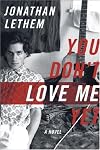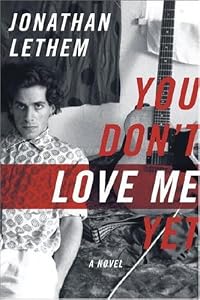
You Don't Love Me Yet: A Novel
by Jonathan Lethem
On This Page
Description
From the incomparable Jonathan Lethem, a raucous romantic farce that explores the paradoxes of love and art Lucinda Hoekke spends eight hours a day at the Complaint Line, listening to anonymous callers air their random grievances. Most of the time, the work is excruciatingly tedious. But one frequent caller, who insists on speaking only to Lucinda, captivates her with his off-color ruminations and opaque self-reflections. In blatant defiance of the rules, Lucinda and the Complainer arrange a show more face-to-face meeting—and fall desperately in love. Consumed by passion, Lucinda manages only to tear herself away from the Complainer to practice with the alternative band in which she plays bass. The lead singer of the band is Matthew, a confused young man who works at the zoo and has kidnapped a kangaroo to save it from ennui. Denise, the drummer, works at No Shame, a masturbation boutique. The band’s talented lyricist, Bedwin, conflicted about the group’s as-yet-nonexistent fame, is suffering from writer’s block. Hoping to recharge the band’s creative energy, Lucinda “suggests” some of the Complainer’s philosophical musings to Bedwin. When Bedwin transforms them into brilliant songs, the band gets its big break, including an invitation to appear on L.A.’s premiere alternative radio show. The only problem is the Complainer. He insists on joining the band, with disastrous consequences for all. Brimming with satire and sex, You Don’t Love Me Yet is a funny and affectionate send-up of the alternative band scene, the city of Los Angeles, and the entire genre of romantic comedy, but remains unmistakably the work of the inimitable Jonathan Lethem. show lessTags
Recommendations





Member Reviews
Well that didn't work, did it?
I got so bored of the book halfway through that I had to stop and read Cat's Cradle. Even if you somehow manage to be a Vonnegut-hater, you'll find it way superior. It's disappointing. Motherless Brooklyn was part of my coursework in college, and I have good memories of that one, so stumbling upon another Lethem work after all these years should have been a cause for celebration.
The characters are uninteresting, nothing of importance seems to happen, and it's a slog to read. I can abide by unlikeable characters as long as there's a reason for them. There's no real reason for this or any of the random nonsense that happens. It doesn't matter if you pose the book as a romantic comedy if it's such a miserable, show more unenlightening read. You can suggest it's a parody, satire, whatever, but that just makes it seem mean-spirited and, again, without redeeming lessons. It's over the top and yet it focuses intimately on the details you don't want, let alone need, to know about. None of the fantastical events go anywhere, and yet you limp towards the ending where the main character ends up back where she started, devolved back into her miserable cycle of delusion and destruction. Is that supposed to be some sort of unconvincing metaphor for real life?
This may be the first time I've ever had the notion that I'd be okay giving one of my beloved books to the library for sale. show less
I got so bored of the book halfway through that I had to stop and read Cat's Cradle. Even if you somehow manage to be a Vonnegut-hater, you'll find it way superior. It's disappointing. Motherless Brooklyn was part of my coursework in college, and I have good memories of that one, so stumbling upon another Lethem work after all these years should have been a cause for celebration.
The characters are uninteresting, nothing of importance seems to happen, and it's a slog to read. I can abide by unlikeable characters as long as there's a reason for them. There's no real reason for this or any of the random nonsense that happens. It doesn't matter if you pose the book as a romantic comedy if it's such a miserable, show more unenlightening read. You can suggest it's a parody, satire, whatever, but that just makes it seem mean-spirited and, again, without redeeming lessons. It's over the top and yet it focuses intimately on the details you don't want, let alone need, to know about. None of the fantastical events go anywhere, and yet you limp towards the ending where the main character ends up back where she started, devolved back into her miserable cycle of delusion and destruction. Is that supposed to be some sort of unconvincing metaphor for real life?
This may be the first time I've ever had the notion that I'd be okay giving one of my beloved books to the library for sale. show less
Deliciously gonzo and somehow sweet at the same time. Short and fast, perfect read for a snowstorm or long flight. Rock'n'roll wannabees in a Los Angeles that just barely predates cellphones, you can tell because everybody seems very of the moment (this moment) and yet they're always glancing at their answering machines to see if anybody called. I didn't really acquire this book; my husband runs some Little Free Libraries so there are always boxes of books in the garage, and the other day to my horror I had run out of novels to read, so I raided his backup supply. I'd never heard of this book, either. It found me and I seized it with the same desperation the characters in the book grasp and grab. My story worked out, as did theirs.
Jonathan Lethem always wrote books in much the same way that Yo La Tengo make music; a reference here, an influence there, an irresistably charming fusion of twee pop, disco, free jazz and aggressive punk. Or in Lethem's case, some pop cultural journalism, some Austerian New York/Brooklyn, some satire, some Woody Allen sex and characters just overdone enough to be both funny and believable. All of it ever so slightly transparent so that you can see the layers underneath where he tries to work out how society and culture work and go together... if they even do.
He did that perfectly in Fortress of Solitude and Motherless Brooklyn, two novels that simultaneously deconstructed and reconstructed the world while touching on music, art, movies show more and literature as reference points. Not to mention The Disappointment Artist, which starts out as a collection of essays and ends up as a frank autobiography describing growing up and his memories of his parents by kicking off from things like the films of John Cassavetes, Philip K Dick's non-SF novels, the subway station where they filmed The Warriors and others. In Lethem's books there's no high and low culture, just a world teeming with impressions.
A lot of that carries over to You Don't Love Me Yet, but this time he's taken the logical step and done what many male (and, sure, some female) authors do sooner or later: he's written an if-I-were-a-rockstar novel. You know, one of those novels where an author who's always loved music writes about what it might be like to be in a band, comes up with cool song titles with no pressure to actually turn them into songs, smart ways to handle record companies, etc. (It's a genre of mixed success; for a truly pointless recent example, check out Douglas Cowie's Owen Noone and the Marauder. Or rather, don't.)
Of course, Lethem wouldn't be Lethem if he didn’t a) make his "rockstars" a struggling indie band who have never played live, never recorded, and can't even come up with a band name that's obscure enough, and b) took it as an excuse to philosophise about some other thigs as well. You Don't Love Me Yet is a kindly satire of the American independent music scene, and our four heroes – Lucinda, Denise, Michael and Bedwin – your archetypical around-30 slightly disfunctional types you may see hovering around the Pavement section of your local "alternative" record store. At its best, it's something like a novelization of the delightful webcomic Questionable Content. But at the same time, he seems to want to say something about the debate within culture today, especially for collage artists like himself: the very concept of owning, of immaterial rights. Who can rightfully claim to own a piece of music, a person, a word, a heart... or why not a kangaroo. (Don't ask.) How we all run around trying to find that missing piece, complain to complete strangers (what's an alternative rock audience but the songwriter's personal therapists, paying for the privilege?), how we all tell ourselves that if we can just get that one thing right everything will fall into place...
"Seems", I wrote. Because unfortunately he doesn't quite manage. One scene at the beginning feels symtomatic; two of our anti-heroes go to a gallery and semi-ironically look at a large white cube titled "Chamber Containing The Volumetric Representation of the Number of Hours It Took Me to Arrive At This Idea" – the ultimate self-reference, the snake biting its own tail. They crawl inside the cube and have sex. And part of me almost thinks the book could have ended there, because far too often I find myself wondering if the correct summary of You Don't Love Me Yet should be something like "Book About What Happens Over The 224 Pages It Contains". Just like so many struggling bands, Lethem this time has all the riffs and effect pedals he can come up with but he can't quite find that hook, that chorus that makes a song more than just 3 minutes of drums and guitar. Not completely unlike the equally disappointing The Brooklyn Follies, the book ambles around amid confrontations, love scenes and film geek discussions without ever really moving. The snake bites its own tail, panta rei and at the end we've had a few laughs, a few questions and a few good song titles, but not much more. Lethem is a brilliant stylist and that gets him far, but those vertigo-inducing perspectives from both high and low that his last few books brought me never really appear. You Don't Love Me Yet is easy enough to like, but I never find myself loving it. show less
He did that perfectly in Fortress of Solitude and Motherless Brooklyn, two novels that simultaneously deconstructed and reconstructed the world while touching on music, art, movies show more and literature as reference points. Not to mention The Disappointment Artist, which starts out as a collection of essays and ends up as a frank autobiography describing growing up and his memories of his parents by kicking off from things like the films of John Cassavetes, Philip K Dick's non-SF novels, the subway station where they filmed The Warriors and others. In Lethem's books there's no high and low culture, just a world teeming with impressions.
A lot of that carries over to You Don't Love Me Yet, but this time he's taken the logical step and done what many male (and, sure, some female) authors do sooner or later: he's written an if-I-were-a-rockstar novel. You know, one of those novels where an author who's always loved music writes about what it might be like to be in a band, comes up with cool song titles with no pressure to actually turn them into songs, smart ways to handle record companies, etc. (It's a genre of mixed success; for a truly pointless recent example, check out Douglas Cowie's Owen Noone and the Marauder. Or rather, don't.)
Of course, Lethem wouldn't be Lethem if he didn’t a) make his "rockstars" a struggling indie band who have never played live, never recorded, and can't even come up with a band name that's obscure enough, and b) took it as an excuse to philosophise about some other thigs as well. You Don't Love Me Yet is a kindly satire of the American independent music scene, and our four heroes – Lucinda, Denise, Michael and Bedwin – your archetypical around-30 slightly disfunctional types you may see hovering around the Pavement section of your local "alternative" record store. At its best, it's something like a novelization of the delightful webcomic Questionable Content. But at the same time, he seems to want to say something about the debate within culture today, especially for collage artists like himself: the very concept of owning, of immaterial rights. Who can rightfully claim to own a piece of music, a person, a word, a heart... or why not a kangaroo. (Don't ask.) How we all run around trying to find that missing piece, complain to complete strangers (what's an alternative rock audience but the songwriter's personal therapists, paying for the privilege?), how we all tell ourselves that if we can just get that one thing right everything will fall into place...
"Seems", I wrote. Because unfortunately he doesn't quite manage. One scene at the beginning feels symtomatic; two of our anti-heroes go to a gallery and semi-ironically look at a large white cube titled "Chamber Containing The Volumetric Representation of the Number of Hours It Took Me to Arrive At This Idea" – the ultimate self-reference, the snake biting its own tail. They crawl inside the cube and have sex. And part of me almost thinks the book could have ended there, because far too often I find myself wondering if the correct summary of You Don't Love Me Yet should be something like "Book About What Happens Over The 224 Pages It Contains". Just like so many struggling bands, Lethem this time has all the riffs and effect pedals he can come up with but he can't quite find that hook, that chorus that makes a song more than just 3 minutes of drums and guitar. Not completely unlike the equally disappointing The Brooklyn Follies, the book ambles around amid confrontations, love scenes and film geek discussions without ever really moving. The snake bites its own tail, panta rei and at the end we've had a few laughs, a few questions and a few good song titles, but not much more. Lethem is a brilliant stylist and that gets him far, but those vertigo-inducing perspectives from both high and low that his last few books brought me never really appear. You Don't Love Me Yet is easy enough to like, but I never find myself loving it. show less
(Reprinted from the Chicago Center for Literature and Photography [cclapcenter.com]. I am the original author of this essay, as well as the owner of CCLaP; it is not being reprinted here illegally.)
Too Awful to Finish: An ongoing essay series
The Accused: You Don't Love Me Yet, by Jonathan Lethem
How far I got: 99 pages (about halfway through)
Crimes:
1) Asking us to give a rat's ass about the truly miserable indie-rock characters on display -- possibly the most untalented, pretentious, snotty, empty-headed, navel-gazing Los Angeles losers the world of contemporary literature has ever given us.
2) Reminding us of just how many of these circle-jerk losers end up internationally famous as part of the indie-rock scene, in many cases because of show more some postmodern media-celebrity-slash-performance-artist who is usually snottier and less tolerable than even them. Yeah, thanks, Lethem; like being an underground artist isn't f---ing depressing enough.
3) Positing a world where an attractive, empowered female bass player would become obsessed with one of the most obviously misogynistic woman-hating literary characters I've come across in years; so obsessed, in fact, that she starts creating lyrics for her band around the obliquely sexist things the man tells her during their anonymous phone-complaint sessions, which of course are part of a super-duper-pretentious conceptual-art installation piece that the bass player has been hired to be a part of (don't ask, seriously, SERIOUSLY, don't ask).
4) Living in Brooklyn. Yeah, you heard me.
Verdict: Oh, so guilty.
Sentence: A five-year exile from the traditional literary industry, writing snotty CD reviews instead for Pitchfork. Seriously, Doubleday -- you need to start peddling this crap to pretentious 19-year-old indie-rockers who don't know any better, and leave us intelligent people the f--k alone. show less
Too Awful to Finish: An ongoing essay series
The Accused: You Don't Love Me Yet, by Jonathan Lethem
How far I got: 99 pages (about halfway through)
Crimes:
1) Asking us to give a rat's ass about the truly miserable indie-rock characters on display -- possibly the most untalented, pretentious, snotty, empty-headed, navel-gazing Los Angeles losers the world of contemporary literature has ever given us.
2) Reminding us of just how many of these circle-jerk losers end up internationally famous as part of the indie-rock scene, in many cases because of show more some postmodern media-celebrity-slash-performance-artist who is usually snottier and less tolerable than even them. Yeah, thanks, Lethem; like being an underground artist isn't f---ing depressing enough.
3) Positing a world where an attractive, empowered female bass player would become obsessed with one of the most obviously misogynistic woman-hating literary characters I've come across in years; so obsessed, in fact, that she starts creating lyrics for her band around the obliquely sexist things the man tells her during their anonymous phone-complaint sessions, which of course are part of a super-duper-pretentious conceptual-art installation piece that the bass player has been hired to be a part of (don't ask, seriously, SERIOUSLY, don't ask).
4) Living in Brooklyn. Yeah, you heard me.
Verdict: Oh, so guilty.
Sentence: A five-year exile from the traditional literary industry, writing snotty CD reviews instead for Pitchfork. Seriously, Doubleday -- you need to start peddling this crap to pretentious 19-year-old indie-rockers who don't know any better, and leave us intelligent people the f--k alone. show less
"Monster Eyes" is the hit song and name of a band trying to make it in Los Angeles. Thin foggy characters, but the story moves along quickly and character names are amusing, such as the DJ, Fancher Autumnbreast. While I really liked Motherless Brooklyn, the author seems to have pulled this book together in a hurry without his usual careful attention to characters and setting.
I find Lethem very irregular - some of his novels are greatly detailed, rich character-driven books; some are rather fantastical and light on the details, but pleasant, like Murukami's After Dark - and then there are a few I just can't get much out of. This is one of those. You Don't Love Me Yet is told from a third-person point of view focused on a single character, a band member (I don't know what she lives off of - like many in Lethem's work, she doesn't seem to do enough to earn a living) who has some foolish adventures and winds up pretty much in the same place she started, emotionally as well as practically. Whether you like this book will probably depend on whether you can care about the characters - the plot has one ridiculous show more element, but otherwise is very quotidian - reasonably average lives for the underemployed artist types - the focus is really on who the people are. I didn't care for the main - or any of the supporting characters - probably because they are all shallow and self-involved and don't seem capable of growth. Lethem may be making a point here, that really, that's how we all are. But even so,I just couldn't get into it. I think best for people who can enjoy a book about characters they don't like (maybe people who watched Seinfeld or enjoyed Vile Bodies?) and don't need plot complexities to be interested. show less
Ah, Jonathan Lethem. Even when you give us lightweight confection you delight us with your clever comparisons, your wonderful dialog, and your uncanny ability to give voice to those sensations and feelings we thought could never be put into words.
Case in point: You Don't Love Me Yet.
On the surface it's a story about a girl in a rock band who during the day mans a "complain line" as part of an art experiment (this is Los Angeles, after all). One of her regular complainers has such a way with words that she co-opts his complaints as lyrics, which kick start the band to new levels. The catch? At their first gig the Complainer (as he's called) hears the new stuff and wants in. Wackiness ensues.
The admittedly brief synopsis above doesn't show more begin, however, to describe the experience of reading You Don't Love Me Yet, and doesn't hint at the many explorations of love and relationships, and the nature of music and how it affects not only the people listening to it, but the people making it as well. Lethem is a writer I'm proud to say I've been turned onto ever since his first novel Gun, With Occasional Music and although he's moved away from the science fiction to mainstream (if you can call it that) literative fiction and all the accolades that accompany, his biggest strength of conveying ideas and emotions directly to the reader has only gotten better with time. If you're a musician and you've ever played in front of a crowd you'll love this book - his description of what happens to a crowd during a show is spot-on, and the characterizations of the various band members are uncanny in how they at once embrace everything that's both romantic and realistic about the "struggling musician" type.
Very quick, very enjoyable. Now please get to work on something epic along the lines of your last novel The Fortress of Solitude. show less
Case in point: You Don't Love Me Yet.
On the surface it's a story about a girl in a rock band who during the day mans a "complain line" as part of an art experiment (this is Los Angeles, after all). One of her regular complainers has such a way with words that she co-opts his complaints as lyrics, which kick start the band to new levels. The catch? At their first gig the Complainer (as he's called) hears the new stuff and wants in. Wackiness ensues.
The admittedly brief synopsis above doesn't show more begin, however, to describe the experience of reading You Don't Love Me Yet, and doesn't hint at the many explorations of love and relationships, and the nature of music and how it affects not only the people listening to it, but the people making it as well. Lethem is a writer I'm proud to say I've been turned onto ever since his first novel Gun, With Occasional Music and although he's moved away from the science fiction to mainstream (if you can call it that) literative fiction and all the accolades that accompany, his biggest strength of conveying ideas and emotions directly to the reader has only gotten better with time. If you're a musician and you've ever played in front of a crowd you'll love this book - his description of what happens to a crowd during a show is spot-on, and the characterizations of the various band members are uncanny in how they at once embrace everything that's both romantic and realistic about the "struggling musician" type.
Very quick, very enjoyable. Now please get to work on something epic along the lines of your last novel The Fortress of Solitude. show less
Members
- Recently Added By
Lists

Books Set in California
110 works; 15 members

music to my eyes
86 works; 12 members

Books Read in 2007
324 works; 7 members

Biggest Disappointments
606 works; 165 members
Books Set in Los Angeles
40 works; 8 members

Books With Complete Sentence Titles
374 works; 15 members
Author Information

100+ Works 24,603 Members
Jonathan Lethem was born in Brooklyn, New York on February 19, 1964. His first novel, Gun, with Occasional Music was published in 1994. His other works include As She Climbed across the Table (1997), Amnesia Moon (1995), The Fortress of Solitude (2003), You Don't Love Me Yet (2007), Chronic City (2009), and Dissident Gardens (2013). He won the show more National Book Critics Circle Award for Motherless Brooklyn (1999). He also writes short stories, comics and essays. His work has appeared in The New Yorker, Harper's, Rolling Stone, Esquire, The New York Times, The Paris Review, McSweeney's and other periodicals and anthologies. (Bowker Author Biography) show less
Some Editions
Awards and Honors
Series
Belongs to Publisher Series
L'eclèctica (152)
Common Knowledge
- Original publication date
- 2007
- People/Characters
- Lucinda Hoekke; Matthew Plangent; Denise; Bedwin
- Important places
- Los Angeles, California, USA
- Related movies
- You Don't Love Me Yet (in development | IMDb)
- Epigraph
- Mistakes are bound to happen, there's gonna be another summer
I know what I think and what I'm supposed to do
Maybe I don't think as much as you
--"You Don't Love Me Yet," The Vulgar Boatmen
I have my start
But I have never begun
Because without you my life is unsung
--"You Don't Love Me Yet," Roky Erickson - Dedication
- for Eliot Duhan
- First words
- They met at the museum to end it.
- Quotations
- This happens: An invitation becomes exponential. [CD 3]
Inaudible above the low crackle and drone of speakers broadcasting nothing but their own electrical readiness at top volume ... [CD 3]
The band had discovered itself onstage like Helen Keller connecting at last the idea or name for a thing to the thing itself. [CD 3]
"I want what we all want," said Carl. "To move certain parts of the interior of myself into the external world to see if they can be embraced." [CD 4 Track 7]
"You can't be deep without a surface" [Carl the complainer: CD 4 Track 7]
Pour love on the broken places [bumper sticker: CD 1] (show all 7)
All thinking is wishful [t-shirt slogan: CD 5 Track 5] - Last words
- (Click to show. Warning: May contain spoilers.)"You can't be deep without a surface."
Classifications
Statistics
- Members
- 944
- Popularity
- 27,996
- Reviews
- 33
- Rating
- (2.91)
- Languages
- 5 — English, German, Italian, Portuguese, Spanish
- Media
- Paper, Audiobook, Ebook
- ISBNs
- 19
- ASINs
- 7