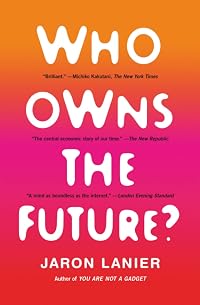
Who Owns the Future?
by Jaron Lanier
On This Page
Description
Evaluates the negative impact of digital network technologies on the economy and particularly the middle class, citing challenges to employment and personal wealth while exploring the potential of a new information economy.Tags
Recommendations










Member Recommendations

Member Reviews
I'm sympathetic to the author's complaints but the central idea of a utopian future that runs on microtransations paid to everyone based on the fact the they are alive and generate data is full of holes and self-contradictions. In the same book the author complains about how digitisable domains fall foul of a fat tail "superstar" distribution where only ones at the very top get any money at all but fails to see that this is what he proposes.
I think the most telling passage is when he mistakenly describes the Morlocks and the Eloi from the Time Machine by switching their ancestry around to conform to his views (claiming Morlocks descended from the rich and Eloi from the poor). What editor would let something like this slip through? The show more author might be a visionary but seeing what can be might be interfering with seeing what is. He genuinely believes the digital economy is the biggest obstacle and threat and traditional problems of resources, wars etc. don't come into it.
He also pre-emptively admits that he hasn't really worked out any details and then goes on to list random minutiae of his proposed system but at the same time admits no critique of the technical or logical feasibility because the details will work themselves out correctly naturally. How do you engage that kind of discussion?
There are also a lot of passive aggressive comments on the economy shutting down his industries of choice and this must be the first time I've seen someone use "open source/linux/wikipedia types" as an insult. Then again he does mention he works for Microsoft but I think that's a bit beyond towing the company line. show less
I think the most telling passage is when he mistakenly describes the Morlocks and the Eloi from the Time Machine by switching their ancestry around to conform to his views (claiming Morlocks descended from the rich and Eloi from the poor). What editor would let something like this slip through? The show more author might be a visionary but seeing what can be might be interfering with seeing what is. He genuinely believes the digital economy is the biggest obstacle and threat and traditional problems of resources, wars etc. don't come into it.
He also pre-emptively admits that he hasn't really worked out any details and then goes on to list random minutiae of his proposed system but at the same time admits no critique of the technical or logical feasibility because the details will work themselves out correctly naturally. How do you engage that kind of discussion?
There are also a lot of passive aggressive comments on the economy shutting down his industries of choice and this must be the first time I've seen someone use "open source/linux/wikipedia types" as an insult. Then again he does mention he works for Microsoft but I think that's a bit beyond towing the company line. show less
Important problem, terrible solution. Lanier notes that many people are increasingly providing free content to large online services, at the same time as many traditional jobs are being destroyed or their conditions becoming immiserated. Proposed solution: everyone should be entitled to micropayments for their online contributions, which would be I guess netted out at regular intervals (he doesn’t really say). I am befuddled by his theory that you can have monetized microproperty rights without government involvement. He criticizes libertarians and then reenacts them. His micropayment idea explicitly disparages government, when only an unwaivable, inalienable right would get the job done that he wants done (and at that point we should show more have a guaranteed basic income instead; why should your financial well being depend on whether you entertain others?). He says that in his world, instead of government mandates, lawyers would come in and renegotiate deals on behalf of ordinary users to protect their microinterests, as if lawyers hadn't already tried! Many times! And lost, because unless a contract term is unlawful it is enforceable. Perhaps relatedly, his treatment of the mortgage crisis is ridiculous; he argues that it was caused by the same speeded up information flow as that which produced Google/inability to control one’s own information. But the crash wasn't a crisis of lack of transparent information about who had your mortgage, something that wasn't under the borrower's control anyway. He's a very smart dude who thinks his intelligence makes him an expert in anything. show less
I've read many books on society's current economic predicament resulting from networked information technologies clashing with outmoded political economic systems, but Jaron Lanier tries tackling the problem from a prescriptive engineering approach which I find refreshing and fruitful. To clarify, by taking an engineering approach I don't mean simple technocratic reductionist thinking which presupposes technical fixes to be silver bullets that trump political or social advances, I mean a holistic and humanistic engineering of technosocial systems that incorporates social and political dynamics into the foundation of our networked technologies. Larry Lessig coined the phrase 'code is law', and Lanier builds on this idea in his new book show more to show us that 'code is economics'.
Ironically, one of Lanier's major gripes is centered precisely on the free/open source/creative commons ideology that Lessig helped popularize and which has become a dominant mindset of information technology designers, entrepreneurs, and activists. While filled with good intentions, this movement, according to Lanier, is the seed of much of the problems we are facing and can only lead to a dystopian future. This movement wants information to be free because information is abundant in a digital network where the cost of copying bits is close to zero. However, when information is free, the only way to make sustainable profits within the information economy is to become spying platforms and gatekeepers of information that act as intermediaries between consumers and producers/advertisers, exploiting both in the process. For those lucky enough to be close to these gatekeepers, which Lanier calls siren servers, huge benefits can be had, but for most people any significant economic benefits from producing information becomes either a crap shoot within digital markets dominated by winner-take-all power law distributions or promotional material for unsustainable offline activities such as singing for your money. As our society increasingly transforms its activities into information processing (software is eating the world as Marc Andreesen put it), the logical conclusion of a free information economy dominated by siren servers is a drastic shrinking of the overall economy, huge social inequalities, and massive civil unrest.
Lanier's proposed solution to this nightmare is to revisit an old idea by Ted Nelson that predates the internet and personal computer revolutions by decades. Nelson was one of the first people to sketch out a vision for hypertext and a networked information system, but the main differences between his ideas and what eventually became the web was the bidirectional nature of the links that form the networks instead of the one-way links of the current www, and the persistence of single identities of information objects with cached local images instead of the copying and duplication of disparate data in use today. With two-way links to atomic chunks of information, metadata that identifies the ownership and use rights of each atom, and a micropayment system that compensates actors at all levels of the information economy, the remixing/mashup dreams of the creative commons can be had while still enabling a true information economy that grows instead of shrinks, and with a large portion of that growth happening in the middle. People will become active and compensated actors within all information processes they engage in instead of being exploited passive users of spying gatekeeper siren servers. Not only those who engage in commercial transactions will profit like they do now with e-commerce, but micro-royalties will propagate to each individual whenever their information property is used in those transactions, enabling not only income generation but wealth generation for the masses. If you're going to have a capitalist society, might as well digitize capital completely, not just the markets. Lanier's outline of such a system is just a rough draft vision document, the devil surely is in the details, and bootstrapping such a system within the current regime is a nontrivial task to put it mildly, but as a plausible vision for how to move forward I find it an optimistic and worthy direction to pursue. show less
Ironically, one of Lanier's major gripes is centered precisely on the free/open source/creative commons ideology that Lessig helped popularize and which has become a dominant mindset of information technology designers, entrepreneurs, and activists. While filled with good intentions, this movement, according to Lanier, is the seed of much of the problems we are facing and can only lead to a dystopian future. This movement wants information to be free because information is abundant in a digital network where the cost of copying bits is close to zero. However, when information is free, the only way to make sustainable profits within the information economy is to become spying platforms and gatekeepers of information that act as intermediaries between consumers and producers/advertisers, exploiting both in the process. For those lucky enough to be close to these gatekeepers, which Lanier calls siren servers, huge benefits can be had, but for most people any significant economic benefits from producing information becomes either a crap shoot within digital markets dominated by winner-take-all power law distributions or promotional material for unsustainable offline activities such as singing for your money. As our society increasingly transforms its activities into information processing (software is eating the world as Marc Andreesen put it), the logical conclusion of a free information economy dominated by siren servers is a drastic shrinking of the overall economy, huge social inequalities, and massive civil unrest.
Lanier's proposed solution to this nightmare is to revisit an old idea by Ted Nelson that predates the internet and personal computer revolutions by decades. Nelson was one of the first people to sketch out a vision for hypertext and a networked information system, but the main differences between his ideas and what eventually became the web was the bidirectional nature of the links that form the networks instead of the one-way links of the current www, and the persistence of single identities of information objects with cached local images instead of the copying and duplication of disparate data in use today. With two-way links to atomic chunks of information, metadata that identifies the ownership and use rights of each atom, and a micropayment system that compensates actors at all levels of the information economy, the remixing/mashup dreams of the creative commons can be had while still enabling a true information economy that grows instead of shrinks, and with a large portion of that growth happening in the middle. People will become active and compensated actors within all information processes they engage in instead of being exploited passive users of spying gatekeeper siren servers. Not only those who engage in commercial transactions will profit like they do now with e-commerce, but micro-royalties will propagate to each individual whenever their information property is used in those transactions, enabling not only income generation but wealth generation for the masses. If you're going to have a capitalist society, might as well digitize capital completely, not just the markets. Lanier's outline of such a system is just a rough draft vision document, the devil surely is in the details, and bootstrapping such a system within the current regime is a nontrivial task to put it mildly, but as a plausible vision for how to move forward I find it an optimistic and worthy direction to pursue. show less
This book was my everest. It took 16 months of starting and stopping to read it in completion. The first half of the book flew by in a whirlwind of intrigue and critical thought but as its conclusion approached, the narrative seemed to shift abruptly from a blend of social science, economics, technology, and cultural application to a tone heavily dominated by complex economic models and name-dropping accomplishments. I wasn't going to let myself put another book down when it seemed dull just to start another to half-finish, and it was one of the most difficult commitments I have ever held myself to. I like the metaphor an earlier reviewer used likening this book to being stuck in an elevator with your most brilliant friend and an excess show more of wine. Lanier can be thought-provoking and profoundly articulate just as much as he can be obnoxiously braggy and far too dense. It's been one hell of a challenge to get through. show less
Jaron Lanier, although a legend in the techie world, values people above technology. His latest book continues his examination of our current Internet universe, and finds it wanting in fairness and economic incentives for innovation. Lanier offers one possible solution, one that is plausible and workable in my opinion. Should be read, carefully, by as many as possible.
This book is a little hard to judge. It does not really break new ground (promoting micro-payments, ownership of your own data; pointing out the true bargain we make when we "get" things for "free"; pointing out the lopsidedness of current views of technological advancement of efficiency; and so forth) but it does tie all these together in a conceptual/social-economic framework
In particular, it argues against the current "free" model of the web: users exchange their information (demographics, location, shopping habits, appliance repair expertise, how to change a car headlight, restaurant reviews... book reviews) for "free" services such as Facebook, YouTube, or GoodReads. This seems like a great deal. But: over the medium to long term, show more this shrinks the economy. There are fewer car headlamps to change, less need to pay book reviewers, and (in Lanier's favorite example) fewer paid musicians. So you give away your information/expertise/time for free, and get something for free, and the "Siren Server" (in Lanier's coinage) makes money; but *only* the "Siren Server" (YouTube, Facebook, etc.) makes money. This all might look fine, until the expertise being given away is your's, and hence in the longer term the economy starts to unravel. This is the direction that Silicon Valley (which he uses to mean both Silicon Valley, but also the larger technophile/libertarian culture) is and wants to move in.
There is a lot more to this book, as well. For instance, the repeated (and, to me agreeable) assertion that the economy is not some thing outside of us, with some innate, external purpose like efficiency; that we can choose to make human contributions "worthwhile" -to make the economy humanistic- or continue down the path of making everything "free" and hence human contributions worth nothing. Note that this is similar to the main point, but from a different perspective.
Some cons: Lack of conciseness, a bit of a choppy composition, a bit too personal (as we are being asked, essentially, to change the world/future.)
The book has the feel, a bit, of a manifesto: it doesn't try to be academic or scientific. Or perhaps its better to say it feels, a bit, like science fiction, in the best possible sense: possibilities and difficulties are being laid out in a narrative fashion. In either case, it is a bit vague: he does proposes some partial solutions, while acknowledging that they are not fleshed out, as well as some -not sure what I want to call them- target values.
To be honest, I think I am still processing the book a bit; while it has it's issues, that right there is a very good thing. show less
In particular, it argues against the current "free" model of the web: users exchange their information (demographics, location, shopping habits, appliance repair expertise, how to change a car headlight, restaurant reviews... book reviews) for "free" services such as Facebook, YouTube, or GoodReads. This seems like a great deal. But: over the medium to long term, show more this shrinks the economy. There are fewer car headlamps to change, less need to pay book reviewers, and (in Lanier's favorite example) fewer paid musicians. So you give away your information/expertise/time for free, and get something for free, and the "Siren Server" (in Lanier's coinage) makes money; but *only* the "Siren Server" (YouTube, Facebook, etc.) makes money. This all might look fine, until the expertise being given away is your's, and hence in the longer term the economy starts to unravel. This is the direction that Silicon Valley (which he uses to mean both Silicon Valley, but also the larger technophile/libertarian culture) is and wants to move in.
There is a lot more to this book, as well. For instance, the repeated (and, to me agreeable) assertion that the economy is not some thing outside of us, with some innate, external purpose like efficiency; that we can choose to make human contributions "worthwhile" -to make the economy humanistic- or continue down the path of making everything "free" and hence human contributions worth nothing. Note that this is similar to the main point, but from a different perspective.
Some cons: Lack of conciseness, a bit of a choppy composition, a bit too personal (as we are being asked, essentially, to change the world/future.)
The book has the feel, a bit, of a manifesto: it doesn't try to be academic or scientific. Or perhaps its better to say it feels, a bit, like science fiction, in the best possible sense: possibilities and difficulties are being laid out in a narrative fashion. In either case, it is a bit vague: he does proposes some partial solutions, while acknowledging that they are not fleshed out, as well as some -not sure what I want to call them- target values.
To be honest, I think I am still processing the book a bit; while it has it's issues, that right there is a very good thing. show less
Lanier summons pointed criticism to the technological optimist phylosophy that permeates digital startups and established digital business alike. His critique is not well organised but is still a relatively unique perspective which one needs to consider for futurology.
I rate the book less for its overall quality but for those key thinking points which should be evaluated while we look at technological and cultural development. Its a book I find myself arguing against but these arguments lead me to understand the issues.
I rate the book less for its overall quality but for those key thinking points which should be evaluated while we look at technological and cultural development. Its a book I find myself arguing against but these arguments lead me to understand the issues.
Members
- Recently Added By
Lists

Top Five Books of 2014
1,064 works; 398 members
Author Information

Awards and Honors
Common Knowledge
- Canonical title*
- La dignità ai tempi di Internet: per un'economia digitale equa
- Original title
- Who Owns the Future?
*Some information comes from Common Knowledge in other languages. Click "Edit" for more information.
Classifications
- Genres
- Technology, Economics, Nonfiction, General Nonfiction
- DDC/MDS
- 303.48 — Society, government, & culture Social sciences, sociology & anthropology Social processes Social change Causes of change
- LCC
- HC79 .I55 .L365 — Social sciences Economic history and conditions Economic history and conditions Special topics
- BISAC
Statistics
- Members
- 789
- Popularity
- 35,194
- Reviews
- 20
- Rating
- (3.52)
- Languages
- 5 — English, French, German, Italian, Spanish
- Media
- Paper, Audiobook, Ebook
- ISBNs
- 22
- ASINs
- 14