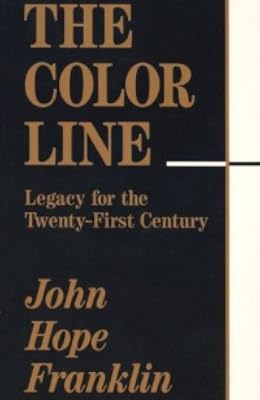
The Color Line: Legacy for the Twenty-First Century (Paul Anthony Brick Lectures)
by John Hope Franklin
On This Page
Description
"The problem of the twentieth century will be the problem of the color line - the relation of the darker to the lighter races of men," wrote author and civil rights leader W.E.B. Du Bois in 1903. As the twentieth century comes to a close, one of America's most distinguished historians takes an unflinching look at race relations in America today. Distilling more than two centuries of history, John Hope Franklin reflects on the most tragic and persistent social problem. In our nation's history show more - the color line - as it becomes our legacy for the next century. The Color Line originated as three lectures delivered at the University of Missouri-Columbia in April 1992, just one day after the "not guilty" verdict was returned in the trial of Los Angeles police officers in the beating of Rodney King. The violence that shook Los Angeles and soon erupted in other cities across the country provided a dramatic backdrop for Franklin's message: the. Color line holds fast - in education, in housing, in health care, and in the legal system. Franklin illuminates some of the key episodes in our nation's history that have brought us to the present day. He traces America's forward and backward steps on the path toward racial equality, from the Carter administration's record number of appointments of African Americans to the bench to the Reagan administration's effort to continue support for educational institutions that. Persisted in racial discrimination and segregation. Examining the historical role of race in both the Republican and Democratic parties, Franklin argues that while opponents of affirmative action claim to promote a color-blind legal system, many have adopted race-encoded rhetoric to raise the specter of racial fear and hatred. Franklin also outlines the questionable civil rights record of Clarence Thomas, whose nomination and confirmation as Supreme Court justice. Provoked considerable controversy among civil rights leaders. The color line continues to flourish in the final decade of the twentieth century. "Perhaps the very first thing we need to do as a nation and as individual members of society," writes Franklin, "is to confront our past and see it for what it is." Only by facing the truth of our history can we hope to envision another kind of society for our future. Here John Hope Franklin brilliantly aids in that task as he. Shines the sharp light of history on the color line, our legacy for the twenty-first century. show lessTags
Recommendations








Member Reviews
[Review written by my younger self]
Franklin's The Color Line is the chronicle of US racial struggles from the 17th century onwards. The color line, that subtle racial strain that separates society in schools, housing, government, and employment, is covered in great detail. Focusing on the oppression of the African American race in the US, Franklin covers President Carter's attempts at recruiting more women and black people into his administration and goes on to criticize President Reagan's attempts at removing any office appointment that contradicted his values. The various incidents of racial tension and outright persecution become the framework for Franklin's stand against the color line.
As first suggested by the distinguished show more writer, sociologist, and co-founder of the NAACP, William Edward Bughardt Do Bois, the racism that divides American will keep on growing and alienating persons. In carrying on this premonition, Franklin admonishes, just as Du Bois, that the world in general cannot function properly if color continues to be a fact in all aspects of life and in considerations of rank and leadership.
Franklin denounces those who claim the United States is color-blind and accuses them of being noncommittal, not interested in changing their country for the better. He refers to the Plessy vs. Ferguson case, stating that the Supreme Court Justice John Marshall Harlan and Plessy's attorney Albion Tourgee figured prominently in the dissent of civil rights, adamantly believing the law and Constitution, like justice herself, is color-blind. Not acknowledging racial tension, Franklin believes, allows others to abuse racial discrimination.
The various claims Franklin makes are supported with a plethora of evidence and instances. This should be expected with the gravity of the accusations he makes. State governments, he writes, would not be color-blind while the national government executes non-racist laws purely on the reluctant need and superficial responsibility of pleasing the people.
He reveals the government's extensive role in the color line going as far back as Virginia's explicit definitions of a "Negro" in 1879 (with the main requirement of having one-fourth or more of "Negro" blood). Franklin infers that such precise, authorized forms of discrimination can occur again if the color line is not recognized and eliminated.
At first glance, Franklin's work appears far from an objective historical reference. While his accounts of the pivotal events of the civil rights movement are seemingly accurate, Franklin's acrid attitude and condescending tone may make the reader dubious. Across the pages, his script has a tone of anger and frustration at the silence of the African American race and the people who invoke this silence. He takes on a certain sarcasm in speaking of the unappreciated achievements of the African American.
It is possible, though, that the biased demeanor of his prose is purposeful, meant to inspire people to further investigate the implications of the color line. Franklin spews forth his information without mercy or sensitivity. In his aggression for the color line, Franklin is not suggesting the elimination of aspects of culture and the total disregard of color. Franklin advises his readers to sway the government away from the color line, and to look to themselves as individuals not to keep lengthening the color line's divisions. The solution, he says, is in looking at America's past without dismissing it or flinching at it, without closing eyes or minds to the brutal events of racial inhumanity. In doing so, Franklin endeavors all Americans to look at each other, not in terms of color, but as human beings. show less
Franklin's The Color Line is the chronicle of US racial struggles from the 17th century onwards. The color line, that subtle racial strain that separates society in schools, housing, government, and employment, is covered in great detail. Focusing on the oppression of the African American race in the US, Franklin covers President Carter's attempts at recruiting more women and black people into his administration and goes on to criticize President Reagan's attempts at removing any office appointment that contradicted his values. The various incidents of racial tension and outright persecution become the framework for Franklin's stand against the color line.
As first suggested by the distinguished show more writer, sociologist, and co-founder of the NAACP, William Edward Bughardt Do Bois, the racism that divides American will keep on growing and alienating persons. In carrying on this premonition, Franklin admonishes, just as Du Bois, that the world in general cannot function properly if color continues to be a fact in all aspects of life and in considerations of rank and leadership.
Franklin denounces those who claim the United States is color-blind and accuses them of being noncommittal, not interested in changing their country for the better. He refers to the Plessy vs. Ferguson case, stating that the Supreme Court Justice John Marshall Harlan and Plessy's attorney Albion Tourgee figured prominently in the dissent of civil rights, adamantly believing the law and Constitution, like justice herself, is color-blind. Not acknowledging racial tension, Franklin believes, allows others to abuse racial discrimination.
The various claims Franklin makes are supported with a plethora of evidence and instances. This should be expected with the gravity of the accusations he makes. State governments, he writes, would not be color-blind while the national government executes non-racist laws purely on the reluctant need and superficial responsibility of pleasing the people.
He reveals the government's extensive role in the color line going as far back as Virginia's explicit definitions of a "Negro" in 1879 (with the main requirement of having one-fourth or more of "Negro" blood). Franklin infers that such precise, authorized forms of discrimination can occur again if the color line is not recognized and eliminated.
At first glance, Franklin's work appears far from an objective historical reference. While his accounts of the pivotal events of the civil rights movement are seemingly accurate, Franklin's acrid attitude and condescending tone may make the reader dubious. Across the pages, his script has a tone of anger and frustration at the silence of the African American race and the people who invoke this silence. He takes on a certain sarcasm in speaking of the unappreciated achievements of the African American.
It is possible, though, that the biased demeanor of his prose is purposeful, meant to inspire people to further investigate the implications of the color line. Franklin spews forth his information without mercy or sensitivity. In his aggression for the color line, Franklin is not suggesting the elimination of aspects of culture and the total disregard of color. Franklin advises his readers to sway the government away from the color line, and to look to themselves as individuals not to keep lengthening the color line's divisions. The solution, he says, is in looking at America's past without dismissing it or flinching at it, without closing eyes or minds to the brutal events of racial inhumanity. In doing so, Franklin endeavors all Americans to look at each other, not in terms of color, but as human beings. show less
Franklin's The Color Line is the chronicle of US racial struggles from the 17th century onwards. The color line, that subtle racial strain that separates society in schools, housing, government, and employment, is covered in great detail. Focusing on the oppression of the African American race in the US, Franklin covers President Carter's attempts at recruiting more women and black people into his administration and goes on to criticize President Reagan's attempts at removing any office appointment that contradicted his values. The various incidents of racial tension and outright persecution become the framework for Franklin's stand against the color line. As first suggested by the distinguished writer, sociologist, and co-founder of show more the NAACP, William Edward Bughardt Do Bois, the racism that divides American will keep on growing and alienating persons. In carrying on this premonition, Franklin admonishes, just as Du Bois, that the world in general cannot function properly if color continues to be a fact in all aspects of life and in considerations of rank and leadership.Franklin denounces those who claim the United States is color-blind and accuses them of being noncommittal, not interested in changing their country for the better. He refers to the Plessy vs. Ferguson case, stating that the Supreme Court Justice John Marshall Harlan and Plessy's attorney Albion Tourgee figured prominently in the dissent of civil rights, adamantly believing the law and Constitution, like justice herself, is color-blind. Not acknowledging racial tension, Franklin believes, allows others to abuse racial discrimination. The various claims Franklin makes are supported with a plethora of evidence and instances. This should be expected with the gravity of the accusations he makes. State governments, he writes, would not be color-blind while the national government executes non-racist laws purely on the reluctant need and superficial responsibility of pleasing the people. He reveals the government's extensive role in the color line going as far back as Virginia's explicit definitions of a "Negro" in 1879 (with the main requirement of having one-fourth or more of "Negro" blood). Franklin infers that such precise, authorized forms of discrimination can occur again if the color line is not recognized and eliminated.At first glance, Franklin's work appears far from an objective historical reference. While his accounts of the pivotal events of the civil rights movement are seemingly accurate, Franklin's acrid attitude and condescending tone may make the reader dubious. Across the pages, his script has a tone of anger and frustration at the silence of the African American race and the people who invoke this silence. He takes on a certain sarcasm in speaking of the unappreciated achievements of the African American. It is possible, though, that the biased demeanor of his prose is purposeful, meant to inspire people to further investigate the implications of the color line. Franklin spews forth his information without mercy or sensitivity. In his aggression for the color line, Franklin is not suggesting the elimination of aspects of culture and the total disregard of color. Franklin advises his readers to sway the government away from the color line, and to look to themselves as individuals not to keep lengthening the color line's divisions. The solution, he says, is in looking at America's past without dismissing it or flinching at it, without closing eyes or minds to the brutal events of racial inhumanity. In doing so, Franklin endeavors all Americans to look at each other, not in terms of color, but as human beings. show less
Ratings
Members
- Recently Added By
Author Information

32+ Works 2,497 Members
The son of an attorney who practiced before the U.S. Supreme Court, John Hope Franklin was born in Rentiesville, Oklahoma on January 2, 1915. He received a B. A. from Fisk University in 1935 and a master's degree in 1936 and a Ph.D. in 1941 from Harvard University. During his career in education, he taught at a numerous institutions including show more Brooklyn College, Harvard University, the University of Chicago, and Duke University. He also had teaching stints in Australia, China, and Zimbabwe. He has written numerous scholarly works including The Militant South, 1800-1861 (1956); Reconstruction After the Civil War (1961); The Emancipation Proclamation (1963); and The Color Line: Legacy for the 21st Century (1993). His comprehensive history From Slavery to Freedom: A History of African-Americans (1947) is generally acknowledged to be the basic survey of African American history. He received numerous awards during his lifetime including the Medal of Freedom in 1995 and the John W. Kluge Prize for the Study of Humanities in 2006. He worked with Thurgood Marshall's team of lawyers in their effort to end segregation in the 1954 case Brown v. Board of Education and participated in the 1965 march from Selma to Montgomery, Alabama with Dr. Martin Luther King, Jr. He was president of the American Historical Association, the Organization of American Historians, the Southern Historical Association, and the American Studies Association. He was also a founding member of the Black Academy of Arts and served on the U.S. Commission for UNESCO and the Committee on International Exchange of Scholars. He died of congestive heart failure on March 25, 2009 at the age of 94. (Bowker Author Biography) show less
Common Knowledge
- Important events
- African-American Civil Rights Movement
Classifications
- Genres
- Anthropology, Nonfiction, History, Politics and Government, General Nonfiction
- DDC/MDS
- 305.8 — Society, government, & culture Social sciences, sociology & anthropology Social group - Age, Gender, Ethnicity Ethnic and national groups
- LCC
- E185.615 .F69 — History of the United States United States
- BISAC
Statistics
- Members
- 43
- Popularity
- 687,427
- Reviews
- 2
- Rating
- (3.00)
- Languages
- English
- Media
- Paper, Ebook
- ISBNs
- 3