
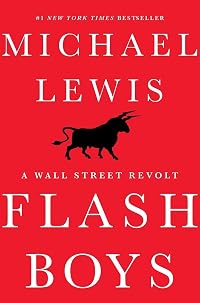
Flash Boys: A Wall Street Revolt
by Michael Lewis
On This Page
Description
In this book the author argues that post-crisis Wall Street continues to be controlled by large banks and explains how a small, diverse group of Wall Street men have banded together to reform the financial markets. A report on a high-tech predator stalking the equity markets, this book is about a small group of Wall Street guys who figure out that the U.S. stock market has been rigged for the benefit of insiders and that, post-financial crisis, the markets have become not more free but less, show more and more controlled by the big Wall Street banks. Working at different firms, they come to this realization separately; but after they discover one another, they band together and set out to reform the financial markets. This they do by creating an exchange in which high-frequency trading, source of the most intractable problems, will have no advantage whatsoever. The characters are each completely different from what you think of when you think "Wall Street guy." Several have walked away from jobs in the financial sector that paid them millions of dollars a year. From their new vantage point they investigate the big banks, the world's stock exchanges, and high-frequency trading firms as they have never been investigated, and expose the many strange new ways that Wall Street generates profits. The author shines a light into the darkest corners of the financial world, where anyone in contact with the market, even a retirement account, is part of the story. But in the end, this is the story of people who have somehow preserved a moral sense in an environment where you don't get paid for that; they have perceived an institutionalized injustice and are willing to go to war to fix it. show lessTags
Recommendations






Member Reviews
Nuevo libro de Michael Lewis [ML], que ha levantado algunas olas en los EE.UU. En él relata (principalmente) la historia de Brad Katsuyama, un trader de RBC (Royal Bank of Canada) que detecta algo raro en los mercados de acciones americanos (las acciones que intenta comprar o vender parecen desvanecerse en el momento que pulsa su botón de compra/venta, por lo que toda operación le cuesta más dinero del que preveía) y empieza a tirar del hilo hasta llegar a descubrir un estado de las cosas que, aun siendo legal, pone en clara desventaja a cualquier operador de acciones frente a las empresas de trading de alta frecuencia (HFT, High Frequency Trading). El libro, como todo lo de ML, está muy bien escrito, es claro, conciso, show more interesante e informativo. Tras su aparición incluso la SEC (Securities Exchange Comission) americana, el equivalente de nuestra CNMV, ha iniciado una investigación, que como todas las demás servirá para poco.
La aventura que narra el libro es impresionante, y a poco interés que tenga el lector en los mercados financieros se convierte en un thriller apasionante, con la diferencia de que narra hechos reales. Muy interesante. show less
La aventura que narra el libro es impresionante, y a poco interés que tenga el lector en los mercados financieros se convierte en un thriller apasionante, con la diferencia de que narra hechos reales. Muy interesante. show less
Michael Lewis has given us another great read, leaving us pondering big issues about the latest wall street scam and the point of society. In today’s world, the information he shares about high-frequency trading (HFT) on Wall Street feels dated before it arrives on the page…before we read it…before we can act on it. At first I was aghast that information about the, in effect, skimming or taxing of trades on the [any] stock market was old—this stuff was recognized in 2010! Why are we just learning about it?!
But of course now I realize that the folks that knew about it weren’t talking—why would they? And the market was going up, so taxes on increases weren’t as onerous to investors as it would have been had they been losing show more their shirts. But also, Brad Katsuyama was setting up his own exchange, IEX, to do something to counter the activity. It would not have made as satisfying to discover the problem without a solution being presented.
Katsuyama gathered a collection of folks no one could make up in their wildest dreams and sought ways to hamper the effects of high-frequency trades on investors. Lewis calls Katsuyama "an American hero" in his April 1 interview with Charlie Rose. Katsuyama was Canadian-born and came to Wall Street for the Royal Bank of Canada. He was successful as a trader, making about two million dollars a year in salary and bonuses, but noticed odd things happening to his trades about 2007. Lewis shares what happened to Katsuyama's thinking as he explored the reasons for the artifacts he was noticing on his screen as he traded.
This is an interesting story, but the most interesting part of the story is undoubtedly what comes next. Three days after the publication of Lewis’ book, Attorney General Holder announced the DOJ has an on-going investigation into high-frequency trading on stock exchanges. While the activities of high-frequency traders may or may not be strictly illegal, there is no doubt about its corrosive and costly effects.
Traders knowledgeable about the scandal acknowledge that something much like this skimming has been going on since the market began over a century ago, and will probably go on again in another form if this instance is regulated out of existence. Many of the traders introduced in this book are filled with awe at the perspicacity and persistence of HFT traders and wonder if the incentives were changed if the activities would modulate.
As it happens, this fishtails nicely into [author:Jaron Lanier|3010868]’s discussion about the internet in general, in [book:Who Owns the Future?|15802693] In that book Lanier suggests that modifying incentives (he gives possible ways to do that) would make a different landscape for those eager to participate in the economy. Financial remuneration is not the only incentive attractive to human beings. After all, how much can one person spend? On the other hand, the accumulation of vast sums of money in the hands of a few can cause major societal disruption. This is not simply a case of ill-gotten funds as in days of old. Computers have changed a lot of things, and the changes are exponential.
It’s a new world, and Lewis excavates a small corner to reveal talented folks beavering away at the underpinnings of our, and the world’s, financial pillars. This was one heck of a fascinating wake-up call.
-------
The NYTimes Sunday Magazine on 4/6/14 had pictures of the IEX staff and Brad Katsuyama and a short synopsis of the whole story. The book is better, but time is money. show less
But of course now I realize that the folks that knew about it weren’t talking—why would they? And the market was going up, so taxes on increases weren’t as onerous to investors as it would have been had they been losing show more their shirts. But also, Brad Katsuyama was setting up his own exchange, IEX, to do something to counter the activity. It would not have made as satisfying to discover the problem without a solution being presented.
Katsuyama gathered a collection of folks no one could make up in their wildest dreams and sought ways to hamper the effects of high-frequency trades on investors. Lewis calls Katsuyama "an American hero" in his April 1 interview with Charlie Rose. Katsuyama was Canadian-born and came to Wall Street for the Royal Bank of Canada. He was successful as a trader, making about two million dollars a year in salary and bonuses, but noticed odd things happening to his trades about 2007. Lewis shares what happened to Katsuyama's thinking as he explored the reasons for the artifacts he was noticing on his screen as he traded.
This is an interesting story, but the most interesting part of the story is undoubtedly what comes next. Three days after the publication of Lewis’ book, Attorney General Holder announced the DOJ has an on-going investigation into high-frequency trading on stock exchanges. While the activities of high-frequency traders may or may not be strictly illegal, there is no doubt about its corrosive and costly effects.
Traders knowledgeable about the scandal acknowledge that something much like this skimming has been going on since the market began over a century ago, and will probably go on again in another form if this instance is regulated out of existence. Many of the traders introduced in this book are filled with awe at the perspicacity and persistence of HFT traders and wonder if the incentives were changed if the activities would modulate.
As it happens, this fishtails nicely into [author:Jaron Lanier|3010868]’s discussion about the internet in general, in [book:Who Owns the Future?|15802693] In that book Lanier suggests that modifying incentives (he gives possible ways to do that) would make a different landscape for those eager to participate in the economy. Financial remuneration is not the only incentive attractive to human beings. After all, how much can one person spend? On the other hand, the accumulation of vast sums of money in the hands of a few can cause major societal disruption. This is not simply a case of ill-gotten funds as in days of old. Computers have changed a lot of things, and the changes are exponential.
It’s a new world, and Lewis excavates a small corner to reveal talented folks beavering away at the underpinnings of our, and the world’s, financial pillars. This was one heck of a fascinating wake-up call.
-------
The NYTimes Sunday Magazine on 4/6/14 had pictures of the IEX staff and Brad Katsuyama and a short synopsis of the whole story. The book is better, but time is money. show less
I know next to nothing about trading and finance. And whenever anyone tries to explain it to me, my eyes won’t focus. So, I was hesitant to pick up this book. But, while a few passages explaining what went wrong with the stock markets around 2006 were a bit confusing for me, the book’s substance was completely understandable. Michael Lewis looks at the human side of his story in addition to the numbers.
The people who stood up against the big investment banks with their dark pools used to hide how they ripped off their investors kept me, by turns, infuriated and amazed. That these people were smart enough and cared enough to beat the system and do the right thing was inspiring. The book outlines a modern-day David and Goliath tale show more that made me feel that, despite rampant greed and corruption, there may be hope for us after all. show less
The people who stood up against the big investment banks with their dark pools used to hide how they ripped off their investors kept me, by turns, infuriated and amazed. That these people were smart enough and cared enough to beat the system and do the right thing was inspiring. The book outlines a modern-day David and Goliath tale show more that made me feel that, despite rampant greed and corruption, there may be hope for us after all. show less
I’ve worked my way through the films of David Lynch, read a fair chunk of Stephen King, watched the creepier moments of The X-Files and even, for real horror, kept watching the nightly news. But nothing’s quite as disturbing as Michael Lewis’s books about the world of high finance. Because his books confirm that the history of Wall Street (and other financial institutions) tell you things aren’t as bad as you thought. They’re worse. And Lewis is such a good writer, with a gift for clarifying complex concepts and finding a story of hope at the heart of darkness, that he can sweep all the smoke and mirrors which have hidden that fact away.
The story at the heart of the book is one about the search speed from investment banks and show more stock exchanges, to be able to trade on the market in microseconds, milliseconds and nanoseconds. Without a human angle it’d be an arid tale, even with the angle of high frequency traders using the speeds of signal between different exchanges to rig the market and make vast profits for adding no real value. The hero of the book is Brad Katsuyama, who at times appears to be the only honest broker and who figures out how high frequency traders (HFTs) make their profit. He’s the underdog hero of so many of Lewis’s books, the insider who figures out the system’s corrupt and, eventually, how to at least ameliorate that corruption. It follows him through an Ocean’s 11 ‘getting a gang together’ story, which uses team members he assembles to explore aspects of the collision between Wall Street and technology that’s occurred through the last decade. This is half the secret of Lewis’s excellence; his ability to explain aspects of the situation by putting human faces on them (the other half being that, as an ex-insider, he understands the markets and their language). For much of the book it’s a disheartening journey through the more venal aspects of human nature; how investment banks and stock markets were affected by technology; how the history of Wall Street is simply one of being one step ahead of the regulators; how banks and markets exploited new technology and regulations, then exploited programmers and coders, and how the only Goldman Sachs employee jailed after the financial crash was arrested for a common practice of emailing essentially valueless code to himself. Lewis lays out the importance of even nanoseconds in the HFT strategy of exploiting investors, how even in the digital era physical location had become vital. He explains clearly and concisely how the exploitation of traders developed through a combination of ‘dark pools’ (essentially trades conducted opaquely in a closed market within a bank itself) and orders sent by traders reaching different exchanges at different speeds thanks to their hardware and location.
Lewis follows Katsuyama from the realisation of this to his creation of a new, fairer stock market designed to protect investors. It’s at times one man (well, several men eventually) against a system invested in institutional corruption and there are times you marvel – their throwing in six figure jobs for low-paying jobs to create this new exchange for example. Tellingly, when selling the concept of a new exchange Katsuyama has to sell it to investors at ‘long-term greedy’ rather than, as conceived, essentially altruistic. Wall Street does not understand altruism, except to exploit it.
Flash Boys is ultimately compelling because it sounds a note of hope; not all bankers are greedy, not all markets can be rigged. But it’s clear that whatever the victory won, it’s only a temporary one. Human nature, particularly where money is to be made, means people and institutions will seek and find loopholes and exploit them. And there won’t always be Katsuyamas around to realise what going on and be motivated to speak out. As with Moneyball, The Blind Side and The Big Short it’s a heartening underdog tale but, assuming stock markets still exist in a century, the Michael Lewis of that era is almost certainly going to be writing a similar story. It’s human nature, unchanging and eternal in an ephemeral world. And human nature, as here, is the most uplifting and terrifying element in existence. show less
The story at the heart of the book is one about the search speed from investment banks and show more stock exchanges, to be able to trade on the market in microseconds, milliseconds and nanoseconds. Without a human angle it’d be an arid tale, even with the angle of high frequency traders using the speeds of signal between different exchanges to rig the market and make vast profits for adding no real value. The hero of the book is Brad Katsuyama, who at times appears to be the only honest broker and who figures out how high frequency traders (HFTs) make their profit. He’s the underdog hero of so many of Lewis’s books, the insider who figures out the system’s corrupt and, eventually, how to at least ameliorate that corruption. It follows him through an Ocean’s 11 ‘getting a gang together’ story, which uses team members he assembles to explore aspects of the collision between Wall Street and technology that’s occurred through the last decade. This is half the secret of Lewis’s excellence; his ability to explain aspects of the situation by putting human faces on them (the other half being that, as an ex-insider, he understands the markets and their language). For much of the book it’s a disheartening journey through the more venal aspects of human nature; how investment banks and stock markets were affected by technology; how the history of Wall Street is simply one of being one step ahead of the regulators; how banks and markets exploited new technology and regulations, then exploited programmers and coders, and how the only Goldman Sachs employee jailed after the financial crash was arrested for a common practice of emailing essentially valueless code to himself. Lewis lays out the importance of even nanoseconds in the HFT strategy of exploiting investors, how even in the digital era physical location had become vital. He explains clearly and concisely how the exploitation of traders developed through a combination of ‘dark pools’ (essentially trades conducted opaquely in a closed market within a bank itself) and orders sent by traders reaching different exchanges at different speeds thanks to their hardware and location.
Lewis follows Katsuyama from the realisation of this to his creation of a new, fairer stock market designed to protect investors. It’s at times one man (well, several men eventually) against a system invested in institutional corruption and there are times you marvel – their throwing in six figure jobs for low-paying jobs to create this new exchange for example. Tellingly, when selling the concept of a new exchange Katsuyama has to sell it to investors at ‘long-term greedy’ rather than, as conceived, essentially altruistic. Wall Street does not understand altruism, except to exploit it.
Flash Boys is ultimately compelling because it sounds a note of hope; not all bankers are greedy, not all markets can be rigged. But it’s clear that whatever the victory won, it’s only a temporary one. Human nature, particularly where money is to be made, means people and institutions will seek and find loopholes and exploit them. And there won’t always be Katsuyamas around to realise what going on and be motivated to speak out. As with Moneyball, The Blind Side and The Big Short it’s a heartening underdog tale but, assuming stock markets still exist in a century, the Michael Lewis of that era is almost certainly going to be writing a similar story. It’s human nature, unchanging and eternal in an ephemeral world. And human nature, as here, is the most uplifting and terrifying element in existence. show less
I'll start with my criticisms, which are mostly stylistic.
It seems that Lewis decided to write a book about the story of Goldman Sachs programmer Aleynikov, accused of stealing code. When he realized that wasn't book length material, plus the latter was writing his own memoir, he pivoted to the story of the IEX exchange, founded to fight the ills of high-frequency trading (HFT) and lack of transparency on Wall Street. Lewis had to make a valiant effort to glue these two separate together, which added more padding. Even so, he had to add even more padding, because the IEX story also isn't book length. So he repeats his explanations of the evils of HFT over and over and over....
Nonetheless, the book is short enough, the topic important show more enough, the people and story are interesting enough, and Lewis is a good enough writer to make this book well worth the read.
Lot's of people (particularly from the finance industry) have all kinds of other criticisms, which I'm sure you will find in other reviews):
1. Lewis over-simplifies or distorts in his explanation of HFT
2. His need to portray the story as good vs evil further over simplifies a complex topic
3. Wall Street serves a useful purpose and books like these will lead to more useless regulation of a vital industry
Since I am neither an economist nor a Wall Street expert, I can't fully judge the validity of the first criticism. But there is enough evidence to show that the gist of Lewis' accusations are totally accurate. A truly free market, in the Adam Smith sense of that institution, requires a free flow of information to all participants. Wall Street banks in general, and HFT traders in particular, make every effort possible to restrict access to information and to game this proprietary information to generate unproductive rent.
As to the second criticism, while the rent-seeking of the banks and HFT traders isn't necessarily "evil," it is certainly harmful to the overall productivity of the economy. Moreover, given that economies are inherently unstable, the added instability of HFT is NOT a good thing. This is the gist of the book's criticism of HFT.
By contrast, IEX' aim is to create transparency in the markets, which every person who thinks capitalism is a good system should support unconditionally. That IEX and its founders are the heroes of the book, actually directly undermines the third criticism: Lewis is specifically advocating a market solution (IEX) to the problem, not more regulation (which he points out often makes the problem worse). While heavily critical of banks and the SEC, this book is hardly a Marxist tract.
So ignore the criticisms of people who make money off our ignorance, and read this book! show less
It seems that Lewis decided to write a book about the story of Goldman Sachs programmer Aleynikov, accused of stealing code. When he realized that wasn't book length material, plus the latter was writing his own memoir, he pivoted to the story of the IEX exchange, founded to fight the ills of high-frequency trading (HFT) and lack of transparency on Wall Street. Lewis had to make a valiant effort to glue these two separate together, which added more padding. Even so, he had to add even more padding, because the IEX story also isn't book length. So he repeats his explanations of the evils of HFT over and over and over....
Nonetheless, the book is short enough, the topic important show more enough, the people and story are interesting enough, and Lewis is a good enough writer to make this book well worth the read.
Lot's of people (particularly from the finance industry) have all kinds of other criticisms, which I'm sure you will find in other reviews):
1. Lewis over-simplifies or distorts in his explanation of HFT
2. His need to portray the story as good vs evil further over simplifies a complex topic
3. Wall Street serves a useful purpose and books like these will lead to more useless regulation of a vital industry
Since I am neither an economist nor a Wall Street expert, I can't fully judge the validity of the first criticism. But there is enough evidence to show that the gist of Lewis' accusations are totally accurate. A truly free market, in the Adam Smith sense of that institution, requires a free flow of information to all participants. Wall Street banks in general, and HFT traders in particular, make every effort possible to restrict access to information and to game this proprietary information to generate unproductive rent.
As to the second criticism, while the rent-seeking of the banks and HFT traders isn't necessarily "evil," it is certainly harmful to the overall productivity of the economy. Moreover, given that economies are inherently unstable, the added instability of HFT is NOT a good thing. This is the gist of the book's criticism of HFT.
By contrast, IEX' aim is to create transparency in the markets, which every person who thinks capitalism is a good system should support unconditionally. That IEX and its founders are the heroes of the book, actually directly undermines the third criticism: Lewis is specifically advocating a market solution (IEX) to the problem, not more regulation (which he points out often makes the problem worse). While heavily critical of banks and the SEC, this book is hardly a Marxist tract.
So ignore the criticisms of people who make money off our ignorance, and read this book! show less
The story of an outsider who figured out some of the ways in which big banks and high-frequency trading firms were screwing ordinary investors (e.g., your retirement account, if you have one, and mine) and did a little bit about it. Frustrating in that regulators don’t know and don’t care, and the one person who goes to jail in the book is a Goldman Sachs employee who doesn’t seem to have done anything wrong (he was just reconvicted on state charges, making the story even sadder). What’s amazing was how compartmentalized so much of this was, such that the people building the technology didn’t know what it was being used for. Here’s a quote from one: “I felt like the getaway driver .… Each time, it was like, ‘Drive show more faster! Drive faster!’ Then it was like, ‘Get rid of the airbags!’ Then it was, ‘Get rid of the fucking seats!’ Towards the end I’m like, ‘Excuse me, sirs, but what are you doing in the bank?’” And yet there was information if you knew where to look—people would disclose on their LinkedIn pages that they were specialists in manipulating particular exchanges, “like saying on your LinkedIn profile, ‘I have all the skills of a robber and I know this one house intimately.’” Key deals are done with no documentation—sound like anything else the banks have done recently? Although this particular story ends well, with the new exchange succeeding in getting a ton of business protecting investors, it’s hard to believe the manipulations have ended. show less
This is yet another terrifically readable -- more accurately compulsively readable -- book by Michael Lewis on a yet another corrupt aspect of our corrupt financial system. That sounds dreary and judgmental, but the book isn't in the least dreary. It is an engrossing story of how a few investors noticed odd patterns in the pricing of the stocks they bought, tried to find out what caused those patterns, discovered an elaborate and almost entirely invisible system whereby one set of Wall Streeters ripped off another, and set out to change the system. The characters, I thought, were extraordinarily interesting. Some reviews call them dull, but as a long time Wall Streeter I find people who are motivated by something other than personal show more gain wildly exotic, and very interesting. The writing, as usual, sparkles, and as usual makes clear that which is almost impossibly complex. It is a very enjoyable read, and a very instructive one.
It may not be dreary, but it is judgmental -- so judgmental that some reviewers accuse Lewis of a one sided approach. That may well be: I'm not an expert in HFT (very few people are) so I can't really judge. But even if it is one sided, there are times when a one sided approach is justified. HFT is just one of the many distortions in our current financial system, and by no means the most egregious. It does distort markets, and does skim off a bit from many investors trades, but the cost of HFT to the system as a whole is measured in factions of a percent. The cost of other recent financial innovations, in contrast -- collateralized debt obligations, for example -- ran into the trillions of dollars, and is still running hard. What makes HFT important is the fact that it is an examplar of how the few rip off the many. And it is an examplar that has emerged primarily after 2007-2008 crisis, suggesting that the game goes on as before.
Can anything be done about this? One of Lewis' key points is that HFT emerged as a result of a regulation intended to make trading fairer and more transparent. There is absolutely nothing new in this. Ever since money existed, smart people have been figuring out how to extract money from the system, and governments have been trailing in their wakes, trying to put in rules to prevent them from doing so. But the fact that human nature leads to financial corruption, and that regulators will always be a step or two behind the financiers, doesn't mean that corruption should be accepted, and efforts to regulate abandoned. Financial manouvers like HFT cost all of us, ultimately, for the benefit of a very true. Regulation, and criminalization, are needed. Lewis' book has already prompted government enquiries, and for that reason alone it is a success. show less
It may not be dreary, but it is judgmental -- so judgmental that some reviewers accuse Lewis of a one sided approach. That may well be: I'm not an expert in HFT (very few people are) so I can't really judge. But even if it is one sided, there are times when a one sided approach is justified. HFT is just one of the many distortions in our current financial system, and by no means the most egregious. It does distort markets, and does skim off a bit from many investors trades, but the cost of HFT to the system as a whole is measured in factions of a percent. The cost of other recent financial innovations, in contrast -- collateralized debt obligations, for example -- ran into the trillions of dollars, and is still running hard. What makes HFT important is the fact that it is an examplar of how the few rip off the many. And it is an examplar that has emerged primarily after 2007-2008 crisis, suggesting that the game goes on as before.
Can anything be done about this? One of Lewis' key points is that HFT emerged as a result of a regulation intended to make trading fairer and more transparent. There is absolutely nothing new in this. Ever since money existed, smart people have been figuring out how to extract money from the system, and governments have been trailing in their wakes, trying to put in rules to prevent them from doing so. But the fact that human nature leads to financial corruption, and that regulators will always be a step or two behind the financiers, doesn't mean that corruption should be accepted, and efforts to regulate abandoned. Financial manouvers like HFT cost all of us, ultimately, for the benefit of a very true. Regulation, and criminalization, are needed. Lewis' book has already prompted government enquiries, and for that reason alone it is a success. show less
Members
- Recently Added By
Lists

Non-Fiction Worth Reading
1,015 works; 261 members

Books read in 2015
13 works; 2 members

Books Read in 2019
4,052 works; 110 members
Author Information

33+ Works 35,690 Members
Michael Lewis was born in New Orleans, Louisiana on October 15, 1960. He received a BA in art history from Princeton University in 1982 and a Masters in economics from the London School of Economics in 1985. He is a non-fiction author/journalist of mostly financial themes. His books include Liar's Poker, Moneyball: The Art of Winning an Unfair show more Game, The Blind Side: Evolution of a Game, The Money Culture, Boomerang, Flash Boys: A Wall Street Revolt, The Big Short: Inside the Doomsday Machine and The Undoing Project: A Friendship That Changed Our Minds. (Bowker Author Biography) show less
Awards and Honors
Awards
Distinctions
Notable Lists
Common Knowledge
- Alternate titles
- Flash Boys. Cracking the Money Code
- Original publication date
- 2014
- Important places
- Wall Street, Manhattan, New York, New York, USA
- Epigraph
- A man got to have a code. - Omar Little
- Dedication
- For Jim Pastoriza Who has never missed an adventure
- First words
- (Introduction) I suppose this book started when I first heard the story of Sergey Aleynikof, the Russian computer programmer who had worked for Goldman Sachs and then, in the summer of 2009, after he'd quit his job, was arres... (show all)ted by the FBI and charged by the United States government with stealing Goldman Sachs's computer code.
By the summer of 2009 the line had a life of its own, and two thousand men were digging and boring the strange home it needed to survive. - Last words
- (Click to show. Warning: May contain spoilers.)On the other hand, as a vivid benefit, you become very much independent of material property and learn to appreciate very simple pleasures in life such as the sunlight and morning breeze.
(Click to show. Warning: May contain spoilers.)(Epilogue) All that one needed to discover the truth about the tower was the desire to know it. - Blurbers
- Gladwell, Malcolm
- Original language
- English US
- Canonical DDC/MDS
- 332.62092273
- Canonical LCC
- HG4928.5
Classifications
- Genres
- Business, General Nonfiction, Nonfiction
- DDC/MDS
- 332.62092273 — Society, government, & culture Economics Banking & Money Investing Investment Managers Biography And History Biography
- LCC
- HG4928.5 — Social sciences Finance Finance Investment, capital formation, speculation By region or country
- BISAC
Statistics
- Members
- 2,550
- Popularity
- 7,473
- Reviews
- 76
- Rating
- (4.04)
- Languages
- 12 — Chinese, Czech, Dutch, English, Finnish, French, German, Polish, Portuguese, Spanish, Swedish, Turkish
- Media
- Paper, Audiobook, Ebook
- ISBNs
- 37
- UPCs
- 1
- ASINs
- 16