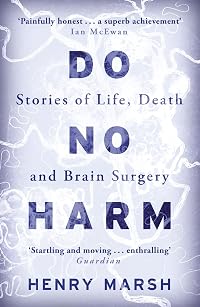
Do No Harm: Stories of Life, Death, and Brain Surgery
by Henry Marsh
On This Page
Description
"Neurosurgeon Henry Marsh reveals the fierce joy of operating, the profoundly moving triumphs, the harrowing disasters, the haunting regrets, and the moments of black humor that characterize a brain surgeon's life. If you believe that brain surgery is a precise and exquisite craft, practiced by calm and detached surgeons, this ... brutally honest account will make you think again"--Amazon.com.Tags
Recommendations








Member Recommendations
fountainoverflows While Marsh's book is ostensibly a collection of stories about experiences with neurosurgery patients, there is a great deal to be gleaned about doctors'--and, in particular, surgeons' emotional states, especially when the diagnosis is very grim.
Member Reviews
A really engaging book that manages to makes its complex subject matter (brain surgery) accessible and fascinating. Marsh throws in a fair amount of commentary on the state of the modern NHS but his writing is never preachy and the book overall is satisfying and thought provoking. His meditations on death and the question of whether we should avoid it at all costs are especially interesting.
I'm a huge fan of medical memoirs, probably because in another life, I would have been a doctor. As it is, I can read about it and live vicariously through people like Henry Marsh without actually having to hold a scalpel.
Dr. Marsh has this remarkable ability to take incredibly dense subjects like neuroscience and neurosurgery and make them not just comprehensible but genuinely fascinating. He structures each chapter around a specific neurological condition, then weaves in his personal experiences dealing with that condition. It's a great mix of exciting storytelling and educational information that never reads like a textbook.
The title "Do No Harm" carries this beautiful irony throughout the book. Brain surgery inherently causes harm show more (you're literally cutting into someone's skull) so Marsh is constantly navigating this impossible balance between the harm of intervention and the harm of doing nothing. Every decision has life-altering consequences, and he doesn't shy away from showing you both his triumphs and his devastating failures. This isn't one of those medical memoirs where the doctor presents himself as some infallible hero. Dr. Marsh admits to mistakes, arrogance, and profound doubt. He's the flawed protagonist of his own story, which makes the whole thing feel refreshingly honest.
The institutional critique woven throughout adds another layer. Dr. Marsh doesn't just tell you about individual patients; he shows you the bureaucratic obstacles and healthcare system failures that complicate everything. His observations about the NHS feel particularly relevant, and you get the sense of someone who has spent decades grappling with systemic problems while trying to do right by individual patients. It's sobering but no less interesting for it.
What struck me most was how Dr. Marsh tackles the cost of excellence... the personal sacrifices required for professional achievement, along with the toll that carrying this much responsibility takes on a person. He's examining his own life and legacy while still in the middle of living it, which gives the whole memoir a quality of someone philosophizing about death while very much alive. It's not morbid... it's just honest about what it means to spend your career in such intimate proximity to mortality.
I really enjoyed this book. The format worked beautifully, the writing was elegant and thought-provoking, and Dr. Marsh's willingness to show you his mistakes alongside his successes made it feel genuine rather than self-congratulatory. It's the kind of medical memoir that transcends the genre to become something more universal: a meditation on responsibility, failure, mortality, and meaning. show less
Dr. Marsh has this remarkable ability to take incredibly dense subjects like neuroscience and neurosurgery and make them not just comprehensible but genuinely fascinating. He structures each chapter around a specific neurological condition, then weaves in his personal experiences dealing with that condition. It's a great mix of exciting storytelling and educational information that never reads like a textbook.
The title "Do No Harm" carries this beautiful irony throughout the book. Brain surgery inherently causes harm show more (you're literally cutting into someone's skull) so Marsh is constantly navigating this impossible balance between the harm of intervention and the harm of doing nothing. Every decision has life-altering consequences, and he doesn't shy away from showing you both his triumphs and his devastating failures. This isn't one of those medical memoirs where the doctor presents himself as some infallible hero. Dr. Marsh admits to mistakes, arrogance, and profound doubt. He's the flawed protagonist of his own story, which makes the whole thing feel refreshingly honest.
The institutional critique woven throughout adds another layer. Dr. Marsh doesn't just tell you about individual patients; he shows you the bureaucratic obstacles and healthcare system failures that complicate everything. His observations about the NHS feel particularly relevant, and you get the sense of someone who has spent decades grappling with systemic problems while trying to do right by individual patients. It's sobering but no less interesting for it.
What struck me most was how Dr. Marsh tackles the cost of excellence... the personal sacrifices required for professional achievement, along with the toll that carrying this much responsibility takes on a person. He's examining his own life and legacy while still in the middle of living it, which gives the whole memoir a quality of someone philosophizing about death while very much alive. It's not morbid... it's just honest about what it means to spend your career in such intimate proximity to mortality.
I really enjoyed this book. The format worked beautifully, the writing was elegant and thought-provoking, and Dr. Marsh's willingness to show you his mistakes alongside his successes made it feel genuine rather than self-congratulatory. It's the kind of medical memoir that transcends the genre to become something more universal: a meditation on responsibility, failure, mortality, and meaning. show less
I started reading this book on a Saturday morning and finished it that evening. It was impossible to put down. Henry Marsh talks about his career as a neurosurgeon and holds little back; besides the success stories, he tells us of the procedures that went wrong, mistakes he made, and the ongoing struggle to provide patient care while under pressure from pencil-pushing managers and recklessly cost-cutting politicians.
He describes in poetic detail the anatomy of the brain and how the intense magnification of the operating microscope changes his perspective on what lies inside the skull---if a blood vessel is nicked by accident when removing a tumour, the sudden storm of red filling your vision will make it feel like the surgeon is show more drowning in blood. Some of the details, while matter-of-fact, made me cringe and go into the fetal position: how the surgeons bolt the patient's head into position on the operating table, cutting into the scalp and FLIPPING IT OVER (this is where I had to put my head between my knees for a bit), and using a sucker to vacuum out tumours. I am also not yet convinced about operations done under local anaesthetic; Marsh says that the brain itself does not feel pain, and I must admit that it would be helpful for the surgeon to know what bits they're poking, but the image still gives me the creeps. But despite these horrifying details, I could not stop reading. (To be honest, the bits that grossed me out the most were his accounts of his own medical woes relating to retinal detachment and eye surgery.)
There is even a chapter on dealing with his mother's final illness and death, and how she was lucky enough to have something very close to a perfect death. This chapter, in combination with other anecdotes about the state of the UK National Health Service (and how it compares with private hospitals), is highly timely and makes an excellent prompt to read Being Mortal or another book dealing with this topic.
The only thing preventing this from being a perfect book was the fact that it was slightly repetitive -- some facts or statements were repeated fairly close together, such as the statement that approximately 1/4 of the blood pumped by your heart each minute goes to your brain (and this is why blood loss is so catastrophic in neurosurgery). The book also skipped around a little bit in time. For this reason it may be better to ration yourself to a chapter at a time, but with stories as fascinating as these it's difficult to resist. show less
He describes in poetic detail the anatomy of the brain and how the intense magnification of the operating microscope changes his perspective on what lies inside the skull---if a blood vessel is nicked by accident when removing a tumour, the sudden storm of red filling your vision will make it feel like the surgeon is show more drowning in blood. Some of the details, while matter-of-fact, made me cringe and go into the fetal position: how the surgeons bolt the patient's head into position on the operating table, cutting into the scalp and FLIPPING IT OVER (this is where I had to put my head between my knees for a bit), and using a sucker to vacuum out tumours. I am also not yet convinced about operations done under local anaesthetic; Marsh says that the brain itself does not feel pain, and I must admit that it would be helpful for the surgeon to know what bits they're poking, but the image still gives me the creeps. But despite these horrifying details, I could not stop reading. (To be honest, the bits that grossed me out the most were his accounts of his own medical woes relating to retinal detachment and eye surgery.)
There is even a chapter on dealing with his mother's final illness and death, and how she was lucky enough to have something very close to a perfect death. This chapter, in combination with other anecdotes about the state of the UK National Health Service (and how it compares with private hospitals), is highly timely and makes an excellent prompt to read Being Mortal or another book dealing with this topic.
The only thing preventing this from being a perfect book was the fact that it was slightly repetitive -- some facts or statements were repeated fairly close together, such as the statement that approximately 1/4 of the blood pumped by your heart each minute goes to your brain (and this is why blood loss is so catastrophic in neurosurgery). The book also skipped around a little bit in time. For this reason it may be better to ration yourself to a chapter at a time, but with stories as fascinating as these it's difficult to resist. show less
"Every surgeon carries within himself a small cemetery, where from time to time he goes to pray- a place of bitterness and regret, where he must look for an explanation for his failures."
-René Leriche, La philosophie de la chirurgie, 1951
I loved this book, and I can say with confidence that it's the best nonfiction book I have ever read. (Before you get too excited, bear in mind that I don't have extensive experience in the nonfic realm.) But, honestly, if you're even slightly interested in neuroscience or surgery and want to read an intelligently written, frank account of modern medicine, this is the book for you. If, however, you're the squeamish sort who shrieks at the mention of blood or is simply not down with pretty graphic show more descriptions of surgery, perhaps you should stay away from this one. I feel I should say, though, that I found the descriptions of neurosurgical procedures incredibly fascinating and beautifully written.
Henry Marsh's voice is clear in every page of this book. He's tough, brutally honest, and I found his outlook on life, death, and brain surgery refreshing. Marsh, like most every surgeon, struggles with professional objectivity, with giving hope to patients and sometimes having to take it away, with the high stakes of his practise and the looming fact that he can't save every patient who passes into the ward. It's a hard, gruelling, yet rewarding career, and being able to see a typical day (and some atypical ones) in the life of Dr Marsh was not only interesting but his musings on hope, medicine, when to give up, and death in the modern age were thought-provoking as well.
Like any career, neurosurgery has its highs and lows, and we see both in Do No Harm. There are good days:
And, inevitably, there are bad ones:
Some things mentioned here weren't entirely clear to me, mostly the parts where Marsh describes the Trust or what he thinks of the NHS or how NHS hospitals differ from others, or how he could afford private insurance but now cannot. This is because I live in the U.S., where we have a commercial healthcare system, and so some of the gripes the author has with how things are run in the U.K. went over my head. That doesn't mean, though, that I didn't appreciate Marsh's dislike of useless authority, or his hatred of hospital bureaucracy and pointless lectures. I especially loved his occasional refusal to adhere to meaningless rules, and his frustration at when delays and problems are caused due to unnecessary restrictions and regulations imposed by the management. My favourite was when he was having his time wasted by being forced to attend a mandatory lecture by a man who didn't know what he was talking about:
Click the spoiler for an amazing close-up of the tiny arteries and veins on the surface of the brain! (Don't click it if you're squeamish, obviously.)
-René Leriche, La philosophie de la chirurgie, 1951
I loved this book, and I can say with confidence that it's the best nonfiction book I have ever read. (Before you get too excited, bear in mind that I don't have extensive experience in the nonfic realm.) But, honestly, if you're even slightly interested in neuroscience or surgery and want to read an intelligently written, frank account of modern medicine, this is the book for you. If, however, you're the squeamish sort who shrieks at the mention of blood or is simply not down with pretty graphic show more descriptions of surgery, perhaps you should stay away from this one. I feel I should say, though, that I found the descriptions of neurosurgical procedures incredibly fascinating and beautifully written.
Henry Marsh's voice is clear in every page of this book. He's tough, brutally honest, and I found his outlook on life, death, and brain surgery refreshing. Marsh, like most every surgeon, struggles with professional objectivity, with giving hope to patients and sometimes having to take it away, with the high stakes of his practise and the looming fact that he can't save every patient who passes into the ward. It's a hard, gruelling, yet rewarding career, and being able to see a typical day (and some atypical ones) in the life of Dr Marsh was not only interesting but his musings on hope, medicine, when to give up, and death in the modern age were thought-provoking as well.
I left them in the little room, their knees squeezed together as the four of them sat on the small sofa and wondered, yet again, as I walked away down the dark hospital corridor, at the way we cling so tightly to life and how there would be so much less suffering if we did not. Life without hope is hopelessly difficult but at the end hope can so easily make fools of us all.
Like any career, neurosurgery has its highs and lows, and we see both in Do No Harm. There are good days:
I went down the stairs to my office to see if there was any more paperwork to be done but just for once Gail had left my office empty. It had been a good day. I had not lost my temper. I had finished the list. The patients were well. The pathology had been benign. I had been able to cancel the two spines at the beginning of the list rather than at the end. There were no major problems with the patients on the wards. What more could a surgeon want?
And, inevitably, there are bad ones:
None of us felt able to make our usual sardonic jokes at the morning meeting. The first case was a man who had died as a result of an entirely avoidable delay in his being transferred to our unit; another was a young woman who had become brain dead after a haemorrhage. We looked glumly at her brain scan.
'That's a dead brain,' one of my colleagues explained to the juniors. 'Brain looks like ground glass.'
The last case was an eight-year-old who had tried to hang himself and had suffered hypoxic brain damage.
'Can we have some rather less depressing cases please?' someone asked, but there were none and the meeting came to an end.
Some things mentioned here weren't entirely clear to me, mostly the parts where Marsh describes the Trust or what he thinks of the NHS or how NHS hospitals differ from others, or how he could afford private insurance but now cannot. This is because I live in the U.S., where we have a commercial healthcare system, and so some of the gripes the author has with how things are run in the U.K. went over my head. That doesn't mean, though, that I didn't appreciate Marsh's dislike of useless authority, or his hatred of hospital bureaucracy and pointless lectures. I especially loved his occasional refusal to adhere to meaningless rules, and his frustration at when delays and problems are caused due to unnecessary restrictions and regulations imposed by the management. My favourite was when he was having his time wasted by being forced to attend a mandatory lecture by a man who didn't know what he was talking about:
How strange it is, I thought as I listened to him talking, that after thirty years of struggling with death, disaster and countless crises and catastrophes, having watched patients bleed to death in my hands, having had furious arguments with colleagues, terrible meetings with relatives, moments of utter despair and of profound exhilaration- in short, a typical neurosurgical career- how strange it is that I should now be listening to a young man with a background in catering telling me that I should develop empathy, keep focused and stay calm. As soon as the signing-out register had been passed around, and I had signed it, thus confirming that the Trust could now state that I had been trained in Empathy and Self-control, and the classification of Abuse and of Fire Extinguishers, in addition to many other things I had already forgotten, I charged out of the room despite Chris' protests that he had not yet finished.
Click the spoiler for an amazing close-up of the tiny arteries and veins on the surface of the brain! (Don't click it if you're squeamish, obviously.)
"I often have to cut into the brain, and it is something I hate doing," is the opening sentence in this engaging memoir. Each chapter is titled after a disease of the brain, a few I was familiar with: Trauma, Infarct, Medullablastoma, (which I was familiar with since my niece suffered this when she was 6--she is now 25 and in good health, although for Marsh's patient the cancer recurred when the patient was in his 40's), but most of which I hadn't heard of, i.e. Akinetic Mutism, Neurotmesis, Empyema, Astrocytoma, Oligodendroglioma, etc. etc. Don't those mysterious words just make you salivate to read this book? (Just kidding). However, despite these esoteric chapter titles, Marsh's stories of his experiences in neurosurgery are highly show more engaging and eminently readable.
Marsh states that frequently the most difficult part of brain surgery is deciding whether or not to operate, since the risks are usually great, benefits may be nominal, and mistakes, even when death is avoided, can be devastating. In Marsh's view, mistakes are "unacceptable, but inevitable," and he does not shy away from including in his stories his mistakes as well as his success stories.
In addition to his stories about his patients, his stories about the state of the science of the medicine of the brain, and the stories about his personal life, I also enjoyed his wry sense of humor, mostly in regard to his dealings with the British health bureaucracy.
3 1/2 stars show less
Marsh states that frequently the most difficult part of brain surgery is deciding whether or not to operate, since the risks are usually great, benefits may be nominal, and mistakes, even when death is avoided, can be devastating. In Marsh's view, mistakes are "unacceptable, but inevitable," and he does not shy away from including in his stories his mistakes as well as his success stories.
In addition to his stories about his patients, his stories about the state of the science of the medicine of the brain, and the stories about his personal life, I also enjoyed his wry sense of humor, mostly in regard to his dealings with the British health bureaucracy.
3 1/2 stars show less
Henry Marsh, considerado el mejor neurocirujano de la Gran Bretaña, nos comparte en este libro sus experiencias la mayoría de ellas, donde las cosas no han resultado como debieran
"Ante todo no hagas daño
Atribuido a Hipocrates de Cos 460 A.C"
Nos comparte que tanto él, como sus colegas médicos en cualquier especialidad son solo seres humanos, personas que tienen fallos, pero estos fallos tienen enormes consecuencias, por lo tanto, nos muestra ese pequeño cementerio que arrastra en su interior, no de manera morbosa, si no mas bien, de manera humana, realista, la forma en que cada una de esas lapidas ha sido un recordatorio de lo que sus fallos le han hecho a otras personas, situaciones con las que tiene que vivir día a día.
«Todo show more cirujano lleva en su interior un pequeño cementerio al que acude a rezar de vez en cuando, un lugar lleno de amargura y pesar, en el que debe buscar explicación a sus fracasos.»
RENÉ LERICHE, La filosofía de la cirugía, 1951
Por supuesto, no todas son tragedias, tiene muchos casos exitosos, no en balde es considerado el mejor en su especialidad, pero con una enorme humildad, Marsh, nos explica como en realidad, si, claro que la experiencia importa, si, claro que los conocimientos valen, pero es la suerte, la mala y la buena, la que juega sobre todo un papel importante en el éxito o fracaso de una operación de cerebro.
De una manera sencilla, mordaz, increíblemente fascinante, Marsh nos cuenta la forma en que se hace médico, como decide hacerse neurocirujano. Su narración es tan ágil y tan sencilla que podemos comprender fácilmente de que nos habla.
"Al fin y al cabo, una cuarta parte de la sangre que
bombea el corazón va a parar al cerebro. Está visto que pensar es un proceso que exige muchísima energía"
Vivimos con Marsh, como es difícil hablar con los pacientes, con sus familiares, no solo para dar diagnósticos muchas veces desalentadores, si no también explicarles consecuencias de una operación y peor aun dar la cara cuando las operaciones no salen bien, todo un arte el hablar con las personas siendo medico, algo que Marsh de manera muy humana nos hace ver, porque al final, no todos los médicos tienen esa empatia que se requiere o sencillamente la fortaleza, la franqueza o el coraje de dar la cara
"Cuando he tenido que dar malas noticias, nunca sé si lo he hecho bien o no. Los pacientes no van a llamarme después para decirme «Dr. Marsh, me ha gustado muchísimo cómo me ha dicho que iba a morir», y tampoco para soltarme «Dr. Marsh, lo ha hecho fatal». Lo único que puedes esperar es no haber metido demasiado la pata.·
Todas esas situaciones en las que se tiene que luchar con colegas de los que se depende para salir adelante, como anestesistas, enfermeras, radiologos, etc, porque al final el medico cirujano no es su jefe y si alguno decide no cooperar para que se lleve a cabo la operación, el traslado, otorgarle una cama, etc, puede resultar en una frustración tremenda, en atrasos, en malos tratos a los pacientes, que sin embargo, como bien recalca Marsh, los pacientes difícilmente reclaman, ya que son pacientes, no clientes y en esa tesitura, por naturaleza, no reclaman lo suficiente.
"Como les digo siempre entre risas a mis residentes, los médicos no sufren lo suficiente"
Lidiar con el aparato burocrático, informes, cambios de administración, cambios de sistemas, que el gobierno considere lo que se supone mejor para los pacientes sin considerar lo que opinan los especialistas y quienes los tratan diariamente, la salud publica apabullada de crisis de administración, con lo que no queda mas que lidiar constantemente, porque no se tiene otra opción
"Operar es la parte más fácil, ¿sabe? —dijo finalmente—. Cuando uno llega a mi edad, se da cuenta de que todas las dificultades tienen que ver con la toma de decisiones."
Lo que supone para un médico con practica y experiencia tener que soltar el bisturí a los practicantes, saber que tiene que hacerlo con la angustia de saber que pueden equivocarse y que solo él será responsable de esa equivocación, pero vamos, alguien tiene que enseñarles y tienen que tener practica, puesto que los médicos con experiencia, algún día se jubilarán.
Marsh, nos lleva también a través de su trabajo altruista a Ucrania, como es que llega ahí, como se compromete a esa causa para ir a atender pacientes en un país pobre, con pocos recursos y lo poco que puede hacer ahí.
Un libro fascinante, donde vemos la cara personal de uno de los mejores médicos en su especialidad, no solo en Gran Bretaña, puesto que es considerado uno de los mejores del mundo y honestamente esa sencillez de él para contarnos sus experiencias, las buenas, las malas, las mundanas, no hace mas que hacernos darnos cuenta que a pesar de todo, por muy buenos médicos que sean, solo son personas que hacen un trabajo y que detrás de esas mentes y manos mágicas, también se esconden inseguridades, miedos, fracasos y una vida llena de altas y bajas.
Un libro que recomendaría para cualquiera, me encanto y realmente lo disfrute muchísimo, cada capitulo lo titula con uno de esos nombres extraños que tienen las enfermedades del cerebro y donde nos explica lo que significa y como se trata.
Extraordinario. show less
"Ante todo no hagas daño
Atribuido a Hipocrates de Cos 460 A.C"
Nos comparte que tanto él, como sus colegas médicos en cualquier especialidad son solo seres humanos, personas que tienen fallos, pero estos fallos tienen enormes consecuencias, por lo tanto, nos muestra ese pequeño cementerio que arrastra en su interior, no de manera morbosa, si no mas bien, de manera humana, realista, la forma en que cada una de esas lapidas ha sido un recordatorio de lo que sus fallos le han hecho a otras personas, situaciones con las que tiene que vivir día a día.
«Todo show more cirujano lleva en su interior un pequeño cementerio al que acude a rezar de vez en cuando, un lugar lleno de amargura y pesar, en el que debe buscar explicación a sus fracasos.»
RENÉ LERICHE, La filosofía de la cirugía, 1951
Por supuesto, no todas son tragedias, tiene muchos casos exitosos, no en balde es considerado el mejor en su especialidad, pero con una enorme humildad, Marsh, nos explica como en realidad, si, claro que la experiencia importa, si, claro que los conocimientos valen, pero es la suerte, la mala y la buena, la que juega sobre todo un papel importante en el éxito o fracaso de una operación de cerebro.
De una manera sencilla, mordaz, increíblemente fascinante, Marsh nos cuenta la forma en que se hace médico, como decide hacerse neurocirujano. Su narración es tan ágil y tan sencilla que podemos comprender fácilmente de que nos habla.
"Al fin y al cabo, una cuarta parte de la sangre que
bombea el corazón va a parar al cerebro. Está visto que pensar es un proceso que exige muchísima energía"
Vivimos con Marsh, como es difícil hablar con los pacientes, con sus familiares, no solo para dar diagnósticos muchas veces desalentadores, si no también explicarles consecuencias de una operación y peor aun dar la cara cuando las operaciones no salen bien, todo un arte el hablar con las personas siendo medico, algo que Marsh de manera muy humana nos hace ver, porque al final, no todos los médicos tienen esa empatia que se requiere o sencillamente la fortaleza, la franqueza o el coraje de dar la cara
"Cuando he tenido que dar malas noticias, nunca sé si lo he hecho bien o no. Los pacientes no van a llamarme después para decirme «Dr. Marsh, me ha gustado muchísimo cómo me ha dicho que iba a morir», y tampoco para soltarme «Dr. Marsh, lo ha hecho fatal». Lo único que puedes esperar es no haber metido demasiado la pata.·
Todas esas situaciones en las que se tiene que luchar con colegas de los que se depende para salir adelante, como anestesistas, enfermeras, radiologos, etc, porque al final el medico cirujano no es su jefe y si alguno decide no cooperar para que se lleve a cabo la operación, el traslado, otorgarle una cama, etc, puede resultar en una frustración tremenda, en atrasos, en malos tratos a los pacientes, que sin embargo, como bien recalca Marsh, los pacientes difícilmente reclaman, ya que son pacientes, no clientes y en esa tesitura, por naturaleza, no reclaman lo suficiente.
"Como les digo siempre entre risas a mis residentes, los médicos no sufren lo suficiente"
Lidiar con el aparato burocrático, informes, cambios de administración, cambios de sistemas, que el gobierno considere lo que se supone mejor para los pacientes sin considerar lo que opinan los especialistas y quienes los tratan diariamente, la salud publica apabullada de crisis de administración, con lo que no queda mas que lidiar constantemente, porque no se tiene otra opción
"Operar es la parte más fácil, ¿sabe? —dijo finalmente—. Cuando uno llega a mi edad, se da cuenta de que todas las dificultades tienen que ver con la toma de decisiones."
Lo que supone para un médico con practica y experiencia tener que soltar el bisturí a los practicantes, saber que tiene que hacerlo con la angustia de saber que pueden equivocarse y que solo él será responsable de esa equivocación, pero vamos, alguien tiene que enseñarles y tienen que tener practica, puesto que los médicos con experiencia, algún día se jubilarán.
Marsh, nos lleva también a través de su trabajo altruista a Ucrania, como es que llega ahí, como se compromete a esa causa para ir a atender pacientes en un país pobre, con pocos recursos y lo poco que puede hacer ahí.
Un libro fascinante, donde vemos la cara personal de uno de los mejores médicos en su especialidad, no solo en Gran Bretaña, puesto que es considerado uno de los mejores del mundo y honestamente esa sencillez de él para contarnos sus experiencias, las buenas, las malas, las mundanas, no hace mas que hacernos darnos cuenta que a pesar de todo, por muy buenos médicos que sean, solo son personas que hacen un trabajo y que detrás de esas mentes y manos mágicas, también se esconden inseguridades, miedos, fracasos y una vida llena de altas y bajas.
Un libro que recomendaría para cualquiera, me encanto y realmente lo disfrute muchísimo, cada capitulo lo titula con uno de esos nombres extraños que tienen las enfermedades del cerebro y donde nos explica lo que significa y como se trata.
Extraordinario. show less
I loved Do No Harm by Henry Marsh and did not want it to end. It tells of his work as a neurosurgeon with brutal honesty and intense compassion. He reminds me so much of my father who was also a doctor but not a neurosurgeon. One thing that I already knew stood out, that doctors will admit their mistakes to other doctors about not so much to others. He goes through his own mistakes and he learns from them but always with regret that he made a mistake the first time. Like when he took out most of a brain tumor and decided to try to get the rest out. The patient would have been much better off if he had stopped when he was ahead. That stood as a lesson to not let pride get into the way of doing the best that you can for your patient.
Henry show more Marsh begins each chapter with a different kind of brain disease or brain problem and discusses cases. His life is deeply affected by his feelings for the patient. He worries over how to break the news to the patient when there was no point in operating, when the operation might only buy a few months or maybe five years. He carefully thinks about how to break disastrous news to the parents of children. He points out the absurdities of the health system and often left me laughing or shaking my head. He did not go along with the status quo, he stood out for making his own decisions and owning the consequences good or disastrous. I was deeply touched by his and his sister’s care for their dying mother and how deeply they loved her. He is deeply human.
I had trigeminal neuralgia, a condition, which is in the book,back in the 1970s. Luckily for me the last ditch hope of a medicine stopped the intensely painful jolts of pain across my face on my right side. Now I understand my neurologist told me with nervous gulp that the only other resort was surgery. He looked so scared himself that I didn’t ask him about the risks. Now, I know.
I now know that when a surgeon rushes through a surgical discussion without serious thought to what it is to be on “the other side” that they may have not have been a patient themselves.
I highly recommend this book for anyone who wants to learn about medicine and the human side of being a neurosurgeon.
I received this ARC from the publisher as a win from FirstReads but that in no way influenced my thoughts or feelings in this review. show less
Henry show more Marsh begins each chapter with a different kind of brain disease or brain problem and discusses cases. His life is deeply affected by his feelings for the patient. He worries over how to break the news to the patient when there was no point in operating, when the operation might only buy a few months or maybe five years. He carefully thinks about how to break disastrous news to the parents of children. He points out the absurdities of the health system and often left me laughing or shaking my head. He did not go along with the status quo, he stood out for making his own decisions and owning the consequences good or disastrous. I was deeply touched by his and his sister’s care for their dying mother and how deeply they loved her. He is deeply human.
I had trigeminal neuralgia, a condition, which is in the book,back in the 1970s. Luckily for me the last ditch hope of a medicine stopped the intensely painful jolts of pain across my face on my right side. Now I understand my neurologist told me with nervous gulp that the only other resort was surgery. He looked so scared himself that I didn’t ask him about the risks. Now, I know.
I now know that when a surgeon rushes through a surgical discussion without serious thought to what it is to be on “the other side” that they may have not have been a patient themselves.
I highly recommend this book for anyone who wants to learn about medicine and the human side of being a neurosurgeon.
I received this ARC from the publisher as a win from FirstReads but that in no way influenced my thoughts or feelings in this review. show less
Members
- Recently Added By
Published Reviews
ThingScore 100
As a young doctor just starting out, Henry Marsh watched a neurosurgeon operate on a woman’s brain, going after a dangerous aneurysm that could rupture and kill her. This kind of surgery — taking place several inches inside the patient’s head — was perilous, and often compared, as he writes in his riveting new memoir, to bomb disposal work, “though the bravery required is of a show more different kind as it is the patient’s life that is at risk and not the surgeon’s.”
There was “the chase,” as the surgeon stalked his prey deep within the brain, then “the climax as he caught the aneurysm, trapped it, and obliterated it with a glittering, spring-loaded titanium clip, saving the patient’s life.” More than that, Dr. Marsh goes on, “the operation involved the brain, the mysterious substrate of all thought and feeling, of all that was important in human life — a mystery, it seemed to me, as great as the stars at night and the universe around us. The operation was elegant, delicate, dangerous and full of profound meaning. What could be finer, I thought, than to be a neurosurgeon?”
Dr. Marsh would become one of Britain’s foremost neurosurgeons, and in this unflinching book, “Do No Harm,” he gives us an extraordinarily intimate, compassionate and sometimes frightening understanding of his vocation. . . . . show less
There was “the chase,” as the surgeon stalked his prey deep within the brain, then “the climax as he caught the aneurysm, trapped it, and obliterated it with a glittering, spring-loaded titanium clip, saving the patient’s life.” More than that, Dr. Marsh goes on, “the operation involved the brain, the mysterious substrate of all thought and feeling, of all that was important in human life — a mystery, it seemed to me, as great as the stars at night and the universe around us. The operation was elegant, delicate, dangerous and full of profound meaning. What could be finer, I thought, than to be a neurosurgeon?”
Dr. Marsh would become one of Britain’s foremost neurosurgeons, and in this unflinching book, “Do No Harm,” he gives us an extraordinarily intimate, compassionate and sometimes frightening understanding of his vocation. . . . . show less
added by PLReader
Lists

Best Medical Nonfiction
79 works; 29 members

medical memoirs
24 works; 3 members

BBC Radio 4 Bookclub
340 works; 13 members
Author Information

3 Works 1,827 Members
Henry Marsh is a neurosurgeon who authored the memoir Do No Harm: Stories of Life, Death and Brain Surgery which won the PEN/Ackerley Prize 2015. The prize in the amout of £3000 (A$6115) is awarded to the author of a notable work of memoir or autobiography. (Bowker Author Biography)
Some Editions
Awards and Honors
Awards
Distinctions
Work Relationships
Common Knowledge
- Original publication date
- 2014
- People/Characters
- Henry Marsh
- Blurbers
- Mosley, Michael
Classifications
Statistics
- Members
- 1,325
- Popularity
- 18,175
- Reviews
- 52
- Rating
- (4.05)
- Languages
- 16 — Catalan, Danish, Dutch, English, Estonian, Finnish, German, Hungarian, Italian, Norwegian (Bokmål), Portuguese, Romanian, Russian, Spanish, Swedish, Turkish
- Media
- Paper, Audiobook, Ebook
- ISBNs
- 41
- UPCs
- 1
- ASINs
- 17