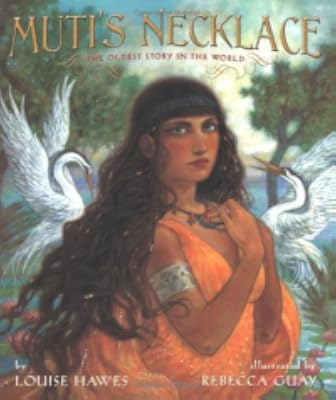
Muti's Necklace: The Oldest Story in the World
by Louise Hawes 
On This Page
Description
Muti treasures the necklace her father gave her so much that she risks the wrath of Egypt's pharaoh when it falls into the water. Based on an ancient Egyptian story.Tags
Recommendations








Member Reviews
Author Louise Hawes and illustrator Rebecca Guay together retell an ancient Egyptian fairy-tale in this lovely picture-book. Given a beautiful necklace made of turquoise and carnelian by her father, Muti grows up surrounded by his love, and by the love of her mother and brother. Eventually she becomes a servant in the palace of King Snefru, the Pharaoh of all Egypt. When the Pharaoh's whim sees her pressed into service as the leader of his oar-girls, she does her job well, until the necklace is lost in the Royal Lake. Refusing to take up her oar again, Muti defies the captain, the Pharaoh, and the Pharaoh's magician, until finally an awesome act of magic is performed, to allow her to retrieve her beloved necklace...
Originally contained show more in the Westcar Papyrus - an ancient Egyptian text containing five stories, and dated to between the 18th and 16th centuries BC - this story is indeed one of the oldest recorded fairy-tales in the world. An English translation of it in its original form can be found in Miriam Lichtheim's Ancient Egyptian Literature Volume I: The Old and Middle Kingdoms. Hawes has taken some liberties with the story in her retelling, focusing on the rowing girl, rather than the king, and giving her heroine a name and a family. It's interesting to note that scholars believe the original was an oblique satire and critique of King Snefru, who is covertly mocked for not being able to control a mere oar-girl without the help of a magician. Hawes has chosen to tell her story from the girl's perspective, making her heroic rather than willful, and centering the narrative on the idea of the power and pull of home and family. As hers is a children's retelling, I think this choice makes sense, and it certainly makes for an engaging narrative. It's also interesting to note that the episode in which the court magician causes the waters of the lake to recede, allowing Muti to walk out onto the lake floor and retrieve her necklace, is reminiscent of the parting of the Red Sea, in the biblical book of Exodus. Perhaps this story was an influence on the much-later biblical one, just as the Babylonian Enuma Elish was?
Leaving aside textual issues, Muti's Necklace: The Oldest Story in the World is a gorgeous book, from a visual perspective. The accompanying illustrations from Rebecca Guay are simply breathtaking, capturing the beauty and mystery of Muti's world. Although I am familiar with Guay's work from the cover-art she provided to a number of children's novels - Dia Calhoun's The Phoenix Dance, Jackie French Koller's A Wizard Named Nell, etc. - this is the first of her picture-books I have picked up. I certainly intend to track down more, given how much I enjoyed her work here! Recommended to fairy-tale lovers, and to young children fascinated by Ancient Egypt. show less
Originally contained show more in the Westcar Papyrus - an ancient Egyptian text containing five stories, and dated to between the 18th and 16th centuries BC - this story is indeed one of the oldest recorded fairy-tales in the world. An English translation of it in its original form can be found in Miriam Lichtheim's Ancient Egyptian Literature Volume I: The Old and Middle Kingdoms. Hawes has taken some liberties with the story in her retelling, focusing on the rowing girl, rather than the king, and giving her heroine a name and a family. It's interesting to note that scholars believe the original was an oblique satire and critique of King Snefru, who is covertly mocked for not being able to control a mere oar-girl without the help of a magician. Hawes has chosen to tell her story from the girl's perspective, making her heroic rather than willful, and centering the narrative on the idea of the power and pull of home and family. As hers is a children's retelling, I think this choice makes sense, and it certainly makes for an engaging narrative. It's also interesting to note that the episode in which the court magician causes the waters of the lake to recede, allowing Muti to walk out onto the lake floor and retrieve her necklace, is reminiscent of the parting of the Red Sea, in the biblical book of Exodus. Perhaps this story was an influence on the much-later biblical one, just as the Babylonian Enuma Elish was?
Leaving aside textual issues, Muti's Necklace: The Oldest Story in the World is a gorgeous book, from a visual perspective. The accompanying illustrations from Rebecca Guay are simply breathtaking, capturing the beauty and mystery of Muti's world. Although I am familiar with Guay's work from the cover-art she provided to a number of children's novels - Dia Calhoun's The Phoenix Dance, Jackie French Koller's A Wizard Named Nell, etc. - this is the first of her picture-books I have picked up. I certainly intend to track down more, given how much I enjoyed her work here! Recommended to fairy-tale lovers, and to young children fascinated by Ancient Egypt. show less
Another beautiful "cinderella" story with gorgeous illustations to draw kids in. The main character is a strong woman, and I would use this to teach about main characters and story progression.
Ratings
Members
- Recently Added By
Lists

A Child's Book Tour of Egypt
27 works; 2 members
Author Information

17+ Works 454 Members
Louise Hawes is a LibraryThing Author, an author who lists their personal library on LibraryThing.
All Editions
Classifications
Statistics
- Members
- 61
- Popularity
- 506,682
- Reviews
- 2
- Rating
- (4.10)
- Languages
- English
- Media
- Paper
- ISBNs
- 2
- UPCs
- 1
- ASINs
- 1