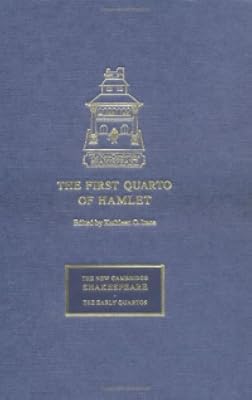
The Tragicall Historie of Hamlet Prince of Denmarke
by William Shakespeare, Graham Holderness (Editor)
On This Page
Description
The first quarto of Hamlet is radically different from the second quarto and Folio versions of the play, and about half their length. But despite its uneven verbal texture and simpler characterisation, the first quarto presents its own workable alternatives to the longer texts, reordering and combining key plot elements, and even including a unique scene between Horatio and the Queen. This new critical edition is designed for students, scholars and actors who are intrigued by the first show more printed text of Shakespeare's Hamlet. Although the first quarto has been reprinted many times, there is no other modernised edition in print. Irace's introduction outlines views of its origins, its special features, and its surprisingly rich performance history; her textual notes point out differences between the first quarto and the longer second quarto and Folio versions and offer alternatives which actors or directors might choose for specific productions. show lessTags
Recommendations

















Member Reviews
Hamlet: The First Quarto, 1603 by William Shakespeare is a reproduction of an earlier version of Hamlet. Included with the play is a lengthy discussion of its history as well as it was known in the 1960s as well as some thoughts on why this version is so very different from the one performed now, written by Albert B. Weiner.
Now I'm not a Shakespearean scholar — just a casual consumer. Hamlet happens to be one of my favorite plays. The reason I read this version was I wanted to look up Claudius's name just to verify that I'd remembered the king's name correctly. Turns out in this version, the king didn't have a name and most of the other characters didn't have the names they have now.
So while the First Quarto didn't help me answer my show more initial question, I got sucked into the discussion of piracy and story tropes. If you think the internet has made piracy worse, I would argue this book shows it hasn't.
While Albert B. Weiner argues in his introductory essay that Hamlet wasn't outright pirated, piracy did exist back then. Copyright, though, wasn't owned by the author. It was owned by whomever commissioned the play just as modern day patents are often owned by the company who hires the inventor.
But plays were remembered by audience goers and there were probably guys there who were great at whatever the Elizabethan version of shorthand was. So just as cellphones are now used to record films in theaters, plays were watched, transcribed, changed up a bit and shipped out to other places to be put on.
So if you're interested in reading something that is clearly Hamlet but isn't quite, I recommend reading the First Quarto version. It's really no different than the numerous relaunches of various comic book stories that Marvel and DC have done. But it's Hamlet! show less
Now I'm not a Shakespearean scholar — just a casual consumer. Hamlet happens to be one of my favorite plays. The reason I read this version was I wanted to look up Claudius's name just to verify that I'd remembered the king's name correctly. Turns out in this version, the king didn't have a name and most of the other characters didn't have the names they have now.
So while the First Quarto didn't help me answer my show more initial question, I got sucked into the discussion of piracy and story tropes. If you think the internet has made piracy worse, I would argue this book shows it hasn't.
While Albert B. Weiner argues in his introductory essay that Hamlet wasn't outright pirated, piracy did exist back then. Copyright, though, wasn't owned by the author. It was owned by whomever commissioned the play just as modern day patents are often owned by the company who hires the inventor.
But plays were remembered by audience goers and there were probably guys there who were great at whatever the Elizabethan version of shorthand was. So just as cellphones are now used to record films in theaters, plays were watched, transcribed, changed up a bit and shipped out to other places to be put on.
So if you're interested in reading something that is clearly Hamlet but isn't quite, I recommend reading the First Quarto version. It's really no different than the numerous relaunches of various comic book stories that Marvel and DC have done. But it's Hamlet! show less
>
Dec 7, 2014Italian
Ratings
Members
- Recently Added By
Lists

Works concerning William Shakespeare
75 works; 4 members
Author Information

6,149+ Works 443,437 Members
William Shakespeare, 1564 - 1616 Although there are many myths and mysteries surrounding William Shakespeare, a great deal is actually known about his life. He was born in Stratford-Upon-Avon, son of John Shakespeare, a prosperous merchant and local politician and Mary Arden, who had the wealth to send their oldest son to Stratford Grammar School. show more At 18, Shakespeare married Anne Hathaway, the 27-year-old daughter of a local farmer, and they had their first daughter six months later. He probably developed an interest in theatre by watching plays performed by traveling players in Stratford while still in his youth. Some time before 1592, he left his family to take up residence in London, where he began acting and writing plays and poetry. By 1594 Shakespeare had become a member and part owner of an acting company called The Lord Chamberlain's Men, where he soon became the company's principal playwright. His plays enjoyed great popularity and high critical acclaim in the newly built Globe Theatre. It was through his popularity that the troupe gained the attention of the new king, James I, who appointed them the King's Players in 1603. Before retiring to Stratford in 1613, after the Globe burned down, he wrote more than three dozen plays (that we are sure of) and more than 150 sonnets. He was celebrated by Ben Jonson, one of the leading playwrights of the day, as a writer who would be "not for an age, but for all time," a prediction that has proved to be true. Today, Shakespeare towers over all other English writers and has few rivals in any language. His genius and creativity continue to astound scholars, and his plays continue to delight audiences. Many have served as the basis for operas, ballets, musical compositions, and films. While Jonson and other writers labored over their plays, Shakespeare seems to have had the ability to turn out work of exceptionally high caliber at an amazing speed. At the height of his career, he wrote an average of two plays a year as well as dozens of poems, songs, and possibly even verses for tombstones and heraldic shields, all while he continued to act in the plays performed by the Lord Chamberlain's Men. This staggering output is even more impressive when one considers its variety. Except for the English history plays, he never wrote the same kind of play twice. He seems to have had a good deal of fun in trying his hand at every kind of play. Shakespeare wrote 154 sonnets, all published on 1609, most of which were dedicated to his patron Henry Wriothsley, The Earl of Southhampton. He also wrote 13 comedies, 13 histories, 6 tragedies, and 4 tragecomedies. He died at Stratford-upon-Avon April 23, 1616, and was buried two days later on the grounds of Holy Trinity Church in Stratford. His cause of death was unknown, but it is surmised that he knew he was dying. (Bowker Author Biography) show less

Graham Holderness is Professor of English at the University of Hertfordshire.
Series
Belongs to Publisher Series
Common Knowledge
- Canonical title
- The Tragicall Historie of Hamlet Prince of Denmarke
- Original title
- The Tragicall Historie of Hamlet Prince of Denmarke
- Original publication date
- 1603
- People/Characters
- Hamlet; Horatio; King; Queene; Leartes; Ofelia (show all 9); Corambis; Rossencraft; Gilderstone
- Important places
- Denmark
- Disambiguation notice
- This work refers only to editions of the first quarto (Q1, 1603). Please do not combine with the second quarto (Q2, 1604) or the First Folio (F1, 1623), let alone with modern editions of the text. All of them are to Q1 as Hyp... (show all)erion to a satyr.
Classifications
Statistics
- Members
- 81
- Popularity
- 393,393
- Reviews
- 2
- Rating
- (3.88)
- Languages
- Dutch, English, Russian
- Media
- Paper, Ebook
- ISBNs
- 12
- ASINs
- 6