
On This Page
Description
Pulitizer Prize biographer Robert A. Caro follows Lyndon Johnson through both the most frustrating and the most triumphant periods of his career, describing Johnson's volatile relationship with John Kennedy and Robert Kennedy during the fight they waged for the 1960 Democratic nomination for president, through Johnson's unhappy vice presidency, his assumption to the presidency after Kennedy's assassination, his victories over the budget and civil rights, and the eroding trap of Vietnam.Tags
Recommendations








Member Reviews
This is the 4th book in Caro’s voluminous biography of LBJ. It covers the years of his vice presidency through his transition to presidential power and concludes with his signing of the Civil Rights Act of 1964 on July 2nd. I have learned so much working my way through these volumes over the course of several years and the 5th is not yet published. I have also come to respect the political and legislative genius of a man I truly detested. His personality had much in common with our current president - bullying, crudeness, run-away ego characterized by constant boasting and lying, meanness, an ambition so great that winning justified any behavior. The biggest difference - and it is hugely significant - was his compassion for and show more empathy with people who were poor, discriminated against, those who were refused access to the tools and institutions and resources necessary to dream of a better future and achieve it. He knew poverty because he’d lived it. And he used his power and his genius to do something to make the world better for those trapped by their circumstances. For that I give him my respect and admiration. show less
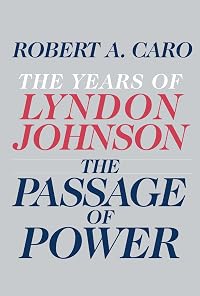
"The Passage of Power" is Robert Caro's fourth of five planned volumes on the life and time of Lyndon Johnson. This one is like the others in that it is meticulously researched and well written. "Passage" covers the end times of Johnson's time as Majority Leader in the Senate to his time as Vice President under John Kennedy through his inheriting the Presidency upon the murder of Kennedy and then the transition the next few months after that.
There is to be sure a lot of history in the book but what really fascinated me was Johnson's personality. Caro's first three books detail Johnson's rise from a hard childhood in rural Texas to college and then on to his first elections and on to the Senate. Johnson had a talent for acquiring power show more and for a determining a person's weakest point. He was ruthless in using both things to get what he wanted. Upon his elevation to Majority Leader in the Senate he ran the place and didn't put up with nonsense from anybody.
This book describes how Johnson wanted the Presidency more than anything but had a huge fear of failure that kept him from pursuing the 1960 elections. He ended up accepting the VP candidacy despite the fierce opposition of John Kennedy's brother Robert. I had never paid Robert Kennedy much attention. He seemed to me to be another passionately liberal Kennedy who liked to play touch football but as Caro describes him Robert Kennedy was ruthless in his own way. He was very aggressive and was kind of his brother's attack dog for many things. It turns out that Robert Kennedy and Lyndon Johnson hated each other.
The book goes on to describe how Johnson was dismayed to find out that the Vice President didn't have much of job and that JFK kept him on a short leash and did not include him on discussions of many issues of the day. As Caro describes it, deprived of his power Johnson became whiny and miserable.
Upon John Kennedy's death however Johnson immediately took over the reins of the government and moved quickly to try and keep as many of "Kennedy's men" to stay and put his own stamp on the administration. John Kennedy had been trying to push some major civil rights legislation but had been getting nowhere with it despite Johnson trying to offer advice. The basic problem was that the "Solid South" had been blocking Civil Rights legislation for decades and the way they did was by holding other important bills hostage. Johnson knew the game because he had been one of those actively blocking civil rights legislation for years. Johnson knew that although the northern Liberals such as Hubert Humphrey had the passion on their side, the Solid South knew the Senates rules and parliamentary procedure by heart. So legislation died a thousand deaths of delaying tactics and gutting amendments.
A fascinating part of the book is the description of Johnson's intricate knowledge of the Senate's rules and his relationships with the players in order to get bill after bill passed. I've read elsewhere speculation that if Kennedy had lived his legislation may not have passed.
Another fascinating side of Johnson was his complete corruption. This book and Caro's previous books detail Johnson's greed in acquiring wealth and the payoff's he took and lots and lots of shady dealings. For example upon becoming President he needed to have certain pesky reporters who were investigating his various shady dealings stopped. Newspaper companies are vulnerable because of their associated radio and television stations. Johnson called up the owners and threatened them with audits and other harassment if the reporters didn't quit. They quit.
So Johnson was a complex character. A man who stood with the "solid south" for years to deny civil rights to minorities and also the man who got them the right to vote and ended official segregation. A great leader but also a craven crook.
In 1964 he had negative ratings in the single digits. I was in grade school in Price, Utah when he ran against Barry Goldwater. We would link arms and march around the school yelling "LBJ for the USA" over and over during recess. Several years later we would see protesters on television linking arms and yelling "Hey, Hey, LBJ how many kids did you kill today." By the time I got to eighth grade, by then in the little burgh of Eagar, Arizona it was hard for me to imagine how the country could last five more years.
I can't wait for Caro's next book. I hope that he hurries because he is 77 years old and I don't need him running out of gas before he finishes.. The next book covers Johnson's downfall and the Vietnam War.
Anyway, for those that stuck with me, this is a great book. Five stars out of five. show less
There is to be sure a lot of history in the book but what really fascinated me was Johnson's personality. Caro's first three books detail Johnson's rise from a hard childhood in rural Texas to college and then on to his first elections and on to the Senate. Johnson had a talent for acquiring power show more and for a determining a person's weakest point. He was ruthless in using both things to get what he wanted. Upon his elevation to Majority Leader in the Senate he ran the place and didn't put up with nonsense from anybody.
This book describes how Johnson wanted the Presidency more than anything but had a huge fear of failure that kept him from pursuing the 1960 elections. He ended up accepting the VP candidacy despite the fierce opposition of John Kennedy's brother Robert. I had never paid Robert Kennedy much attention. He seemed to me to be another passionately liberal Kennedy who liked to play touch football but as Caro describes him Robert Kennedy was ruthless in his own way. He was very aggressive and was kind of his brother's attack dog for many things. It turns out that Robert Kennedy and Lyndon Johnson hated each other.
The book goes on to describe how Johnson was dismayed to find out that the Vice President didn't have much of job and that JFK kept him on a short leash and did not include him on discussions of many issues of the day. As Caro describes it, deprived of his power Johnson became whiny and miserable.
Upon John Kennedy's death however Johnson immediately took over the reins of the government and moved quickly to try and keep as many of "Kennedy's men" to stay and put his own stamp on the administration. John Kennedy had been trying to push some major civil rights legislation but had been getting nowhere with it despite Johnson trying to offer advice. The basic problem was that the "Solid South" had been blocking Civil Rights legislation for decades and the way they did was by holding other important bills hostage. Johnson knew the game because he had been one of those actively blocking civil rights legislation for years. Johnson knew that although the northern Liberals such as Hubert Humphrey had the passion on their side, the Solid South knew the Senates rules and parliamentary procedure by heart. So legislation died a thousand deaths of delaying tactics and gutting amendments.
A fascinating part of the book is the description of Johnson's intricate knowledge of the Senate's rules and his relationships with the players in order to get bill after bill passed. I've read elsewhere speculation that if Kennedy had lived his legislation may not have passed.
Another fascinating side of Johnson was his complete corruption. This book and Caro's previous books detail Johnson's greed in acquiring wealth and the payoff's he took and lots and lots of shady dealings. For example upon becoming President he needed to have certain pesky reporters who were investigating his various shady dealings stopped. Newspaper companies are vulnerable because of their associated radio and television stations. Johnson called up the owners and threatened them with audits and other harassment if the reporters didn't quit. They quit.
So Johnson was a complex character. A man who stood with the "solid south" for years to deny civil rights to minorities and also the man who got them the right to vote and ended official segregation. A great leader but also a craven crook.
In 1964 he had negative ratings in the single digits. I was in grade school in Price, Utah when he ran against Barry Goldwater. We would link arms and march around the school yelling "LBJ for the USA" over and over during recess. Several years later we would see protesters on television linking arms and yelling "Hey, Hey, LBJ how many kids did you kill today." By the time I got to eighth grade, by then in the little burgh of Eagar, Arizona it was hard for me to imagine how the country could last five more years.
I can't wait for Caro's next book. I hope that he hurries because he is 77 years old and I don't need him running out of gas before he finishes.. The next book covers Johnson's downfall and the Vietnam War.
Anyway, for those that stuck with me, this is a great book. Five stars out of five. show less
Geez, what can I say about author Robert Caro but I can't believe he did it again. I mean, I can, his reputation precedes him, but he is so prolific, so good, so thorough, so clear and concise, so focused and blah blah blah.
"The Passage of Power" author Robert Caro's fourth installment into "The Years of Lyndon Johnson" series, takes a back seat to none of the other award winning, highly acclaimed, excellently written first three volumes.
This volume consists of the years of 1958-1964. The run for the 1960 party nomination, his time as Vice President, the JFK murder and the transition on that fateful day up to the 1964 presidential campaign.
As in depth as he always is, his sources are incredible, and it might be more apt to say who he show more didn't interview than who he did. The inexplicable 1958 "run" he made, his utter helplessness in his VP position to do anything but absorb the neglect and abuse from the Kennedy family, the depth of the hate of LBJ and RFK, the details of the post-shooting, the funeral and how quickly he seized the reins of power and established himself as the new president.
Caro's clear and lovely prose puts the reader on the shoulder of history, feeling like you are there, living the events he describes through the words and phrases he uses. I was especially taken aback with his writing on the the time after the murder until after the funeral. This was so good, I could see the strain on Jackie's face, I could hear RFK's voice when he got in the plane once it landed back in DC as he shoved his way to the back. I could see the crowds, the pomp and circumstance, the military, the limos and the ever-burning flame at his gravesite in Arlington National Cemetery. A totally engrossing piece of writing by a master of his craft.
But this is a series on power and Caro shows up exceptionally well how dejected and pathetic Johnson was when he had none as VP and how he utterly changed once he had acquired it again.
Such an enjoyable book, he really did do it again. I would recommend this to anyone who loves great writing, history, or biography. This quickly became one of the favorites of mine of the series, which says a lot. Not quite a five star, but darn close a 4.5. show less
"The Passage of Power" author Robert Caro's fourth installment into "The Years of Lyndon Johnson" series, takes a back seat to none of the other award winning, highly acclaimed, excellently written first three volumes.
This volume consists of the years of 1958-1964. The run for the 1960 party nomination, his time as Vice President, the JFK murder and the transition on that fateful day up to the 1964 presidential campaign.
As in depth as he always is, his sources are incredible, and it might be more apt to say who he show more didn't interview than who he did. The inexplicable 1958 "run" he made, his utter helplessness in his VP position to do anything but absorb the neglect and abuse from the Kennedy family, the depth of the hate of LBJ and RFK, the details of the post-shooting, the funeral and how quickly he seized the reins of power and established himself as the new president.
Caro's clear and lovely prose puts the reader on the shoulder of history, feeling like you are there, living the events he describes through the words and phrases he uses. I was especially taken aback with his writing on the the time after the murder until after the funeral. This was so good, I could see the strain on Jackie's face, I could hear RFK's voice when he got in the plane once it landed back in DC as he shoved his way to the back. I could see the crowds, the pomp and circumstance, the military, the limos and the ever-burning flame at his gravesite in Arlington National Cemetery. A totally engrossing piece of writing by a master of his craft.
But this is a series on power and Caro shows up exceptionally well how dejected and pathetic Johnson was when he had none as VP and how he utterly changed once he had acquired it again.
Such an enjoyable book, he really did do it again. I would recommend this to anyone who loves great writing, history, or biography. This quickly became one of the favorites of mine of the series, which says a lot. Not quite a five star, but darn close a 4.5. show less
This great doorstop of a biography (volume #4 in Caro’s magnum opus on Lyndon Johnson) for a long time. So when it showed up on a “buy one, get one free” sale on Audible, I decided to try the spoken product. And I am so glad I did.
We follow LBJ through the 1960 Presidential campaign where Johnson dithered away his chances to mount a meaningful Presidential run and then, to everyone’s astonishment, gave up his powerful position as Majority Leader of the Senate to run for the Vice Presidency with JFK.
And what a trial the Vice Presidency turns out to be. It really does seem like it’s “not worth a warm bucket of spit.” But then comes the fateful day in Dallas, and all that changes in the blink of an eye, and Johnson comes show more into his own.
Her is LBJ with all his flaws exposed, but still a towering political figure cajoling, twisting arms and even threatening as he strong arms the monumental Civil Rights Act of 1964. Where JFK was unable to deal effectively with Congress, Johnson knows exactly what to do, and proceeds with a vengeance.
This volume ends just before the 1964 Presidential campaign and left me hoping that Caro hurries up and finishes the last volume in this story. show less
We follow LBJ through the 1960 Presidential campaign where Johnson dithered away his chances to mount a meaningful Presidential run and then, to everyone’s astonishment, gave up his powerful position as Majority Leader of the Senate to run for the Vice Presidency with JFK.
And what a trial the Vice Presidency turns out to be. It really does seem like it’s “not worth a warm bucket of spit.” But then comes the fateful day in Dallas, and all that changes in the blink of an eye, and Johnson comes show more into his own.
Her is LBJ with all his flaws exposed, but still a towering political figure cajoling, twisting arms and even threatening as he strong arms the monumental Civil Rights Act of 1964. Where JFK was unable to deal effectively with Congress, Johnson knows exactly what to do, and proceeds with a vengeance.
This volume ends just before the 1964 Presidential campaign and left me hoping that Caro hurries up and finishes the last volume in this story. show less
Thought I would just dip and out of this weighty tome, picking and choosing certain topics, such as the Civil Rights Act of 1964. Wrong!! Caro’s lively storytelling, keen sense of detail, thoughtful reflections, and compelling portraits of key individuals completely drew me in. I found this to be a quick read despite the size of the biography. The first third (roughly) of the book focuses on Johnson’s botched bid for the presidency in 1960, acceptance of the vice presidency, and years in that second office. Despite the fact that his bread and butter had always been his ability to read individuals quickly and accurately and determine their strengths and weaknesses , he failed to do so with John F. Kennedy. After failing to gain a show more real measure of the man during the 1960 campaign for presidential nomination, Johnson compounded this by thinking he could steamroll Kennedy into giving him more power and access than any previous vice president. Kennedy easily dismissed this. If he failed to include Johnson in important legislative strategy discussions – a place the Texan could have greatly benefitted the administration – it is due to in some measure to the vice president’s behavior when he was around the president. For example, Johnson rarely spoke out in meetings, even though he frequently shared his misgivings with others. Johnson’s constant and tactless pleading for appointments, photo-ops, and other considerations did not help either. Lastly, Johnson’s long running feud with Robert Kennedy further alienated him from the inner circle. Caro devotes considerable time discussing the relationship between these two men. Clearly, he will return to this theme in the next and final volume. Yet, President Kennedy intended to keep Johnson on the ticket because he needed Texas, or so it seemed until September 1963. A combination of the Bobby Baker (a very close Johnson associate and protégé ) scandal splashing across the headlines and Governor John Connally’s (another close Johnson associate and protégé) rapidly ascending influence in Texas hurt the vice president’s chances of remaining on the ticket in 1964. It was the nadir of Johnson’s long career in politics. Then everything changed at Dealey Plaza in Dallas. Johnson is at his best from the assassination through to the passage of the Civil Rights Act of 1964. He consoles the nation, brilliantly steers major legislation through the Congress, establishes himself as president, and inspires bold new action, including the landmark Civil Rights Act. Caro is impressed by these achievements and Johnson’s personal restraint. Throughout this period Johnson contains himself, holding his unpleasant personality traits – his self-pity, need to dominate others, bullying, narcissism, etc. – in check. Unfortunately, that Lyndon Johnson will be back in the next volume when we will see him mix great achievements and terrible disasters. show less
When I looked back to see when I'd read Master of the Senate, Robert Caro's last volume on LBJ, I almost couldn't believe that it was a full decade ago. Back then I read the first three volumes, but the third was the one I enjoyed the most (being something of a political junkie myself, I appreciated the amazing level of Senate-minutiae Caro was able to pack in). At long last the next volume has arrived, and I'm pleased to say it was entirely worth the wait. The Passage of Power (Knopf, 2012) is yet another brick of a book, but it pulled me in completely (to such an extent that I literally dreamed one night that I was in a meeting with LBJ - not an entirely pleasant experience, to be sure, but a testament to Caro's ability to set a show more scene, I think).
This volume covers the 1960 campaign, LBJ's miserable (to put it mildly) three years as vice-president, and then "the transition," the seven-week period following JFK's assassination when Johnson took up the reins of power. Just how much happened during that brief period (even in just remainder of 1963, really) is absolutely astounding, and Caro deftly manages to convey just how quickly and urgently the wheels began to turn as Johnson assumed the presidency. Knowing that he had to both continue the program begun by Kennedy and also begin to put his own stamp on the administration if he wanted to have a record to run on in 1964, Johnson deployed his full arsenal of political weapons to the greatest possible effect. The results, truly, were nothing short of remarkable.
There are parts of this book which are terribly difficult to read. Johnson's treatment of subordinates often left something to be desired, and Caro's description of LBJ's vice-presidency (when he in turn was treated quite poorly by the Kennedy partisans) is cringe-inducing. I'd known about the level of hate (not too strong a word, as Caro notes) which characterized the relationship between LBJ and Robert Kennedy, but Caro explores it to a level I hadn't read before. On the other hand, there are some sections here which highlight some really interesting aspects of Johnson's personality: the state visit of the West German chancellor to his Texas ranch, the surprising step he took to integrate an Austin social club, and the way(s) he managed to get Kennedy's tax and civil rights bills passed make for wonderful reading.
Some reviews have said that Caro repeats too much here from previous volumes; I didn't find this a problem, since it's been ten years. I appreciated the refreshers. I hope it won't be another decade before the next (and final) book makes its appearance, but no matter how long it takes, I'll be waiting. Mr. Caro, keep up the good work.
http://philobiblos.blogspot.com/2012/05/book-review-passage-of-power.html show less
This volume covers the 1960 campaign, LBJ's miserable (to put it mildly) three years as vice-president, and then "the transition," the seven-week period following JFK's assassination when Johnson took up the reins of power. Just how much happened during that brief period (even in just remainder of 1963, really) is absolutely astounding, and Caro deftly manages to convey just how quickly and urgently the wheels began to turn as Johnson assumed the presidency. Knowing that he had to both continue the program begun by Kennedy and also begin to put his own stamp on the administration if he wanted to have a record to run on in 1964, Johnson deployed his full arsenal of political weapons to the greatest possible effect. The results, truly, were nothing short of remarkable.
There are parts of this book which are terribly difficult to read. Johnson's treatment of subordinates often left something to be desired, and Caro's description of LBJ's vice-presidency (when he in turn was treated quite poorly by the Kennedy partisans) is cringe-inducing. I'd known about the level of hate (not too strong a word, as Caro notes) which characterized the relationship between LBJ and Robert Kennedy, but Caro explores it to a level I hadn't read before. On the other hand, there are some sections here which highlight some really interesting aspects of Johnson's personality: the state visit of the West German chancellor to his Texas ranch, the surprising step he took to integrate an Austin social club, and the way(s) he managed to get Kennedy's tax and civil rights bills passed make for wonderful reading.
Some reviews have said that Caro repeats too much here from previous volumes; I didn't find this a problem, since it's been ten years. I appreciated the refreshers. I hope it won't be another decade before the next (and final) book makes its appearance, but no matter how long it takes, I'll be waiting. Mr. Caro, keep up the good work.
http://philobiblos.blogspot.com/2012/05/book-review-passage-of-power.html show less
It's so frustrating to end the series (so far) on such an interesting point in history. Caro once again does better than anyone in neither lionizing nor demonizing LBJ, but just giving you the reality of history and letting you judge for yourself. I appreciate how thoroughly Caro goes to make sure he's gotten accounts from everyone he can so disputed stories have both sides told. We barely cover any of LBJ's presidency in this volume, merely the first 6 months or so after JFK is assassinated. But that alone is so insightful to LBJ's presidency to come.
Members
- Recently Added By
Published Reviews
ThingScore 81
Robert Caro’s epic biography of Lyndon Johnson—this is the fourth volume of a planned five—was originally conceived and has been largely executed as a study of power. But this volume has been overtaken by a more pressing theme. It is a study in hate. The book’s impressive architectonics come from the way everything is structured around two poles or pillars—Lyndon Johnson and Robert show more Kennedy, radiating reciprocal hostilities at every step of the story. Caro calls it “perhaps the greatest blood feud of American politics in the twentieth century.” With some reservations about the word “blood,” one has to concede that Caro makes good his claim for this dynamic in the tale he has to tell. show less
added by Shortride
What he did to advance civil rights and equal opportunity was too important. I remain grateful to him. L.B.J. got to me, and after all these years, he still does. With this fascinating and meticulous account of how and why he did it, Robert Caro has once again done America a great service.
added by DieFledermaus
At the heart of “The Passage of Power,” the latest installment of Robert A. Caro’s magisterial biography of Johnson, is the story of how he was catapulted to the White House in the wake of Kennedy’s assassination, how he steadied and reassured a shell-shocked nation, and how he used his potent political skills and the momentum generated by Kennedy’s death to push through Congress his show more predecessor’s stalled tax-cut bill and civil rights legislation and to lay the groundwork for his own revolutionary “war on poverty.”
It’s a breathtakingly dramatic story about a pivotal moment in United States history, and just as Johnson used his accumulated knowledge of the art of power to push the nation along the path he’d envisioned, so in these pages does Mr. Caro use the intimate knowledge of Johnson he’s acquired over 36 years to tell that story with consummate artistry and ardor, demonstrating a tirelessness — in his interviewing and dissection of voluminous archives — that rivals his subject’s. show less
It’s a breathtakingly dramatic story about a pivotal moment in United States history, and just as Johnson used his accumulated knowledge of the art of power to push the nation along the path he’d envisioned, so in these pages does Mr. Caro use the intimate knowledge of Johnson he’s acquired over 36 years to tell that story with consummate artistry and ardor, demonstrating a tirelessness — in his interviewing and dissection of voluminous archives — that rivals his subject’s. show less
added by kidzdoc
Lists

Top Five Books of 2013
1,562 works; 721 members

Best Biographies
216 works; 26 members

Non-Fiction Worth Reading
1,015 works; 261 members

Top Five Books of 2018
802 works; 264 members

Top Five Books of 2015
811 works; 241 members

Presidents and First Ladies
25 works; 6 members

Mustich's 1000 Books to Read Before You Die: A Life Changing List
1,001 works; 19 members

NYT 100 best books of 21st C
100 works; 31 members

.
184 works; 1 member
Author Information

20+ Works 14,882 Members
Robert Allan Caro was born October 30, 1935 in New York. He went to Princeton University, where he majored in English and became managing editor of The Daily Princetonian. Caro began his professional career as a reporter with the New Brunswick Daily Home News. He took a brief leave to work for the Middlesex County Democratic Party as a publicist. show more He went on to six years as an investigative reporter with the Long Island newspaper Newsday. Robert Caro then went on to write about influential people in New York. His work The Power Broker was a biography on New York urban planner Robert Moses, that highlighted the fight for a proposed bridge across Long Island Sound from Rye to Oyster Bay. He then went on to write about Lyndon Johnson's life in a 5 volume set. Caro's books portray Johnson as a complex character who he also saw as a visionary progressive. He enjoyed writing about politicians and their use of power. For his biographies, he has won two Pulitzer Prizes in Biography, the National Book Award, the Francis Parkman Prize which is awarded by the Society of American Historians to the book that "best exemplifies the union of the historian and the artist" two National Book Critics Circle Awards, the H.L. Mencken Award, the Carr P. Collins Award from the Texas Institute of Letters, and a Gold Medal in Biography from the American Academy of Art and Letters. In October 2007, Caro was named a "Holtzbrinck Distinguished Visitor" at the American Academy in Berlin. In 2010, he received the National Humanities Medal from President Obama, the highest award in the humanities given in this country and in 2012 his title Passage of Power: The Years of Lyndon Johnson made the New York Times Best Seller List. (Bowker Author Biography) show less
Awards and Honors
Awards
Distinctions
Series

Work Relationships
Is contained in
Common Knowledge
- Canonical title
- The Passage of Power
- Original publication date
- 2012
- People/Characters
- Lyndon Baines Johnson
- Important places
- Washington, D.C., USA
- Dedication
- For Ina
and
For Chase and Carla
and
For Barry, Shana and Jesse With love - First words
- (Introduction) Air Force One, the President's plane, is divided, behind the crew's cockpit, into three compartments.
When he was young - seventeen and eighteen years old - Lyndon Johnson worked on a road gang that was building a highway (an unpaved highway: roads in the isolated, impoverished Texas Hill Country weren't paved in the 1920s) b... (show all)etween Johnson City and Austin. - Last words
- (Click to show. Warning: May contain spoilers.)But he had done it long enough.
Classifications
- Genres
- Biography & Memoir, History, General Nonfiction, Nonfiction
- DDC/MDS
- 973.923092 — History & geography History of North America United States 1901- Cold War, Vietnam War, Digital Age (1953-2001) John F. Kennedy (1961-1963) Cuban Missile Crisis, Bay of Pigs, Apollo Program Biography
- LCC
- E846 .C37 — History of the United States United States Later twentieth century, 1961-2000 Johnson's administrations, November 22, 1963-1969
- BISAC
Statistics
- Members
- 1,876
- Popularity
- 11,430
- Reviews
- 46
- Rating
- (4.61)
- Languages
- English, German
- Media
- Paper, Audiobook, Ebook
- ISBNs
- 18
- UPCs
- 1
- ASINs
- 11