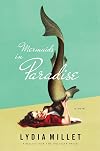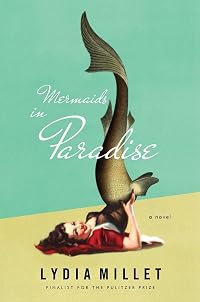
Mermaids in Paradise
by Lydia Millet
On This Page
Description
In this hilarious novel from Pulitzer Prize finalist Lydia Millet, a honeymooning couple makes friends with a marine biologist who discovers genuine mermaids in a coral reef-and who, the next night, apparently drowns in her hotel bathtub. As a resort chain swoops in to corner the market on mermaids, the newlyweds (opinionated, skeptical narrator Deb and handsome online gamer Chip, the world's friendliest man) join forces with other vacationers-including an ex-Navy SEAL with a love of show more explosives and a hipster Tokyo VJ-to protect the mermaids from the corporate 'Venture of Marvels' that wants to turn their habitat into a theme park. show lessTags
Recommendations





Member Reviews
I skimmed some of the reviews before reading MERMAIDS IN PARADISE, and so approached the ending with some trepidation (having enjoyed the book quite a bit thus far).
Was it the Nancy situation, I wondered, that got people so worked up? I mean, it's not a *terrible* resolution to the murder mystery.
Or the whales? Really? I found that twist rather lovely and poetic.
And then I got to THE AFTERMATH, and yeah. There it is.
As much as I can understand the negative audience reaction, my opinion actually swings the other way: after some reflection, I feel like it's the perfectly right, logical and cynical ending to a story such as this.
There are clues: in the destruction of the coral reefs. The violent reaction (amongst Bible thumpers, show more anyway) to the mermaids. The Venture of Marvels. Five million years. ("The writing gave us everything all of a sudden, then nothing forever.")
How else *could* this story end? show less
Was it the Nancy situation, I wondered, that got people so worked up? I mean, it's not a *terrible* resolution to the murder mystery.
Or the whales? Really? I found that twist rather lovely and poetic.
And then I got to THE AFTERMATH, and yeah. There it is.
As much as I can understand the negative audience reaction, my opinion actually swings the other way: after some reflection, I feel like it's the perfectly right, logical and cynical ending to a story such as this.
There are clues: in the destruction of the coral reefs. The violent reaction (amongst Bible thumpers, show more anyway) to the mermaids. The Venture of Marvels. Five million years. ("The writing gave us everything all of a sudden, then nothing forever.")
How else *could* this story end? show less
Deb and Chip get married and travel to the British Virgin Islands for their honeymoon. They take local excursions and go snorkeling. Chip tells Deb he has seen mermaids. She does not believe him, so she heads off to see for herself. The local ecotourism industry and the resort’s corporate owner plan to profit from the discovery. During the trip, they meet a parrotfish expert and get involved in an ecological murder mystery.
Deb is the protagonist and narrator. She has a snarky sense of humor. Her friend Gina is a cynic with an ironic point of view. Chip comes off as a loveable goofball. This book will absolutely not be for everyone. Satire is hit or miss with me, but I think this book is brilliant environmental satire. My only show more complaint is that the ending came out of nowhere, but I can understand the reason for it.I see the parallels in how we go about our everyday lives while pending disasters get progressively worse.
Every now and then I run across an author that suits my taste perfectly. Lydia Millet is my most recent discovery. She has a clever and articulate writing style. I absolutely loved Dinosaurs, and I am in the process of reading her back catalogue. show less
Deb is the protagonist and narrator. She has a snarky sense of humor. Her friend Gina is a cynic with an ironic point of view. Chip comes off as a loveable goofball. This book will absolutely not be for everyone. Satire is hit or miss with me, but I think this book is brilliant environmental satire. My only show more complaint is that the ending came out of nowhere, but I can understand the reason for it.
Every now and then I run across an author that suits my taste perfectly. Lydia Millet is my most recent discovery. She has a clever and articulate writing style. I absolutely loved Dinosaurs, and I am in the process of reading her back catalogue. show less
Deb and Chip get married, head to a Caribbean resort for their honeymoon, go snorkelling, and find themselves in a ecological murder mystery that places their commitment to each other and the planet on the line. Or something like that. At any rate, Deb narrates and it is her voice that is the real charmer here: her wry comments on cruise ships and the kinds of people who populate them; her instinctual fear of and yet attraction to the “heartland” peoples; her friend Gina’s insistently ironic stance (which is really Deb’s own stance); her periodic personality breakdowns; and the kindness that she and others display even in this time of duress. This is a novel with a sting in the tail, but there’s more than enough in what is show more mentioned above to warrant giving it a go without spoiling anything.
There is a lightness of touch here that masks a deeper seriousness. And sadness. The latter can come as a shock but if you look back you’ll see that a lot of it was there from the beginning. Nevertheless, I could have stood a bit more at the end.
Gently recommended. show less
There is a lightness of touch here that masks a deeper seriousness. And sadness. The latter can come as a shock but if you look back you’ll see that a lot of it was there from the beginning. Nevertheless, I could have stood a bit more at the end.
Gently recommended. show less
This book is imperfect, but imperfect in utterly fascinating ways. Millet, more than any other author I've come across, is willing to face up to the dilemmas of writing satire within the tradition of realism (or, perhaps, realism in the tradition of satire). As in any satire, some scenes in this book exist only to make an intellectual point, and for laughs. For instance: Deb and Chip stand in for any contemporary, socially consciousness young couple, and Millet could set them up as such in any way she liked. She chose the wedding industry and tough-guy mud running, because those things are deeply harmful to, you know, civilization as a whole, and need to be mocked. She mocks them. The mockery is enjoyable. Deb's friend Gina is an ironic show more academic for no particularly good reason, except that ironic academics (including myself) deserve mockery. And so it goes. There are mermaids because that gives Millet a way to write about, inter alia, feminism, environmental destruction, capitalism, and tourism, all things she has dealt with in her previous three novels to great effect. Only this is much funnier.
The problem is that this intellectual, humorous approach clashes rather badly with mainstream literary realism. By the end of the book, it seems that we should really be caring for these characters. Poor Gina is only ironic because her mother died young. Chip might mud-run and play video games, but he's a good guy. Deb might be sarcastic, but she's smart and compassionate. Etc...
As many of the negative reviews here unintentionally point out, that's a very difficult problem, and Millet hasn't solved it. The negative reviews all complain that the characters aren't sufficiently likable (well, it's a satire, so...); or the narrator is unreliable (it's the first person, and Deb is giving her opinion...); or the mermaids come out of nowhere (again, it's a satire, not a love story). I was tempted to write a negative review in which I complain about the characters being too realistic, the mermaids being insufficiently bizarre, and so on, but really, what's fascinating is the craft problem of the book. Can anyone combine these two ways of writing? I hope Millet keeps trying.
****
[Spoiler alert]:
Now, in other news, the ending of this book is fairly ridiculous, and a really good example of how to fail at combining the intellectual/humorous/satirical and the emotional/moving/realistic strands. As you may know, Millet ends the book by kind of mentioning, by the by, that the world is about to end. As an intellectual point, it's not bad: these people have been fighting over some mermaids (will they be commercially exploited, or will they be allowed to live in peace under the watchful gaze of big science?), even though in a very short period of time an asteroid would swing by and obliterate the planet. I.e., your petty squabbles about, say, abortion, pale in significance compared to the actually existing problem of environmental destruction.
This is very nicely done as an intellectual point: lest you somehow missed the point that the mermaids were not mermaids, but a deep ecological symbol for nature as a whole, the asteroid should make it pretty obvious (an asteroid strike we could have avoided, by the way, if we'd only worked together). All these people's activities--marriage, mud-racing, mermaid rescuing--stand in for our daily activities--marriage, mud-racing, reading Lydia Millet books. We're wasting time, and the asteroid/climate change approacheth.
It is not, however, aesthetically pleasing. In fact, it's downright silly, coming as it does in the last two pages of the book. How Deb, who is quite garrulous, could have failed to mention the forthcoming end of the world is not clear to me. Also not clear to me is why Millet, a fabulous craftsperson, could have failed to incorporate this more smoothly. I hope that it's just setting up a sequel, but I fear it's just one more fascinating, failed experiment in bringing together mind and heart. show less
The problem is that this intellectual, humorous approach clashes rather badly with mainstream literary realism. By the end of the book, it seems that we should really be caring for these characters. Poor Gina is only ironic because her mother died young. Chip might mud-run and play video games, but he's a good guy. Deb might be sarcastic, but she's smart and compassionate. Etc...
As many of the negative reviews here unintentionally point out, that's a very difficult problem, and Millet hasn't solved it. The negative reviews all complain that the characters aren't sufficiently likable (well, it's a satire, so...); or the narrator is unreliable (it's the first person, and Deb is giving her opinion...); or the mermaids come out of nowhere (again, it's a satire, not a love story). I was tempted to write a negative review in which I complain about the characters being too realistic, the mermaids being insufficiently bizarre, and so on, but really, what's fascinating is the craft problem of the book. Can anyone combine these two ways of writing? I hope Millet keeps trying.
****
[Spoiler alert]:
Now, in other news, the ending of this book is fairly ridiculous, and a really good example of how to fail at combining the intellectual/humorous/satirical and the emotional/moving/realistic strands. As you may know, Millet ends the book by kind of mentioning, by the by, that the world is about to end. As an intellectual point, it's not bad: these people have been fighting over some mermaids (will they be commercially exploited, or will they be allowed to live in peace under the watchful gaze of big science?), even though in a very short period of time an asteroid would swing by and obliterate the planet. I.e., your petty squabbles about, say, abortion, pale in significance compared to the actually existing problem of environmental destruction.
This is very nicely done as an intellectual point: lest you somehow missed the point that the mermaids were not mermaids, but a deep ecological symbol for nature as a whole, the asteroid should make it pretty obvious (an asteroid strike we could have avoided, by the way, if we'd only worked together). All these people's activities--marriage, mud-racing, mermaid rescuing--stand in for our daily activities--marriage, mud-racing, reading Lydia Millet books. We're wasting time, and the asteroid/climate change approacheth.
It is not, however, aesthetically pleasing. In fact, it's downright silly, coming as it does in the last two pages of the book. How Deb, who is quite garrulous, could have failed to mention the forthcoming end of the world is not clear to me. Also not clear to me is why Millet, a fabulous craftsperson, could have failed to incorporate this more smoothly. I hope that it's just setting up a sequel, but I fear it's just one more fascinating, failed experiment in bringing together mind and heart. show less
Deb and Chip are newlyweds. Deb, our dry, skeptical, and opinionated narrator, sets about telling us her story, taking us into her confidence, beginning by telling us how she met Chip (nice guy, jock, gamer…etc), the "kickass" bridal party her best friend Gina put together, the bachelor party Chip had, their wedding, and lastly, their choice of honeymoon location. This is fifty-six pages of very funny/dry/acerbic/bawdy observations of everyone and everything.
Deb & Chip decide to honeymoon in the British Virgin Islands and off they go. But, a romantic moment on the beach is interrupted by the local scientist (parrotfish expert), breathlessly running towards them in her wetsuit shouting about "mermaids!"
She was disturbed, of course—we show more hardly knew the woman. Maybe it was a schizoid deal, we figured, or maybe a drug problem we didn’t have all the info yet, but the situation had to be handled humanely. If there’s one thing Chip is, it’s game. He’s game for almost anything, and so much the better if, later it might make good material for an anecdote to tell at a party.
The scientist plans and oversees their next diving session, and Deb & Chip and a few others also see the mermaids. Despite caution, word begins to break out, and all hell breaks loose because every governmental, scientific, or money-making entity wants a piece of the action. Here the story becomes a bit madcap at this point, and loses something in the telling that is hard to identify, but this last half of the story seemed less funny and perhaps better suited to television adaptation. Or, it could be just me (I think ‘funny’ can be a personal thing) .
I’ve enjoyed other of Lydia Millet's writing, the collection Love in Infant Monkeys comes to mind, and while this one didn’t entirely please, there’s another of her novels in the TBR pile. show less
Deb & Chip decide to honeymoon in the British Virgin Islands and off they go. But, a romantic moment on the beach is interrupted by the local scientist (parrotfish expert), breathlessly running towards them in her wetsuit shouting about "mermaids!"
She was disturbed, of course—we show more hardly knew the woman. Maybe it was a schizoid deal, we figured, or maybe a drug problem we didn’t have all the info yet, but the situation had to be handled humanely. If there’s one thing Chip is, it’s game. He’s game for almost anything, and so much the better if, later it might make good material for an anecdote to tell at a party.
The scientist plans and oversees their next diving session, and Deb & Chip and a few others also see the mermaids. Despite caution, word begins to break out, and all hell breaks loose because every governmental, scientific, or money-making entity wants a piece of the action. Here the story becomes a bit madcap at this point, and loses something in the telling that is hard to identify, but this last half of the story seemed less funny and perhaps better suited to television adaptation. Or, it could be just me (I think ‘funny’ can be a personal thing) .
I’ve enjoyed other of Lydia Millet's writing, the collection Love in Infant Monkeys comes to mind, and while this one didn’t entirely please, there’s another of her novels in the TBR pile. show less
I was not expecting this AT ALL. A couple of newlyweds go on their honeymoon to a Caribbean resort, and discover actual mermaids living in the coral reef. The resort wants to turn the mermaids into a commercial attraction, our couple and their friends want to stop them. So.
This is one of those books that I wasn't very happy with right out of the gate. It's billed as a humorous book (I think that's a bad sign), and while I get why it's funny, it's relentless in being wry and arch all the time. For probably the entire first half of the book, I was thinking that this style would really work better for short stories, and I was tempted to put it down several times because I was exhausted by how wry and arch everyone was. The characters show more didn't seem like real people that I could like or dislike, it was like listening to people I didn't know shout one-liners over each other. It was that feeling that the book thought itself very humorous. It's like that thing where sometimes people don't get that a big part of the reason that our friends are funny is because we know our friends already, and then you get stuck listening to a line-by-line account of every allegedly funny thing your coworker's friends said over the weekend, and you don't care at all. Book, I don't know you well enough to care if you are that funny yet.
But, thank goodness for Chip, the newlywed husband, because I started to like him, and kept with it. The second half of the book really picked up -- not even in terms of plot, but it simply seemed more engaging. The reading felt much easier. I was thinking, okay, this is a solid three stars.
And THEN, then in the last two pages of the book ... I don't think this is really a spoiler, but in the in last two pages of the book, the story got completely reframed and I was all JAW DROPPED. Impressive. If you were watching me, the funniest part of the book was probably my exaggerated WHAT THE WHAT face as I went back to read that part again. Absolutely five stars on the wrap-up. show less
This is one of those books that I wasn't very happy with right out of the gate. It's billed as a humorous book (I think that's a bad sign), and while I get why it's funny, it's relentless in being wry and arch all the time. For probably the entire first half of the book, I was thinking that this style would really work better for short stories, and I was tempted to put it down several times because I was exhausted by how wry and arch everyone was. The characters show more didn't seem like real people that I could like or dislike, it was like listening to people I didn't know shout one-liners over each other. It was that feeling that the book thought itself very humorous. It's like that thing where sometimes people don't get that a big part of the reason that our friends are funny is because we know our friends already, and then you get stuck listening to a line-by-line account of every allegedly funny thing your coworker's friends said over the weekend, and you don't care at all. Book, I don't know you well enough to care if you are that funny yet.
But, thank goodness for Chip, the newlywed husband, because I started to like him, and kept with it. The second half of the book really picked up -- not even in terms of plot, but it simply seemed more engaging. The reading felt much easier. I was thinking, okay, this is a solid three stars.
And THEN, then in the last two pages of the book ... I don't think this is really a spoiler, but in the in last two pages of the book, the story got completely reframed and I was all JAW DROPPED. Impressive. If you were watching me, the funniest part of the book was probably my exaggerated WHAT THE WHAT face as I went back to read that part again. Absolutely five stars on the wrap-up. show less
"Mermaids in Paradise" is a comedic book about a honeymoon gone awry. The newlywed couple, Deb and Chip, expect nothing but sand, sun, and relaxation during their trip to the Caribbean, but when they meet a marine biologist named Nancy they stumble upon a discovery no one saw coming. While snorkeling in the coral reef they sight actual mermaids! To prove it's true, they capture the mermaids on camera and plan on preserving the mermaids instead of exploiting them, however things take a turn when Nancy goes missing and the resort steals the video footage in order to market the mermaids to tourists. Deb and Chip ditch their traditional honeymoon plans and find themselves fighting to save the mermaids and their ocean environment. This book show more is equally hilarious and philosophical, and made me yearn to take a trip of my own to the tropics!
show less
LeeAnn K. / Marathon County Public Library
Find this book in our library catalog.
Members
- Recently Added By
Lists

Kirkus Reviews Best Fiction of 2014
100 works; 7 members
Author Information

27+ Works 4,434 Members
Lydia Millet is the author of Omnivores and George Bush, Dark Prince of Love. She lives in Tucson, Arizona and New York City. (Bowker Author Biography)
Awards and Honors
Distinctions
Common Knowledge
- Canonical title
- Mermaids in Paradise
- Original publication date
- 2014
- First words
- Chip picked out the destination for our honeymoon.
- Last words
- (Click to show. Warning: May contain spoilers.)We went on smiling, smiling, and smiling, until the very moment when the whiskey touched our lips.
Classifications
Statistics
- Members
- 319
- Popularity
- 99,954
- Reviews
- 20
- Rating
- (2.99)
- Languages
- English
- Media
- Paper, Audiobook, Ebook
- ISBNs
- 11
- ASINs
- 1