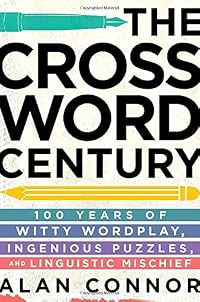
The Crossword Century: 100 Years of Witty Wordplay, Ingenious Puzzles, and Linguistic Mischief
by Alan Connor
On This Page
Description
A British comic writer at The Guardian explores the history of the crossword puzzle, which made its debut in 1913 and went from being considered a menace to productivity to being used to recruit codebreakers by the military.Tags
Recommendations







Member Recommendations

Member Reviews
This is a review of Alan Connor’s book The Crossword Century: 100 Years of Witty Wordplay, Ingenious Puzzles, and Linguistic Mischief, published by Gotham Books.
I’ve been inspired. I want to let you know what I think of this book and will resort to my first attempt at a Cryptic puzzle clue to do so. The answer, such as it is, will appear at the end of the review. Here we go, - An archer’s best placement - _ _ _ _ _ _ _ _ (8 letters).
If the execution of this cryptic is poor blame me. But give credit to Connor for making me want to try my hand at this esoteric art. Connor is one of those clever writers who can make the construction of a pencil or the workings of an escalator seem like a passion worth pursuing. The subject matter show more becomes so absorbing in his hands that I began to look for hidden messages in the naming and arrangement of his chapters. (I’m still convinced they’re there, I’m just not clever enough to find them.)
Crossword Century contains an overview of nearly everything you might wish to know about word related puzzles. Their introduction, their use in espionage - whether real or imagined – the unspoken rules existing between constructors and solvers (Was I fair in the above puzzle? Read and find out.), the battle between humans and computers, puzzles in mystery literature, the future of the puzzlers, and much more.
Credit Connor with using the journalist’s flair for adding just the right amount of curious and intriguing stories to move the more practical elements of crossword-ing along.
This was a very enjoyable and rewarding read. What did I think of it? Here’s the answer to my, perhaps, crummy cryptic: TOPNOTCH. show less
I’ve been inspired. I want to let you know what I think of this book and will resort to my first attempt at a Cryptic puzzle clue to do so. The answer, such as it is, will appear at the end of the review. Here we go, - An archer’s best placement - _ _ _ _ _ _ _ _ (8 letters).
If the execution of this cryptic is poor blame me. But give credit to Connor for making me want to try my hand at this esoteric art. Connor is one of those clever writers who can make the construction of a pencil or the workings of an escalator seem like a passion worth pursuing. The subject matter show more becomes so absorbing in his hands that I began to look for hidden messages in the naming and arrangement of his chapters. (I’m still convinced they’re there, I’m just not clever enough to find them.)
Crossword Century contains an overview of nearly everything you might wish to know about word related puzzles. Their introduction, their use in espionage - whether real or imagined – the unspoken rules existing between constructors and solvers (Was I fair in the above puzzle? Read and find out.), the battle between humans and computers, puzzles in mystery literature, the future of the puzzlers, and much more.
Credit Connor with using the journalist’s flair for adding just the right amount of curious and intriguing stories to move the more practical elements of crossword-ing along.
This was a very enjoyable and rewarding read. What did I think of it? Here’s the answer to my, perhaps, crummy cryptic: TOPNOTCH. show less
 This review was written for LibraryThing Early Reviewers.
My crossword credentials are suspect. Anything beyond the New York Times Tuesday puzzle is foreign territory and seemingly beyond my reach — or at least my patience. And yet I am drawn to them and admire those geniuses that manage to gobble a week's worth before their morning breakfast has cooled.
The history of crosswords is full of the kind of characters and episodes that make biography and history such a fascinating read. Alan Conner’s The Crossword Century is such a book. Concise at 180 pages, each one is rich in word lore and and invention. Though the book has the appearance of being culled from a weekly crossword column (which it was), it is nevertheless a joyful, quick read for a lazy summer afternoon before tackling the show more Sunday Puzzle. show less
The history of crosswords is full of the kind of characters and episodes that make biography and history such a fascinating read. Alan Conner’s The Crossword Century is such a book. Concise at 180 pages, each one is rich in word lore and and invention. Though the book has the appearance of being culled from a weekly crossword column (which it was), it is nevertheless a joyful, quick read for a lazy summer afternoon before tackling the show more Sunday Puzzle. show less
This review was written for LibraryThing Early Reviewers.A breezy and enjoyable discussion of tidbits and curious aspects of crosswords: not so much an inventory or assay of the history, as the title might suggested, but a dip into specific developments. Some are historic and arguably influential on the phenomena, but many simply of interest to Connor. Connor divides the essays into the development of the rules and conventions (collected as the Across section) and those more or less examining the cultural influence (in Down, characterised as "what happens to the crossword once it escapes into the world and meets its solvers"). These essays apparently originated as newspaper columns, which gives a fair idea of the length and depth of the discussions.
The British cryptic was always beyond my show more ken, and though I'm no nearer to taking it up, it makes a good deal more sense now Connor's explained it. A bit of a crossword on overdrive, but emphasizing the clues more than the assembled configuration of words and how those interplay in a crossword. Connor avers that in Britain at least, "quick crosswords in tabloids were for the workers; cryptics were for those who had had a classical education." [62] The state of affairs after the initial collective shock of crosswords being a malign influence (much like billiards or the cinema?) had worn off, and became a rampant success.
Amounted to an entertaining diversion with a pleasant conversationalist. Whets the appetite for a proper examination of the history and conventions of the puzzle, though. show less
The British cryptic was always beyond my show more ken, and though I'm no nearer to taking it up, it makes a good deal more sense now Connor's explained it. A bit of a crossword on overdrive, but emphasizing the clues more than the assembled configuration of words and how those interplay in a crossword. Connor avers that in Britain at least, "quick crosswords in tabloids were for the workers; cryptics were for those who had had a classical education." [62] The state of affairs after the initial collective shock of crosswords being a malign influence (much like billiards or the cinema?) had worn off, and became a rampant success.
Amounted to an entertaining diversion with a pleasant conversationalist. Whets the appetite for a proper examination of the history and conventions of the puzzle, though. show less
This review was written for LibraryThing Early Reviewers.If you're hoping for a deep exploration of any of its topics, this book will disappoint. It's very lightweight. But it's consistently, gently enjoyable. Connor flits easily from one topic to another (some examples: the history of the cryptic crossword; the world of competitive solving; PG Wodehouse's relationship with the crossword), only pursuing each for as long as it interests him and never asking much of the reader. That might sound like a backhanded compliment, but sometimes an easy read is exactly what you need. Indeed, I found myself happily sinking into a 'just one more chapter' state of mind.
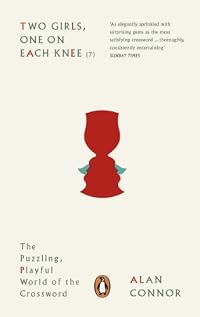
Early on I was a bit nonplussed (in both senses) by one aspect of the author's voice: despite being an Englishman living in England, he show more seems to be writing not only for an American audience but from an American perspective, even to the point of adopting an 'oh those wacky Brits' tone in parts (for example, when discussing the origins of the cryptic crossword). I can't be bothered researching this properly, but I think this book is effectively the American edition of Connor's 'Two Girls, One on Each Knee'? If so, that probably explains it. In any case, the awkwardness seemed to fade away, or at least become entirely tolerable, by around the half-way mark.
I originally wanted to give this three stars, but I think that was based on some pseudo-objective idea of what it 'deserved', and probably simple pretentiousness on my part. I found it a pleasure to read, and so long as your expectations are properly calibrated I heartily recommend it. show less
Early on I was a bit nonplussed (in both senses) by one aspect of the author's voice: despite being an Englishman living in England, he show more seems to be writing not only for an American audience but from an American perspective, even to the point of adopting an 'oh those wacky Brits' tone in parts (for example, when discussing the origins of the cryptic crossword). I can't be bothered researching this properly, but I think this book is effectively the American edition of Connor's 'Two Girls, One on Each Knee'? If so, that probably explains it. In any case, the awkwardness seemed to fade away, or at least become entirely tolerable, by around the half-way mark.
I originally wanted to give this three stars, but I think that was based on some pseudo-objective idea of what it 'deserved', and probably simple pretentiousness on my part. I found it a pleasure to read, and so long as your expectations are properly calibrated I heartily recommend it. show less
I was more excited by the premise--and promise--of this book than I was by its presentation. The topic is certainly worthy of book-length treatment; but I felt the chapters--essentially independent essays related to the idea of crossword puzzles and other such diversions--didn't hang together particularly well. They are, though, filled with a remarkable amount of trivia on matters linguistic, historical, and otherwise. I wasn't keen on the way in which many chapters ended in ellipses: Was the idea to bridge a transition that the reader was to supply on his or her own? Perhaps the advance uncorrected proof I received via the LibraryThing Early Reviewers scheme was simply lacking an important piece? I compared this book with Connor's Two show more Girls, One on Each Knee: The Puzzling, Playful World of the Crossword, released in the UK in 2013, and I found that the contents of that version had been incorporated into a crossword puzzle themselves near the outset of the book. Hmm. Why was the same not done in the US edition? The first two sentences of the Introduction to this edition are: "This is a book about having FUN with words. And if you're wondering why that word is in capital letters, all will become clear." When? Maybe I was just not an observant enough reader (odd, though, since I noticed quite a number of errors--particularly answers to clues that didn't quite match the number of letters prompted [the answers typically needed to be pluralized]). If the words in all caps throughout the book were to have been used in some sort of crossword, I missed that element. (Given the type of book it is, though, I expected twists and tricks and games and other such, well, normally unexpected elements.) Anyway, I did like how Connor bridged the Atlantic (focusing primarily on the UK and the USA); but I would enjoyed the presentations MUCH more if additional examples had been included--particularly of the acrostics and clues for cryptic crosswords. And actual examples of non-English crosswords would have been a lovely addition (as opposed simply to having to read about them in prose form). Indeed: Shouldn't I have been inspired to pick up a pen (or pencil) while reading and interact with the book? (Such had been my hope.) show less
This review was written for LibraryThing Early Reviewers.I like crosswords as much as the next person--I'm no fanatic, but I thought I might enjoy a quick examination of the history and conventions of this perennially popular puzzle format. This slight, breezy book provided such an overview. I found the history of the crossword puzzles interesting--did you know that crossword puzzles were once regarded as a threat to society, somewhat like video games are today? However, I got lost in the drawn-out discussion of "cryptic" puzzles, which require the solver to think in terms of anagrams, acrostics, and other clever formulations to fill in the grid. I also found (with a few exceptions, such as a more-detailed-than-necessary recap of an episode of The Simpsons that involved crossword puzzles) show more that the book had a decidedly British slant.
If you really like crosswords, especially the difficult "cryptic" kind, you may enjoy this book. show less
If you really like crosswords, especially the difficult "cryptic" kind, you may enjoy this book. show less
This review was written for LibraryThing Early Reviewers.I received this book through LibraryThing's Early Reviewers. I was really excited when I saw it because my boyfriend and I do crosswords every day through an app that aggregates a bunch of crosswords from different sources. A book about the history of crosswords definitely allows for an interesting structure and organization. Connor has an "Across" section and a "Down" section. The Across chapters are all devoted to the history and evolution of crosswords from December 21, 1913 to present day, while the Down chapters are more concerned with how crosswords have fit in socially and culturally since their invention. My favorite chapter in the Across sections were about the "language" of crossword puzzles and common words that show up show more frequently (EMU, for one). But personally, my favorite parts were the Down chapters. I was a History major in college and found that I gravitated towards social and cultural history more than anything else.The parts about what constitutes cheating and whether you prefer to do puzzles alone or with a partner were really interesting. My boyfriend and I are usually at odds over what we consider cheating, so it was entertaining to know that we are not the only ones having these debates! Overall, if you enjoy doing crosswords, it should be an interesting read for you. show less
This review was written for LibraryThing Early Reviewers.Members
- Recently Added By
Published Reviews
ThingScore 100
Alan Connor’s charming, fascinating history... is the guide you have been waiting for. In a single, gloriously decipherable chapter he lays out with perfect clarity the entire range of rules and devices through which cryptic clues work their magic.
added by alanconnor
The brilliant new book on crosswords that delivers fun galore whether you're a doer or a duffer.
added by alanconnor
Connor’s wry, good-natured tone and his commitment to the serious business of play make him the perfect guide to a great pastime.
added by alanconnor
Author Information

12 Works 323 Members
Some Editions
Common Knowledge
- Original publication date
- 2013-11-07
- People/Characters
- P. G. Wodehouse; Stephen Sondheim; Arthur Wynne; Lisa Simpson; Noël Coward; Vladimir Nabokov (show all 10); William Archibald Spooner; Sotades; Colin Dexter; Stephen Fry
- Important events
- D-Day (1944)
- Related movies
- Brief Encounter (1945); The Freshman (1925)
- Dedication
- For Raphael
For Lucy - First words
- This is a book about having fun with words. Jumbling them, tumbling them, hiding and sneaking them into unexpected places, making riddles, jokes and poetry in the form of crossword clues.
- Last words
- (Click to show. Warning: May contain spoilers.)Up your 14 across!
- Publisher's editor
- Carey, Brooke; Conford, Helen
- Blurbers
- Pollack, John; McRaney, David
Classifications
- Genres
- Nonfiction, General Nonfiction
- DDC/MDS
- 793.73 — Arts & recreation Recreation, sports, and performing arts Indoor games and amusements Non-action games, puzzles [boardgames now 794] Puzzles and puzzle games
- LCC
- GV1507 .C7 .C544 — Geography, Anthropology and Recreation Recreation. Leisure Recreation. Leisure Games and amusements Parties. Party games and stunts Puzzles
- BISAC
Statistics
- Members
- 117
- Popularity
- 277,047
- Reviews
- 27
- Rating
- (3.31)
- Languages
- English
- Media
- Paper, Ebook
- ISBNs
- 3
- ASINs
- 1