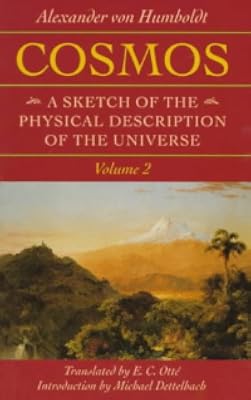
Cosmos: A Sketch of the Physical Description of the Universe
by Alexander von Humboldt
von Humboldt's Kosmos (Collections and Selections — Set)
On This Page
Description
Polymath Alexander von Humboldt, a self-described 'scientific traveller', was one of the most respected scientists of his time. Humboldt's wanderlust led him across Europe and to South America, Mexico, the US, & Russia, & his voyages & observations resulted in the discovery of many species previously unknown to Europeans. Originating as lectures delivered in Berlin & Paris (1827-1828), his multi-volume Cosmos: Sketch of a Physical Description of the Universe (1845-1860) represented the show more culmination of his lifelong interest in understanding the physical world. Volume 2 reviews poetic descriptions of nature as well as landscape painting from antiquity through to modernity, before using the same time-span to examine a 'history of the physical contemplation of the universe'. show lessTags
Recommendations























Member Reviews
1987, 88, or 89
ca. 10€ booklooker
Apr 15, 2026German
Ratings
Members
- Recently Added By
Lists

Geography and Travel from The Book-Lover
291 works; 1 member
Author Information

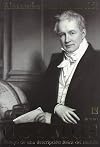
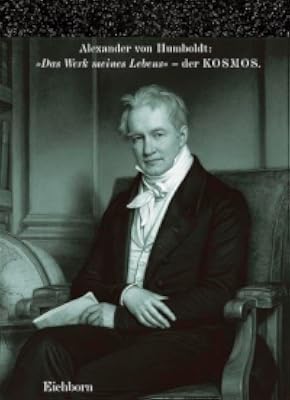
Baron Alexander von Humboldt was born in Berlin, Germany. During his early school years, he studied such subjects as geology, biology, metallurgy, and mining, and his main interest was in nature and other lands. In 1796 Humboldt traveled to the German Alps, where he measured the atmospheric pressure, humidity, and oxygen content of the air. show more Shortly after, in 1799, he was granted permission by the Spanish king to explore Spain's mysterious holdings in the Americas. For the next five years, he and his companion, Aime Bonplaud, explored the region that is now Venezuela, Cuba, Colombia, Peru, Ecuador, and Mexico. While in the Andes, he fell prey to mountain sickness, which led him to become the first person to explain that the sickness was caused by a lack of oxygen. During these travels, he and Bonplaud collected 60,000 plant specimens; mapped the area; and studied its climates, bodies of water, wildlife, and minerals. The findings of this exhaustive adventure were published in a 23-volume series, Voyage de Humboldt et Bonplaud (1805--34). In 1829, at the invitation of the Russian government, Humboldt made an expedition to Russia and Siberia, categorizing, observing, and recording as he went. One of the results of this expedition was a 5-volume work, Kosmos (1845-62), in which he tried to combine the vague ideals of the eighteenth century with the exact scientific requirements of his own. Considered one of the founders of modern geography, Humboldt showed geographers that there was more to the study of geography than the shape of Earth and its regions. He gave them a system of geographic inquiry, he was the first to draw an isothermal map, studied tropical storms and volcanoes, and pioneered the field of terrestrial magnetism. Equally important, he was responsible for one of the first examples of international scientific cooperation, which led to the formation of a system of meteorological stations throughout Russia and Great Britain. During one of his many expeditions, he measured the temperature of the current with which his ship sailed from Lima, Peru, to Acapulco, Mexico. Later this current was named the Humboldt Current in his honor. (Bowker Author Biography) show less
Awards and Honors
Notable Lists
Series

Belongs to Publisher Series
Die Andere Bibliothek (Sonderband)
Work Relationships
Common Knowledge
- Canonical title
- Cosmos: A Sketch of the Physical Description of the Universe
- Original title
- Kosmos : Entwurf einer physischen Weltbeschreibung
- Original language*
- Deutsch
*Some information comes from Common Knowledge in other languages. Click "Edit" for more information.
Classifications
Statistics
- Members
- 145
- Popularity
- 225,890
- Reviews
- 2
- Rating
- (4.29)
- Languages
- 7 — Czech, English, French, German, Italian, Spanish, Swedish
- Media
- Paper, Ebook
- ISBNs
- 21
- ASINs
- 5