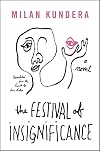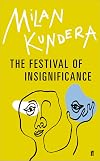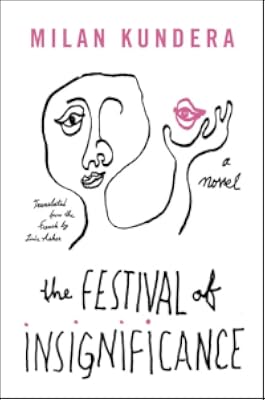
The Festival of Insignificance
by Milan Kundera
On This Page
Description
"An enchanting new novel from one of the most distinguished writers of our time, an altogether serious comedy that is the synthesis and culmination of his oeuvre"--Tags
Recommendations






Member Reviews
The Festival of Insignificance by Milan Kundera is a recommended, short novel about five friends and the inconsequentiality of life.
Alain, Ramon, D'Ardelo, Charles, and Caliban are friends living in Paris. While Alain obsesses over the exposed navels of young women as the new erotic/seductive zone, Ramon is strolling through the park and meets D'Ardelo who lies about having cancer and then says he wants to plan a party, using Charles to plan it and Caliban to help. There is also much discussion of Stalin.
The tile of the novel really describes it and will tell you if it is a good selection for you. It really is a novel about nothing. The book is very short, more of a novella, has no story, and very little character development. After I show more first read it, I had to pause before writing a review. Honestly, I didn't like the characters, and didn't see a point to the novel. The Washington Post review noted that to the unsympathetic, "The Festival of Insignificance will come across as simply inconsequential and pretentious." But then I went back to the title and pondered Kundera's thoughts some more.
Ramon tells us that, "Insignificance is the essence of existence." Moreover, Ramon insists that insignificance will set a person free, require no presence of mind, no vigilance. So we have it established that Kundera is giving us permission to just experience his novel for what it is without looking for an overriding theme or great point. It must also be noted that The Festival of Insignificance is also humorous and celebrates the absurd at times. There are keen bits of startling insight embedded within the musing and antics of these men, such as the theory about "observation posts standing each on a different point in history, from which people talk together unable to understand one another." The discussion becomes in reality two monologues. It is a novel about irrelevance, detachment, insignificance, and, yes, it is a memorial, a festival, to insignificance.
Disclosure: I received an advanced reading copy of this book from the publisher for review purposes. show less
Alain, Ramon, D'Ardelo, Charles, and Caliban are friends living in Paris. While Alain obsesses over the exposed navels of young women as the new erotic/seductive zone, Ramon is strolling through the park and meets D'Ardelo who lies about having cancer and then says he wants to plan a party, using Charles to plan it and Caliban to help. There is also much discussion of Stalin.
The tile of the novel really describes it and will tell you if it is a good selection for you. It really is a novel about nothing. The book is very short, more of a novella, has no story, and very little character development. After I show more first read it, I had to pause before writing a review. Honestly, I didn't like the characters, and didn't see a point to the novel. The Washington Post review noted that to the unsympathetic, "The Festival of Insignificance will come across as simply inconsequential and pretentious." But then I went back to the title and pondered Kundera's thoughts some more.
Ramon tells us that, "Insignificance is the essence of existence." Moreover, Ramon insists that insignificance will set a person free, require no presence of mind, no vigilance. So we have it established that Kundera is giving us permission to just experience his novel for what it is without looking for an overriding theme or great point. It must also be noted that The Festival of Insignificance is also humorous and celebrates the absurd at times. There are keen bits of startling insight embedded within the musing and antics of these men, such as the theory about "observation posts standing each on a different point in history, from which people talk together unable to understand one another." The discussion becomes in reality two monologues. It is a novel about irrelevance, detachment, insignificance, and, yes, it is a memorial, a festival, to insignificance.
Disclosure: I received an advanced reading copy of this book from the publisher for review purposes. show less
Kundera was never afraid of the big questions. How should I live? What’s the point of existence? But he was less interested in the answers than what you do with them. The four friends whose lives intertwine in The Festival of Insignificance are all trying to figure out what matters in the new millennium, when the certainties of the past now appear shaky at best. Coincidence, jokes, and absurdities pepper their stories, but their search is earnest. And as Kundera hints, their conclusions hold lessons for all our futures.
Képzeljünk el egy báltermet (egy elég pici báltermet), ahol emberek XIV. Lajos kori ruhákban táncolnak valami bizarrul bonyolult párcserélős táncot – mondjuk egy francia négyest. Ha ez megvan, a táncosokat cseréljük ki fiktív jelenkori értelmiségiekre és a szovjet sztálinizmus rég megboldogult vezető funkcionáriusaira (köztük magára Sztálinra), a táncot pedig helyettesítsük elegáns, okos diskurzusokkal – ha így teszünk, eljutunk ehhez a könyvhöz. A jelentéktelenség ünnepe olyan szöveg, amiben a cselekményt az újabb és újabb csoportokba rendeződő szereplők párbeszédei helyettesítik. Totálisan hiányzik belőle minden, ami életszerűvé tenné, vagy a realitásra való utalásként show more lenne értelmezhető – tulajdonképpen nem más, mint egy pucér allegória arról, hogy kipusztult a világból a nagy formátumú rendező akarat (hála Istennek), és helyette diadalt aratott a jelentéktelenség (ez viszont sajnos). Egy ilyen leegyszerűsített szövegtest alkalmasint kétféleképpen születhet: 1.) a teljes textust fáradtságos munkával addig faragják, húzzák, pontosítják és célszerűsítik, amíg csak a minimalista váz marad 2.) szimplán csak a vázlatát írják meg egy nagyobb ívű, gazdagabb történetnek. Természetesen nem vehetek mérget arra, hogy ez a Kundera-mű speciel az utóbbi csoportba tartozik, de mégis: nagyon határozottan ez a benyomásom róla. És ez baj, mert amíg az első csoportba tartozó könyveket általában véve imádatommal üldözöm, addig az utóbbiakkal kapcsolatban mindig hiányérzetem van – és ezt az álláspontot még akkor is tartom, ha közben nehezen tudnék olyan tuti módszert javasolni, amivel tévedhetetlenül meg lehetne különböztetni a két csoportot. Amúgy persze nem rossz könyv ez – van például benne egy csomó jel, amin elindulva számos érdekes gondolatot átfuttathatunk magunkon. Az egyik szereplőt például Caliban-nak hívják, és hát itt vannak ezek a fránya női köldökök is… Szóval ha akar az ember, elmélázgathat csendesen a regényen – csak éppen Kundera nem tudott meggyőzni engem arról, hogy akarnom kell. Úgyhogy, bár gyengének talán nem nevezném, de attól tartok, A jelentéktelenség ünnepe hamarosan el fog tűnni azon karakteresebb olvasmányok halma alatt, amiket a jövőben rápakolok. show less
I like how one can almost always recognize Kundera's writing within the first page of his works, his voice and concerns are so distinctively his. The Festival of Insignificance also reads like a typical Kundera. The first chapter introduces a man walking on the streets of Paris, reflecting on the particularity of different erotic orientations. He is fixated on the navel of women, and of course he has a theory for it. The book carries among 5 friends, all with their unique miseries and eccentricities.
After reading a few other reviews here, I realize that a lot of people are not a big fan of this work. And I may not be one of them but I do get their complaints from it. However, I recently read an interview of Kundera with the Paris show more Review from some decades ago, after which I have to come to read him a little differently and appreciate him more so because of it. I think once seen from this new perspective, one might be able to look at this novel more favorably. Here is an excerpt from the interview when he speaks of Kafka:
Another one:
Kundera's special talent for polyphonic confrontations is unparalleled to any other contemporary writer. I cherish him so much. show less
After reading a few other reviews here, I realize that a lot of people are not a big fan of this work. And I may not be one of them but I do get their complaints from it. However, I recently read an interview of Kundera with the Paris show more Review from some decades ago, after which I have to come to read him a little differently and appreciate him more so because of it. I think once seen from this new perspective, one might be able to look at this novel more favorably. Here is an excerpt from the interview when he speaks of Kafka:
By the way, do you realize that people don’t know how to read Kafka simply because they want to decipher him? Instead of letting themselves be carried away by his unequalled imagination, they look for allegories and come up with nothing but clichés: life is absurd (or it is not absurd), God is beyond reach (or within reach), et cetera. You can understand nothing about art, particularly modern art, if you do not understand that imagination is a value in itself. Novalis knew that when he praised dreams. They “protect us against life’s monotony,” he said, they “liberate us from seriousness by the delight of their games.”
Another one:
Yet there is another way to get around the suspect and worn-out aspect of the plot, and that is to free it from the requirement of likelihood. You tell an unlikely story that chooses to be unlikely!
Kundera's special talent for polyphonic confrontations is unparalleled to any other contemporary writer. I cherish him so much. show less
Después de la hermosura desbordante, el arte más puro, que el inconformista y ávido lector puede encontrar el La insoportable levedad del ser o El libro de la risa y el olvido, la búsqueda anhelante de la perfección literaria en la última obra de Kundera es un destino obligatorio. Si bien es cierto que, ya avisado previamente por la crítica, no se trataba de una de sus mejores obras, en ella se encuentra su agudeza narrativa, su sarcástico buen humor, su poderosa crítica a la sociedad y a la humanidad, así como al individuo por sí solo.
¿Qué pretendía hacernos llegar Kundera tras este curioso retrato crudamente humorístico? ¿Qué pretendía incluso al parodiar la intimidad de Stalin, el abandono de una madre a un hijo, show more el suicidio, el cáncer, la misma muerte? Probablemente pretendía traspasar el equilibro de nuestros pensamientos, invitándonos a su estambótica fiesta personal, con platos agridulces, con vino de brick y con música distorsionada de fondo para amenizar la velada.
No, es cierto que el famoso y aclamado escritor no ha sido del todo hábil a la hora de plasmar sus pensamientos entre sus páginas. Pero no debemos de ser demasiado injustos, no podemos reclamar el mismo nivel artístico en otra la carrera literaria de un mismo autor. Permitámosle, pues, a Kundera, flaquear un poco. Limitémonos, pues, a abrir sus páginas con un café bien caliente y a dejarnos deleitar por los pequeños retazos de su ingenio que aún palpitan. Olvidemos las expectativas, sintámonos leves, seamos conscientes de la lítost, maldita lítost, amada lítost de sus letras camufladas, escondidas, heridas, que fallecen. Y así, una vez más, disfrutemos del arte de leer una pequeña joya, poco pulida, de un hábil mago de la psicología de los personajes. show less
¿Qué pretendía hacernos llegar Kundera tras este curioso retrato crudamente humorístico? ¿Qué pretendía incluso al parodiar la intimidad de Stalin, el abandono de una madre a un hijo, show more el suicidio, el cáncer, la misma muerte? Probablemente pretendía traspasar el equilibro de nuestros pensamientos, invitándonos a su estambótica fiesta personal, con platos agridulces, con vino de brick y con música distorsionada de fondo para amenizar la velada.
No, es cierto que el famoso y aclamado escritor no ha sido del todo hábil a la hora de plasmar sus pensamientos entre sus páginas. Pero no debemos de ser demasiado injustos, no podemos reclamar el mismo nivel artístico en otra la carrera literaria de un mismo autor. Permitámosle, pues, a Kundera, flaquear un poco. Limitémonos, pues, a abrir sus páginas con un café bien caliente y a dejarnos deleitar por los pequeños retazos de su ingenio que aún palpitan. Olvidemos las expectativas, sintámonos leves, seamos conscientes de la lítost, maldita lítost, amada lítost de sus letras camufladas, escondidas, heridas, que fallecen. Y así, una vez más, disfrutemos del arte de leer una pequeña joya, poco pulida, de un hábil mago de la psicología de los personajes. show less
Not to everyone's taste (no plot, a meandering story, characters weaving in and out, much musing on philosophical and cultural issues with a very light touch), but I must admit I loved "hearing" Kundera's narrative voice again after years of not having read him. It is not one of his best (or most "significant") books, but, for me, well worth reading.
The Festival of Insignificance, Milan Kundera, performed by Richmond Hoxie, translated from the French, by Linda Asher.
This strange and brief little book is about a short time in the lives of a group of friends, Alain, Ramon, Charles and Caliban, as they plan a cocktail party for another friend, D’Ardelo, who has told them he is dying of Cancer. Each of the characters has his own particular issues to deal with which reveal themselves as the scenes evolve. At one point, I thought perhaps the tale was actually, in the end, a performance of a play, but instead, it was each character playing his own part, deciding on his own role.
Alain, was abandoned by his mother. He imagines conversations with her. Ramon is dealing with aging. He is show more also dealing with a mother who is about to abandon him, by dying, Charles gives Caliban work as a waiter and encourages his fantasies and performances. Caliban pretends to be Pakistani to fulfill his need to act, since he is currently unemployed. Alain contemplates the idea of a woman’s navel becoming the new seat of eroticism, and yet, it is not the seat of birth and the continuation of life. D’ardelo is pretending to be dying because a man who recently passed away was getting all the attention. A widow grieves briefly and is congratulated for her ability to love live so much that she can recover so quickly from her loss and go on, attending parties, even with eyes red from crying.
It is a spoof on life, I think, and although the author says existence is insignificant, ironically, each of the characters seeks to make his own existence worthy of notice, in some way, and in essence, with the talk of sex, sickness, angels, sorrow, and surviving as best as one can, under whatever circumstances one finds oneself, it seemed to be more profound than it pretended to be. There seemed to be many incongruous explanations and tales, but they really concerned themselves with significant subjects like life and death, success and failure, good health and illness. The stories about Stalin had greater hidden meaning, Alain’s fantasies about his missing mother were thought provoking. Who was the boy she drowned? Was it Alain? Can he make peace with her memory? The conversations between two characters, each speaking in a language not understood by the other, were humorous but also poignant because they were both so needy that the sound of the sympathy in their voices was enough to sustain them. The irony is that the insignificant was truly very significant. All of the characters seemed a bit detached from reality which is probably why they were searching for ways to achieve happiness and contentment, to find meaning for their very existence, because we all pass through life briefly, pass out of everyone’s memory eventually, and leave no lasting mark unless we find a way to make our moment in time the essence of significance.
The narrator provided a perfectly nuanced interpretation of the book, using just the right amount of emphasis for each situation to make its meaning clear. show less
This strange and brief little book is about a short time in the lives of a group of friends, Alain, Ramon, Charles and Caliban, as they plan a cocktail party for another friend, D’Ardelo, who has told them he is dying of Cancer. Each of the characters has his own particular issues to deal with which reveal themselves as the scenes evolve. At one point, I thought perhaps the tale was actually, in the end, a performance of a play, but instead, it was each character playing his own part, deciding on his own role.
Alain, was abandoned by his mother. He imagines conversations with her. Ramon is dealing with aging. He is show more also dealing with a mother who is about to abandon him, by dying, Charles gives Caliban work as a waiter and encourages his fantasies and performances. Caliban pretends to be Pakistani to fulfill his need to act, since he is currently unemployed. Alain contemplates the idea of a woman’s navel becoming the new seat of eroticism, and yet, it is not the seat of birth and the continuation of life. D’ardelo is pretending to be dying because a man who recently passed away was getting all the attention. A widow grieves briefly and is congratulated for her ability to love live so much that she can recover so quickly from her loss and go on, attending parties, even with eyes red from crying.
It is a spoof on life, I think, and although the author says existence is insignificant, ironically, each of the characters seeks to make his own existence worthy of notice, in some way, and in essence, with the talk of sex, sickness, angels, sorrow, and surviving as best as one can, under whatever circumstances one finds oneself, it seemed to be more profound than it pretended to be. There seemed to be many incongruous explanations and tales, but they really concerned themselves with significant subjects like life and death, success and failure, good health and illness. The stories about Stalin had greater hidden meaning, Alain’s fantasies about his missing mother were thought provoking. Who was the boy she drowned? Was it Alain? Can he make peace with her memory? The conversations between two characters, each speaking in a language not understood by the other, were humorous but also poignant because they were both so needy that the sound of the sympathy in their voices was enough to sustain them. The irony is that the insignificant was truly very significant. All of the characters seemed a bit detached from reality which is probably why they were searching for ways to achieve happiness and contentment, to find meaning for their very existence, because we all pass through life briefly, pass out of everyone’s memory eventually, and leave no lasting mark unless we find a way to make our moment in time the essence of significance.
The narrator provided a perfectly nuanced interpretation of the book, using just the right amount of emphasis for each situation to make its meaning clear. show less
Members
- Recently Added By
Published Reviews
ThingScore 66
Voilà ce que célèbre Kundera dans sa petite fête de 142 pages qui, dans un refus de la gravité qui le fait flirter lui-même avec l'insignifiance, nous prévient de la menace qu'est le sérieux, sans qu'on sache vraiment au final ce qui est le plus tragique entre l'insignifiance et le sérieux qu'on veut lui opposer. Un point d'orgue déconcertant et malicieux d'un écrivain qui semble show more revenu de tout. show less
added by Serviette
L'animateur en a contre le principe de Milan Kundera à vouloir se soustraire à la dictature de l'histoire et considère que La fête de l'insignifiance n'est tout simplement pas fait pour lui. « Mais si vous aimez Milan Kundera, sa qualité de réflexion, sa manière d'aborder des sujets en faisant mine de ne pas y toucher, mais d'y revenir, vous allez adorer ça »
added by Serviette
Tout dans le nouveau roman de Milan Kundera est insignifiance. Les quatre amis, héros du roman, sont insignifiants au point qu’on a du mal à les distinguer les uns des autres.
added by Serviette
Lists

Books Read in 2015
3,299 works; 129 members
International Dublin Literary Award Longlist 2017
147 works; 3 members

Dublin Literary Award Longlist 2017
147 works; 2 members
Kirkus Starred Fiction Reviews of Books Published in 2015
310 works; 6 members
Author Information

53+ Works 61,430 Members
One of the foremost contemporary Czech writers, Kundera is a novelist, poet, and playwright. His play The Keeper of the Keys, produced in Czechoslovakia in 1962, has long been performed in a dozen countries. His first novel, The Joke (1967), is a biting satire on the political atmosphere in Czechoslovakia in the 1950s. It tells the story of a show more young Communist whose life is ruined because of a minor indiscretion: writing a postcard to his girlfriend in which he mocks her political fervor.The Joke has been translated into a dozen languages and was made into a film, which Kundera wrote and directed. His novel Life Is Elsewhere won the 1973 Prix de Medicis for the best foreign novel. Kundera has been living in France since 1975. His books, for a long time suppressed in his native country, are once again published.The Unbearable Lightness of Being (1984), won him international fame and was a successful English-language film. In this work Kundera moves toward more universal and philosophically tinged themes, thus transforming himself from a political dissident into a writer of international significance. (Bowker Author Biography) show less
Some Editions
Awards and Honors
Awards
Distinctions
Series
Belongs to Publisher Series
Gallimard, Folio (6032)
Work Relationships
Common Knowledge
- Canonical title
- The Festival of Insignificance
- Original title
- La fête de l'insignifiance
- Alternate titles
- La Festa de la Insignificança
- Original publication date
- 2013
- Blurbers
- Rushdie, Salman; Fuentes, Carlos; Updike, John; Glendinning, Victoria; McEwan, Ian
- Original language*
- Französisch
*Some information comes from Common Knowledge in other languages. Click "Edit" for more information.
Classifications
Statistics
- Members
- 806
- Popularity
- 34,431
- Reviews
- 28
- Rating
- (3.06)
- Languages
- 22 — Catalan, Chinese, Czech, Danish, Dutch, English, Estonian, Finnish, French, German, Hebrew, Hungarian, Italian, Korean, Lithuanian, Polish, Portuguese, Romanian, Russian, Spanish, Swedish, Turkish
- Media
- Paper, Audiobook, Ebook
- ISBNs
- 56
- UPCs
- 1
- ASINs
- 12