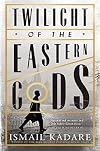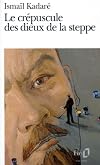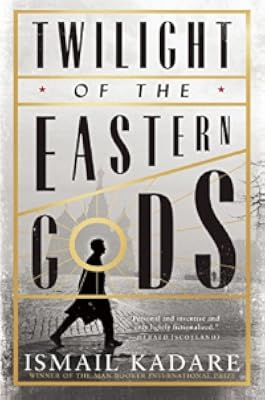
Twilight of the Eastern Gods
by Ismaïl Kadaré
On This Page
Description
A fictionalized recreation of the author's experiences as a student at the prestigious Gorky Institute for World Literature describes the school's descent into a dangerously Socialist Realist aesthetic that almost caused him to abandon writing altogether.Tags
Recommendations





















Member Reviews
Interesting to read about the Gorky Institute of World Literature and the furor over the award if the Nobel to Pasternak. Art/Writing flourishes under patronage but languishes when that patronage is used to suppress its voice except in glorifying the State, whether it's a "bad" communist/socialist state like the U.S.S.R. or a "good" capitalist/imperial state like the U.S.A. This book was a good reminder of that.
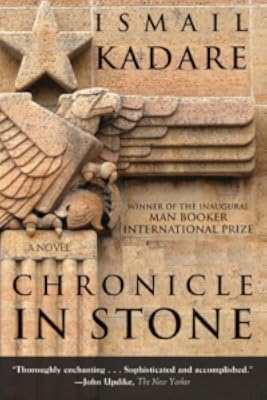
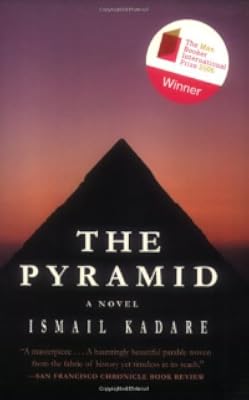
I think I've read enough Kadare now to pinpoint the type of his writing I like the best: books about something he has direct experience with, but not books that border on the autobiographical. When he writes a story about something he has limited or no experience with, like The Pyramid or The Siege, the book doesn't rise to the heights of his works where he can draw upon his life experiences. When he writes something that's less a fictional story than a recounting of actual events, the structure of the work suffers and the writing isn't quite as lively, lyrical, or beautiful as normal. Chronicle in Stone only has these issues to a minor degree, as Kadare was writing of his childhood decades after the fact- and at that point, childhood show more is less an actual experience than a series of stories you've told yourself a thousand times before. Twilight of the Eastern Gods, however, is a book written while the memories were still fresh to Kadare, and so the book lacks the slight otherworldly mood present in many of his other works. The writing is also far more sterile than Kadare's usually is, meaning that, although there are still beautiful scenes and passages, there are fewer here than in other Kadare books. While the blurb on the flap of the book makes it sound as though there is an overriding story drawing parallels between Kadare and Pasternak, in fact Pasternak only becomes a central topic two-thirds into the book. Instead the main plot primarily concerns a failed relationship that is also a reimagining of an Albanian myth, though this main plot takes up far fewer pages than the space Kadare uses to recount vignettes and scenes from his time at the Gorky Institute. These scenes never come to a climax or resolution, and while some provide context and symbolic significance to the failing central romance, others don't, which leaves the book feeling somewhat disjointed and rambling. In sum, it's not bad, but it's a long way from my favorite Kadare. Going forward I'm going to prioritize his purely fictional works above any more of his semi-autobiographical works, though of course you'll have to give each a try to figure out if you share my preference. show less
Le narrateur du Crépuscule des dieux de la steppe suit les cours de l'Institut Gorki à Moscou, où il côtoie quotidiennement des écrivains soviétiques. Il fréquente aussi des jeunes filles russes, dont Lida, qu'il aime. La détérioration des relations entre l'Albanie et l'Union soviétique, l'affaire Pasternak, une épidémie de variole vont briser le glacis des apparences, révéler que « le temps de la perfidie » est venu. À l'été de Riga, où le narrateur a passé ses vacances dans une maison de repos en compagnie de vieux écrivains qui jouent au ping-pong, aux feuilles cuivrées de l'automne dans les environs de Moscou, succèdent l'hiver moscovite, un cimetière, le chaos étouffé des beuveries de cette tour de Babel show more qu'est le foyer de l'Institut Gorki - où la poussière voile chaque jour un peu plus la faible lumière des ampoules de 40 watts -, l'isolement imposé par la quarantaine, la mort, vraie ou symbolique. Sur la place Rouge, les silhouettes figées, trapues, des dirigeants soviétiques, les dieux de la steppe, se craquellent sous le gel. show less
> Babelio : https://www.babelio.com/livres/Kadare-Le-Crepuscule-des-dieux-de-la-steppe/51224
> Si ce n'est vraiment pour ses qualités romanesques, ce livre mérite et même vaut d'être lu pour son aspect documentaire sur la vie intellectuelle dans l'URSS stalinienne (je sais que Staline était déjà mort, mais je vous assure que la vie de tous les jours était encore bien stalinienne) par quelqu'un qui tente de dire les choses sans émettre en même temps son jugement. C'est très intéressant.
—Danieljean (Babelio)
> Guérin Jean-Yves. La revue de presse : Hubert Prolongeau - (Télérama) - Publié le 28/07/20
Ce diptyque, s’il vante la résistance de Hodja aux pressions internationales, est aussi pour Kadaré un prétexte pour show more peindre le quotidien d’une dictature. Les héros, nombreux, y sont ballottés au gré des vents d’une histoire qu’ils ne contrôlent pas du tout. … ; (en ligne),
URL : https://www.telerama.fr/livre/trois-raisons-de-re-lire-le-temps-des-querelles-di...
> LE CRÉPUSCULE DES DIEUX DE LA STEPPE by Ismaïl Kadaré (Gallimard)
In: Revue Esprit Nouvelle série, No. 52 (4) (Avril 1981), pp. 166-167… ; (en ligne),
URL : https://esprit.presse.fr/article/jeanyves-guerin/le-crepuscule-des-dieux-de-la-s... show less
> Si ce n'est vraiment pour ses qualités romanesques, ce livre mérite et même vaut d'être lu pour son aspect documentaire sur la vie intellectuelle dans l'URSS stalinienne (je sais que Staline était déjà mort, mais je vous assure que la vie de tous les jours était encore bien stalinienne) par quelqu'un qui tente de dire les choses sans émettre en même temps son jugement. C'est très intéressant.
—Danieljean (Babelio)
> Guérin Jean-Yves. La revue de presse : Hubert Prolongeau - (Télérama) - Publié le 28/07/20
Ce diptyque, s’il vante la résistance de Hodja aux pressions internationales, est aussi pour Kadaré un prétexte pour show more peindre le quotidien d’une dictature. Les héros, nombreux, y sont ballottés au gré des vents d’une histoire qu’ils ne contrôlent pas du tout. … ; (en ligne),
URL : https://www.telerama.fr/livre/trois-raisons-de-re-lire-le-temps-des-querelles-di...
> LE CRÉPUSCULE DES DIEUX DE LA STEPPE by Ismaïl Kadaré (Gallimard)
In: Revue Esprit Nouvelle série, No. 52 (4) (Avril 1981), pp. 166-167… ; (en ligne),
URL : https://esprit.presse.fr/article/jeanyves-guerin/le-crepuscule-des-dieux-de-la-s... show less
Feb 18, 2021 (Edited)French
Ratings
Members
- Recently Added By
Author Information

180+ Works 7,868 Members
Ismail Kadare is the most prominent of contemporary Albanian writers. He has written poetry, short stories, literary criticism, and seven novels. His works have been translated and published in more than two dozen countries. An internationally known figure, he has visited and lectured in many countries. He was also a representative to Albania's show more People's Assembly. In 1990 Kadare left Albania for Paris where he became openly dissident. (Bowker Author Biography) show less
Some Editions
Series
Belongs to Publisher Series
Common Knowledge
- Canonical title
- Twilight of the Eastern Gods
- Original title
- Muzgu i perëndive të stepës
- Original publication date
- 1978; 1981, 1. ed. italiana
- People/Characters*
- Constantin; Lida
- Important places*
- Moscou, Russie
- First words
- Nous jouions au ping pong en plein air, non loin du bord de mer, jusqu'à près de minuit, car il faisait encore assez clair, bien que la période des nuits blanches fût passée.
Giocavamo a ping pong all'aperto, non lontano dalla riva del mare, fin quasi a mezzanotte, perché c'era ancora abbastanza luce, anche se la stagione delle notti bianche era finita. - Quotations
- Intorno c’era il chiasso abituale di una serata danzante dell’Istituto Gorki, con quel colore particolare che viene dal contrasto tra la gloria eterna della letteratura ed i suoi rappresentanti viventi, che a tratti si me... (show all)ttevano a ballare goffamente, balbettavano o dicevano banalità. Sapevo che quelle serate avevano vera vita soltanto nelle prime ore, quando le ragazze erano ancora suggestionate all’idea di conoscere finalmente degli scrittori. E quei Goethe e quei Villon, i loro cavalieri, stavano loro intorno: ecco la gloria, vicinissima, dovevano soltanto voltare il capo. Le presento il mio amico Piotr Reutski, un poeta. Ha letto Il mattino delle betulle? L’autore è lui. Davvero? Sì, è proprio lui. E tutto questo veleggiava in un’aura di sottintesi, di illusioni che conoscendo gli scrittori si possa diventare un personaggio, magari acquisire il diritto di vedere le proprie iniziali in capo ad un poema o ad un racconto, per non parlare dei diari postumi, della corrispondenza intima, delle memorie, degli archivi.
Eravamo ancora nella prima metà della serata (perché nella seconda la verità si toglieva a poco a poco i veli, e arrivava il momento in cui le ragazze incominciavano a guardare i cavalieri con disprezzo e cercavano di sfuggire alle loro strette; capitava anche, come nel caso di Nutfulla Shakenov, che una schiaffeggiasse l’uomo di cui, due ore prima, sognava di vedere il nome unito al proprio per l’eternità, sul marmo della tomba, accanto ai versi che lui le avrebbe dedicato [...] - Last words
- (Click to show. Warning: May contain spoilers.)En m'éloignant, je l'imaginai, debout sur le boulevard Tverskoï, le visage tourné vers les grilles sombres du jardin de l'Institut, attendant vainement que je revienne de cette région d'où personne n'est jamais revenu.
(Click to show. Warning: May contain spoilers.)Mentre mi allontanavo la pensai, in piedi su corso Tverśkoi, il volto verso i tetri cancelli del giardino dell'Istituto, la pensai aspettare invano il mio ritorno da quei luoghi dai quali nessuno è mai tornato. - Original language
- Albanian
*Some information comes from Common Knowledge in other languages. Click "Edit" for more information.
Classifications
- Genres
- Fiction and Literature, General Fiction
- DDC/MDS
- 891.9913 — Literature & rhetoric Literatures of other languages East Indo-European and Celtic literatures Baltic and other Indo-European languages Other Indo-European languages Albanian Albanian fiction
- LCC
- PG9621 .K3 .M8913 — Language and Literature Slavic languages and literatures. Baltic languages. Albanian language Slavic. Baltic. Albanian Albanian
- BISAC
Statistics
- Members
- 165
- Popularity
- 198,908
- Reviews
- 5
- Rating
- (3.66)
- Languages
- 9 — Dutch, English, French, German, Italian, Japanese, Romanian, Spanish, Swedish
- Media
- Paper, Ebook
- ISBNs
- 20
- ASINs
- 6