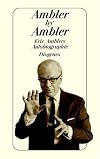
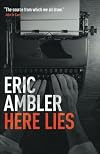
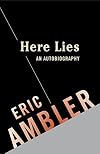
Here Lies
by Eric Ambler
On This Page
Description
Finally we hear from the master himself. The writer whom Graham Greene called "unquestionably our best thriller writer" and who John le Carr once called "the source on which we all draw." If his 1985 autobiography, the self-deprecatingly entitled Here Lies Eric Ambler, is to be believed, his intention as a young man was to be a playwright. Ambler found a novel way (forgive the pun) to introduce his first full length work, by giving his girlfriend a bound page proof in a cinema on King's show more Road, Chelsea, just before the lights went down. So became The Dark Frontier (1936) and thereafter some of the greatest thrillers of the 20th century, such as Epitaph for a Spy, Cause for Alarm, The Mask of Dimitrios and Journey into Fear, a good number of which were reduced to film and other "media" (before such things were called media). Not long after finishing Journey into Fear Ambler stopped writing and joined the army, later working for Ealing Studios and J. Arthur Rank, where he adapted Nicholas Montserrat's The Cruel Sea for film before decamping for fame and relative fortune in Hollywood. In 1958 he married Joan Harrison, Alfred Hitchcock's long time assistant and collaborator. Hitchcock even organised their wedding. Get inside the mind and life of one of the inventors and indeed archetypes of the thriller genre. show lessTags
Recommendations












Member Reviews
Ambler's autobiography, published in 1985 when he was 76 years old, offers a lot of insight into the man, but not so much into how he wrote, except that he obviously did it quickly. Indeed, in the very first chapter he writes, in regard to responding to questions from folks he meets on book tours, "For the rest of the tour I dealt with persistent buttonholers by referring them to my forthcoming autobiography. It would, I assured them, be brutally frank: the ideal handbook for anyone setting out to make a fast book writing thrillers."
Ambler then continues, "I knew I could never do it. Only an idiot believes that he can write the truth about himself." So--how much is true here, and how much does it matter?
Ambler's pre-war suspense novels show more are still models of their kind and have often been imitated. He is credited with rescuing the genre from the usual hacks who were trying to imitate John Buchan. Reading any of his early novels, you are cast into a Hitchcock film, although Hitchcock never filmed any of them. Reading this book, you can at least see the intelligence behind these books. Born in 1909, Ambler was the son of music hall entertainers (and had a hand at it himself, playing the piano in a not-so-successful act), but developed an early taste for science and engineering, winning a scholarship at age 16. By that time, however, his interest had turned to playwriting and he spent much of his time playing hooky in the theater. His aptitude gets him an apprenticeship with a manufacturer of electrical items, where he is soon tasked with figuring out how to sell some defective lightbulbs; thus his second career as a advertising copywriter is born. All the while he continues to write, and some of his early one-act plays were produced, but he professes to have forgotten the names of most of them. When he turns to novels in the 1930s, success is almost immediate. His books are published both in Britain and America. The film rights sell for more than he originally received for the book itself. Almost overnight, it seems, he is a best-selling and respected author. So when World War II happens, he finds himself enlisted in a film making unit after initial stints learning how to ride a motorcycle and how to be an artillery officer. Some of his wartime adventures, particularly in the company of John Huston, are harrowing to say the least. But mostly he is trying to make propaganda films, working with David Niven, who was already a star, and Peter Ustinov, who was to become one.
Once the war ends, the book sort of fizzles to a conclusion. While writing at length about his first wife, we never find out about Ambler's second. Nor are we treated to anecdotes about his years as a screenwriter before he returned to writing novels in the 1950s. The only up-to-date parts we get are at the very beginning when he tells us (fascinatingly) about a car accident he miraculously survived in Switzerland and segues into his dislike for book tours. Though he lived another 14 years, he never wrote the second act of his autobiography. But maybe it wasn't needed. By showing, in significant detail, how he grew up, introducing us to his relatives and friends, and telling the story of how an intelligent British man born when he did excelled both during the Depression and World War II, he demonstrates the self-assurance, intelligence, and dexterity that made him a great novelist. His works are still well worth reading. show less
Ambler then continues, "I knew I could never do it. Only an idiot believes that he can write the truth about himself." So--how much is true here, and how much does it matter?
Ambler's pre-war suspense novels show more are still models of their kind and have often been imitated. He is credited with rescuing the genre from the usual hacks who were trying to imitate John Buchan. Reading any of his early novels, you are cast into a Hitchcock film, although Hitchcock never filmed any of them. Reading this book, you can at least see the intelligence behind these books. Born in 1909, Ambler was the son of music hall entertainers (and had a hand at it himself, playing the piano in a not-so-successful act), but developed an early taste for science and engineering, winning a scholarship at age 16. By that time, however, his interest had turned to playwriting and he spent much of his time playing hooky in the theater. His aptitude gets him an apprenticeship with a manufacturer of electrical items, where he is soon tasked with figuring out how to sell some defective lightbulbs; thus his second career as a advertising copywriter is born. All the while he continues to write, and some of his early one-act plays were produced, but he professes to have forgotten the names of most of them. When he turns to novels in the 1930s, success is almost immediate. His books are published both in Britain and America. The film rights sell for more than he originally received for the book itself. Almost overnight, it seems, he is a best-selling and respected author. So when World War II happens, he finds himself enlisted in a film making unit after initial stints learning how to ride a motorcycle and how to be an artillery officer. Some of his wartime adventures, particularly in the company of John Huston, are harrowing to say the least. But mostly he is trying to make propaganda films, working with David Niven, who was already a star, and Peter Ustinov, who was to become one.
Once the war ends, the book sort of fizzles to a conclusion. While writing at length about his first wife, we never find out about Ambler's second. Nor are we treated to anecdotes about his years as a screenwriter before he returned to writing novels in the 1950s. The only up-to-date parts we get are at the very beginning when he tells us (fascinatingly) about a car accident he miraculously survived in Switzerland and segues into his dislike for book tours. Though he lived another 14 years, he never wrote the second act of his autobiography. But maybe it wasn't needed. By showing, in significant detail, how he grew up, introducing us to his relatives and friends, and telling the story of how an intelligent British man born when he did excelled both during the Depression and World War II, he demonstrates the self-assurance, intelligence, and dexterity that made him a great novelist. His works are still well worth reading. show less
Ratings
Members
- Recently Added By
Lists

Edgar Award
418 works; 15 members
Author Information

68+ Works 10,360 Members
Eric Ambler was born in London on June 28, 1909. Ambler toured in the late 1920s as a music-hall comedian and wrote plays, following in the footsteps of his parents, who were entertainers. After studying engineering at London University from 1924 to 1927, he took an apprenticeship in engineering at the Edison Swan Electric Company. When the show more company became part of Associated Electrical Industries, he worked in its advertising department and wrote avant-garde plays in his spare time. By 1937 he was the director of a London ad agency. He later resigned and moved to Paris where he dedicated himself to writing. In 1936, his first novel, The Dark Frontier, appeared and followed by another five by 1940, as well as working as script consultant for Alexander Korda. During World War II he joined first the artillery and was then later posted to a combat photographic unit. He served in Italy as assistant director of army cinematography and during this period, wrote and produced nearly one hundred training and propaganda films. After the war Ambler was screenwriter for the Rank organization and starting from 1951 he published a number of novels with Charles Rodda under the pseudonym Eliot Reed. Several of his novels were made into films, including A Coffin for Dimitrios in 1944, Journey into Fear in 1942, and Topkapi in 1964. Ambler also wrote screenplays, including those for The Cruel Sea in 1953 and The Guns of Navarone in 1961. In the 1960s he moved to Hollywood and was responsible for the TV shows Checkmate and The Most Deadly Game. Ambler received the Gold Dagger in 1959 for Passage of Arms, in 1967 for Dirty Story and in 1972 for The Levanter. He also received the Diamond Dagger in 1986 plus an Edgar in 1964 for The Light of Day and was nominated Grand Master in 1975. Ambler was named an Officer of the Order of the British Empire in 1981, and received other literary awards in France and Sweden. He died in London in October 1998. Ambler published 23 novels total, 19 under his own name and four in collaboration Eric Amber died in London on October 22, 1998, at the age of 89. (Bowker Author Biography) show less
Awards and Honors
Awards
Common Knowledge
- Canonical title
- Here Lies
- Original title
- Here Lies
- Original publication date
- 1985
- People/Characters
- Eric Ambler
Classifications
Statistics
- Members
- 82
- Popularity
- 386,177
- Reviews
- 1
- Rating
- (3.80)
- Languages
- English, French, German, Spanish
- Media
- Paper, Ebook
- ISBNs
- 16
- ASINs
- 5