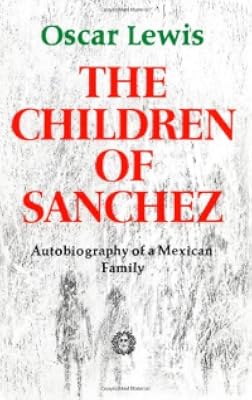
The Children of Sanchez
by Oscar Lewis
On This Page
Description
Anthropologist's tape-recorded documentary in which each of five members of a slum-dwelling Mexico City family tells about their lives. Once or twice in every generation a scientific work appears which has the immediacy and force of great literature. The Children of Sanchez is such a book. It brings us in touch with the lives of its subjects in such a way that the reader is drawn into their world as if he were reading a great novel. This is an intimate account of an actual family from the show more slums of Mexico City. The story they tell is in their own words. The reader learns not only what it is like to grow up in a one-room home in a slum tenement in the heart of a great modern city, but, insofar as the lives in this book may be generalized, about the culture of poverty throughout the world--the culture shared by 80% of the world's people. The lives of the Sanchez family reveal a world of violence and death, of suffering and brutality, of broken homes and the cruelty of the poor to the poor. But they reveal, too, an intensity of feeling and human warmth, a sense of individuality, a capacity for joy, a hope for a better life, a desire for sympathy and love, a readiness to share the little they possess, and the courage to carry on in the face of great adversity.--From publisher description. show lessTags
Recommendations























Member Reviews
This is an anthropolgical study of an extended working class Mexican family in the 1950s. But if that sounds dull, I just want to say that it reads of a pretty gripping family saga; and as a work of psychology.
Father Sanchez has made something of himself through hard graft at the restaurant he works in, and a bit of enterprise. He seems exceptionally duty bound to his numerous children and grandchildren, forever helping them financially. And yet he is a flawed man- a womanizer, violent, harsh...
Lewis interviews each of his four children (by deceased first wife) three times. They take him through their lives, the events, the relationships...
Anthropologically, this introduces us to a very alien world. The machismo (wives expect to be show more beaten, kept short of funds); the lack of stability as marriage is a rare thing and people indulge in a succession of short lived affairs; the poverty; the corrupt police; the violence, drunkenness; the religion but, too, a bit of witchcraft... And what is it LIKE sharing one room with eighteen others- the ones you dislike,the ones with unsavory habits. the lack of privacy? The interviewees share their thoughts...
And then the story- one with no convenient tied-up ends as people lurch from one disaster to another. Infidelity, jail breaks, lottery wins..
But for me, it was predominantly a psychological masterpiece. Here we have four characters who know much of each others' lives. Yet the different slant on an event when relayed fronm two perspectives! Sanchez' disillusionment with the failures his children have turned out is set aside the traumatized Roberto- rejected, unloved, beaten as a child...and who (for perhaps that very reason) goes rather off the rails...
An absolute tour de force. show less
Father Sanchez has made something of himself through hard graft at the restaurant he works in, and a bit of enterprise. He seems exceptionally duty bound to his numerous children and grandchildren, forever helping them financially. And yet he is a flawed man- a womanizer, violent, harsh...
Lewis interviews each of his four children (by deceased first wife) three times. They take him through their lives, the events, the relationships...
Anthropologically, this introduces us to a very alien world. The machismo (wives expect to be show more beaten, kept short of funds); the lack of stability as marriage is a rare thing and people indulge in a succession of short lived affairs; the poverty; the corrupt police; the violence, drunkenness; the religion but, too, a bit of witchcraft... And what is it LIKE sharing one room with eighteen others- the ones you dislike,the ones with unsavory habits. the lack of privacy? The interviewees share their thoughts...
And then the story- one with no convenient tied-up ends as people lurch from one disaster to another. Infidelity, jail breaks, lottery wins..
But for me, it was predominantly a psychological masterpiece. Here we have four characters who know much of each others' lives. Yet the different slant on an event when relayed fronm two perspectives! Sanchez' disillusionment with the failures his children have turned out is set aside the traumatized Roberto- rejected, unloved, beaten as a child...and who (for perhaps that very reason) goes rather off the rails...
An absolute tour de force. show less
This is the heartbreaking story of a family from DF, who live near the Lowest level of poverty in the nation's capital. The Sanchez family, father Jesus, sons Roberto and Manuel, and daughters Consuelo and Marta, tell their stories via tape recorder to anthropologist Oscar Lewis. For those who live in a bubble and cannot relate to this kind of reality check, they may become depressed and put a bad review, as I saw at least one Goodreads reviewer do. Mexican society is extremely patriarchal, and more so among the poor. Machistas destroy families by treating their domestic partners cruelly, having multiple families, giving no thought to impregnating multiple women multiple times and then leaving these children to neglect and starvation. show more Those children naturally grow up and do the same thing; they never have a chance to get educated and break the cycle. I would estimate that 80% of the present globe's population is from this background, with all the cost in wasted lives, especially for the women, that this implies. show less
A pioneering work from a visionary anthropologist, The Children of Sanchez is hailed around the world as a watershed achievement in the study of poverty—a uniquely intimate investigation, as poignant today as when it was first published. It is the epic story of the Sánchez family, told entirely by its members—Jesus, the 50-year-old patriarch, and his four adult children—as their lives unfold in the Mexico City slum they call home. Weaving together their extraordinary personal narratives, Oscar Lewis creates a sympathetic but ultimately tragic portrait that is at once harrowing and humane, mystifying and moving. An invaluable document, full of verve and pathos, The Children of Sanchez reads like the best of fiction, with the added show more impact that it is all, undeniably, true. show less
Probably not bad from a sociological point of view, but I must admit to some skepticism about how much of this case study is actually true. Some meta material I've read suggests that the answer is "not all that much, really." Read as fiction, this simply wasn't all that interesting, so I'm afraid that I'm bailing around page 85 or so.
Summary: An anthropological documentary on the lives of four children and their father in the Mexico City slums relies on the words of the five protagonists themselves
An anthropological documentary on the lives of four children and their father in the Mexico City slums relies on the words of the five protagonists themselves.
Brutalmente crudo y humano a la vez.
Members
- Recently Added By
Lists

Non-Fiction Worth Reading
1,015 works; 261 members
Author Information

27+ Works 1,396 Members
Oscar Lewis, an American anthropologist, was renowned for his studies of poverty in Mexico and Puerto Rico and for his controversial concept of "the culture of poverty." After graduating from Columbia University, where he studied under Ruth Benedict, Franz Boas, and Margaret Mead, his first major book, Life in a Mexican Village (1951), was a show more restudy of Robert Redfield's village of Tepoztlan, which reached a number of conclusions opposed to those reached by Redfield. Much of the controversy over the culture of poverty disappeared when Lewis labeled it a subculture; ironically, reactionaries have used the concept to blame the poor for their poverty, whereas Lewis believed the poor to be victims. Many of his books are based on tape recordings of family members, a technique in which Lewis was a pioneer. (Bowker Author Biography) show less
Some Editions
Awards and Honors
Series
Belongs to Publisher Series
Common Knowledge
- Canonical title*
- Les enfants de Sánchez. Autobiographie d'une famille mexicaine
- Original publication date
- 1961
- People/Characters
- Jesus Sanchez; Manuel Sanchez; Roberto Sanchez; Consuelo Sanchez; Marta Sanchez
- Important places*
- Mexique
- Dedication
- I dedicate this book with profound affection and gratitude to the Sanchez family whose identity must remain anonymous
- First words
- I can say I had no childhood.
- Last words
- (Click to show. Warning: May contain spoilers.)It will be a protection for them when I fall down and don't get up again.
- Original language*
- Français
*Some information comes from Common Knowledge in other languages. Click "Edit" for more information.
Classifications
- Genres
- Anthropology, Nonfiction, Biography & Memoir
- DDC/MDS
- 309.172 — Society, government, & culture Social sciences, sociology & anthropology [Formerly: History of Social Science] No longer used [Formerly: Historical and geographical treatment]
- LCC
- HQ562 .L38 — Social sciences The family. Marriage, Women and Sexuality The Family. Marriage. Women The family. Marriage. Home
- BISAC
Statistics
- Members
- 492
- Popularity
- 61,209
- Reviews
- 9
- Rating
- (4.13)
- Languages
- 8 — Chinese, English, Finnish, French, German, Italian, Spanish, Swedish
- Media
- Paper, Ebook
- ISBNs
- 18
- ASINs
- 19