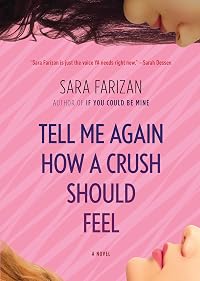
Tell Me Again How a Crush Should Feel
by Sara Farizan
On This Page
Description
High school junior Leila's Persian heritage already makes her different from her classmates at Armstead Academy, and if word got out that she liked girls life would be twice as hard, but when a new girl, Saskia, shows up, Leila starts to take risks she never thought she would, especially when it looks as if the attraction between them is mutual, so she struggles to sort out her growing feelings by confiding in her old friends.Tags
Recommendations





Member Recommendations
Member Reviews
On the cover, Sarah Dessen, who books I usually enjoy, tells me “Sara Farizan is just the voice YA needs right now,” so I had high hopes for a lesbian romance with a Persian protagonist. Unfortunately, I wound up slimming through the novel, because the much-lauded voice is that same banal upper middle class whine that sets me on edge with so much American fiction.
Not everyone’s a David Levithan, creating authentic voices that revel in nuance and philosophy, but plenty of YA authors can do an everyday voice without dumbing it down into mundanity. For me, this novel fails on all counts. Not only does the first person narrator lack sophistication of vocabulary, sentence structure or content, but there’s nothing much to distinguish show more her characterisation from dozens of other stories out there. Sure Leila’s a lesbian, but her naiveté regarding her first relationship is too superficial to make sense, and both it’s complication and resolution are underdeveloped. Sure she’s Persian, but her family experiences seem tacked on to the all-American schoolgirl persona. The characterisation simply isn’t strong enough to represent the dynamics of growing up as a first generation American, and the plot doesn’t allow her to live out the consequences of her decisions. Whether she is choosing to ditch school for a day or falling in love with the rich, exotic allure of the new girl, the stakes just aren’t that high.
When I started writing this review, I felt there was little Persian content here, but then I itemised in my head and realised there was heaps. From wedding scenes starring mouth-watering food, to her sister aiding and abetting a sleepover with her love interest and angst about coming out to parents who grew up in a country where gay relationships can receive the death penalty (read Deboroah Ellis’ Moon at Nine, if you want to know more), there’s lots that students from middle eastern backgrounds will relate to. I’ve had students complain about customs such as taraf (polite offerings to show respect), not to speak of the pressure to become a doctor or engineer, whether or not they excel in science, and I’m sure they’ll be delighted to read an own voices novel that reflects their experiences. However, there’s not really enough substance to convey these experiences to someone outside the culture – they come across as a tick-box of stereotypes rather than immersing the reader in the culture. I can’t really recommend this one at all. show less
Not everyone’s a David Levithan, creating authentic voices that revel in nuance and philosophy, but plenty of YA authors can do an everyday voice without dumbing it down into mundanity. For me, this novel fails on all counts. Not only does the first person narrator lack sophistication of vocabulary, sentence structure or content, but there’s nothing much to distinguish show more her characterisation from dozens of other stories out there. Sure Leila’s a lesbian, but her naiveté regarding her first relationship is too superficial to make sense, and both it’s complication and resolution are underdeveloped. Sure she’s Persian, but her family experiences seem tacked on to the all-American schoolgirl persona. The characterisation simply isn’t strong enough to represent the dynamics of growing up as a first generation American, and the plot doesn’t allow her to live out the consequences of her decisions. Whether she is choosing to ditch school for a day or falling in love with the rich, exotic allure of the new girl, the stakes just aren’t that high.
When I started writing this review, I felt there was little Persian content here, but then I itemised in my head and realised there was heaps. From wedding scenes starring mouth-watering food, to her sister aiding and abetting a sleepover with her love interest and angst about coming out to parents who grew up in a country where gay relationships can receive the death penalty (read Deboroah Ellis’ Moon at Nine, if you want to know more), there’s lots that students from middle eastern backgrounds will relate to. I’ve had students complain about customs such as taraf (polite offerings to show respect), not to speak of the pressure to become a doctor or engineer, whether or not they excel in science, and I’m sure they’ll be delighted to read an own voices novel that reflects their experiences. However, there’s not really enough substance to convey these experiences to someone outside the culture – they come across as a tick-box of stereotypes rather than immersing the reader in the culture. I can’t really recommend this one at all. show less
“I also began to notice how white everything was. The students, the students’ teeth, and the fences surrounding the outdoor swimming pools we never used. We all seemed to categorize ourselves without ever explicitly saying anything. Where does that leave students who don’t have a clear category?”
It’s not easy being different in school. Leila already stands out because of her Iranian background, but she also holds close to her a secret – she likes girls.
“I’m not ready to announce my lady-loving inclinations as yet. I can hear the whispering, knowing that what they are snickering about could easily be me. I’m already different enough at this school. I don’t need to add anything else to that.”
Leila is drawn to Saskia show more – she’s confident, clever, poised, she stands out yet is comfortable with that. She’s not quite so sure why Saskia wants to befriend her though.
Leila constantly worries about coming out to her family. A family they know have shunned their son who was seen kissing another man. How would her own conservative Iranian parents react?
“You know where they’re from, being gay is illegal? They imprison people over there for feeling like I do! Sentence them to death sometimes.”
When I reflect back on Lucy and Linh, the other book I recently read that focuses on teenagers in school, Tell Me Again How A Crush Should Feel is less complex, more simply told. There’s nothing wrong with that though. Sometimes a lighter read is what’s needed. It’s a lighter read yet it discusses some complicated issues that face many teens out there – discovering their own identity, standing up for themselves and what they believe in, relationships with family and friends, and learning that it’s ok to be different. show less
It’s not easy being different in school. Leila already stands out because of her Iranian background, but she also holds close to her a secret – she likes girls.
“I’m not ready to announce my lady-loving inclinations as yet. I can hear the whispering, knowing that what they are snickering about could easily be me. I’m already different enough at this school. I don’t need to add anything else to that.”
Leila is drawn to Saskia show more – she’s confident, clever, poised, she stands out yet is comfortable with that. She’s not quite so sure why Saskia wants to befriend her though.
Leila constantly worries about coming out to her family. A family they know have shunned their son who was seen kissing another man. How would her own conservative Iranian parents react?
“You know where they’re from, being gay is illegal? They imprison people over there for feeling like I do! Sentence them to death sometimes.”
When I reflect back on Lucy and Linh, the other book I recently read that focuses on teenagers in school, Tell Me Again How A Crush Should Feel is less complex, more simply told. There’s nothing wrong with that though. Sometimes a lighter read is what’s needed. It’s a lighter read yet it discusses some complicated issues that face many teens out there – discovering their own identity, standing up for themselves and what they believe in, relationships with family and friends, and learning that it’s ok to be different. show less
“I also began to notice how white everything was. The students, the students’ teeth, and the fences surrounding the outdoor swimming pools we never used. We all seemed to categorize ourselves without ever explicitly saying anything. Where does that leave students who don’t have a clear category?”
It’s not easy being different in school. Leila already stands out because of her Iranian background, but she also holds close to her a secret – she likes girls.
“I’m not ready to announce my lady-loving inclinations as yet. I can hear the whispering, knowing that what they are snickering about could easily be me. I’m already different enough at this school. I don’t need to add anything else to that.”
Leila is drawn to Saskia show more – she’s confident, clever, poised, she stands out yet is comfortable with that. She’s not quite so sure why Saskia wants to befriend her though.
Leila constantly worries about coming out to her family. A family they know have shunned their son who was seen kissing another man. How would her own conservative Iranian parents react?
“You know where they’re from, being gay is illegal? They imprison people over there for feeling like I do! Sentence them to death sometimes.”
When I reflect back on Lucy and Linh, the other book I recently read that focuses on teenagers in school, Tell Me Again How A Crush Should Feel is less complex, more simply told. There’s nothing wrong with that though. Sometimes a lighter read is what’s needed. It’s a lighter read yet it discusses some complicated issues that face many teens out there – discovering their own identity, standing up for themselves and what they believe in, relationships with family and friends, and learning that it’s ok to be different. show less
It’s not easy being different in school. Leila already stands out because of her Iranian background, but she also holds close to her a secret – she likes girls.
“I’m not ready to announce my lady-loving inclinations as yet. I can hear the whispering, knowing that what they are snickering about could easily be me. I’m already different enough at this school. I don’t need to add anything else to that.”
Leila is drawn to Saskia show more – she’s confident, clever, poised, she stands out yet is comfortable with that. She’s not quite so sure why Saskia wants to befriend her though.
Leila constantly worries about coming out to her family. A family they know have shunned their son who was seen kissing another man. How would her own conservative Iranian parents react?
“You know where they’re from, being gay is illegal? They imprison people over there for feeling like I do! Sentence them to death sometimes.”
When I reflect back on Lucy and Linh, the other book I recently read that focuses on teenagers in school, Tell Me Again How A Crush Should Feel is less complex, more simply told. There’s nothing wrong with that though. Sometimes a lighter read is what’s needed. It’s a lighter read yet it discusses some complicated issues that face many teens out there – discovering their own identity, standing up for themselves and what they believe in, relationships with family and friends, and learning that it’s ok to be different. show less
Ugh, I don't know how to feel about this book! I don't know what to think.
On one hand, it's incredibly diverse, and that's great! But then again, Sara Farizan doesn't always handle that diversity well, which is . . . not so great. :/
Book content warnings (whew here we go):
homophobia/biphobia/lesbophobia
transphobia
homophobic & biphobic stereotypes
lesbophobic slurs
forced coming-out
Jewish slurs
sexual harassment
cissexism
unhealthy relationships
(and probably more . . . )
A high-school junior, Leila is a student at a preppy academy, a 1st generation Persian immigrant, and unknown to anyone, a lesbian. Life is hard enough already without anyone knowing about that.
But when new-student Saskia enters her life, Leila is immediately smitten and has show more a harder time hiding herself from everyone, including herself. But Saskia brings with her a whole world of drama, and Leila wonders if Saskia's even a good person, if her feelings for her are real or superficial, and what it really means (re: title) to have a crush.
So, what this book does really well:
- the main character dealing with her emotions/becoming familiar with her sexuality, especially coming from a traditional Persian family, etc.
- the relationship between Leila and her family (this is done SO well)
- the relationship between Leila and Lisa (I won't get into this too much to not spoil anything, but it's very sweet)
- basically the main and lots of secondary characters are done Very well, and it's so lovely to witness
- that ending! it wraps up in such a satisfactory way, that I momentarily forgot everything I disliked about it and just reveled in that beautiful ending :'))
What this book . . . really doesn't do well: (and it's a lot)
- bi representation
--- Lisa, a bi character, vehemently denies the label of bi, instead just wanting to be "____sexual", and haven't we all seen that 1000 times in the media? Everyone hates the b word!!
--- Saskia. We don't know her sexuality. We assume she's straight ("I can't even look at my own vagina in a mirror! ew!"(cissexism warning), but then again she looks at Leila with lust in her eye, and goes out of her way to continue to kiss her and pursue her, so . . . is she curious? Does she have internalized hobophobia? We don't know. But it DOES seem like she's falling into the evil, promiscuous, and over-sexualized bisexual stereotype that needs to die. :/
- transphobic stereotypes
--- Toward the end of the book, Leila and the only gay character team up to help middle school students put on Cinderella with a twist: Cinderella is . . . non-gender conforming? At least that's what they said. But . . . when we actually see the play, the character of Cinderella is simply performed by a boy in a dress who's speaking in falsetto for laughs. That's . . . simple transphobia there, not anything non-gender conforming. The book even specified it was done for humor, so . . .
- bad representation of lgbt ppl in general
--- The only gay character is someone named Tomas, who's a very flamboyant man. Now that's not bad, because many gay men are flamboyant, but Tomas enjoys being a straight woman's accessory, openly hates "hardcore lesbians", and lives only for other people's drama without having any other character--or character development. He has no other personality, and even says he wants/has no other connections than what will give him drama.
--- There's a group of stagehands Leila meets who she (and everyone else) assumes are lesbians. She has this superior attitude throughout the entire book of "not like other lesbians" and even goes as far to say "will I end up like them? will I date someone like them??". AKA, lesbians who are feminists, lesbians who don't shave their legs, lesbians who aren't very feminine, etc. I don't know what Sara Farizan has against lesbians, but what the hell.
Anyway, it's sooo tough to rate this book, or even like it? Because there was so much that I didn't like about that made it tough to enjoy. Even if there was much I did like about it! show less
On one hand, it's incredibly diverse, and that's great! But then again, Sara Farizan doesn't always handle that diversity well, which is . . . not so great. :/
Book content warnings (whew here we go):
homophobia/biphobia/lesbophobia
transphobia
homophobic & biphobic stereotypes
lesbophobic slurs
forced coming-out
Jewish slurs
sexual harassment
cissexism
unhealthy relationships
(and probably more . . . )
A high-school junior, Leila is a student at a preppy academy, a 1st generation Persian immigrant, and unknown to anyone, a lesbian. Life is hard enough already without anyone knowing about that.
But when new-student Saskia enters her life, Leila is immediately smitten and has show more a harder time hiding herself from everyone, including herself. But Saskia brings with her a whole world of drama, and Leila wonders if Saskia's even a good person, if her feelings for her are real or superficial, and what it really means (re: title) to have a crush.
So, what this book does really well:
- the main character dealing with her emotions/becoming familiar with her sexuality, especially coming from a traditional Persian family, etc.
- the relationship between Leila and her family (this is done SO well)
- the relationship between Leila and Lisa (I won't get into this too much to not spoil anything, but it's very sweet)
- basically the main and lots of secondary characters are done Very well, and it's so lovely to witness
- that ending! it wraps up in such a satisfactory way, that I momentarily forgot everything I disliked about it and just reveled in that beautiful ending :'))
What this book . . . really doesn't do well: (and it's a lot)
- bi representation
--- Lisa, a bi character, vehemently denies the label of bi, instead just wanting to be "____sexual", and haven't we all seen that 1000 times in the media? Everyone hates the b word!!
--- Saskia. We don't know her sexuality. We assume she's straight ("I can't even look at my own vagina in a mirror! ew!"(cissexism warning), but then again she looks at Leila with lust in her eye, and goes out of her way to continue to kiss her and pursue her, so . . . is she curious? Does she have internalized hobophobia? We don't know. But it DOES seem like she's falling into the evil, promiscuous, and over-sexualized bisexual stereotype that needs to die. :/
- transphobic stereotypes
--- Toward the end of the book, Leila and the only gay character team up to help middle school students put on Cinderella with a twist: Cinderella is . . . non-gender conforming? At least that's what they said. But . . . when we actually see the play, the character of Cinderella is simply performed by a boy in a dress who's speaking in falsetto for laughs. That's . . . simple transphobia there, not anything non-gender conforming. The book even specified it was done for humor, so . . .
- bad representation of lgbt ppl in general
--- The only gay character is someone named Tomas, who's a very flamboyant man. Now that's not bad, because many gay men are flamboyant, but Tomas enjoys being a straight woman's accessory, openly hates "hardcore lesbians", and lives only for other people's drama without having any other character--or character development. He has no other personality, and even says he wants/has no other connections than what will give him drama.
--- There's a group of stagehands Leila meets who she (and everyone else) assumes are lesbians. She has this superior attitude throughout the entire book of "not like other lesbians" and even goes as far to say "will I end up like them? will I date someone like them??". AKA, lesbians who are feminists, lesbians who don't shave their legs, lesbians who aren't very feminine, etc. I don't know what Sara Farizan has against lesbians, but what the hell.
Anyway, it's sooo tough to rate this book, or even like it? Because there was so much that I didn't like about that made it tough to enjoy. Even if there was much I did like about it! show less
In the beginning of the book, Leila is thankful that she doesn't have a crush on anyone she goes to school with, because a) that would make high school even more difficult and b) she is a closeted lesbian, and she really, really, really doesn't want to go there right now. The younger daughter in a Persian-American family, Leila is terrified that her relatively conservative family will disown her. And then, of course, she develops a crush on someone - the new girl, Saskia, who is well-traveled, intelligent, and incredibly hot.
First off, let me say that I am so thankful that today's youth have more diversity in YA than I ever had growing up in the rural area of a red state. Granted, there are still lots of whitewashed books and a general show more lack of diversity, but at least there are SOME books out there for the queer kids of today. The first queer book I stumbled upon was Odd Girl Out by Ann Bannon, and that wasn't until I was seventeen. It amazes and thrills me that this book was available at my local library!
Okay, done with that. :)
I think the book captured the painful awkwardness that can be the high school experience for anyone. Leila has a sarcastic sense of humor, a sense of humor that I share, so I found myself laughing along with some of her observations and comments. And I could also relate to the thought of losing your family because you own up to who and what you truly are.
I didn't care for the fact that Leila could be quite judgmental, though. She assumes that the "tech girls" who work in theater were all lesbian because of their appearances.It turns out that none of them were, but they were a hell of a lot more accepting of Leila than she had been of them initially. Leila separates herself from them in her mind, and while it is true that oftentimes the only things that some lesbians have in common with other lesbians is their sexuality, Leila's dismissal of "not being like them" stung the wrong way.
And then the whole thing with Saskia being crazy in the end...blah. I am so sick of lesbian books where one of the characters is crazy! It feels like an old, dated throwback to the pulp novels of the 50s, and besides, can't we treat those with mental disorders a little better today?
And then Lisa having a crush on Leila...hmm. Leila went from "I am getting my friend Lisa back in my life" to "oh so she is my girlfriend now" super quickly and with very little introspect. Ever since Leila discovered that Lisa was a lesbian and had had a crush on her, it was automatically assumed that they would become girlfriends. Why? Two lesbians can totally be friends with one another. I just felt like their whole relationship was rushed. show less
First off, let me say that I am so thankful that today's youth have more diversity in YA than I ever had growing up in the rural area of a red state. Granted, there are still lots of whitewashed books and a general show more lack of diversity, but at least there are SOME books out there for the queer kids of today. The first queer book I stumbled upon was Odd Girl Out by Ann Bannon, and that wasn't until I was seventeen. It amazes and thrills me that this book was available at my local library!
Okay, done with that. :)
I think the book captured the painful awkwardness that can be the high school experience for anyone. Leila has a sarcastic sense of humor, a sense of humor that I share, so I found myself laughing along with some of her observations and comments. And I could also relate to the thought of losing your family because you own up to who and what you truly are.
I didn't care for the fact that Leila could be quite judgmental, though. She assumes that the "tech girls" who work in theater were all lesbian because of their appearances.
And then Lisa having a crush on Leila...hmm. Leila went from "I am getting my friend Lisa back in my life" to "oh so she is my girlfriend now" super quickly and with very little introspect. Ever since Leila discovered that Lisa was a lesbian and had had a crush on her, it was automatically assumed that they would become girlfriends. Why? Two lesbians can totally be friends with one another. I just felt like their whole relationship was rushed.
The first time I read this, I laughed, I cried, and loved every minute. I raced to Google for information on details of the book, ignoring my post-bac homework for a bit. Then I went back to it and was cranky. I couldn't stop thinking about this book. I wanted to read it again immediately. The second time reading was tonight. When I first read it, the title drew me in. It reminded me of a short story I'd read as a tween about a high school girl that ended with her friend saying, "If it didn't hurt, they wouldn't call it a crush." I expected this book to be that heartbreaking, and was so annoyed when it wasn't. This time, I remembered parts of it. I still laughed. I rolled my eyes a lot, and I haaaated Saskia all over again. Things that show more I didn't notice the first read: um, that is NOT what a stage manager is. I was so frustrated, and wondered where the author got the idea. And why the stereotypical negative portrayal of gay male high schoolers? Both of these things had me lower the original rating considerably. I'm still looking really forward to rereading another work of Farizan's. show less
Tell Me Again How a Crush Should Feel by Sara Farizan, is a pleasing, low key romance–much more low key than her debut novel If You Could Be Mine. Leila knows her crush on girls would devastate her Iranian born parents…confirmed by the fact that a neighbor disowned their son when he came out. As a result, she can’t tell her parents or her perfect sister, Nahal, the apple of her parents’ eyes, so she thinks. She doesn’t want to be disowned, unloved.
When a new, beautiful girl, Saskia, transfers to her school and shows interest in Leila, she’s ecstatic. She can’t stop thinking about her, her looks, the smell of her hair, the feeling as their arms brush together. She has high hopes that Saskia will become her girlfriend. But show more Saskia is erratic, sometimes encouraging, sometimes conniving and sometimes hurtful.
At school, all students must have an extracurricular activity. Since Leila’s no athlete, it takes little encouragement from Saskia to convince Leila to drop soccer and try out for the school play together, Twelfth Night. Although she doesn’t get a part (and Saskia does), Leila agrees to work backstage where she meets Tanya, Simone and Christine, the rumored stereotypical ‘backstage lesbians’.
While all of this is going on, Leila reconnects with a childhood friend, Lisa Katz, who had migrated to the ‘in crowd’ at school, leaving the Lisa/Leila friendship in the dust.
(Possible spoiler) I’ll admit that parts of the story are predictable, as is the ending (but it’s the ending you want). But that doesn’t detract from this sweet story. Leila is like any sixteen year old in the throes of love, regardless of whether it’s homosexual or heterosexual love, whether you’re a guy or a girl. Her insecurities about romance will resonate with most teens, since both genders go through the heartbreak of romance at some point in their young lives.
Additionally, we all think we know our siblings, only to find out they’re totally different than our image of them. Nahal is no exception.
And finally, the book reinforces the unconditional love that a parent has (should have) for a child.
Tell Me Again How a Crush Should Feel will make any romantic feel good, which is certainly how a crush should feel. show less
When a new, beautiful girl, Saskia, transfers to her school and shows interest in Leila, she’s ecstatic. She can’t stop thinking about her, her looks, the smell of her hair, the feeling as their arms brush together. She has high hopes that Saskia will become her girlfriend. But show more Saskia is erratic, sometimes encouraging, sometimes conniving and sometimes hurtful.
At school, all students must have an extracurricular activity. Since Leila’s no athlete, it takes little encouragement from Saskia to convince Leila to drop soccer and try out for the school play together, Twelfth Night. Although she doesn’t get a part (and Saskia does), Leila agrees to work backstage where she meets Tanya, Simone and Christine, the rumored stereotypical ‘backstage lesbians’.
While all of this is going on, Leila reconnects with a childhood friend, Lisa Katz, who had migrated to the ‘in crowd’ at school, leaving the Lisa/Leila friendship in the dust.
(Possible spoiler) I’ll admit that parts of the story are predictable, as is the ending (but it’s the ending you want). But that doesn’t detract from this sweet story. Leila is like any sixteen year old in the throes of love, regardless of whether it’s homosexual or heterosexual love, whether you’re a guy or a girl. Her insecurities about romance will resonate with most teens, since both genders go through the heartbreak of romance at some point in their young lives.
Additionally, we all think we know our siblings, only to find out they’re totally different than our image of them. Nahal is no exception.
And finally, the book reinforces the unconditional love that a parent has (should have) for a child.
Tell Me Again How a Crush Should Feel will make any romantic feel good, which is certainly how a crush should feel. show less
Members
- Recently Added By
Lists

Books Read in 2014
2,343 works; 89 members

Books Read in 2015
3,299 works; 129 members

Workman Publishing
38 works; 1 member

Books Set in Massachusetts
41 works; 8 members

School library books removed after TX state legislator inquiry
429 works; 6 members
Author Information

7+ Works 1,414 Members
Awards and Honors
Awards
Common Knowledge
- Canonical title
- Tell Me Again How a Crush Should Feel
- Original publication date
- 2014-10-07
Classifications
Statistics
- Members
- 387
- Popularity
- 80,815
- Reviews
- 19
- Rating
- (3.63)
- Languages
- English
- Media
- Paper, Audiobook, Ebook
- ISBNs
- 14
- ASINs
- 4