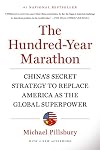
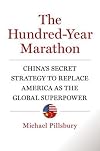
The Hundred-Year Marathon: China's Secret Strategy to Replace America as the Global Superpower
by Michael Pillsbury
On This Page
Description
"For more than forty years, the United States has reached out to China, helping it develop a booming economy and take its place on the world stage, in the belief that there is little to fear--and everything to gain--from China's rise. But what if the Chinese have had a different plan all along? The Hundred-Year Marathon reveals China's secret strategy to supplant the United States as the world's dominant power, and to do so by 2049, the one hundredth anniversary of the founding of the show more People's Republic. Michael Pillsbury, who has served in senior national security positions in the U.S. government since the days of Richard Nixon and Henry Kissinger, draws on Chinese documents, speeches, and books (many of them never translated into English) to reveal the roots of this strategy in traditional Chinese statecraft and track how the Chinese are putting it into practice today. Pillsbury shows how American policymakers have been willfully blind to these developments for decades--and he includes himself in that critique, as he was once a leading voice in favor of aiding China. He also calls for the United States to design a new, more competitive strategy toward China as it really is, and not as we might wish it to be. The Hundred-Year Marathon is a wakeup call for all Americans concerned about how we have misread the greatest national security challenge of the twenty-first century"-- show lessTags
Recommendations



Member Reviews
Listened to about 2 hours of this. There are two key problems with the book.
The first is that it seems like almost all of the content depends on just one source, the author. There are a bunch of red flags in the text that point to this, like the conspiratorial language that's used, the author's insistence that other China experts don't understand Chinese nearly as well as he does (and so should be ignored), or claims that others have been successfully 'duped' by China's public statements but that Pillsbury has spoken to former USSR operatives and knows what's really going on. Having a single source doesn't always mean a book is problematic; philosophical or autobiographical texts tend to have this same attribute and can work fine. But show more when you make a bunch of claims about a nation of over a billion people based on only personal experience and a claimed better understanding of Mandarin, I think it's fair to cry foul.
The second deals with the thesis of the book. Throughout the beginning chapters, Pillsbury keeps talking about how China wants to overtake the US, how they're not OK playing second-fiddle, how China has tried to deceive the US into thinking they don't have world leader ambitions, etc. The language and tone in which the author presents these ideas is meant to evoke fear, concern, and surprise on the side of the reader. But this is totally unsurprising to me: wouldn't it make sense that China intends to be #1, especially when it has the greatest population? Becoming the world's leading power is a very reasonable long-term goal for any nation-state. Pillsbury's presentation is akin a basketball coach telling his players things like "the other team wants to beat us!" and "you don't get it, they want to be the champions, they're not OK taking second place!" I think most people would be confused that the coach would think players need to be reminded of this key attribute of any competition.
Not recommended. show less
The first is that it seems like almost all of the content depends on just one source, the author. There are a bunch of red flags in the text that point to this, like the conspiratorial language that's used, the author's insistence that other China experts don't understand Chinese nearly as well as he does (and so should be ignored), or claims that others have been successfully 'duped' by China's public statements but that Pillsbury has spoken to former USSR operatives and knows what's really going on. Having a single source doesn't always mean a book is problematic; philosophical or autobiographical texts tend to have this same attribute and can work fine. But show more when you make a bunch of claims about a nation of over a billion people based on only personal experience and a claimed better understanding of Mandarin, I think it's fair to cry foul.
The second deals with the thesis of the book. Throughout the beginning chapters, Pillsbury keeps talking about how China wants to overtake the US, how they're not OK playing second-fiddle, how China has tried to deceive the US into thinking they don't have world leader ambitions, etc. The language and tone in which the author presents these ideas is meant to evoke fear, concern, and surprise on the side of the reader. But this is totally unsurprising to me: wouldn't it make sense that China intends to be #1, especially when it has the greatest population? Becoming the world's leading power is a very reasonable long-term goal for any nation-state. Pillsbury's presentation is akin a basketball coach telling his players things like "the other team wants to beat us!" and "you don't get it, they want to be the champions, they're not OK taking second place!" I think most people would be confused that the coach would think players need to be reminded of this key attribute of any competition.
Not recommended. show less
This was a early reviewer selection. Over time, I have read and pretty much accepted traditional ideas on the philosophical difference between the Eastern and the Western mindset. Namely those ideas of the West favoring the individual and the East placing society in the favored spot. Thus I had always been skeptical of the notion that the Chinese would be able to adapt, as U. S. leaders hoped, to a Western societal/cultural model based on free enterprise and capitalism in the hands of independent free thinkers. This book seems to fortify my inner skeptic. Written by an American diplomatic insider, the thrust of the argument is that the Chinese Government has long regarded the U. S. Government an adversary and has never intended to show more emulate its model of society. Rather it intends, over the very long haul to overtake and displace the U. S. I don't have a lot of trouble agreeing with this assessment out of hand but the book makes a very good, historically backed, argument for its acceptance. show less
 This review was written for LibraryThing Early Reviewers.
A very interesting read from someone who clearly knows his stuff. His main thesis is that America has been fooled by China, who has been on a path to overtake the US since the time of Nixon. And he has convincing insider information from his time as a "spy" to bring to bear. So much so that you become convinced that it may be too late for the US to do anything about it.
But there is something about how he tells his story that makes you think that perhaps he's overcompensating for the times he feels he was duped by China to now thinking China can do no wrong. And then you wonder if perhaps his judgment may be wrong now just as it was wrong before, and perhaps there is hope for the US. I am not convinced that present US leadership has the show more skills to meet the challenge. But this book has certainly made me rethink what I thought I knew about America's relations with China. show less
But there is something about how he tells his story that makes you think that perhaps he's overcompensating for the times he feels he was duped by China to now thinking China can do no wrong. And then you wonder if perhaps his judgment may be wrong now just as it was wrong before, and perhaps there is hope for the US. I am not convinced that present US leadership has the show more skills to meet the challenge. But this book has certainly made me rethink what I thought I knew about America's relations with China. show less
Michael Pillsbury has worked as a defense policy advisor since the Nixon presidency. He may even have had some responsibility for the “opening” of China and the restoration of diplomatic relations with the U.S. However, his view of China today has moved about 180 degrees and now can be considered a voice of the neo-cons and their view of China as a threat to the U.S. role as the global superpower. It is not necessarily an unwarranted view. While U.S. interests want to believe that China is turning into both a capitalist and democratic society, Pillsbury argues that the Politburo is controlled by the hard-right military intent on securing world domination by 2050. We are, in part, responsible for China’s resurgence as an economic show more power. Our consumer interests of wanting inexpensive TVs, smartphones, and other products sold cheaply at Wal-Mart have limited our ability to view China’s secret strategy. Providing new translations for Chinese language he paints a dark picture of the future. It certainly does not appear that China is any closer to democracy than it was in 1989 and its control of the Internet within its borders shows that the Chinese government continues to fear transparency and dissent. While I remained concerned about the author’s conversion, his book provides an important starting point for a discussion on our continued relations with China. show less
This review was written for LibraryThing Early Reviewers.I was not surprised as I read this book.
I've been through my own intellectual crisis, reading many political books, watching the news, freaking out about the Tiananmen Square Massacre, and generally trying to get a general drift of China in global politics. Bits and pieces came to light from the time of Mao, the Cultural Revolution, the closing and opening of borders, Nixion, and then the great strategy boiled down to: "When capable, feign incapacity."
This book spells it all out, but let me make an analogy.
You know that A-Type next-door neighbor of yours that is totally driven, at all costs, to succeed? The one who was really rude to you until you got your own really excellent job? The one who didn't give you the time of day until you show more brought home your Mercedes?
Yeah, that one. The one who suddenly became all smiles and showed appreciation for all your wonderful accomplishments, but you later, (much later,) discovered that he was talking massive amounts of shit about you to his family, his extended family, and harshly shut down any lines of communication between his children and yours? Or the fact that for the last 20 (or is it 30, now?) years, he's been borrowing all your tools in your garage and never giving them back, has been using your accountant, has been making copies of all your entire movie collection, and during that entire time, he has always made that class of major justifications: "I'm not lucky, I just never got the breaks I needed, I'm physically unable to do the work, my boss hates me..." and you, like the chump you are, loaned him money, taught him everything you knew about how to make it big, and your wife and children STILL give the family charitable donations.
Take that analogy and apply it to China and USA. Not only is the censorship rampant over there, but all their schools teach total BS about how America has been pushing down China for the last 150 years. Anyone sent over in official capacities will look shamefaced about this and so many other facts, say it's just a small minority in their government and smile. Officials have been doing nothing but reassure and make all the right noises to the West, making promises and yet always breaking them.
This isn't about rogue elements in China, you know. They are autocratic. The Hawks established a plan to pretend weakness, get others to do all the heavy lifting for them, and get so strong, economically, that they will replace the West as the most dominant power in the world. They're actions speak powerfully and clearly. They have a long-term plan. Say whatever they need in order to get to the top, make sure they indoctrinate each generation to massively distrust other systems (first Russia, then America) and take the slow path to total dominance.
Again, this shouldn't come as any surprise. Any country with designs on power will go about things in a similar way.
But here's the thing: this book is written by someone who has been deep in the policy-and-analysis end of things in America. He had his own disillusionment, first believing that the best road was through peace and mutual aid. When the weight of such proof of duplicity in united fronts became too obvious, he spoke out. More and more proof is everywhere. 70% of all electronic intrusions come from China. There is near-total disdain for ecological problems including the cancer rates in their own population caused by industrial pollution. Free speech is nearly nonexistent. There has been a near-total eradication of the very IDEA of the Tiananmen Square Massacre in China. Those dissidents who DID want to have an honest partnership with the world were subsequently murdered or imprisoned.
And all the while, official faces try to disarm and downplay all this and say all the right things to get more money, aid, and technology. (Although, I'm sure by now, technology isn't all that required. They send tons of students abroad every year to get as much as they want.)
And the poor-me scenario? Their GNP tripled between 1997 and 2007. And yet, they're still playing the same card. Coal power is blanketing the skies in neighboring countries.
I'm not being alarmist. Anyone who keeps up with the news can piece together a much larger picture than I can in a short review. I find it very telling that both Russia and China are united in painting America as devils, however, and not in some piecemeal way. I'm talking systematic, state-sponsored propaganda. show less
I've been through my own intellectual crisis, reading many political books, watching the news, freaking out about the Tiananmen Square Massacre, and generally trying to get a general drift of China in global politics. Bits and pieces came to light from the time of Mao, the Cultural Revolution, the closing and opening of borders, Nixion, and then the great strategy boiled down to: "When capable, feign incapacity."
This book spells it all out, but let me make an analogy.
You know that A-Type next-door neighbor of yours that is totally driven, at all costs, to succeed? The one who was really rude to you until you got your own really excellent job? The one who didn't give you the time of day until you show more brought home your Mercedes?
Yeah, that one. The one who suddenly became all smiles and showed appreciation for all your wonderful accomplishments, but you later, (much later,) discovered that he was talking massive amounts of shit about you to his family, his extended family, and harshly shut down any lines of communication between his children and yours? Or the fact that for the last 20 (or is it 30, now?) years, he's been borrowing all your tools in your garage and never giving them back, has been using your accountant, has been making copies of all your entire movie collection, and during that entire time, he has always made that class of major justifications: "I'm not lucky, I just never got the breaks I needed, I'm physically unable to do the work, my boss hates me..." and you, like the chump you are, loaned him money, taught him everything you knew about how to make it big, and your wife and children STILL give the family charitable donations.
Take that analogy and apply it to China and USA. Not only is the censorship rampant over there, but all their schools teach total BS about how America has been pushing down China for the last 150 years. Anyone sent over in official capacities will look shamefaced about this and so many other facts, say it's just a small minority in their government and smile. Officials have been doing nothing but reassure and make all the right noises to the West, making promises and yet always breaking them.
This isn't about rogue elements in China, you know. They are autocratic. The Hawks established a plan to pretend weakness, get others to do all the heavy lifting for them, and get so strong, economically, that they will replace the West as the most dominant power in the world. They're actions speak powerfully and clearly. They have a long-term plan. Say whatever they need in order to get to the top, make sure they indoctrinate each generation to massively distrust other systems (first Russia, then America) and take the slow path to total dominance.
Again, this shouldn't come as any surprise. Any country with designs on power will go about things in a similar way.
But here's the thing: this book is written by someone who has been deep in the policy-and-analysis end of things in America. He had his own disillusionment, first believing that the best road was through peace and mutual aid. When the weight of such proof of duplicity in united fronts became too obvious, he spoke out. More and more proof is everywhere. 70% of all electronic intrusions come from China. There is near-total disdain for ecological problems including the cancer rates in their own population caused by industrial pollution. Free speech is nearly nonexistent. There has been a near-total eradication of the very IDEA of the Tiananmen Square Massacre in China. Those dissidents who DID want to have an honest partnership with the world were subsequently murdered or imprisoned.
And all the while, official faces try to disarm and downplay all this and say all the right things to get more money, aid, and technology. (Although, I'm sure by now, technology isn't all that required. They send tons of students abroad every year to get as much as they want.)
And the poor-me scenario? Their GNP tripled between 1997 and 2007. And yet, they're still playing the same card. Coal power is blanketing the skies in neighboring countries.
I'm not being alarmist. Anyone who keeps up with the news can piece together a much larger picture than I can in a short review. I find it very telling that both Russia and China are united in painting America as devils, however, and not in some piecemeal way. I'm talking systematic, state-sponsored propaganda. show less
I am impressed how paranoid the author is. It's exactly the kind of paranoia you want from an analyst. What I don't like is the hypocrisy of the west. We complain about China doing all kinds of terrible things and yet claim outrageously that somehow we're not guilty of the same exact thing. When you point it out it's always the same excuse: when we do it, we do it for good reasons. Even more depressing is that this sort of bias is considered patriotic.
A hugely important book while incredibly controversial. I realize people will disagree, but I fail to see how the dovish China "analysts" are so quick to dismiss Pillsbury in general and this book in particular. I've read most of their books and they don't come close to making as convincing a case as Pillsbury does, nor can any of them document their materials to back up their premises nearly as well as this author does. I bought into this almost immediately and have not changed my outlook since.
Members
- Recently Added By
Author Information

5 Works 382 Members
Michael Pillsbury was educated at Stanford University and Columbia University. He is a former analyst at the RAND Corporation and has served in senior positions in the Defense Department and on the staff of four U.S. Senate committees. He is the director of the Center on Chinese Strategy at the Hudson Institute and has served in presidential show more administrations from Richard Nixon to Barack Obama. (Bowker Author Biography) show less
Awards and Honors
Classifications
- Genres
- Politics and Government, Nonfiction, General Nonfiction, History, Business
- DDC/MDS
- 327.1 — Society, Government, and Culture Political science International Relations: Spies Foreign policy and specific topics in international relations
- LCC
- JZ1734 .P55 — Political Science International relations International relations Scope of international relations. Political theory. Scope of international relations with regard to
- BISAC
Statistics
- Members
- 338
- Popularity
- 93,373
- Reviews
- 21
- Rating
- (4.13)
- Languages
- English
- Media
- Paper, Audiobook, Ebook
- ISBNs
- 8
- UPCs
- 1
- ASINs
- 6