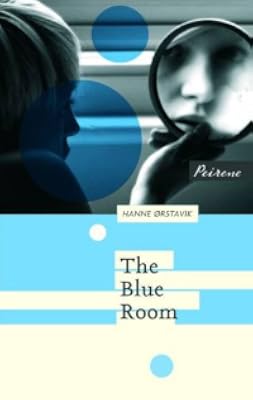
The Blue Room
by Hanne Orstavik
On This Page
Description
"Johanne is a young woman in her twenties who lives in Oslo with her mother. When she falls in love with Ivar, she finally feels ready to leave home. The couple plan a trip to America. But the morning of her departure, Johanne wakes up to find the door locked. Can she overcome her fears? Will she shout for help? Will she climb out of her seventh floor window?"--Provided by publisher.Tags
Recommendations







































Member Reviews
Hanne Ørstavik’s bracingly odd novel, The Blue Room, tells the unsettling story of Johanne, a young woman in her early 20s, a college student, who, to save money, lives with her mother in her mother’s Oslo apartment. (There is no talk of Johanne’s father. A brother, Edward, who is attending school in the US, is mentioned in passing.) Johanne’s life revolves around her classes, her mother (“Mum”), and her devotion to God. Academically, Ørstavik suggests that Johanne is a middling student who sometimes struggles. Socially, she comes across as underdeveloped; she is timid and naïve, lacks confidence, and is almost tragically isolated. She is about to lose her closest friend, Karin, who has trained to be a pastor and will show more soon be leaving the city to take up a post. Johanne craves her mother’s approval, and the two spend much of their free time in each other’s company. But Johanne also dreams of being independent, of gaining her psychologist qualification and opening a practice. Being financially dependent on her mother, it seems that Johanne lives her life in deference to her mother’s needs more so than her own. Her mother is involved with a man, Svenn—who has a family, so their opportunities for intimacy are few—and on occasions when Johanne sees that her mother has left money out, it’s a signal that she is to take the money, remove herself from the apartment and keep herself occupied for the length of Svenn’s visit. Everything changes though, when Johanne meets Ivar, who works in the university cafeteria. Ivar, a bit older and much more worldly than Johanne, is a musician with an active social and sexual life, and Johanne suddenly finds herself attracted to another person in a way that starts her rethinking her approach to living in the world. After they have sex, Johanne obsesses over Ivar’s body and can think of little besides pleasing him. Wisely or not, Johanne invites Ivar over for dinner and afterward must deal with her mother’s passive-aggressive comments: “This Ivar, Johanne, are you sure he’s right for you?” The novel opens at a crucial juncture in Johanne and Ivar’s liaison. The two have been involved for several weeks and Ivar wants Johanne to come with him on a trip to the US. But the end of term is near, and Johanne faces increasing pressure to complete her schoolwork. After much internal debate, she decides to go. But on the morning of their scheduled departure, Johanne gets out of bed and finds the door to her bedroom locked. She can’t get out, her mother has left for work, she has no phone, and she’s naked—her clothes from the previous day are in the wash and her wardrobe is in the hallway. She could smash the window, but she can’t leave that way because the apartment is on the 4th floor. Everything we subsequently learn about Johanne, her mother, and Ivar comes to us via Johanne’s anxious perspective while she’s trapped in her bedroom. We can’t help but wonder if her mother has deliberately locked her in. Will she escape? Will Ivar wait for her? For the remainder of the book Johanne’s thoughts roam freely and sometimes veer in surprising directions, even descending into violent and twisted sexual fantasy. Narratively and psychologically, The Blue Room fascinates while providing a quick, sometimes disturbing read. In this novel we take a deep dive into the mind of a young woman learning a life lesson the hard way. Will she let her mother win and remain docile and compliant, or is this the wake-up call she needs? show less
Johanne wakes up to find herself locked in her bedroom, in the tiny Oslo flat which she shares with her mother Unni. She soon realizes that Unni must have wanted to stop her from going to the US with her new (first?) boyfriend, Ivar, whom she met at the canteen of the college where she studies psychology.
Over the course of the book, Johanne tells us something about her world. She doesn't tell us everything, though, and we cannot really trust what she does let us know. In fact, it doesn't take long for us to notice that although she leads a more-or-less normal life, Johanne has her psychological hang-ups and disturbing mood swings. In particular, happy-clappy spiritual visions tend to alternate with shocking, violent thoughts. These show more issues might be a result of the oppressive presence of Unni who, in turn, appears to have problems with her own mother. In this novella it seems that, to paraphrase Larkin, "woman hands on misery to woman".
Ørstavik’s work had been translated into eighteen languages but this was her first work to be translated into English (by Deborah Dawkin), thanks to the innovative Peirene Press. It is a brilliant, clever psychological/character study but not necessarily an "entertaining" book in the usual sense of the word. I confess I found it a challenging, occasionally painful read. show less
Over the course of the book, Johanne tells us something about her world. She doesn't tell us everything, though, and we cannot really trust what she does let us know. In fact, it doesn't take long for us to notice that although she leads a more-or-less normal life, Johanne has her psychological hang-ups and disturbing mood swings. In particular, happy-clappy spiritual visions tend to alternate with shocking, violent thoughts. These show more issues might be a result of the oppressive presence of Unni who, in turn, appears to have problems with her own mother. In this novella it seems that, to paraphrase Larkin, "woman hands on misery to woman".
Ørstavik’s work had been translated into eighteen languages but this was her first work to be translated into English (by Deborah Dawkin), thanks to the innovative Peirene Press. It is a brilliant, clever psychological/character study but not necessarily an "entertaining" book in the usual sense of the word. I confess I found it a challenging, occasionally painful read. show less
Johanne wakes up to find herself locked in her bedroom, in the tiny Oslo flat which she shares with her mother Unni. She soon realizes that Unni must have wanted to stop her from going to the US with her new (first?) boyfriend, Ivar, whom she met at the canteen of the college where she studies psychology.
Over the course of the book, Johanne tells us something about her world. She doesn't tell us everything, though, and we cannot really trust what she does let us know. In fact, it doesn't take long for us to notice that although she leads a more-or-less normal life, Johanne has her psychological hang-ups and disturbing mood swings. In particular, happy-clappy spiritual visions tend to alternate with shocking, violent thoughts. These show more issues might be a result of the oppressive presence of Unni who, in turn, appears to have problems with her own mother. In this novella it seems that, to paraphrase Larkin, "woman hands on misery to woman".
Ørstavik’s work had been translated into eighteen languages but this was her first work to be translated into English (by Deborah Dawkin), thanks to the innovative Peirene Press. It is a brilliant, clever psychological/character study but not necessarily an "entertaining" book in the usual sense of the word. I confess I found it a challenging, occasionally painful read. show less
Over the course of the book, Johanne tells us something about her world. She doesn't tell us everything, though, and we cannot really trust what she does let us know. In fact, it doesn't take long for us to notice that although she leads a more-or-less normal life, Johanne has her psychological hang-ups and disturbing mood swings. In particular, happy-clappy spiritual visions tend to alternate with shocking, violent thoughts. These show more issues might be a result of the oppressive presence of Unni who, in turn, appears to have problems with her own mother. In this novella it seems that, to paraphrase Larkin, "woman hands on misery to woman".
Ørstavik’s work had been translated into eighteen languages but this was her first work to be translated into English (by Deborah Dawkin), thanks to the innovative Peirene Press. It is a brilliant, clever psychological/character study but not necessarily an "entertaining" book in the usual sense of the word. I confess I found it a challenging, occasionally painful read. show less
Thanks to Peirene for publishing this book in English translation, given the quality of the book this is long overdue. A student awakes to find her bedroom door locked, and the rest of the book concerns her thoughts and memories through the day as the back story is pieced together. Without wanting to give too much away, we learn of the woman's relationship with her mother, with her new boyfriend, with God, and with her studies. While we may all have the same forces acting on us and the same inner urges, the mix and strength of hers leads to the situation she finds herself in.
The writing is superb, above all I'd say its strength lies in the rate the story unfolds, creating tension and surprise but never outstaying its welcome. A show more thoroughly compelling read, I'd love to read more by this author. show less
The writing is superb, above all I'd say its strength lies in the rate the story unfolds, creating tension and surprise but never outstaying its welcome. A show more thoroughly compelling read, I'd love to read more by this author. show less
I more or less read the book in one time. Not many books make me do that these days. Furst of all they are mostly too thick and secondly, my attention is drawn away form them easily for some reason.
Not with this book though. It is written like a 'voyage autour de ma chambre'*
Johanne doesn't leave her bedroom during the whole book. Yet the reader learns a lot about her life, her thoughts, [b:conversations with God|15015|Conversations with God An Uncommon Dialogue (Book 1)|Neale Donald Walsch|http://photo.goodreads.com/books/1166669525s/15015.jpg|16955] and how her daily routine is. Johanne's mother locked her in. I wondered why a mother would do that with a grown up girl.
Gradually the reasons get clearer and I felt for both the main show more characters. It is the mother who is jealous of her daughter being in love, afraid that she might do something stupid and throw away her career, her life and probably also afraid to lose her daughter, to let go.
The daughter on the other hand is head over heels in love, forgets almost to listen to her inner voice that keeps warning her, she is afraid to make her mother angry, unhappy and sad AND she is afraid to lose the place to live if she does: she can't afford to rent an appartment of her own without taking a loan.
The two women live very close to one another, there is hardly any privacy. So, they know all the other person is doing. Yet they do not really talk, have heart to heart conversations and therefore they don't know what is going on INSIDE the other persons heart and head.
These are the reasons that the mother locked her in, like she herself said at the end of the book: I did it so you could think things over.
I liked the book very much. I think it is worth a second or a third read.
*I cannot remember the English term for a book that describes how a person takes the reader on a trip, without moving fysically from one place to the other. I think this is the French one, but please excuse me and correct me if I am totally wrong! show less
Not with this book though. It is written like a 'voyage autour de ma chambre'*
Johanne doesn't leave her bedroom during the whole book. Yet the reader learns a lot about her life, her thoughts, [b:conversations with God|15015|Conversations with God An Uncommon Dialogue (Book 1)|Neale Donald Walsch|http://photo.goodreads.com/books/1166669525s/15015.jpg|16955] and how her daily routine is. Johanne's mother locked her in. I wondered why a mother would do that with a grown up girl.
Gradually the reasons get clearer and I felt for both the main show more characters. It is the mother who is jealous of her daughter being in love, afraid that she might do something stupid and throw away her career, her life and probably also afraid to lose her daughter, to let go.
The daughter on the other hand is head over heels in love, forgets almost to listen to her inner voice that keeps warning her, she is afraid to make her mother angry, unhappy and sad AND she is afraid to lose the place to live if she does: she can't afford to rent an appartment of her own without taking a loan.
The two women live very close to one another, there is hardly any privacy. So, they know all the other person is doing. Yet they do not really talk, have heart to heart conversations and therefore they don't know what is going on INSIDE the other persons heart and head.
These are the reasons that the mother locked her in, like she herself said at the end of the book: I did it so you could think things over.
I liked the book very much. I think it is worth a second or a third read.
*I cannot remember the English term for a book that describes how a person takes the reader on a trip, without moving fysically from one place to the other. I think this is the French one, but please excuse me and correct me if I am totally wrong! show less
Narrated by a young Norwegian woman, a psychology student, in a sort of stream of consciousness style. She lives with her mother but has just started a relationship with the guy who works in the college canteen. On the verge of going off to America with him, she finds her mother has locked her in her room. And while trapped, she runs through recent events in her mind.
Johanne is not an easy character to understand. She seems torn between the settled life at home and the excitement of her romance: "I wished I could split my body in two, give one part to Mum and the other to Ivar. Then they could both have their share, and I could keep my ribcage as a little raft on which I'd curl up and float away."
It's mildly interesting, but none of the show more characters really come to life and we never fully understand any of them. show less
Johanne is not an easy character to understand. She seems torn between the settled life at home and the excitement of her romance: "I wished I could split my body in two, give one part to Mum and the other to Ivar. Then they could both have their share, and I could keep my ribcage as a little raft on which I'd curl up and float away."
It's mildly interesting, but none of the show more characters really come to life and we never fully understand any of them. show less
This was given a seriously good write up I the guardian. And it's ok as a mild diversion but there is nothing much special here. Characters are not very developed and the story is predictable and too slow in unfolding.myes it gives you mug to ponder about mother daughter relationships and sexual awakening but these have been done better than this before. Too much hype to live up to
Members
- Recently Added By
Author Information

24+ Works 807 Members
Some Editions
Awards and Honors
Awards
Series
Belongs to Publisher Series
Peirene Press (Coming of Age: Towards Identity, 14)
Work Relationships
Is contained in
Common Knowledge
- Canonical title
- The Blue Room
- Original title
- Like sant som jeg er virkelig
- People/Characters
- Johanne; Unni; Ivar; Karin
- Important places
- Oslo, Norway
- First words
- I cannot get out. Something must have happened to the lock.
- Last words
- (Click to show. Warning: May contain spoilers.)I see the reflection of my own eyes in hers. And feel nothing.
- Original language
- Norwegian
Classifications
- Genres
- Fiction and Literature, General Fiction
- DDC/MDS
- 839.8238 — Literature & rhetoric German & related literatures Other Germanic literatures Danish and Norwegian literatures Norwegian literature Norwegian Bokmål fiction 2000–
- LCC
- PT8951.25 .R785 .L5513 — Language and Literature German, Dutch and Scandinavian literatures Norwegian literature Individual authors or works 1961-2000
- BISAC
Statistics
- Members
- 96
- Popularity
- 336,192
- Reviews
- 9
- Rating
- (3.56)
- Languages
- 9 — Czech, Dutch, English, Finnish, German, Hebrew, Norwegian (Bokmål), Norwegian, Swedish
- Media
- Paper, Ebook
- ISBNs
- 14
- ASINs
- 1