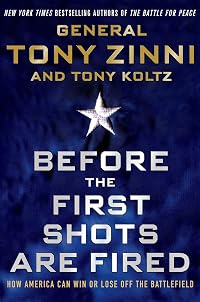
Before the First Shots Are Fired: How America Can Win Or Lose Off The Battlefield
by Tony Zinni
On This Page
Description
"The New York Times bestselling author of The Battle for Peace and retired Four-Star General Tony Zinni examines how America's "military first," view of foreign policy continues to embroil our troops in unwinnable wars"--Tags
Recommendations

















Member Reviews
You know that saying that, to a child with a hammer, all the world looks like a nail? General Tony Zinni, USArmy (Ret.) has convinced me that, to a man who’s spent his whole adult life in the military, all the world looks like a war — or something best solved by war. That’s a great disappointment. I requested the book because the subtitle, “How America Can Win or Lose Off the Battlefield,” and the synopsis from the publisher led me to believe that General Zinni might have a vision to offer of solving the problems of the world without resort to arms. What the book offers instead of that vision is a detailed memoir and justification of Gen. Zinni’s role — always able to see what should have been done but never in a position show more or given the resources to do it — in USAmerica’s military ventures from Vietnam through Afghanistan.
He is most directly critical of George W. Bush’s administration and quite baldly accuses Vice President Cheney of lying to the American people about the reasons for invading Iraq. Zinni is also highly critical of President Obama’s policies and performance, though he seems to know no more than I do about how decisions have actually been made in the Obama White House. He settles for reading the most damaging conclusions possible into the photos we’ve all seen of the gathering in the Situation Room as Osama bin Laden was hunted down, and criticizes the President for robbing John Kerry of his rightful role in settling the initial crisis of Russia’s annexation of Crimea.
Perhaps he's sympathetic to Kerry because of Kerry's military background. Gen. Zinni names many other military figures, usually with a summary of their backgrounds and almost always with information about when Zinni worked with him and what he thought of him. He blatantly idolizes Gen. George Marshall. I can’t think of any women mentioned in any kind of leadership context, though he does speak at least once of the extra burden placed on commanders to integrate women and out gays into their units.
I guess that's my other great disappointment in the book: It's all about the brass, and almost not at all about the troops who do the fighting. They seem to be just another weapon to be used more or less effectively by the officers. He complains about 'taking America to the battlefield' for the comfort of the troops "at ease," and seems to blame the speed with which they jet home from combat for the epidemic of post-traumatic stress disorders. He says Presidents who've never been shot at lack a visceral understanding of what they ask of the troops, or maybe what they ask of the generals. He demonstrates no identification himself with the experience of being shot at. His comments on the most recent uses of National Guard and Reserve troops are hardly more sympathetic.
There is a brief moment in chapter two, in the context of the invasion of Iraq, when Zinni toys with questioning why it’s so easy to respond with military force, why we didn’t deal with al Qaeda and Afghanistan more directly and first, why we didn’t look to other injustices and threats in the world. He criticizes politicians — and generals — who never met an intervention they didn’t like. But he acknowledges that having the most powerful military in the world is its own temptation to use it.
I guess I'm glad to have had a reason to read a book by a General, though I never would have bought it or sought it out for any other reason. I am a pacifist, and it's always good to see things from another perspective. But General Zinni seems to accept that there will always come a crisis, and a time in each crisis, when resolution will depend on shots being fired, and fired by USAmerica’s military. And because of that certainty, we will be required to maintain the largest, most powerful military force on the planet. And we will want to use it. General Zinni spent his finest years as a “combat commander,” whether or not there was active combat in his area. And he is quite clear that he knows how to fight future wars, and construct future pauses in war and geographical shifts in where the war is, more efficiently and effectively than we’ve done at least since “the good war” of the 1940s. I was really hoping he might have seen an entirely different way for the world to run. show less
He is most directly critical of George W. Bush’s administration and quite baldly accuses Vice President Cheney of lying to the American people about the reasons for invading Iraq. Zinni is also highly critical of President Obama’s policies and performance, though he seems to know no more than I do about how decisions have actually been made in the Obama White House. He settles for reading the most damaging conclusions possible into the photos we’ve all seen of the gathering in the Situation Room as Osama bin Laden was hunted down, and criticizes the President for robbing John Kerry of his rightful role in settling the initial crisis of Russia’s annexation of Crimea.
Perhaps he's sympathetic to Kerry because of Kerry's military background. Gen. Zinni names many other military figures, usually with a summary of their backgrounds and almost always with information about when Zinni worked with him and what he thought of him. He blatantly idolizes Gen. George Marshall. I can’t think of any women mentioned in any kind of leadership context, though he does speak at least once of the extra burden placed on commanders to integrate women and out gays into their units.
I guess that's my other great disappointment in the book: It's all about the brass, and almost not at all about the troops who do the fighting. They seem to be just another weapon to be used more or less effectively by the officers. He complains about 'taking America to the battlefield' for the comfort of the troops "at ease," and seems to blame the speed with which they jet home from combat for the epidemic of post-traumatic stress disorders. He says Presidents who've never been shot at lack a visceral understanding of what they ask of the troops, or maybe what they ask of the generals. He demonstrates no identification himself with the experience of being shot at. His comments on the most recent uses of National Guard and Reserve troops are hardly more sympathetic.
There is a brief moment in chapter two, in the context of the invasion of Iraq, when Zinni toys with questioning why it’s so easy to respond with military force, why we didn’t deal with al Qaeda and Afghanistan more directly and first, why we didn’t look to other injustices and threats in the world. He criticizes politicians — and generals — who never met an intervention they didn’t like. But he acknowledges that having the most powerful military in the world is its own temptation to use it.
I guess I'm glad to have had a reason to read a book by a General, though I never would have bought it or sought it out for any other reason. I am a pacifist, and it's always good to see things from another perspective. But General Zinni seems to accept that there will always come a crisis, and a time in each crisis, when resolution will depend on shots being fired, and fired by USAmerica’s military. And because of that certainty, we will be required to maintain the largest, most powerful military force on the planet. And we will want to use it. General Zinni spent his finest years as a “combat commander,” whether or not there was active combat in his area. And he is quite clear that he knows how to fight future wars, and construct future pauses in war and geographical shifts in where the war is, more efficiently and effectively than we’ve done at least since “the good war” of the 1940s. I was really hoping he might have seen an entirely different way for the world to run. show less
 This review was written for LibraryThing Early Reviewers.
General Zinni brings decades of experience leading military operations and conducting diplomacy to this informal yet informed discussion of U.S. foreign policy and national security strategy.
He covers many important points; one of which (referenced several times) concerns the the necessary ties between the political goals of a war and the manner in which the war is fought. This means that political leaders need to be deeply involved in leading and managing a war; they cannot just have a few high level conversations, make a few decisions, and call it a day. Zinni repeatedly criticizes "dilettantes placed [in high positions] who do not have the depth of knowledge or experience to make sound military decisions or offer credible show more recommendations" (p. 19). He offers the leadership of the Pentagon under Rumsfeld as a prime example.
Zinni's straightforward and unpretentious style sometimes blends over into platitudes but the book largely succeeds in presenting an accessible window into some of the failures of national security policymaking over the past few decades. show less
He covers many important points; one of which (referenced several times) concerns the the necessary ties between the political goals of a war and the manner in which the war is fought. This means that political leaders need to be deeply involved in leading and managing a war; they cannot just have a few high level conversations, make a few decisions, and call it a day. Zinni repeatedly criticizes "dilettantes placed [in high positions] who do not have the depth of knowledge or experience to make sound military decisions or offer credible show more recommendations" (p. 19). He offers the leadership of the Pentagon under Rumsfeld as a prime example.
Zinni's straightforward and unpretentious style sometimes blends over into platitudes but the book largely succeeds in presenting an accessible window into some of the failures of national security policymaking over the past few decades. show less
This review was written for LibraryThing Early Reviewers.A delicate takedown of the mismanagement of the military, published years after it would have been useful. I understand why it would have been difficult for Zinni to come forward about his misgivings before the invasion of Iraq, and appreciate that he is evenhanded in this book without pussyfooting around the fact that the Bush administration willfully ignored intelligence when it made the case for invasion, but at this point those of us who suspected the war would be a disaster have been vindicated by the facts, and those who still think the invasion was a good idea are not going to be convinced otherwise by a book like this.
While Zinni's overall points are excellent, and his ability to support them with his long experience in the show more military is a boon, I did not feel like I learned anything particularly new when reading. That said, the book is a strong case for reform on the civilian end of the US's wars, and a collection of insights that I can only hope will be heeded by our leaders in the future. show less
While Zinni's overall points are excellent, and his ability to support them with his long experience in the show more military is a boon, I did not feel like I learned anything particularly new when reading. That said, the book is a strong case for reform on the civilian end of the US's wars, and a collection of insights that I can only hope will be heeded by our leaders in the future. show less
This review was written for LibraryThing Early Reviewers.I enjoyed this book. General Zinni writes in a way that causes you to step back and think. Personally I think that there are rarely easy answers to military questions. However, I think this book helps frame some of the big questions around military action. Whether you agree or disagree with American military policy as it stands or with General Zinni's perspective, this book will have you pondering the big questions. That is part of what I like about this book, I have to engage with it. There is a bit of redundancy which can be off-putting, however, perhaps that is needed to drive a point home. This is readable in sections which also makes it easy to travel with and enjoy.
This review was written for LibraryThing Early Reviewers.You have just been sitting through a PowerPoint presentation and almost everyone is leaving the room. You notice that the one attendee with the large stack of folders is still organizing and placing the folders in his briefcase. You offer to help and an informal conversation starts. You recognize that you are about to hear an open and frank analysis of what really just took place.
If you have ever had this experience, you can imagine if the conversation was with one of the most honored and knowledgeable experts in strategic military and geo-political affairs.
"Before the First Shots are Fired" is a kind of record of a memorable conversation like that.
With this book, you are privy to a real insider analysis of United States military show more actions up to the present time. Retired General Tony Zinni with the help of Tony Koltz, shares a series of thoughts about our broad military strategy and the well recognized names of the military and civilian leadership at the highest levels.
Frustrations with civilian leadership limiting the early input from military expertise is one of the themes through the book. Military emphasis on highly detailed technical and logistical planning is not partnered with the same level of planning from the civilian leadership. Interestingly, the book recognizes the cultural factors from the military perspective that are not emphasized sufficiently from the civilian leaders.
The book is indeed written in a conversational manner even when looking deeply into strategic areas. Contemporary challenges are smoothly put into historical perspective.
If you are tired of the five minute cable news "analysis" and instead prefer a deeper but understandable look behind the scenes of our military role and strategic planning, this book makes a great read. show less
If you have ever had this experience, you can imagine if the conversation was with one of the most honored and knowledgeable experts in strategic military and geo-political affairs.
"Before the First Shots are Fired" is a kind of record of a memorable conversation like that.
With this book, you are privy to a real insider analysis of United States military show more actions up to the present time. Retired General Tony Zinni with the help of Tony Koltz, shares a series of thoughts about our broad military strategy and the well recognized names of the military and civilian leadership at the highest levels.
Frustrations with civilian leadership limiting the early input from military expertise is one of the themes through the book. Military emphasis on highly detailed technical and logistical planning is not partnered with the same level of planning from the civilian leadership. Interestingly, the book recognizes the cultural factors from the military perspective that are not emphasized sufficiently from the civilian leaders.
The book is indeed written in a conversational manner even when looking deeply into strategic areas. Contemporary challenges are smoothly put into historical perspective.
If you are tired of the five minute cable news "analysis" and instead prefer a deeper but understandable look behind the scenes of our military role and strategic planning, this book makes a great read. show less
This review was written for LibraryThing Early Reviewers.World wars are very different from regional conflicts. General Zinni's worldview is shaped by his experience in Vietnam and he traces the US military transition from a big war mentality to the current fighting in the mIddle east. His book provides a perspective on the relationship between Commanders in Chief, the Congress, and top military leadership. The General gives Clinton good marks for the detail he seeks when considering military actions, Bush-Cheney lower marks (or grudging respect) for outmaneuvering Congress on debate prior to the Iraq war declaration, and dismisses Obama politely for his approach to drawing red lines in Syria.
Before the First Shots concisely states the problem but doesn't offer much in the way of answers. show more Still, it is a good read from one of the major players in this key area of the world. show less
Before the First Shots concisely states the problem but doesn't offer much in the way of answers. show more Still, it is a good read from one of the major players in this key area of the world. show less
This review was written for LibraryThing Early Reviewers.I have to say this book really makes you think about the wars that have happened and the wars to come. It opens the layperson's eyes to what needs to be done and who should be doing it. I am not usually interested in military reads but I am trying to read different things and I am really glad I read this one. "Before the First Shots are Fired" is a great read and one that really gets you asking questions. General Zinni is a man with decades of experience and it shows. You can relate to him even though he is political and military. I will definitely suggest this book for anyone to read.
This review was written for LibraryThing Early Reviewers.Members
- Recently Added By
Published Reviews
ThingScore 25
A pacifist's take on a General's view of the world and the necessity of war.
added by bkswrites
Lists

2014 to read.
20 works; 1 member
Author Information

3+ Works 170 Members
General Tony Zinni was Commander in Chief of CENTCOM and special envoy to the Middle East
Classifications
Statistics
- Members
- 53
- Popularity
- 575,475
- Reviews
- 17
- Rating
- (3.72)
- Languages
- English
- Media
- Paper, Ebook
- ISBNs
- 3
- ASINs
- 1