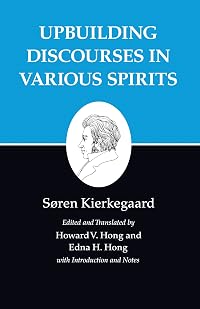
Upbuilding discourses in various spirits
by Søren Kierkegaard
68 Members (4.00)
On This Page
Description
In his praise for Part I of Upbuilding Discourses in Various Spirits, the eminent Kierkegaard scholar Eduard Geismar said, "I am of the opinion that nothing of what he has written is to such a degree before the face of God. Anyone who really wants to understand Kierkegaard does well to begin with it." These discourses, composed after Kierkegaard had initially intended to end his public writing career, constitute the first work of his "second authorship." Characterized by Kierkegaard as show more ethical-ironic, Part One, on the theme of "Purity of Heart Is to Will One Thing," offers a penetrating discussion of double-mindedness and ethical integrity; the irony lies in the relation between factuality and ideality. Part Two, "What We Learn from the Lilies in the Field and from the Birds of the Air," is humorous for Kierkegaard in that it exposes an inverted qualitative difference between the learner and the teacher. In Part Three, "The Gospel of Sufferings, Christian Discourses," the philosopher explores the theme of joy, as in "The Joy of It That the School of Sufferings Educates for Eternity." show lessTags
Recommendations











Member Reviews
Members
- Recently Added By
Author Information

635+ Works 33,263 Members
Born in Copenhagen, Denmark, Søren Kierkegaard was the son of a wealthy middle-class merchant. He lived all his life on his inheritance, using it to finance his literary career. He studied theology at the University of Copenhagen, completing a master's thesis in 1841 on the topic of irony in Socrates. At about this time, he became engaged to a show more woman he loved, but he broke the engagement when he decided that God had destined him not to marry. The years 1841 to 1846 were a period of intense literary activity for Kierkegaard, in which he produced his "authorship," a series of writings of varying forms published under a series of fantastic pseudonyms. Parallel to these, he wrote a series of shorter Edifying Discourses, quasi-sermons published under his own name. As he later interpreted it in the posthumously published Point of View for My Work as an Author, the authorship was a systematic attempt to raise the question of what it means to be a Christian. Kierkegaard was persuaded that in his time people took the meaning of the Christian life for granted, allowing all kinds of worldly and pagan ways of thinking and living to pass for Christian. He applied this analysis especially to the speculative philosophy of German idealism. After 1846, Kierkegaard continued to write, publishing most works under his own name. Within Denmark he was isolated and often despised, a man whose writings had little impact in his own day or for a long time afterward. They were translated into German early in the twentieth century and have had an enormous influence since then, on both Christian theology and the existentialist tradition in philosophy. (Bowker Author Biography) show less
Series
Belongs to Publisher Series
Common Knowledge
- Original title
- Opbyggelige Taler i forskjellig Aand
Classifications
- Genres
- Philosophy, Nonfiction, Religion & Spirituality, General Nonfiction
- DDC/MDS
- 198.9 — Philosophy & psychology Modern western philosophy Philosophy of Scandinavia and Finland Denmark
- LCC
- BV4505 .K4613 — Philosophy, Psychology and Religion Practical Theology Practical Theology Practical religion. The Christian life
- BISAC
Statistics
- Members
- 68
- Popularity
- 449,631
- Rating
- (4.00)
- Languages
- English
- Media
- Paper, Ebook
- ISBNs
- 3
- ASINs
- 1