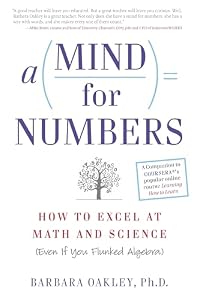
A Mind for Numbers: How to Excel at Math and Science (Even If You Flunked Algebra)
by Barbara Oakley PhD
On This Page
Description
The companion book to COURSERA®'s wildly popular massive open online course "Learning How to Learn"Whether you are a student struggling to fulfill a math or science requirement, or you are embarking on a career change that requires a new skill set, A Mind for Numbers offers the tools you need to get a better grasp of that intimidating material. Engineering professor Barbara Oakley knows firsthand how it feels to struggle with math. She flunked her way through high school math and science show more courses, before enlisting in the army immediately after graduation. When she saw how her lack of mathematical and technical savvy severely limited her options—both to rise in the military and to explore other careers—she returned to school with a newfound determination to re-tool her brain to master the very subjects that had given her so much trouble throughout her entire life.
In A Mind for Numbers, Dr. Oakley lets us in on the secrets to learning effectively—secrets that even dedicated and successful students wish they’d known earlier. Contrary to popular belief, math requires creative, as well as analytical, thinking. Most people think that there’s only one way to do a problem, when in actuality, there are often a number of different solutions—you just need the creativity to see them. For example, there are more than three hundred different known proofs of the Pythagorean Theorem. In short, studying a problem in a laser-focused way until you reach a solution is not an effective way to learn. Rather, it involves taking the time to step away from a problem and allow the more relaxed and creative part of the brain to take over. The learning strategies in this book apply not only to math and science, but to any subject in which we struggle. We all have what it takes to excel in areas that don't seem to come naturally to us at first, and learning them does not have to be as painful as we might think. show less
Tags
Recommendations
Member Reviews
The information in the book isn't necessarily revelatory. In fact, most of us have learned it in some form or another, but it's the way Dr. Oakley lays it out, and supports the claims with evidence, that makes this book important. The book is also accessible to everyone. Instead of presenting in complicated terms, it cuts right to the point in clear language.
I really appreciate that the author was just as tormented and terrified of math in school as many of us were. Seeing her come to love matg, and have multiple engineering and science degrees, adds weight to the techniques she presents. I wish every math/science teacher (especially middle and high school) would read this book.
I really appreciate that the author was just as tormented and terrified of math in school as many of us were. Seeing her come to love matg, and have multiple engineering and science degrees, adds weight to the techniques she presents. I wish every math/science teacher (especially middle and high school) would read this book.
A Mind for Numbers: How to Excel at Math and Science (Even if You Flunked Algebra) by Barbara Oakley, Ph.D. reaches far beyond math and science and even beyond learning. Oakley explores techniques for learning more efficiently and deeply based on her own experience overcoming her difficulty learning math. A Mind for Numbers explores the importance of focused mode and diffused mode in the learning process and how the two support one another in the learning process. Oakley delves into how our brains chunks material for deeper learning. She addresses procrastination, reasons for procrastination, why procrastination is unavoidable, and tips to effectively address procrastination using techniques that allow us to give focused attention to show more priority tasks and use diffuse mode by switching tasks. I recognized several techniques that I employed during my college years and even some that had worked their way into my writing routine though I'd never thought of them as techniques in quite the way she described them. As I read through the book, I saw ways I could use the techniques in the book to improve my research as well as my writing. A Mind for Numbers is a very interesting exploration of the way the brain works and how to more effectively be productive whether studying or working. A Mind for Numbers is a well written, easy to understand, inspiring book of insights into not only the process of learning but the process of being more effective in any endeavor that requires focused attention, time to think, and expansion of one's knowledge base. show less
The is the second book by Professor Oakley that I’ve read (the other is “Mindshift”)…I read this one after Mindshift, having heard about that one first, leading to reading this book.
I can’t say enough about how valuable this book may be for learners (even if you are like me, even in my 60’s and semi-retired, I still consider myself a learner). I realize that all techniques mentioned here might not work for all people, but the fact is, she reveals what much of research is showing about ways we learn, and how that research often contrasts with many learning techniques people use today (which may be preventing them from learning). I used her analogy in one chapter to quickly learn the 5 layers of the human skin by use of a show more “route” through my house…I’ve gone around a couple days now reciting them to my wife, to strange looks…but I’ve got them down…
The author talks about test-taking techniques – I’d always been told and believed that when taking a test, you should find the easiest problems first, do them, then go on to the toughest…she disputes this method. For some of us, doing the easiest ones first might work, especially if we never freeze on the tougher ones and really know the material enough to breeze through them…but for many test takers, they are easily stumped by the tougher ones and have spent energy (and perhaps allowed more stress to build fearing what’s to come) by doing the easier ones, only to freeze on the tough ones. She says that by going immediately to the tough ones for a short period, a minute or two (and shifting to some easy ones if you are really stumped after trying the toughest), your brain can be allowed to sub-consciously be working on a solution for the tough ones while you do easy ones…then shift back to tough ones and your brain may have worked in the background to solve the tougher ones, or at least make progress on them). If brain science/research is what she says, that technique theoretically should work.
In one of the last chapters, she recaps the 10 best study techniques and the 10 worst. A mine of gold is in those lists. And, how I wish I’d had those lists when in college.
The book is substantially aimed at college level learning…but some of the techniques can clearly work for high school and probably lower levels as well…some would have to be adapted to the situation, and some could not. But I enjoyed both books immensely, so much so that I bought a copy of this one (read the library’s copy first) and am giving it to my high school senior granddaughter…to help in her final year, but hopefully see her learn these techniques now in preparation for next year’s college start. The book will also be helpful to my high school junior granddaughter… show less
I can’t say enough about how valuable this book may be for learners (even if you are like me, even in my 60’s and semi-retired, I still consider myself a learner). I realize that all techniques mentioned here might not work for all people, but the fact is, she reveals what much of research is showing about ways we learn, and how that research often contrasts with many learning techniques people use today (which may be preventing them from learning). I used her analogy in one chapter to quickly learn the 5 layers of the human skin by use of a show more “route” through my house…I’ve gone around a couple days now reciting them to my wife, to strange looks…but I’ve got them down…
The author talks about test-taking techniques – I’d always been told and believed that when taking a test, you should find the easiest problems first, do them, then go on to the toughest…she disputes this method. For some of us, doing the easiest ones first might work, especially if we never freeze on the tougher ones and really know the material enough to breeze through them…but for many test takers, they are easily stumped by the tougher ones and have spent energy (and perhaps allowed more stress to build fearing what’s to come) by doing the easier ones, only to freeze on the tough ones. She says that by going immediately to the tough ones for a short period, a minute or two (and shifting to some easy ones if you are really stumped after trying the toughest), your brain can be allowed to sub-consciously be working on a solution for the tough ones while you do easy ones…then shift back to tough ones and your brain may have worked in the background to solve the tougher ones, or at least make progress on them). If brain science/research is what she says, that technique theoretically should work.
In one of the last chapters, she recaps the 10 best study techniques and the 10 worst. A mine of gold is in those lists. And, how I wish I’d had those lists when in college.
The book is substantially aimed at college level learning…but some of the techniques can clearly work for high school and probably lower levels as well…some would have to be adapted to the situation, and some could not. But I enjoyed both books immensely, so much so that I bought a copy of this one (read the library’s copy first) and am giving it to my high school senior granddaughter…to help in her final year, but hopefully see her learn these techniques now in preparation for next year’s college start. The book will also be helpful to my high school junior granddaughter… show less
I've just finished up the Coursera class "Learning How To Learn," taught by Barbara Oakley, who recommended her book during the course. Interestingly, it's almost like reading a transcript of that course, sometimes repeating entire paragraphs word-for-word. The major premise is to teach people a few tricks to "excel in math and science" -- liberal arts majors may also find some good ideas, but it's more for high school or college students in courses that have lots of problem sets. What's most interesting is not the techniques (like the twenty-five minute Pomodoro method, or the "memory palace" memorization concept) but the reasons -- usually distilled from major scientific studies in a relaxed, often funny, tone -- on why certain things show more work and why some things don't. Unfortunately, different things work for different people, and so after reading a few of these study tips, it starts to feel like "just try anything that works." But if you're in the target group, need to get your study habits in shape, and don't know where to start, this is a strong resource.
(I only audited the "Learning How To Learn" class, as Coursera seems to be removing the free "Statement of Accomplishment" option, and I did not feel the course offered enough for the fee-based "Verified Certificate.")
----------------------
LT Haiku:
Rhyme and reason for
hacking your mind to excel
at math and science. show less
(I only audited the "Learning How To Learn" class, as Coursera seems to be removing the free "Statement of Accomplishment" option, and I did not feel the course offered enough for the fee-based "Verified Certificate.")
----------------------
LT Haiku:
Rhyme and reason for
hacking your mind to excel
at math and science. show less
The best practical guide for how to succeed at technical subjects that I've seen (and I've read a fair amount on this subject). Research backed, including lots of stuff I've read elsewhere, but condensed down to solid, practical advice with just a bit of research backstory (many of the other books I've read go into greater detail on the research methodologies, which is great but not really what you care about when you're actively struggling with learning tricky algorithms or writing tough proofs and trying to figure out what you can do to get better).
I'd recommend this to anyone studying Math, Computer Science, Physics, or other technical subjects (and have been actively recommending it to my coding bootcamp students). The book focuses show more on math, but the techniques apply elsewhere. show less
I'd recommend this to anyone studying Math, Computer Science, Physics, or other technical subjects (and have been actively recommending it to my coding bootcamp students). The book focuses show more on math, but the techniques apply elsewhere. show less
I read this book as a companion to the Coursera course "Learning How to Learn," which is taught by the author and is, in fact, nearly identical to the book. But for once I wouldn't brush it off as unnecessarily repetitive; in fact, I'd recommend both the video lecture-based course and the book together. Reading the book really helped drive home some of the key points from the lectures by actually putting them into practice. Spaced repetition and recall - reviewing material some time after you've learned it - are easy to do when the book and lectures are covering the exact same material, but you're a little behind in the book where you are in the lectures, and vice versa. Oakley also recommends trying to recall the material in a show more different setting than you originally learned it, to build flexibility into your understanding - easy to do when I was watching the lectures at home on my computer and reading the book at work over lunch.
I'm not in school any more, but I've been trying to improve my math skills (I got good grades in school by avoiding math wherever possible), and this book & course have offered me some useful techniques for learning, partially just by making it clear what I was already doing instinctively to learn things that come easily to me. Now that I know what those things are, it should be easier to apply them in situations where I have to stretch myself a little more. show less
I'm not in school any more, but I've been trying to improve my math skills (I got good grades in school by avoiding math wherever possible), and this book & course have offered me some useful techniques for learning, partially just by making it clear what I was already doing instinctively to learn things that come easily to me. Now that I know what those things are, it should be easier to apply them in situations where I have to stretch myself a little more. show less
Like most readers, I stumbled upon this book after taking Barbara Oakley's Learning How to Learn Course in Coursera.
This book reinforces the concepts taught in that course. The idea of relaxed learning, giving ourselves plenty of time while learning difficult concepts, avoiding procrastination, and tools that help us avoid the procrastination. The idea of repetition for remembering different concepts is presented and stressed well this book.
The importance of sleep for learning stayed with me and changed me when I took the course based on this book. I never discount sleep for important exams or deadlines now.
The crux of learning is expressed well by this quote from Santiago Ramón y Cajal introduced to us in this book
What a wonderful show more stimulant it would be for the beginner if his instructor, instead of amazing and dismaying him with the sublimity of great past achievements, would reveal instead the origin of each scientific discovery, the series of errors and missteps that preceded it - information that, from a human perspective, is essential to an accurate explanation of discovery. - Santiago Ramón y Cajal show less
This book reinforces the concepts taught in that course. The idea of relaxed learning, giving ourselves plenty of time while learning difficult concepts, avoiding procrastination, and tools that help us avoid the procrastination. The idea of repetition for remembering different concepts is presented and stressed well this book.
The importance of sleep for learning stayed with me and changed me when I took the course based on this book. I never discount sleep for important exams or deadlines now.
The crux of learning is expressed well by this quote from Santiago Ramón y Cajal introduced to us in this book
What a wonderful show more stimulant it would be for the beginner if his instructor, instead of amazing and dismaying him with the sublimity of great past achievements, would reveal instead the origin of each scientific discovery, the series of errors and missteps that preceded it - information that, from a human perspective, is essential to an accurate explanation of discovery. - Santiago Ramón y Cajal show less
Members
- Recently Added By
Lists

Non-Fiction Worth Reading
1,015 works; 260 members

Top Five Books of 2015
811 works; 240 members

Mind Expanding Books by hackerkid
581 works; 8 members

Biblioteca de não ficção
41 works; 1 member
Author Information

20 Works 2,537 Members
Barbara Oakley, Ph.D., is a professor of engineering at Oakland University and a Fellow of the American Institute for Medical and Biological Engineering.
All Editions
Awards and Honors
Common Knowledge
- People/Characters
- Solomon Shereshevsky; Thomas Edison; Salvador Dalí; Magnus Carlsen; Roger Bannister; Joshua Foer (show all 11); Santiago Ramón y Cajal; Richard Feynman; William Kamkwamba; Niels Bohr; Ben Carson
- Epigraph
- The Law of Serendipity: Lady Luck favors the one who tries
- Dedication
- A Mind for Numbers is dedicated to Dr. Richard Felder, whose brilliance and passion have launched extraordinary improvements worldwide in the teaching of science, mathematics, engineering, and technology. My own succes... (show all)ses, like those of tens of thousands of other educators, grow out of his fertile educational approaches. Il miglior maestro.
- First words
- [note to the reader] People who work professionally with math and science often spend years discovering effective learning techniques.
[Chapter 1] What are the odds you'd open your refrigerator door and find a zombie in there, knitting socks? - Last words
- (Click to show. Warning: May contain spoilers.)If you don't get a good sleep before a test, NOTHING ELSE YOU HAVE DONE WILL MATTER.
Classifications
Statistics
- Members
- 1,461
- Popularity
- 15,883
- Reviews
- 24
- Rating
- (3.91)
- Languages
- 6 — Chinese, English, German, Portuguese, Spanish, Turkish
- Media
- Paper, Audiobook, Ebook
- ISBNs
- 12
- UPCs
- 1
- ASINs
- 5