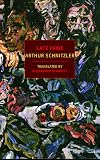
Late Fame
by Arthur Schnitzler
On This Page
Description
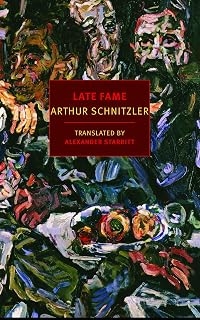
"An NYRB Classics Original One seemingly ordinary evening, Eduard Saxberger arrives home to find the fulfillment of a long-forgotten wish in his sitting room: A visitor has come to tell him that the youth of Vienna have discovered his poetic genius. Saxberger has written nothing for thirty years, yet he now realizes that he is more than merely an Unremarkable Civil Servant after all: He's a Venerable Poet for whom Late Fame is inevitable--if, that is, his new acolytes are to be believed. show more Arthur Schnitzler was one of the most admired, provocative European writers of the twentieth century. The Nazis attempted to burn all of his work, but his archive was miraculously saved, and with it, Late Fame. Never published before, it is a treasure, a perfect satire of literary self-regard and charlatanism"-- show lessTags
Recommendations























Member Reviews
Back in the late seventies, Masterpiece Theatre "did" a bunch of Schnitzler's stories which I found haunting and marvelous. (After seeing the program I went and read the stories). He was Viennese and mainly wrote between the 1880's and his death in 1931. This novella is about a man, Eduard Saxberger, now in his late sixties who is "discovered" by a small group of young writers who call themselves "The Enthusiasts". He wrote one book of poetry called "Wanderings" in his twenties and then gave up poetry and took a job in the civil service. He has led a quiet and uneventful and not unhappy life, although, maybe yes, something has been missing . . . This sudden recognition awakens dormant feelings and ideas, long ago set aside and buried. show more The group settle on having a recital, and want him to write a new poem, when he fails to do this (not without trying) they agree that someone else can read some of his published poems. The timing is somewhat vague, but let us say it all transpires in that time of late winter to early spring, maybe six weeks. The novella explores the sources of contentment and discontentment, of envy and disillusion, of sensitivity and callousness (especially in artists!) -- and, as is written in the afterward, the uncomfortable gap between the creative and the "bourgeois" life. While the novella is rather harsh about the egotism of the young artists, and whiule you might think Schnitzler is showing that the life of the straightforward bourgeois is preferable to the foolish delusions of writers, there is great compassion too for this desire that the young have to create something of beauty and value -- and don't have the determination or talent with which to succeed in the end. I was left with the sense that Schnitzler didn't think it foolish at all to try, but that so few would succeed and that recognizing your limitations is not the worst thing. A lovely novella -- deceptively quiet. **** show less
Although Schnitzler patterned the Enthusiasm literary circle, populated by vain mediocrities, after literary acquaintances of his in Vienna in the 1880s, their behaviors and exchanges ring true today separated by 140 years and 4000 miles. One cannot help but see the empty performances of "unappreciated geniuses" and the backbiting among the Enthusiasts in social media today, and frankly in academia as well.
The Contrast
‘How happy am I,’ in her quiet voice,
She murmurs. ‘So am I,’ he says – more loud.
‘Your pretty ways make me so proud –
I’m glad I made so good a choice.’
— Frederike Kempner Poems, 1852
A Nasty Piece of Work
By mass-consensus, the worst poet of the German language in the 19th-century was known as "The Silesian Swan". Frederike Kempner (1828 – 1904) was this minor poet and major subject of so-called "involuntary humor". She was in her life also known as an advocate against "solitary confinement". One wonders about the relation between those terms. The last version of her collected poems (Gedichte, 1852) includes a series of prefaces in which the author can be observed addressing — over the years — her show more experience being what would come to be known in modern parlance, though in language no less dated, as a "lolcow". In the year of her death even one such as Freud still thought her work good grist, "Beyond doubt, it is the inadequacy of these ‘poems’ that makes them comical – the quite extraordinary clumsiness of their mode of expression, tied as it is to the most commonplace phrases or journalistic clichés, the simplistic limitation of her thoughts, the absence of any trace of poetic thought or language" (Freud, The Joke and its Relation to the Unconscious, 1905). Cliché in healthy profusion, the rut of bad poetry certainly. Kempner, however, is no longer a laughingstock. Time has taken the salt out of the critic, and not merely because one no longer reads verse. We are tired, sometimes, of poetry always being good. Musicians who felt the same, whose feeling so obviously exceeded their technical ability, were once known as punk. At their most expressive, such recordings were hardly music in the technical sense. Likewise, Kempner is one who has written mostly noise. Her poems are totally out of accord, an untuned guitar just piping in feedback. Earnestness never approaches its right expression. Though it seems that precisely by "inadequacy" and "clumsiness" Kepmner's poetry shows how close verse can get — and it is yet a far distance — from communicating sincerity without expression. The quatrain from The Contrast (1852) in which a couple discuss their marriage as if it were an item at the grocery, "I’m glad I made so good a choice," is only a petit bourgeois interior, which nonetheless resonates with uncountable avenues not taken.
One imagines an alternative history: Kempner as the chief character of Late Fame (1894), author of The Wanderings (1853). Unrecognized until old age, when a young man introduces himself as an admirer of her verse, the question remains: is this a humorous situation. Perhaps not so much. Kempner is earnest in a way the chief character of Late Fame (1894) is not. He has given up from weakness and become a different person. But having given up, he wishes, in retrospect, not to have done so. This one supposes is the humorous element. He is a civil servant with pretentions; same as all the others precisely because he sets himself apart. His one book of poetry has already made him ridiculous. No chance to have written past the juvenilia. And the possibility of having been brilliant from a blank slate — which he is not — and then to have forgotten, this only makes him more ridiculous. The agèd poet refuses to write, initially out of false modesty, but subsequently because he finds that he cannot do it. One might observe a man who hasn't written a line forty years finding himself thrown back into the worst "clumsiness" and " journalistic cliché".
"An old man . . . forgotten . . . forgotten . . . lying in a dream . . . dreamt . . . I’ve awoken . . . forgotten . . . dreamt Forgotten . . . then the young generation came . . . they brought me the wreath . . . No, no, that wouldn’t do at all. That bit about the wreath was ludicrous. And he asked himself: so, what did the young people do? . . . the young . . . they came, they bent their knee . . . and the old man awoke . . . he awoke from a dream . . . I was dreaming . . . I dreamt my life . . . yes, that was good, it had to be taken on from there: that he had actually dreamt his life. But how to go on? . . . Always the same words again . . . a dreamt life, a dreamt life . . . and he could not get past them (30)."The question remains, then, why the chief character of Late Fame (1894) doesn't do what Kempner does. Faced with so-called "writer's block", she re-issues her old poems — with minor corrections! He doesn't do what tempts every writer in such circumstances, which is to begin plagiarizing himself. There is something wrong here. When everything else in Late Fame (1894) proceeds as if by the natural psychology of a civil servant, one wonders then what's stopping our chief character from polishing up an bit of old verse and re-issuing it as the genuine article. There is a bar which cuts across the psychology of the text. What is not permitted for him, it seems, is to detract, even by farce, from the intended object of derision, which is Viennese young artists.
There is, from the start, a nastiness in the construction of Late Fame (1894). Certainly one senses it's a somewhat flimsy set-up for a laugh at someone's expense. The reader's experience almost that of Damocles, who perceives the mechanism from which the chief character suspended. There is a more brief and perhaps more elegant plot I have in mind, in which the clerk meets his end at the first meeting of the coffeehouse crew. Compelled to read his youthful verse and given to expect praise from new young friends, he is laughed out of the building. The story concludes much the same, complaining of sour grapes at The Pickled Pear. But this is not the objective of this text. Evidently, the chief character alone is not the sole object of ridicule, nor the psychology of the romantic-poet-turned-civil-servant, but he seems to contaminate everyone with whom he comes in contact. Those who praise him, not knowing what, join in the ridiculous venture. One might imagine the entire Viennese coffeehouse scene sent-up were his work, for one week, to take the populace by storm like a flash in the pan of mixed metaphor. It is precisely that coffeehouse group who come to life, not incidentally, but as portraits of specific persons to whom the text is dedicated: the writer-slash-actor turned grifter, the poet-turned-journalist, the slattern in the yellow overcoat, and those couple hangers-on, one who may in fact be a poet of secret talent and one perhaps who is narrowly the author himself.
It seems the chief character of Late Fame (1894) has been rationed only a certain quantity of interest, which distributions he must take piecemeal. Even his verse is circumscribed. One must do this for poetry that is certainly not very good, but even bad poetry, if transcribed, may be of interest. Were Kempner in his place, she could perhaps make better humor. Of the scenarios open to her, one imagines her plagiarizing old verse. Perhaps it is her own bad poetry in which she has no faith, but accepted! Perhaps it is someone else's good poetry, even unwittingly a famous verse, but accepted because it goes unrecognized! Perhaps it is someone else's good poetry, but rejected by bad taste! Perhaps it is her even very own poetry, but she has managed to compose something quite good despite herself, then what is one to make of all the praise she received for mediocrity. Had she managed any of the above, one might also take advantage of her knack for self-promotion. Kempner was, in retrospect, not so much a 19th century poet as a 21st century "influencer". She goes around to all the Viennese papers, playing one against the other, as Gogol's fraudster from Dead Souls (1842) put to work instead on dead column-inches, ultimately achieving sempiternal syndication, and so her work must be good since it's in all the papers. For one who has had these options closed to him, it is perhaps because he has been made meek, one poor of spirit. Or rather it is because has been led by the nose, trotted out to play his minor part, compelled to be ridiculous in a novella, and then, having not made "so good a choice", returned to his milieu from which one will hear nothing further, and so to be put to death in a manner of speaking, poor devil. show less
This book examines the inner world of a man who has lived his life, who has made compromises and is reconciled to them. He is fleetingly encouraged to think that his moment may not yet have passed when younger poets "discover" his early work, work written before he blended into mainstream humdrum struggle of simply living. We see you hopes for acknowledgement and his chagrin when he realizes that this spotlight , too, will be fleeting. Good character study, some interesting meditations on age. Short, easy read.
What is art?
This book doesn't answer the question, but it is an interesting way of asking it.
This book doesn't answer the question, but it is an interesting way of asking it.
Members
- Recently Added By
Lists

Lo mejor leído en 2025 - Leídos por primera vez: Magistrales (R. D.)
28 works; 1 member
Author Information

449+ Works 7,609 Members
Arthur Schnitzler, Viennese playwright, novelist, short story writer, and physician, was a sophisticated writer much in vogue in his time. He chose themes of an erotic, romantic, or social nature, expressed with clarity, irony, and subtle wit. Reigen, a series of ten dialogues linking people of various social classes through their physical desire show more for one another, has been filmed many times as La Ronde. As a Jew, Schnitzler was sensitive to the problems of anti-Semitism, which he explored in the play Professor Bernhardi (1913), seen in New York in a performance by the Vienna Burgtheater in 1968. Henry Hatfield calls Schnitzler "second only to Hofmannsthal among the Austrian writers of his generation and one of the most underrated of German authors... . He combined the naturalist's devotion to fact with the impressionist's interest in nuance; in other words, he told the truth" (Modern German Literature). In his most famous story, Lieutenant Gustl (1901), Schnitzler employs the stream-of-consciousness technique in an exposition of the follies and gradual disintegration of society in fin de siecle Vienna. Schnitzler has also been linked with Freud (see Vols. 3 and 5) and is credited with consciously introducing elements of modern psychology into his works. (Bowker Author Biography) show less
Some Editions
Awards and Honors
Distinctions
Series
Belongs to Publisher Series
Common Knowledge
- Canonical title
- Late Fame
- Original title
- Später Ruhm
- Original publication date
- 2014
- People/Characters*
- Eduard Saxberger
- Important places*
- Viena, Austria
- First words
- El señor Eduard Saxberger volvió de su paseo y subió lentamente las escaleras que conducían a su vivienda.
- Last words*
- (Click to show. Warning: May contain spoilers.)Y se sintió muy solo mientras iba a paso lento por las quietas calles.
- Original language
- Alemán; German
*Some information comes from Common Knowledge in other languages. Click "Edit" for more information.
Classifications
- Genres
- General Fiction, Fiction and Literature
- DDC/MDS
- 833.912 — Literature & rhetoric German & related literatures German fiction 1900- 1900-1990 1900-1945
- LCC
- PT2638 .N5 .S6313 — Language and Literature German, Dutch and Scandinavian literatures German literature Individual authors or works 1860/70-1960
- BISAC
Statistics
- Members
- 139
- Popularity
- 235,519
- Reviews
- 9
- Rating
- (3.69)
- Languages
- 7 — Dutch, English, Finnish, French, German, Italian, Spanish
- Media
- Paper, Audiobook, Ebook
- ISBNs
- 17
- ASINs
- 6