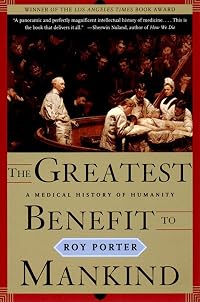
The Greatest Benefit to Mankind: A Medical History of Humanity from Antiquity to the Present
by Roy Porter
On This Page
Description
"Roy Porter explores medicine's evolution against the backdrop of the wider religious, scientific, philosophical, and political beliefs of the culture in which it develops, and he shows how our need to understand where diseases come from and what we can do to control them has - perhaps above all elseinspired developments in medicine through the ages. He charts the remarkable rise of modern medical science - the emergence of specialties such as anatomy, physiology, neurology, and bacteriology show more - as well as the accompanying development of wider medical practice at the bedside, in the hospital, and in the ambitious public health systems of the twentieth century. Along the way the book offers up a treasure trove of historical surprises: how the ancient Egyptians treated incipient baldness with a mixture of hippopotamus, lion, crocodile, goose, snake, and ibex fat; how a mystery epidemic devastated ancient Athens and brought an end to the domination of that great city: how lemons did as much as Nelson to defeat Napoleon: how yellow fever, carried by African mosquitoes to the Americas, led the French to fail utterly in their attempts to recover Haiti after the slave revolt of 1790: and how the explorers of the South Seas brought both syphilis to Tahiti and tuberculosis and measles to the Maoris."--Jacket. show lessTags
Recommendations

















Member Reviews
The defects of this book are many, but it would hurt to give it less than four stars and, the avoidance of pain being one of Porter's main themes, I will stick to a suitably thematic rating. There are delights aplenty to be mined in this compendious history, and a myriad reasons, if you still needed any, to fall down on your knees and give thanks that we live in an age of anaesthetic and antibiotics.
Things have certainly come a long way since – to pick an example almost at random from the early pages – doctors were recommending crocodile-dung pessaries as a form of contraception, as they were in Pharaonic Egypt. (Presumably they worked on the principle that they were a serious mood-killer.) And in general, you're left with a strong show more impression of quite how slow and painstaking progress has been: every basic drug and vitamin pill today, every vaccination and course of antibiotics, is founded on a centuries-long, incremental advance in knowledge that often took several steps backwards for every shuffle forwards.
In 1826, two Italians finally identify the pain-relieving element salicin in willow-bark; it's purified three years later by a French chemist; meanwhile, a Swiss pharmacist extracts a related substance from meadowsweet, and a German researcher uses it to obtain salicylic acid; Gerhardt works out its molecular structure in 1853, and Hoffmann finally synthesises it as acetylsalicylic acid which, in 1899, is renamed aspirin. Similar stories can be retailed for any other substance, and they give you an idea of the scale of knowledge that is being casually discarded by the sort of people who rail against "unnatural" chemicals.
Porter is at his best when he slows down long enough to make these narratives clear. When he fails to do so, the book can rattle through names and dates at a bit of a gallop – the chapters devoted to non-Western forms of medicine in particular, while welcome, seem especially cursory. Luckily, Porter has a great flair for making the kind of quick, thumbnail biographies that a book like this depends on – take, for instance, this potted story of one of the pioneers of dental anaesthesia:
In December 1844, the dentist Horace Wells (1815–48) went to a fair in Hartford, Connecticut, where ‘Professor’ Gardner Colton (1814–98) was giving an exhibition of ‘Exhilarating or Laughing Gas’. Curious whether it could be used for painless tooth extraction, Wells offered himself: Colton administered the gas while Dr John Riggs yanked out a molar. ‘A new era of tooth-pulling!’ Wells exclaimed, on coming round. Eager to exploit his breakthrough, he built a laughing-gas apparatus: a bellows with a tube stuck into the patient's mouth. Demonstrating it in the dentistry class of John C. Warren (1778–1856) at the Massachusetts General Hospital, he botched the procedure, however, and his patient suffered agony. Wells lost medical support, grew depressed, became addicted to chloroform and, after arrest in New York for hurling sulphuric acid at two prostitutes, committed suicide in jail.
Well, that escalated quickly…
Another theme that becomes clear is how far research is in advance of effective treatment. This is something we're familiar with today, when hardly a week seems to go by without another cancer breakthrough in mice or Alzheimer's regression in lab samples, yet seemingly without any practical results ever filtering through to humans in hospitals. Such has always been the case. Matthew Baillie was already complaining about it in the eighteenth century: ‘I know better perhaps than another man, from my knowledge of anatomy, how to discover disease, but when I have done so, I don't know better how to cure it.’ This sense of what Porter calls ‘medicine's Sisyphean strife’ is especially acute in the age of antibiotics, which can't be developed nearly as fast as bacteria can evolve immunity.
Then again, before bacteria were understood, things were infinitely worse. Indeed before Joseph Lister introduced the idea of germ theory, sepsis was astonishingly prevalent. Doctors would waltz in off the street, chuck a bloody apron on over their clothes, and start operating, perhaps with a quick rinse of the hands if you were lucky. There are stories in here of doctors needing a plaster, and simply opening a drawer filled to the brim with plasters of every kind that had been used and reused on patients suffering from every imaginable disease, and then just put back in the drawer after use. As a consequence, surgery was insanely risky. ‘Every single one of the seventy amputations the aged Nélaton performed during the Commune (1871) resulted in death.’
The vast historical sweep offered by a book like this also allows you to see many familiar things in a new way. Nicholas Culpeper, for instance, whose Herbal sits on my shelves and whom I had always vaguely imagined to be a kind of staid proto-botanist, is here presented as part of a grand anarchic tradition of ‘Paracelsan iatrochemistry’, which was all about promoting the values of homespun wisdom against the hegemonic early equivalent of Big Pharma (namely, the College of Physicians). I also see that homoeopathy, with its stress on purity and minimal dosage, seems a lot less ridiculous in the context of the huge, almost unregulated cocktails of drugs that were being sloshed about when it was developed in the eighteenth century.
As for the state of modern medicine, Porter (writing twenty years ago) is circumspect but downbeat. Medicine, he notes, ‘has bedded down with authority in the modern state’, and the huge advances in medical science have only shifted the focus from acute to chronic diseases. ‘Its triumphs are dissolving in disorientations.’ In the United States in particular, he is alarmed by the free-market capitalist approach: ‘Medical consumerism – like all sorts of consumerism, but more menacingly – is designed to be unsatisfying.’ And this is linked to a creeping pathologisation of normal life.
The root of the trouble is structural. It is endemic to a system in which an expanding medical establishment, faced with a healthier population, is driven to medicalising normal events like menopause, converting risks into diseases, and treating trivial complaints with fancy procedures. Doctors and ‘consumers’ are becoming locked within a fantasy that everyone has something wrong with them, everyone and everything can be cured.
Here we see again one of Porter's most admirable qualities – his focus on patients. This is not just a history of medical research, but a history also of the way doctors behave towards the public, and the relationships we have with our bodies and with our medical experts. Porter – presenting himself too as an expert – is well aware that being nice is not necessarily what people want. I detected a hint of approbation in his anecdote about the English surgeon John Abernethy, who was apparently in the habit of barking at fat ladies, ‘Madam, buy a skipping-rope’ – ‘yet,’ Porter notes slyly, ‘he was in demand.’ show less
Things have certainly come a long way since – to pick an example almost at random from the early pages – doctors were recommending crocodile-dung pessaries as a form of contraception, as they were in Pharaonic Egypt. (Presumably they worked on the principle that they were a serious mood-killer.) And in general, you're left with a strong show more impression of quite how slow and painstaking progress has been: every basic drug and vitamin pill today, every vaccination and course of antibiotics, is founded on a centuries-long, incremental advance in knowledge that often took several steps backwards for every shuffle forwards.
In 1826, two Italians finally identify the pain-relieving element salicin in willow-bark; it's purified three years later by a French chemist; meanwhile, a Swiss pharmacist extracts a related substance from meadowsweet, and a German researcher uses it to obtain salicylic acid; Gerhardt works out its molecular structure in 1853, and Hoffmann finally synthesises it as acetylsalicylic acid which, in 1899, is renamed aspirin. Similar stories can be retailed for any other substance, and they give you an idea of the scale of knowledge that is being casually discarded by the sort of people who rail against "unnatural" chemicals.
Porter is at his best when he slows down long enough to make these narratives clear. When he fails to do so, the book can rattle through names and dates at a bit of a gallop – the chapters devoted to non-Western forms of medicine in particular, while welcome, seem especially cursory. Luckily, Porter has a great flair for making the kind of quick, thumbnail biographies that a book like this depends on – take, for instance, this potted story of one of the pioneers of dental anaesthesia:
In December 1844, the dentist Horace Wells (1815–48) went to a fair in Hartford, Connecticut, where ‘Professor’ Gardner Colton (1814–98) was giving an exhibition of ‘Exhilarating or Laughing Gas’. Curious whether it could be used for painless tooth extraction, Wells offered himself: Colton administered the gas while Dr John Riggs yanked out a molar. ‘A new era of tooth-pulling!’ Wells exclaimed, on coming round. Eager to exploit his breakthrough, he built a laughing-gas apparatus: a bellows with a tube stuck into the patient's mouth. Demonstrating it in the dentistry class of John C. Warren (1778–1856) at the Massachusetts General Hospital, he botched the procedure, however, and his patient suffered agony. Wells lost medical support, grew depressed, became addicted to chloroform and, after arrest in New York for hurling sulphuric acid at two prostitutes, committed suicide in jail.
Well, that escalated quickly…
Another theme that becomes clear is how far research is in advance of effective treatment. This is something we're familiar with today, when hardly a week seems to go by without another cancer breakthrough in mice or Alzheimer's regression in lab samples, yet seemingly without any practical results ever filtering through to humans in hospitals. Such has always been the case. Matthew Baillie was already complaining about it in the eighteenth century: ‘I know better perhaps than another man, from my knowledge of anatomy, how to discover disease, but when I have done so, I don't know better how to cure it.’ This sense of what Porter calls ‘medicine's Sisyphean strife’ is especially acute in the age of antibiotics, which can't be developed nearly as fast as bacteria can evolve immunity.
Then again, before bacteria were understood, things were infinitely worse. Indeed before Joseph Lister introduced the idea of germ theory, sepsis was astonishingly prevalent. Doctors would waltz in off the street, chuck a bloody apron on over their clothes, and start operating, perhaps with a quick rinse of the hands if you were lucky. There are stories in here of doctors needing a plaster, and simply opening a drawer filled to the brim with plasters of every kind that had been used and reused on patients suffering from every imaginable disease, and then just put back in the drawer after use. As a consequence, surgery was insanely risky. ‘Every single one of the seventy amputations the aged Nélaton performed during the Commune (1871) resulted in death.’
The vast historical sweep offered by a book like this also allows you to see many familiar things in a new way. Nicholas Culpeper, for instance, whose Herbal sits on my shelves and whom I had always vaguely imagined to be a kind of staid proto-botanist, is here presented as part of a grand anarchic tradition of ‘Paracelsan iatrochemistry’, which was all about promoting the values of homespun wisdom against the hegemonic early equivalent of Big Pharma (namely, the College of Physicians). I also see that homoeopathy, with its stress on purity and minimal dosage, seems a lot less ridiculous in the context of the huge, almost unregulated cocktails of drugs that were being sloshed about when it was developed in the eighteenth century.
As for the state of modern medicine, Porter (writing twenty years ago) is circumspect but downbeat. Medicine, he notes, ‘has bedded down with authority in the modern state’, and the huge advances in medical science have only shifted the focus from acute to chronic diseases. ‘Its triumphs are dissolving in disorientations.’ In the United States in particular, he is alarmed by the free-market capitalist approach: ‘Medical consumerism – like all sorts of consumerism, but more menacingly – is designed to be unsatisfying.’ And this is linked to a creeping pathologisation of normal life.
The root of the trouble is structural. It is endemic to a system in which an expanding medical establishment, faced with a healthier population, is driven to medicalising normal events like menopause, converting risks into diseases, and treating trivial complaints with fancy procedures. Doctors and ‘consumers’ are becoming locked within a fantasy that everyone has something wrong with them, everyone and everything can be cured.
Here we see again one of Porter's most admirable qualities – his focus on patients. This is not just a history of medical research, but a history also of the way doctors behave towards the public, and the relationships we have with our bodies and with our medical experts. Porter – presenting himself too as an expert – is well aware that being nice is not necessarily what people want. I detected a hint of approbation in his anecdote about the English surgeon John Abernethy, who was apparently in the habit of barking at fat ladies, ‘Madam, buy a skipping-rope’ – ‘yet,’ Porter notes slyly, ‘he was in demand.’ show less
This is a massive survey of medicine in history. It is not only about physicians, but about the relations of humans to sickness and healing. Roy Porter is also opinionated, and unafraid to state his opinions, generally skeptical of claims of modern medicine, and supportive of the wisdom of the people with regards to their health. He points out, as is well known, that up to about 1935, when sulfa drugs became available, that doctors were powerless against common infections. He warns against the hubris of public health officials in the face of epidemic viruses from Africa. His discussion of physician-patient interactions, and the National Health Service in Britain, did set me thinking about my interactions with patients
Fascinating - though perhaps lacking in depth, it can be forgiven that, as the range covered is huge. A book for the interested amateur rather than the serious scholar - however, as a jumping off place, it's well worth having. We've tended to read it in bits, fits and starts....
The late Roy Porter wrote an entertaining book about disease and how society lived, died and tried to understand the complexities of the human body.
A wonderfully written single volume of the history of medicine. The only drawback is the lack of footnotes for each chapter.
A gift from my Dad who got it from The Softback Preview for about 99p. It's a wonderful history of medicine, though some of the opinions on modern medicine are a bit odd.
Members
- Recently Added By
Published Reviews
ThingScore 83
Das Buch bietet profundes Faktenwissen in einer spannenden, leicht lesbaren Form, selbst oder gerade für den interessierten Laien. Es ist nicht nur ein Abriss der Medizinhistorie, sondern eine fesselnde Geschichte über Irrungen und Wirrungen, kleine und große Revolutionen in der oft mühsamen und manchmal auch tragischen Medizingeschichte. Es bleibt zu bedauern, dass dieser Reichtum an show more Informationen sich nicht durch ein ausführliches Inhaltsverzeichnis und Glossar erschließen lässt. show less
added by Indy133
Prodigious…Porter […] is no uncritical apologist for the medical establishment, nor does he disparage the accomplishments of modern medicine. His central point is that we are caught up in a revolution of rising expectations generated by a series of spectacular events that occurred since the middle of the last century.
added by Widsith
In stylish prose, he paints a panoramic picture filled with memorable anecdotes, apt quotes, startling statistics, and sobering conclusions…thoroughly impressive.
added by Widsith
Lists

Best Medical Nonfiction
79 works; 29 members

To Read - Medicine
18 works; 1 member

Works referenced in The Turk by Tom Standage
37 works; 1 member

Books Cited in Blueprint by Nicholas Christakis
261 works; 1 member
Author Information

78+ Works 6,046 Members
Roy Sydney Porter was born December 31, 1946. He grew up in a south London working class home. He attended Wilson's Grammar School, Camberwell, and won an unheard of scholarship to Cambridge. His starred double first in history at Cambridge University (1968) led to a junior research fellowship at his college, Christ's, followed by a teaching post show more at Churchill College, Cambridge. His Ph.D. thesis, published as The Making Of Geology (1977), became the first of more than 100 books that he wrote or edited. Porter was a Fellow and Director of Studies in History at Churchill College, Cambridge from 1972 to 1979; Dean from 1977 to 1979; Assistant Lecturer in European History at Cambridge University from 1974 to 1977, Lecturer from 1977 to 1979. He joined the Wellcome Institute fot the History of Medicine in 1979 where he was a Senior Lecturer from 1979 to 1991, a Reader from 1991 to 1993, and finally a Professor in the Social History of Medicine from 1993 to 2001. Porter was Elected a fellow of the British Academy in 1994, and he was also made an honorary fellow by both the Royal College of Physicians and the Royal College of Psychiatrists. Roy Porter died March 4, 2002, at the age of 55. (Bowker Author Biography) show less
Some Editions
Awards and Honors
Common Knowledge
- Canonical title
- The Greatest Benefit to Mankind: A Medical History of Humanity from Antiquity to the Present
- Original title
- The Greatest Benefit to Mankind: A Medical History of Humanity from Antiquity to the Present
- Original publication date
- 1998
- People/Characters
- Hippocrates; Louis Pasteur; Jonas Salk; Dr. Francis Willis; Andreas Vesalius
- Epigraph
- Sick -- Sick -- Sick ... O Sick -- Sick -- Spew
David Garrick, in a letter
I'm sick of gruel, and the dietetics,
I'm sick of pills, and sicker of emetics,
I'm sick of pulses, tardiness or quickness,
I'm sick of blood, its thinness or its thickness --
In short, within a word, I'm sick of ... (show all)sickness!
Thomas Hood, 'Fragment', c. 1844
They are shallow animals, having always employed their minds about Body and Gut, they imagine that in the whole system of things there is nothing but Gut and Body.
Samuel Taylor Coleridge, on dcotors (1796) - Dedication
- To Mikuláŝ Teich, true friend and scholar
- First words
- These are strange times, when we are healthier than ever but more anxious about our health.
- Last words
- (Click to show. Warning: May contain spoilers.)Yet as those expectations become unlimited, they are unfulfillable: medicine will have to redefine its limits even as it is extends its capacities.
- Blurbers
- Sacks, Oliver; Schama, Simon; Hollinger, David A.; Nuland, Sherwin
Classifications
Statistics
- Members
- 926
- Popularity
- 28,834
- Reviews
- 7
- Rating
- (4.03)
- Languages
- Danish, English, German, Spanish
- Media
- Paper, Ebook
- ISBNs
- 9
- ASINs
- 11