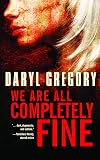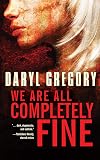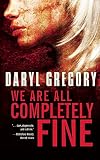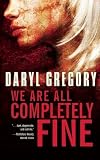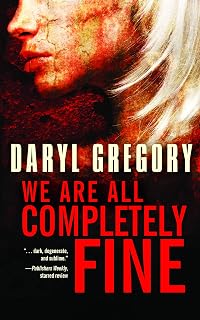
We Are All Completely Fine
by Daryl Gregory
On This Page
Description
World Fantasy Award Winner Shirley Jackson Award Winner Harrison was the Monster Detective, a storybook hero. Now he's in his mid-thirties and spends most of his time popping pills and not sleeping. Stan became a minor celebrity after being partially eaten by cannibals. Barbara is haunted by unreadable messages carved upon her bones. Greta may or may not be a mass-murdering arsonist. Martin never takes off his sunglasses. Never. No one believes the extent of their horrific tales, not until show more they are sought out by psychotherapist Dr. Jan Sayer. What happens when these seemingly-insane outcasts form a support group? Together they must discover which monsters they face are within--and which are lurking in plain sight. show lessTags
Recommendations
























Member Reviews
I enjoyed the hell out of this novella!
A small group of torture survivors are brought together by their doctor for experimental group therapy. These people have been through the most horrible things imaginable. Seriously, it's bad.
What begins as therapeutic meetings for this group eventually morphs into something else. Something otherworldly. Something that is not quite finished.
I loved how this tale was related, it wasn't a dreary recitation of each survivor and what happened to them. It flowed more naturally than that. The characters were well drawn and I couldn't help but feel for them and all they went through.
The only negative thing I can say is that I wish the story had been longer. I felt like I was just getting to the bottom show more of the mystery with Greta, (one of the survivors), and then it was over. However, I am happy to report that this tale ended in such a way that leaves it wide open for a sequel. I, for one, am hoping we get one.
Highly recommended for fans of dark fiction and psychological horror!
I received this novella free from Net Galley, in exchange for an honest review. This is it! show less
A small group of torture survivors are brought together by their doctor for experimental group therapy. These people have been through the most horrible things imaginable. Seriously, it's bad.
What begins as therapeutic meetings for this group eventually morphs into something else. Something otherworldly. Something that is not quite finished.
I loved how this tale was related, it wasn't a dreary recitation of each survivor and what happened to them. It flowed more naturally than that. The characters were well drawn and I couldn't help but feel for them and all they went through.
The only negative thing I can say is that I wish the story had been longer. I felt like I was just getting to the bottom show more of the mystery with Greta, (one of the survivors), and then it was over. However, I am happy to report that this tale ended in such a way that leaves it wide open for a sequel. I, for one, am hoping we get one.
Highly recommended for fans of dark fiction and psychological horror!
I received this novella free from Net Galley, in exchange for an honest review. This is it! show less
We Are All Completely Fine is a fabulous, complicated novella about a group of five damaged people and the psychologist who brings them together. Dr. Jan claims she wants to help them, but the five members have been through various supernatural traumas and are accustomed to disbelief when they share their unlikely histories: “Every small group was a chemistry experiment and the procedure was always the same: bring together a group of volatile elements, put them in a tightly enclosed space, and stir. The result was never a stable compound, but sometimes you arrived at something capable of doing hard work, like a poison that killed cancer cells. And sometimes you get a bomb.“
The story becomes almost a character study as we find out show more more about each person, and the strange situations they’ve survived: “After all, one of the issue we had in common was that we each though we were unique. Not just survivors, but sole survivors. We wore our scars like badges.” But Gregory wisely stays away from historical info-dumping and instead allows their stories to be shared in the course of conversation. As they trust–and challenge–each other, they discover they have more in common than they expected. Shortly after, the pace catapults forward, focusing on immediate danger.
Gregory writes in ways that touch the heart of what it means to be human. He also writes in ways that are horrorific, surprising, and humorous. We Are All Completely Fine is like a psychotherapy text in comic book form, making it accessible and applicable in ways one would have never considered. There are moments that make me squirm, but they are done with such sophistication that Gregory brings me to a place of compassion.
“She believed that people were captains of their own destiny. He agreed, as long as it was understood that every captain was destined to go down with the ship, and there wasn’t a damned thing you could do about it.“
Gregory is fast becoming one of my go-to authors, with stories I can pick up in almost any mood and end up deliciously satisfied. I want something with humor? Here: “And then he wondered what the collective noun was for psychologists: a shortage of shrinks? A confession of counselors?” Or profound: “What the patients didn’t understand was that this was the human condition. The group members’ horrific experiences had not exempted them from existential crises, only exaggerated them.”
Or do I need a diverting plot in a genre-bender setting to distract me from my everyday life? Gregory provides that too. I re-read this today thinking about my review, and was no less entertained or captivated–but I did highlight another handful of lovely phrases. I highly recommend it.
“Also, I might be entertaining the idea of tamping down my nihilism. Just a bit. Not because life is not meaningless–I think that’s inarguable. It’s just that the constant awareness of its pointlessness is exhausting. I wouldn’t mind being oblivious again. I’d love to feel the wind in my face and think, just for a minute, that I’m not going to crash into the rocks.“
Many, many thanks to NetGalley and Tachyon Publications for a review copy, and to Carly for introducing me to Gregory’s works.
2017: Published (and signed!) copy: as fabulous as the advanced copy. Note that he also seems to be doing interesting things with the narrative voice. I think they were there before, but I glossed over. There's a mix of anonymous first person and third that's intriguing--maybe the group as an entity? show less
The story becomes almost a character study as we find out show more more about each person, and the strange situations they’ve survived: “After all, one of the issue we had in common was that we each though we were unique. Not just survivors, but sole survivors. We wore our scars like badges.” But Gregory wisely stays away from historical info-dumping and instead allows their stories to be shared in the course of conversation. As they trust–and challenge–each other, they discover they have more in common than they expected. Shortly after, the pace catapults forward, focusing on immediate danger.
Gregory writes in ways that touch the heart of what it means to be human. He also writes in ways that are horrorific, surprising, and humorous. We Are All Completely Fine is like a psychotherapy text in comic book form, making it accessible and applicable in ways one would have never considered. There are moments that make me squirm, but they are done with such sophistication that Gregory brings me to a place of compassion.
“She believed that people were captains of their own destiny. He agreed, as long as it was understood that every captain was destined to go down with the ship, and there wasn’t a damned thing you could do about it.“
Gregory is fast becoming one of my go-to authors, with stories I can pick up in almost any mood and end up deliciously satisfied. I want something with humor? Here: “And then he wondered what the collective noun was for psychologists: a shortage of shrinks? A confession of counselors?” Or profound: “What the patients didn’t understand was that this was the human condition. The group members’ horrific experiences had not exempted them from existential crises, only exaggerated them.”
Or do I need a diverting plot in a genre-bender setting to distract me from my everyday life? Gregory provides that too. I re-read this today thinking about my review, and was no less entertained or captivated–but I did highlight another handful of lovely phrases. I highly recommend it.
“Also, I might be entertaining the idea of tamping down my nihilism. Just a bit. Not because life is not meaningless–I think that’s inarguable. It’s just that the constant awareness of its pointlessness is exhausting. I wouldn’t mind being oblivious again. I’d love to feel the wind in my face and think, just for a minute, that I’m not going to crash into the rocks.“
Many, many thanks to NetGalley and Tachyon Publications for a review copy, and to Carly for introducing me to Gregory’s works.
2017: Published (and signed!) copy: as fabulous as the advanced copy. Note that he also seems to be doing interesting things with the narrative voice. I think they were there before, but I glossed over. There's a mix of anonymous first person and third that's intriguing--maybe the group as an entity? show less
This book is about what happens after the horror movie. When the Final Girl or Boy staggers off the screen and returns to normal life, what does that life look like? How does that work? Gregory's thesis is: it doesn't work all that well. The past is still present.
The central concept here is that a psychiatrist gathers five survivors of supernatural trauma for group therapy. We get no infodumps; we learn about the group members as they disclose their history, their traumas, their scars (literally, in most cases). We get as much detail as they're willing to provide. There's a current plot, but it's very much rooted in the past. Unsurprisingly, the strength of this book is also rooted in the characters' pasts; what's gripping is equal show more parts who they are and how they got that way.
I found this book fascinating, page-turning, engrossing, and also riiiiiight on the edge of Too Much Horror for me. But I'm a total wimp, and anyone who reads dark or scary books regularly will probably find this not really horror at all. The horror's not really the point, anyway; the point is what happens when the light comes back on. show less
The central concept here is that a psychiatrist gathers five survivors of supernatural trauma for group therapy. We get no infodumps; we learn about the group members as they disclose their history, their traumas, their scars (literally, in most cases). We get as much detail as they're willing to provide. There's a current plot, but it's very much rooted in the past. Unsurprisingly, the strength of this book is also rooted in the characters' pasts; what's gripping is equal show more parts who they are and how they got that way.
I found this book fascinating, page-turning, engrossing, and also riiiiiight on the edge of Too Much Horror for me. But I'm a total wimp, and anyone who reads dark or scary books regularly will probably find this not really horror at all. The horror's not really the point, anyway; the point is what happens when the light comes back on. show less
A very short book that packs an incredible wallop! This is the second book by Gregory that I have read and he is quickly becoming a favorite author. Gregory develops wonderfully flawed characters and places them into fully rendered worlds - and does so with nary a wasted word. This is story-telling that is direct, witty, smart, disturbing, and poignant. This guy needs to write faster because I am going to blaze through his catalog very, very quickly!
Okay, that was a trip. And not the happy, fun kaleidoscopic shapes and colors kind.
This is the story of a therapy group, through the eyes of Harrison Harrison, a member of the group and at least a local celebrity as a monster hunter. Harrison may be a monster hunter, but the other members of the group know monsters — they are all victims of attacks from “the other side."
- Stan is a surviving victim of cannibals.
- Barbara bears the scars of the Scrimshander, who opens his victims flesh to carve figures onto their bones.
- Martin is haunted by an ability to see into the other side when wearing high tech augmented reality glasses.
- Greta, the girl dressed head to toe in black, hides her secret for much of the story, but she’s clearly show more haunted.
And then there’s Jan, the therapist who has more going on than we know. Jan brings them all together, seemingly on the intuition that they are all connected in some way.
And that’s where the “monsters” come in. You’d think the Scrimshander was bad enough, but that’s an hors d’oeuvre.
These are creatures from “the other side,” normally invisible to us and incapable of interacting with us in our world. The monsters are looking for a way, a vessel, through which to enter our world. Or they have already found one.
There’s a very light tongue-in-cheek quality to Gregory’s writing — the characters, some of them anyway, are ready with quips, sarcasm, and irony. It’s still a supernatural horror story, and he doesn’t spare us any of the gory details, but there’s a saving lightness to the whole thing.
And there’s a quirky kind of positive vibe running through the story. The characters can deal with just about anything, and they will, one way or another. It won’t always be pretty, and they may not win all the time, but they are our team after all.
I’m not a horror story fan, so you may want to take that into account in my rating and review. I’m more drawn, for that matter, to the idea that “the other side” is more our own other side than any external force or malevolent influence. For my money, we, at least collectively, have proven ourselves as capable of evil as any monsters over there on the other side. show less
This is the story of a therapy group, through the eyes of Harrison Harrison, a member of the group and at least a local celebrity as a monster hunter. Harrison may be a monster hunter, but the other members of the group know monsters — they are all victims of attacks from “the other side."
- Stan is a surviving victim of cannibals.
- Barbara bears the scars of the Scrimshander, who opens his victims flesh to carve figures onto their bones.
- Martin is haunted by an ability to see into the other side when wearing high tech augmented reality glasses.
- Greta, the girl dressed head to toe in black, hides her secret for much of the story, but she’s clearly show more haunted.
And then there’s Jan, the therapist who has more going on than we know. Jan brings them all together, seemingly on the intuition that they are all connected in some way.
And that’s where the “monsters” come in. You’d think the Scrimshander was bad enough, but that’s an hors d’oeuvre.
These are creatures from “the other side,” normally invisible to us and incapable of interacting with us in our world. The monsters are looking for a way, a vessel, through which to enter our world. Or they have already found one.
There’s a very light tongue-in-cheek quality to Gregory’s writing — the characters, some of them anyway, are ready with quips, sarcasm, and irony. It’s still a supernatural horror story, and he doesn’t spare us any of the gory details, but there’s a saving lightness to the whole thing.
And there’s a quirky kind of positive vibe running through the story. The characters can deal with just about anything, and they will, one way or another. It won’t always be pretty, and they may not win all the time, but they are our team after all.
I’m not a horror story fan, so you may want to take that into account in my rating and review. I’m more drawn, for that matter, to the idea that “the other side” is more our own other side than any external force or malevolent influence. For my money, we, at least collectively, have proven ourselves as capable of evil as any monsters over there on the other side. show less
A group of strangers convene at The Elms for their first group therapy session. Unlike most people however, this group are all survivors of traumatic supernatural activity. Harrison was a monster hunter in his youth, Stan is a victim of a cannibalistic family, Martin can see otherworldly creatures that came out of his augmented reality game, Barbara has messages carved on her bones from the Scrimshander, Greta is the last member of a cult that went up in flames. Dr. Jan Sayer believes them all. The group makes headway with their issues, but not before their monsters catch up with them.
A complex and fast-paced horror novella about confronting your demons both internal and external. Each of the characters has been through something show more horrific, gruesome and unique, something they think no one else would understand. I was very interested in all of the characters and what they went through. I was engaged by how they all dealt with their past trauma differently as well as how they were dealing with what was in front of them at the moment. The connections between the characters was unexpected, especially since they all were dealing with different monsters. Greta's character seemed to take front and center as her monster caused the most trouble and led to the danger that forced the group to work together. I feel like there is more to the story for these characters, but they were left in a place that is good for now.
This book was received for free in return for an honest review. show less
A complex and fast-paced horror novella about confronting your demons both internal and external. Each of the characters has been through something show more horrific, gruesome and unique, something they think no one else would understand. I was very interested in all of the characters and what they went through. I was engaged by how they all dealt with their past trauma differently as well as how they were dealing with what was in front of them at the moment. The connections between the characters was unexpected, especially since they all were dealing with different monsters. Greta's character seemed to take front and center as her monster caused the most trouble and led to the danger that forced the group to work together. I feel like there is more to the story for these characters, but they were left in a place that is good for now.
This book was received for free in return for an honest review. show less
Not my usual sort of read, but the Kindle preview got me interested. Fascinating angle of a therapy group for people traumatized by the (normally unseen) horrors left vague enough to beg a sequel. Having that distance and making nearly all the horror secondhand and subtle made it more enjoyable for me, honestly.
And like a cover blurb says, it's a well-crafted web of overlapping stories that don't reveal the web until the ending and it's a surprising twist worth the wait.
And like a cover blurb says, it's a well-crafted web of overlapping stories that don't reveal the web until the ending and it's a surprising twist worth the wait.
Members
- Recently Added By
Lists

Llibres que he llegit el 2024
77 works; 1 member
Author Information

60+ Works 4,581 Members
Some Editions
Awards and Honors
Awards
Common Knowledge
- Canonical title*
- Nous allons tous très bien, merci
- Original title
- We are all completely fine
- Original publication date
- 2014-08-12
- People/Characters*
- Jan Sayer; Harrison Harrison; Stan; Barbara; Martin Treece; Greta (show all 7); Alia
- Important places
- Dunnsmouth
- Dedication*
- Pour Jill Morgan et Bob Slaney
- First words
- There were six of us in the beginning.
- Last words
- (Click to show. Warning: May contain spoilers.)We only feel at home when we're a little bit afraid.
- Blurbers
- McGuire, Seanan; Datlow, Ellen; Sawyer, Robert J.; Powers, Tim
- Original language
- English
*Some information comes from Common Knowledge in other languages. Click "Edit" for more information.
Classifications
Statistics
- Members
- 463
- Popularity
- 65,444
- Reviews
- 46
- Rating
- (3.76)
- Languages
- 5 — English, French, Hungarian, Italian, Spanish
- Media
- Paper, Audiobook, Ebook
- ISBNs
- 10
- ASINs
- 5