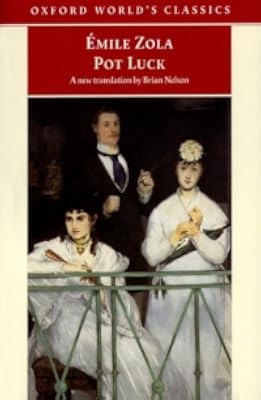
Pot Luck
by Émile Zola
Les Rougon-Macquart (publication order) (10), Les Rougon-Macquart (Zola's recommended reading order) (7)
There is 1 current discussion about this work.
On This Page
Description
The tenth novel in the Rougon-Macquart series by Emile Zola, "Pot Luck (Pot-Bouille)" was first published in serially format in the periodical "Le Gaulois" between January and April 1882. The title of the work, Pot-Bouille, is a 19th-century French slang term for a large cooking pot used for preparing stews. It is a term that really has not direct translation in English. The title of the novel which recounts the activities of the residents of a block of flats in the Rue de Choiseul over the show more course of two years is meant to reflect the greed, ambition and depravity which lie beneath a thin veil of upstanding moral character. The residents of this block of flats are comprised of principally five families: The Campardons, The Duveyriers, The Josserands, The Vabres, and The Pichons. New resident 22-year-old Octave Mouret who has taken a salesman's job at a nearby shop, moves into the building and causes a stir as he pursues the married women of the community." show lessTags
Recommendations





































Member Recommendations

thorold Paris apartment buildings dissected
Member Reviews
Zola takes the risky step of turning the full blast of his satire on the very people who buy his books, the rising urban middle class, the people who like to represent themselves as the guardians of propriety, moderation and good taste. And who aspire to the sort of haut-bourgeois lifestyle that they don't quite have the money, the leisure, or the education to sustain.
The author removes the front wall of a grand-but-shoddy Paris apartment building (rather as Perec did, a century later) and shows us all the unpleasant things that are going on inside it, with a lack of inhibition that makes other 19th century realists look like models of restraint and self-censorship. To add insult to injury, he also goes behind the green baize door and show more shows his readers that their servants know all about what their masters are up to (and all the other tenants in the building, because the builder's meanness in making all the kitchens face onto a hidden lightwell has given the servants a handy private way of gossiping from apartment to apartment).
Most of the scandals, of course, revolve around sex and/or money. Daughters are married off with fraudulent promises of financial settlements on both sides, siblings are cheated out of inheritances, husbands keep mistresses, wives take lovers, the double-standard is applied with impeccable hypocrisy, and the priest and the doctor try to clean up the mess. Zola goes a lot further than most 19th century novelists in showing us both men and women who are driven by purely sexual desire - the wish for love, affection, power or even money takes second place. And he violates some important taboos by showing us (just for example) a husband carrying on with his invalid wife's cousin in the family home, or a young man who spends his nights with the maids in their attic bedrooms, or a maid who is carrying on a passionate affair with the teenage daughter of the family.
At times, the story turns into a hilarious farce, there is just so much going on, and every character is connected to so many different stories. And Zola even inserts a version of himself into the story, as the one tenant in the house who manages to stay out of all the messiness but has attracted the attention of the police by publishing an "unsuitable" novel.
But he also makes sure we realise that there are actual lives of real people at stake, not just middle-class reputations, and he doesn't scruple to rub our noses into the consequences of all this unbridled sex. Half a chapter is devoted to a (very) graphic description of the experience of childbirth from the point of view of a frightened servant who has managed to keep her pregnancy a secret and now has to face delivery on her own, without any preparation. Probably the first time anyone did that in mainstream fiction. And we meet another lower-class unmarried mother, made homeless by a landlord concerned for the respectability of the house just before her baby is due, and later, when suspected of infanticide, sent to prison by the same man in his capacity as a magistrate. Tess of the D'Urbervilles, but with real blood. And other body fluids.
Nana may have been a pretty hard act to follow, but this book seems to manage all right... show less
The author removes the front wall of a grand-but-shoddy Paris apartment building (rather as Perec did, a century later) and shows us all the unpleasant things that are going on inside it, with a lack of inhibition that makes other 19th century realists look like models of restraint and self-censorship. To add insult to injury, he also goes behind the green baize door and show more shows his readers that their servants know all about what their masters are up to (and all the other tenants in the building, because the builder's meanness in making all the kitchens face onto a hidden lightwell has given the servants a handy private way of gossiping from apartment to apartment).
Most of the scandals, of course, revolve around sex and/or money. Daughters are married off with fraudulent promises of financial settlements on both sides, siblings are cheated out of inheritances, husbands keep mistresses, wives take lovers, the double-standard is applied with impeccable hypocrisy, and the priest and the doctor try to clean up the mess. Zola goes a lot further than most 19th century novelists in showing us both men and women who are driven by purely sexual desire - the wish for love, affection, power or even money takes second place. And he violates some important taboos by showing us (just for example) a husband carrying on with his invalid wife's cousin in the family home, or a young man who spends his nights with the maids in their attic bedrooms, or a maid who is carrying on a passionate affair with the teenage daughter of the family.
At times, the story turns into a hilarious farce, there is just so much going on, and every character is connected to so many different stories. And Zola even inserts a version of himself into the story, as the one tenant in the house who manages to stay out of all the messiness but has attracted the attention of the police by publishing an "unsuitable" novel.
But he also makes sure we realise that there are actual lives of real people at stake, not just middle-class reputations, and he doesn't scruple to rub our noses into the consequences of all this unbridled sex. Half a chapter is devoted to a (very) graphic description of the experience of childbirth from the point of view of a frightened servant who has managed to keep her pregnancy a secret and now has to face delivery on her own, without any preparation. Probably the first time anyone did that in mainstream fiction. And we meet another lower-class unmarried mother, made homeless by a landlord concerned for the respectability of the house just before her baby is due, and later, when suspected of infanticide, sent to prison by the same man in his capacity as a magistrate. Tess of the D'Urbervilles, but with real blood. And other body fluids.
Nana may have been a pretty hard act to follow, but this book seems to manage all right... show less
Octave Mouret arrives in Paris, after spending several successful years as a salesman in Marseilles. His friend Campardon secures him a room to let in the same newly built, grand house he lives in with his wife and daughter. As he shows him around, Campardon points out all the many amenities, such as the grand heated staircase and water on every floor, and names the respectable personages that reside there. What quickly becomes apparent, however, is that it is all a facade: the walls are cracking and the paint peeling, the inner courtyard smells like a sewer, and the illustrious inhabitants are adulterous, hypocritical snakes.
One of the families, the Josserands, exemplify the vulgar avarice of their class. Madame Josserand is show more desperately trying to marry off her two daughters for the most advantage without having to pay a dowry. As she strategizes and plots, she throws her daughters at a series of young men.
Then she spoke of everything that mothers taught their dowryless daughters. A complete series of lessons in polite prostitution: the touch of fingers in the dance, the relinquishing of hands behind a door, the indecency of innocence speculating on the prurient appetites of the foolish; then, one fine evening, the full-blown husband, landed just as a common prostitute lands a man; the husband trapped behind a curtain, falling for the bait in the fever of his desire.
In this, Zola's tenth novel in the Rougon-Macquart cycle, he focuses on the hypocrisy and degeneration of the bourgeoisie. While paying lip service to the sanctity of marriage, the privileges of class, and the social mores which define and protect their social position, they are systematically subverting all of them. Servants, while treated abominably and held to a high moral code, are also lusted after, and babies are born never knowing who the father is. Marital relationships are frigid and emotionally abusive, yet extramarital affairs are no better. The grand house is nothing more than a crumbling edifice with a gilt of gold.
And in this Jacobin frenzy one heard, as it were, the inexorable death-knell of a whole class, the collapse and putrefaction of the bourgeoisie, whose rotten props were cracking beneath them.
At first I found the litany of misdeeds a bit tiresome, but in spite of myself, the second half sped quickly. There are only a couple of characters who are not reprehensible, and they tend to be either weak and ineffectual, or blatantly self-serving. Nature and politics play minor roles in this book, and religion is simply the panacea that turns a blind eye and tries to keep the house of cards from collapsing.
Through the wide-open door {Father Mauduit} watched the throng of guests and, as though vanquished, smiled as once more he threw the cloak of religion over the corrupt bourgeois society, as if he were some master of ceremonies, veiling the canker in an attempt to delay the final moment of decomposition. show less
One of the families, the Josserands, exemplify the vulgar avarice of their class. Madame Josserand is show more desperately trying to marry off her two daughters for the most advantage without having to pay a dowry. As she strategizes and plots, she throws her daughters at a series of young men.
Then she spoke of everything that mothers taught their dowryless daughters. A complete series of lessons in polite prostitution: the touch of fingers in the dance, the relinquishing of hands behind a door, the indecency of innocence speculating on the prurient appetites of the foolish; then, one fine evening, the full-blown husband, landed just as a common prostitute lands a man; the husband trapped behind a curtain, falling for the bait in the fever of his desire.
In this, Zola's tenth novel in the Rougon-Macquart cycle, he focuses on the hypocrisy and degeneration of the bourgeoisie. While paying lip service to the sanctity of marriage, the privileges of class, and the social mores which define and protect their social position, they are systematically subverting all of them. Servants, while treated abominably and held to a high moral code, are also lusted after, and babies are born never knowing who the father is. Marital relationships are frigid and emotionally abusive, yet extramarital affairs are no better. The grand house is nothing more than a crumbling edifice with a gilt of gold.
And in this Jacobin frenzy one heard, as it were, the inexorable death-knell of a whole class, the collapse and putrefaction of the bourgeoisie, whose rotten props were cracking beneath them.
At first I found the litany of misdeeds a bit tiresome, but in spite of myself, the second half sped quickly. There are only a couple of characters who are not reprehensible, and they tend to be either weak and ineffectual, or blatantly self-serving. Nature and politics play minor roles in this book, and religion is simply the panacea that turns a blind eye and tries to keep the house of cards from collapsing.
Through the wide-open door {Father Mauduit} watched the throng of guests and, as though vanquished, smiled as once more he threw the cloak of religion over the corrupt bourgeois society, as if he were some master of ceremonies, veiling the canker in an attempt to delay the final moment of decomposition. show less
Zola writes a hilarious and scathing book about the bourgeoisie and their so called high morals, meanwhile they are all f****** each other, and have the most miserable marriages.
The men in the marriages of the bourgeoisie are the biggest s**** ever carrying home stds. Yet, adultery seems to be always blamed on the women. In the introduction:
". . . adultery on the part of a wife was denounced because it usurped the laws men used to determine the social role of women - to bring into the world only The offspring of their husbands, thereby ensuring the purity of their husbands lineage."
And:
"Adultery in the 19th century was most likely, of course, to be that of the husband. While husbands cheated on their wives with near impunity, female show more infidelity was considered a most reprehensible crime, for it jeopardized what was most prized in bourgeois Society: legitimacy of descent. The crime of female adultery was considered so Grievous that an adulterous woman could be imprisoned for up to 2 years, or at the very least expelled from the family home. Female sexuality was thus a constant source of concern for the family and for society as a whole...."
The josserand family has an unbelievable way of living. Madam josserand insists on having Tuesday social evenings, in spite of the fact that their house is so poor (and DIRTY!) that they barely have any food in their cupboards, and poor Monsieur Josserand has to stay up all night writing out some measly tickets that earns him four francs a night. I don't know when he sleeps.
They are so poor, yet they have a servant, Adele, who they starve to death.
"The shelves had the dismal bareness and Sham display of households where poor-quality meat is bought so that there can be a show of flowers on the table. There were just some clean China plates with gold edges, a crumb-brush with some of the plated silver rubbed off its handle, and a cruet-stand in which the oil and vinegar had dried up; but not a single crust, not a scrap of fruit or pastry or cheese. Obviously Adele's insatiable hunger made her lick the plates clean of any rare drop of gravy or sauce left by her employers, until she nearly rubbed the gilt off."
One of the neighbors of the apartment house,Marie Pichon, is the wife of Jules Pichon, and she was raised up with knowledge of nothing, so she knows no better than to let the slutty boy Octave, one of the main characters, fuck her. She doesn't even know how to take care of her daughter, Lilitte. Her parents, Monsieur and Madame Vuilaume, come once a week to have dinner with them, and reprimands Marie for the way she raises her daughter.
" 'think first of bringing her up as we brought you up,' said Madame Vuilaume severely. 'Of course, I'm not condemning music [Marie had spoken of Lilith having piano lessons]; it develops one's feelings. But above all, watch over your daughter; keep every foul breath from her; and do all you can to ensure that she remains ignorant.' ..."
The Josserands have a son named Saturnin, who had a head injury when he was younger and this made him violent and mentally affected. They keep him locked up in his room, but he often breaks out, and threatens violence.
Berthe, his older sister, is able to control him, because he loves her. She's going to get married, so Madame Josserand is afraid that Saturnin is going to disrupt the wedding plans.
"that same evening a cab came to fetch saturnin. His mother had declared that it was too dangerous to let him be present at the ceremony. It would hardly do, at a wedding, to turn a lunatic who talked of splitting people's heads open loose among the guests.; Monsieur josserand, broken hearted, had been obliged to get the poor lad admitted to the Moulineux Asylum, kept by Dr Chassagne. The cab was brought up to the porch at dusk. Saturnin came down, holding Berthe's hand, thinking he was going into the country with her. but when he had got into the cab he struggled furiously, breaking the windows and shaking his bloodstained fists through them. Monsieur josserand went upstairs in tears, overcome by this departure in the dark, his ears still ringing with The wretched boy shrieks, mingled with the cracking of the whip and the galloping of the horse."
Madame josserand scolds him, andlls she always does, for his sensitivity and innocence.
"Monsieur Josserand did not even answer. He spent the night addressing wrappers. By the chill daybreak he had finished his second thousand, and had earned six francs. Several times he had raised his head, listening, as usual, to know whether Saturnin was moving in his room. Then, at the thought of Berthe, he worked with fresh ardour. Poor child! She would have liked a wedding dress of white moire. However, six Francs would enable her to have more flowers in her bridal bouquet."
And just how will this family, the josserands, who are so poor that they can't feed their servant, and have to buy rancid butter at the market, afford to throw a wedding for Berthe and Auguste? Listen to this:
"... The Josserands had been at their wits end to know how to find the 2000 francs which the wedding would cost - 500 francs for the dress, and another 1,500 for their share of the dinner and dance expenses. So they had been obliged to send Berthe to Dr Chassagne's Asylum to see Saturnin, to whom an aunt had just left 3,000 francs; Berthe, having obtained permission to take her brother out for a drive, smothered him with caresses in the carriage until he became quite dazed, and then took him for a moment to see the lawyer, who, not knowing the poor lad's condition, had everything ready for him to sign. Thus it was that the silk dress and the profusion of flowers came as a surprise to all these ladies, who were estimating the cost while exclaiming in admiration: 'exquisite! So tasteful!' "
Berthe is now married to Auguste. It's not a happy marriage, though. Auguste constantly suffers from migraine. He doesn't want to give her money, but she thinks that's what marriage means: your husband buys you pretty dresses and gives you money to go out and party. So, in order to be able to pay for the things she wants, she starts f****** Octave.
"One day, however, she had a great shock. She had just come back from a dog-show when Octave beckoned her to follow him downstairs into the basement, where he gave her an invoice which had been presented during her absence - 62 francs for embroidered stockings. She turned quite pale, and exclaimed:
'good heavens! Did my husband see this?'
"She had an ever-increasing desire for freedom and pleasure - all that, as a girl, she had expected marriage to give her, all that her mother had taught her to extract from a man. She carried with her an appetite as yet unappeased, taking her revenge for her needy youth spent under the paternal roof; for all the inferior meats; for all the economy in butter, which enabled her to buy boots; for all the shabby dresses that had to be patched up a dozen times; for the falsehood of their social position, maintained at the price of squalid misery and filth. Most of all she now desired to make up for those three winters spent traipsing around in ball-slippers through all the mud of paris, trying to catch a husband; evenings of deadly dullness during which she strove to appease her empty stomach with draughts of syrup, bored to tears by having to show off all her virginal airs and graces to stupid young men, inwardly exasperated at being obliged to affect ignorance of everything while knowing all; and all those homecomings in pouring rain without a cab, the chill discomfort of her ice-cold bed, and the maternal smacks that gave her cheeks a glow. At the age of 22 she had still despaired of getting married, humble as a hunchback, looking at herself in her nightgown in the evenings to see if anything was missing. But now she had at last got a husband and, like the sportsman who brutally dispatches with a blow the hare he has breathlessly pursued, so towards Auguste she showed no mercy, treating him like a fallen foe."
She reminds me of Madame bovary, but Berthe gets out of this in a better condition than that one did.
The Campardon family is a gas: Rose, the wife, has a fallen uterus, ever since she had their daughter Angele. So, she is exempted from having sex with her husband, who treats her like a little princess. She stays in bed, in beautiful negligee'ls, with books by her side, and little chocolates to nibble on, while the maid Lisa looks after their daughter.
Rose's cousin Gasparine, had been the husband's girlfriend in their home village, but Gasparine was poor, so Monsieur Campardon Married Rose, who had a dowry. But guess what? Between Monsieur Campardon and Gasparine, who have been having an affair ever since Rose's uterus fell, they conspire to move Gasparine in, and eventually Gasparine quits her job, and becomes Angele's governess, and Rose's handmaid.
"Just then, as victoire [the cook], after washing up, had gone to bed, Lisa came in as she usually did to see if mademoiselle required anything else. Angele was waiting for her in bed; and then it was that, unknown to the parents, they played interminable games of cards on the counter pane. As they played beggar-my-neighbor they talked constantly of Gasparine, that dirty beast, whom the maid crudely pulled to pieces before little Angele. In this way they made up for their humble, hypocritical demeanor during the day, and Lisa took a certain base pleasure in corrupting Angele in this way, satisfying the girl's morbid curiosity now that she was on the verge of puberty. That night they were furious with Gasparine because for the last two days she had locked Up the sugar with which the maid usually filled her pockets in order to empty them out afterwards on the child's bed. Nasty cow! They couldn't even get a lump of sugar to munch before they went to sleep!
'your papa gives her plenty of sugar, though!' Said lisa, with a sensual laugh.
'Oh, yes!' murmured angele, laughing too.
'What does your papa do to her? Come on, show me.'
The child caught the maid around the neck, squeezed her in her bare arms, and kissed her very hard on the mouth, saying as she did so: 'this is what he does! This is what he does!'
Midnight struck. Campardon and gasparine were moaning in their narrow bed,, while Rose, lying contentedly in the middle of hers, stretched out her legs and read Dickens until tears filled her eyes. A profound silence followed; the chaste night cast its shadow over this eminently virtuous family."
Despite Marie's parents' warnings not to have another child, Marie falls pregnant (it's never said, but it could have been Octave's child, right?) With another child.
".. her confinement had taken place in september. They [Monsieur and Madame Vuilaume] had even consented to come to dinner one Tuesday to celebrate the young woman's recovery. She had only been out the day before for the first time. Anxious to appease her mother, whom the very sight of the baby, another girl, annoyed, Marie had put it out to nurse not far from paris. Lilitte was asleep with her head on the table, overcome by a glass of wine which her parents had forced her to drink to her little sister's health.
'well, one can just about cope with two,' said madame, after clinking glasses with Octave. 'But that's enough, jules, do you hear?' "
Well, Marie falls pregnant again, after this one.
Zola is one of my favorite authors. He exposes the hypocrisy and pretensions of upper and middle classes, and makes me laugh, every time. He's the perfect anti-capitalist. show less
The men in the marriages of the bourgeoisie are the biggest s**** ever carrying home stds. Yet, adultery seems to be always blamed on the women. In the introduction:
". . . adultery on the part of a wife was denounced because it usurped the laws men used to determine the social role of women - to bring into the world only The offspring of their husbands, thereby ensuring the purity of their husbands lineage."
And:
"Adultery in the 19th century was most likely, of course, to be that of the husband. While husbands cheated on their wives with near impunity, female show more infidelity was considered a most reprehensible crime, for it jeopardized what was most prized in bourgeois Society: legitimacy of descent. The crime of female adultery was considered so Grievous that an adulterous woman could be imprisoned for up to 2 years, or at the very least expelled from the family home. Female sexuality was thus a constant source of concern for the family and for society as a whole...."
The josserand family has an unbelievable way of living. Madam josserand insists on having Tuesday social evenings, in spite of the fact that their house is so poor (and DIRTY!) that they barely have any food in their cupboards, and poor Monsieur Josserand has to stay up all night writing out some measly tickets that earns him four francs a night. I don't know when he sleeps.
They are so poor, yet they have a servant, Adele, who they starve to death.
"The shelves had the dismal bareness and Sham display of households where poor-quality meat is bought so that there can be a show of flowers on the table. There were just some clean China plates with gold edges, a crumb-brush with some of the plated silver rubbed off its handle, and a cruet-stand in which the oil and vinegar had dried up; but not a single crust, not a scrap of fruit or pastry or cheese. Obviously Adele's insatiable hunger made her lick the plates clean of any rare drop of gravy or sauce left by her employers, until she nearly rubbed the gilt off."
One of the neighbors of the apartment house,Marie Pichon, is the wife of Jules Pichon, and she was raised up with knowledge of nothing, so she knows no better than to let the slutty boy Octave, one of the main characters, fuck her. She doesn't even know how to take care of her daughter, Lilitte. Her parents, Monsieur and Madame Vuilaume, come once a week to have dinner with them, and reprimands Marie for the way she raises her daughter.
" 'think first of bringing her up as we brought you up,' said Madame Vuilaume severely. 'Of course, I'm not condemning music [Marie had spoken of Lilith having piano lessons]; it develops one's feelings. But above all, watch over your daughter; keep every foul breath from her; and do all you can to ensure that she remains ignorant.' ..."
The Josserands have a son named Saturnin, who had a head injury when he was younger and this made him violent and mentally affected. They keep him locked up in his room, but he often breaks out, and threatens violence.
Berthe, his older sister, is able to control him, because he loves her. She's going to get married, so Madame Josserand is afraid that Saturnin is going to disrupt the wedding plans.
"that same evening a cab came to fetch saturnin. His mother had declared that it was too dangerous to let him be present at the ceremony. It would hardly do, at a wedding, to turn a lunatic who talked of splitting people's heads open loose among the guests.; Monsieur josserand, broken hearted, had been obliged to get the poor lad admitted to the Moulineux Asylum, kept by Dr Chassagne. The cab was brought up to the porch at dusk. Saturnin came down, holding Berthe's hand, thinking he was going into the country with her. but when he had got into the cab he struggled furiously, breaking the windows and shaking his bloodstained fists through them. Monsieur josserand went upstairs in tears, overcome by this departure in the dark, his ears still ringing with The wretched boy shrieks, mingled with the cracking of the whip and the galloping of the horse."
Madame josserand scolds him, andlls she always does, for his sensitivity and innocence.
"Monsieur Josserand did not even answer. He spent the night addressing wrappers. By the chill daybreak he had finished his second thousand, and had earned six francs. Several times he had raised his head, listening, as usual, to know whether Saturnin was moving in his room. Then, at the thought of Berthe, he worked with fresh ardour. Poor child! She would have liked a wedding dress of white moire. However, six Francs would enable her to have more flowers in her bridal bouquet."
And just how will this family, the josserands, who are so poor that they can't feed their servant, and have to buy rancid butter at the market, afford to throw a wedding for Berthe and Auguste? Listen to this:
"... The Josserands had been at their wits end to know how to find the 2000 francs which the wedding would cost - 500 francs for the dress, and another 1,500 for their share of the dinner and dance expenses. So they had been obliged to send Berthe to Dr Chassagne's Asylum to see Saturnin, to whom an aunt had just left 3,000 francs; Berthe, having obtained permission to take her brother out for a drive, smothered him with caresses in the carriage until he became quite dazed, and then took him for a moment to see the lawyer, who, not knowing the poor lad's condition, had everything ready for him to sign. Thus it was that the silk dress and the profusion of flowers came as a surprise to all these ladies, who were estimating the cost while exclaiming in admiration: 'exquisite! So tasteful!' "
Berthe is now married to Auguste. It's not a happy marriage, though. Auguste constantly suffers from migraine. He doesn't want to give her money, but she thinks that's what marriage means: your husband buys you pretty dresses and gives you money to go out and party. So, in order to be able to pay for the things she wants, she starts f****** Octave.
"One day, however, she had a great shock. She had just come back from a dog-show when Octave beckoned her to follow him downstairs into the basement, where he gave her an invoice which had been presented during her absence - 62 francs for embroidered stockings. She turned quite pale, and exclaimed:
'good heavens! Did my husband see this?'
"She had an ever-increasing desire for freedom and pleasure - all that, as a girl, she had expected marriage to give her, all that her mother had taught her to extract from a man. She carried with her an appetite as yet unappeased, taking her revenge for her needy youth spent under the paternal roof; for all the inferior meats; for all the economy in butter, which enabled her to buy boots; for all the shabby dresses that had to be patched up a dozen times; for the falsehood of their social position, maintained at the price of squalid misery and filth. Most of all she now desired to make up for those three winters spent traipsing around in ball-slippers through all the mud of paris, trying to catch a husband; evenings of deadly dullness during which she strove to appease her empty stomach with draughts of syrup, bored to tears by having to show off all her virginal airs and graces to stupid young men, inwardly exasperated at being obliged to affect ignorance of everything while knowing all; and all those homecomings in pouring rain without a cab, the chill discomfort of her ice-cold bed, and the maternal smacks that gave her cheeks a glow. At the age of 22 she had still despaired of getting married, humble as a hunchback, looking at herself in her nightgown in the evenings to see if anything was missing. But now she had at last got a husband and, like the sportsman who brutally dispatches with a blow the hare he has breathlessly pursued, so towards Auguste she showed no mercy, treating him like a fallen foe."
She reminds me of Madame bovary, but Berthe gets out of this in a better condition than that one did.
The Campardon family is a gas: Rose, the wife, has a fallen uterus, ever since she had their daughter Angele. So, she is exempted from having sex with her husband, who treats her like a little princess. She stays in bed, in beautiful negligee'ls, with books by her side, and little chocolates to nibble on, while the maid Lisa looks after their daughter.
Rose's cousin Gasparine, had been the husband's girlfriend in their home village, but Gasparine was poor, so Monsieur Campardon Married Rose, who had a dowry. But guess what? Between Monsieur Campardon and Gasparine, who have been having an affair ever since Rose's uterus fell, they conspire to move Gasparine in, and eventually Gasparine quits her job, and becomes Angele's governess, and Rose's handmaid.
"Just then, as victoire [the cook], after washing up, had gone to bed, Lisa came in as she usually did to see if mademoiselle required anything else. Angele was waiting for her in bed; and then it was that, unknown to the parents, they played interminable games of cards on the counter pane. As they played beggar-my-neighbor they talked constantly of Gasparine, that dirty beast, whom the maid crudely pulled to pieces before little Angele. In this way they made up for their humble, hypocritical demeanor during the day, and Lisa took a certain base pleasure in corrupting Angele in this way, satisfying the girl's morbid curiosity now that she was on the verge of puberty. That night they were furious with Gasparine because for the last two days she had locked Up the sugar with which the maid usually filled her pockets in order to empty them out afterwards on the child's bed. Nasty cow! They couldn't even get a lump of sugar to munch before they went to sleep!
'your papa gives her plenty of sugar, though!' Said lisa, with a sensual laugh.
'Oh, yes!' murmured angele, laughing too.
'What does your papa do to her? Come on, show me.'
The child caught the maid around the neck, squeezed her in her bare arms, and kissed her very hard on the mouth, saying as she did so: 'this is what he does! This is what he does!'
Midnight struck. Campardon and gasparine were moaning in their narrow bed,, while Rose, lying contentedly in the middle of hers, stretched out her legs and read Dickens until tears filled her eyes. A profound silence followed; the chaste night cast its shadow over this eminently virtuous family."
Despite Marie's parents' warnings not to have another child, Marie falls pregnant (it's never said, but it could have been Octave's child, right?) With another child.
".. her confinement had taken place in september. They [Monsieur and Madame Vuilaume] had even consented to come to dinner one Tuesday to celebrate the young woman's recovery. She had only been out the day before for the first time. Anxious to appease her mother, whom the very sight of the baby, another girl, annoyed, Marie had put it out to nurse not far from paris. Lilitte was asleep with her head on the table, overcome by a glass of wine which her parents had forced her to drink to her little sister's health.
'well, one can just about cope with two,' said madame, after clinking glasses with Octave. 'But that's enough, jules, do you hear?' "
Well, Marie falls pregnant again, after this one.
Zola is one of my favorite authors. He exposes the hypocrisy and pretensions of upper and middle classes, and makes me laugh, every time. He's the perfect anti-capitalist. show less
In Pot Luck, Zola reveals the deceit of the Bourgeois as only Zola can. A young man, Octave, moves into a large boarding house, filled with middle class families and couples. There he finds seemingly respectable, moral, and well-off people, but as he spends more time there, he quickly finds the cracks in the facade. Every couple has one or the other committing adultery, many of the families are in financial difficulties, and none seem to actually live by the morals they profess to believe in and criticize others for not upholding.
There is a lot of symbolism in this book - from females who wear nice looking dresses with dirty, old linens underneath, to the house itself that masks cracks underneath a state of the art facade (and heated show more staircase). Also, the servants, who throw the trash from their bourgeois employers out the back windows into a courtyard, ruthlessly gossiping about the shortcomings of their employers.
This is a good Zola novel, though it wasn't my favorite. I cared less about the characters than I have in some of his other novels. But, ok Zola is still really, really good. show less
There is a lot of symbolism in this book - from females who wear nice looking dresses with dirty, old linens underneath, to the house itself that masks cracks underneath a state of the art facade (and heated show more staircase). Also, the servants, who throw the trash from their bourgeois employers out the back windows into a courtyard, ruthlessly gossiping about the shortcomings of their employers.
This is a good Zola novel, though it wasn't my favorite. I cared less about the characters than I have in some of his other novels. But, ok Zola is still really, really good. show less
"Have you read this new novel?", asked Leon... "It's well written, but it's another adultery story; they really are going too far!"
I don't think Pot Luck is one of my favourites of Zola's Rougon-Macquart but it's nonetheless quite a good book. Set in an apartment building in the 1860s, Zola mercilessly tears the delicate layers of gentility off of bourgeois morality to expose the many crimes and misdemeanours taking place therein. The tenth in the series, this might be the first time I think the book would have worked far better in serialised format; in novel form - especially 140 years on - it almost feels a bit "fluffy" compared to the previous novels. Nevertheless, this is important as the midpoint, introducing Octave Mouret who will show more be the lead character of the next novel, The Ladies' Paradise.
The book kind of does what it says on the tin, but it's full of those memorable set-pieces for which Zola is known. At this point in his career, he was at last a respected (if highly controversial!) novelist, and his talent for character work is on display. Not just in creating multifarious individuals, but in showing them from multiple points-of-view. No-one is safe from the savagery of his pen. show less
I don't think Pot Luck is one of my favourites of Zola's Rougon-Macquart but it's nonetheless quite a good book. Set in an apartment building in the 1860s, Zola mercilessly tears the delicate layers of gentility off of bourgeois morality to expose the many crimes and misdemeanours taking place therein. The tenth in the series, this might be the first time I think the book would have worked far better in serialised format; in novel form - especially 140 years on - it almost feels a bit "fluffy" compared to the previous novels. Nevertheless, this is important as the midpoint, introducing Octave Mouret who will show more be the lead character of the next novel, The Ladies' Paradise.
The book kind of does what it says on the tin, but it's full of those memorable set-pieces for which Zola is known. At this point in his career, he was at last a respected (if highly controversial!) novelist, and his talent for character work is on display. Not just in creating multifarious individuals, but in showing them from multiple points-of-view. No-one is safe from the savagery of his pen. show less
Zola est entré partout, chez les ouvriers et chez les bourgeois. Chez les premiers, selon lui, tout est visible. La misère comme le plaisir saute aux yeux. Chez les seconds tout est caché. Ils clament : « Nous sommes l'honneur, la morale, la famille. » Faux, répond Zola, vous êtes le mensonge de tout cela. Votre pot-bouille est la marmite où mijotent toutes les pourritures de la famille.
Octave Mouret, le futur patron qui révolutionnera le commerce en créant Au Bonheur des Dames, arrive de province et loue une chambre dans un immeuble de la rue de Choiseul. Beau et enjoué, il séduit une femme par étage, découvrant ainsi les secrets de chaque famille.
Ce dixième volume des Rougon-Macquart, retraçant la vie sous le Second show more Empire, c'est ici la bourgeoisie côté rue et côté cour, avec ses soucis de filles à marier, de rang à tenir ou à gagner, coûte que coûte. Les caricatures de Zola sont cruelles mais elles sont vraies. show less
Octave Mouret, le futur patron qui révolutionnera le commerce en créant Au Bonheur des Dames, arrive de province et loue une chambre dans un immeuble de la rue de Choiseul. Beau et enjoué, il séduit une femme par étage, découvrant ainsi les secrets de chaque famille.
Ce dixième volume des Rougon-Macquart, retraçant la vie sous le Second show more Empire, c'est ici la bourgeoisie côté rue et côté cour, avec ses soucis de filles à marier, de rang à tenir ou à gagner, coûte que coûte. Les caricatures de Zola sont cruelles mais elles sont vraies. show less
Librairie Générale Française (1974),
Mass Market Paperback, 510 pages (French Edition)
Original publication date: 1882
I was rather amused to find that in the introduction to this cheap, badly printed paperback edition, Mr. D'Armand Lanoux, a writer who had received the Prix Goncourt, in what is an oh so very typical French fashion, rather than telling the reader what delights are in store for him or her, went about explaining everything that is wrong with this novel, and how this work is the 'dark' counterpoint to Zola's next novel in the Rougon-Macquart series, Au Bonheur des Dames (The Ladies' Paradise). It seems Pot Bouille was not originally included in the master plan for the Rougon-Macquart series which Zola had given his show more publisher from the outset, but was inserted once it had been completed. Originally, Au Bonheur des Dames was to be an optimistic novel. However, Zola was feeling anything but when came the time to write it, over a decade after the first novel of the series, The Fortune of the Rougons had been launched in 1871.
Lanoux explains that Pot Bouille was written when Zola was into his 40s and experiencing middle-age crisis, was generally unhappy with life, somewhat retired from society and raging and fulminating about everything, though he was by then a very successful author. With this novel, Zola was at the apogee of Naturalism: "Émile Zola's works had a frankness about sexuality along with a pervasive pessimism. Naturalistic works exposed the dark harshness of life, including poverty, racism, violence, prejudice, disease, corruption, prostitution, and filth. As a result, naturalistic writers were frequently criticized for focusing too much on human vice and misery." (Wikipedia). There is plenty of all that to be found here, and Zola's original readers were no doubt shocked by his approach. Zola spelled out his agenda for this novel in a personal note: "Talking about the bourgeoisie is to formulate the most violent accusation one can direct toward French society" [my translation]. According to Lanoux, Zola did this much too successfully indeed, and he leaves us as his final words that the bourgeoisie in Pot Bouille was no more representational of that hated social class than L'Assommoir was a faithful representation of the working classes of the faubourgs.
True enough, it's impossible to read this novel without getting a clear sense that Zola thought the middle-classes of business owners and their wives and children were nothing but hypocrites of the worst kind, touting the virtues of religion and fidelity while living completely depraved lives in private; keeping lovers on the side, even installing their mistresses in comfortable secondary households, and all the while harshly speaking and acting against anyone whose immoral activities were revealed, especially those of the lower classes.
This novel is about the inhabitants of a posh Parisian building, with a grandiose staircase with false marble walls (Zola points out this detail very neatly), where a wealthy shopkeeper and his married children live in different apartments. On one of the upper levels, lives Madame Josserand and her two unmarried daughters, Berthe and Hortense, whom she's been dragging around Paris from one sitting room to another, desperate to find them husbands. Her alcoholic and rich business owner brother has promised to provide a handsome dowry for the girls, but has never actually given them the money, and the Josserands are struggling, barely being able to afford to feed themselves and their undernourished maid Adèle, never mind having a decent dowry to offer potential husbands, so the prospects are few. But Madame Josserand is willing to make any sacrifice to keep up appearances, and she doesn't miss an occasion to berate her overworked husband, who, because of his too honest temperament, has never managed to advance much in his career, and is now forced to bring home piecemeal work at night to pay for the women's luxurious necessities. Into this building, Octave Mouret arrives from the provinces. He has great plans and intends to take Paris by storm. He's an attractive young man and intends to arrive to his ends by becoming the lover of the woman who is likeliest to advance his cause, though there is a bit of trial and error involved before he finds the right one, and a major scandal erupts in the process. What follows is a wonderful upstairs/downstairs spectacle (only in this case, the maids all live on the topmost level of the building in minuscule hovels) with the bourgeois apartment dwellers misbehaving in the most conspicuous ways, while the servants berate and abuse them behind their backs, with daily meetings at the windows of the inner courtyard, where all the master's dirty laundry and plenty of personal insults fly from one floor to the next.
The 'realities' exposed here are sordid enough, but to me it seemed like a logical progression from the world or prostitution and high-class mistresses described in his previous novel, Nana. Zola's powers as a fabulous writer of fictional drama are undiminished here, and this novel reads as a great entertainment. In Madame Josserand, he creates a truly villainous woman, vociferously berating her husband at every turn in her rage about her lack of material comforts; in fact, she continues berating him until he is literally on his death-bed. I found myself thinking about Jane Austen's novels, since Madame Josserand's avowed main concern is to see her daughters well married, which is of course one of the main themes in Austen's stories, though in her defence, there were little to no other options for well-bred girls in Jane Austen's time. Zola makes it clear here that this transaction among the bourgeoisie differed little from outright prostitution, and as I read, I felt like I was possibly getting an insight into what Jane Austen's personal notes might have been (had it been possible for her to keep any), on how her characters truly acted, had she allowed herself, or indeed been able, to give all the details of how crassly humanity can behave in its quest for the comforts of home sweet home. show less
Members
- Recently Added By
Lists

Books whose title names an object usually found in the kitchen
171 works; 14 members
Talk Discussions
Current Discussions
September 2025 Pot-Bouille (Pot Luck) Preface-Chapters 1-3 in Emile Zola Group Read (September 2025)
Author Information

678+ Works 35,755 Members
Zola was the spokesperson for the naturalist novel in France and the leader of a school that championed the infusion of literature with new scientific theories of human development drawn from Charles Darwin (see Vol. 5) and various social philosophers. The theoretical claims for such an approach, which are considered simplistic today, were show more outlined by Zola in his Le Roman Experimental (The Experimental Novel, 1880). He was the author of the series of 20 novels called The Rougon-Macquart, in which he attempted to trace scientifically the effects of heredity through five generations of the Rougon and Macquart families. Three of the outstanding volumes are L'Assommoir (1877), a study of alcoholism and the working class; Nana (1880), a story of a prostitute who is a femme fatale; and Germinal (1885), a study of a strike at a coal mine. All gave scope to Zola's gift for portraying crowds in turmoil. Today Zola's novels have been appreciated by critics for their epic scope and their visionary and mythical qualities. He continues to be immensely popular with French readers. His newspaper article "J'Accuse," written in defense of Alfred Dreyfus, launched Zola into the public limelight and made him the political conscience of his country. (Bowker Author Biography) show less
Some Editions
Series


Work Relationships
Is contained in
Common Knowledge
- Canonical title
- Pot Luck
- Original title
- Pot-bouille
- Original publication date
- 1882
- People/Characters
- Octave Mouret; Madame Hedouin; Madame Josserand
- Related movies*
- Lovers of Paris (1957 | IMDb); Pot-Bouille (1972 | IMDb)
- Original language
- French
*Some information comes from Common Knowledge in other languages. Click "Edit" for more information.
Classifications
Statistics
- Members
- 669
- Popularity
- 42,934
- Reviews
- 19
- Rating
- (3.80)
- Languages
- 9 — Dutch, English, Estonian, French, German, Greek, Hungarian, Italian, Portuguese
- Media
- Paper, Audiobook, Ebook
- ISBNs
- 44
- ASINs
- 38